 |
|
|
|
|
|
| |
| |
|
|
|
|
| |
| |
|
|
Hi all:

I've started my own "Landscape of the week" project, following the idea
   and general concepts of the LOTW project by Christoph Hormann. I'm
really amazed of what he achieved with isosurfaces, so I tried too...

My isolandscapes are not so exotic, mainly because I can't figure how to
obtain such spectacular shapes, but also because I don't have his
patience for testing such slow isos. I tried mutiplying only two pigment
functions (f_ridge and f_crackle), keeping the max_gradient between 3
and 5... at least it renders faster than the sky!

For the sky I combined a pigment for the high-level stratus-like clouds,
and media for the low-level cumulus clouds. The media density for the
cumulus uses the object pattern, taking as objetc a random clonglomerate
of randomly sized spheres. It's slow, but not as slow as I expected. The
idea arrived while looking at the latest cloud technique by Gilles, wich
uses density files.

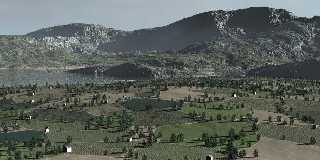
There are other things too small to see on this test, as fields on the
most plain parts, with little iso-trees and simple csg houses placed
with trace() and eval_pigment(), but this is still WIP.

Of course, following with fidelity Christoph idea, the entire scene is
randomly parametrized, so changing a few seeds results in a different
landscape. The render time of this one is 9h, so I think that I can
produce one landscape per week when finished. There are still some
problems, the most obvious one being the interaction between cloud
containers and fog (I'm having a hard time isolating the problem).

Well, I hope to not abandon also this project, as I do with 99% of my
proyects lately. I've a sort of sinusoidal inspiration these days...

Regards,

--
Jaime
Post a reply to this message
Attachments:
Download 'tierra14.jpg' (145 KB)
Preview of image 'tierra14.jpg'

|
|
| |
| |
|
|
|
|
| |
| |
|
|
In article <4090d486@news.povray.org> , Jaime Vives Piqueres
<jai### [at] ignorancia org> wrote:
> I've started my own "Landscape of the week" project, following the idea
> and general concepts of the LOTW project by Christoph Hormann. I'm
> really amazed of what he achieved with isosurfaces, so I tried too...
Really nice! Any chance there will be a higher-resolution render (despite
the render time) that allows a closer look at all the little details that
are in the image?
BTW, how complex is the scene (objects, parsing time, etc)?
Thorsten
____________________________________________________
Thorsten Froehlich, Duisburg, Germany
e-mail: tho### [at] trfde
Visit POV-Ray on the web: http://mac.povray.org org> wrote:
> I've started my own "Landscape of the week" project, following the idea
> and general concepts of the LOTW project by Christoph Hormann. I'm
> really amazed of what he achieved with isosurfaces, so I tried too...
Really nice! Any chance there will be a higher-resolution render (despite
the render time) that allows a closer look at all the little details that
are in the image?
BTW, how complex is the scene (objects, parsing time, etc)?
Thorsten
____________________________________________________
Thorsten Froehlich, Duisburg, Germany
e-mail: tho### [at] trfde
Visit POV-Ray on the web: http://mac.povray.org
Post a reply to this message
|
|
| |
| |
|
|
|
|
| |
| |
|
|
Thorsten Froehlich wrote:
> Really nice! Any chance there will be a higher-resolution render (despite
> the render time) that allows a closer look at all the little details that
> are in the image?

   Thanks! And yes, I will render this and the future LOTW images at
bigger resolution, but not much more. There are details that look better
if they are only barely visible and do not show their simplistic nature.
  This is the reason also for the aerial view.

> BTW, how complex is the scene (objects, parsing time, etc)?

   Not really much, but enough to be a nightmare for me:

   + Single isosurface terrain with max_gradient 3
   + Slope-based procedural texture for the terrain.
   + 300 clouds (object pattern for each cloud uses 24 spheres).
   + 30000 isosurface trees with max_gradient 1.
   + 1000 CSG houses out of some boxes.
   + 5000 vertices for Skylight mesh.
   + No radiosity, only sun and two fill lights (opposed and zenith).

   Parsing time was 3 minutes, mainly because trees and houses both
obtain their positions randomly, and this takes a while even with the
2.1Ghz CPU I have now.

   Regards..

--
Jaime
Post a reply to this message
|
|
| |
| |
|
|
|
|
| |
| |
|
|
Oops.. I forgot to include the statistics:

Statistics for tierra.pov, Resolution 720 x 480
----------------------------------------------------------------------------
Pixels:          346320   Samples:         3116880   Smpls/Pxl: 9.00
Rays:          12188136   Saved:               205   Max Level: 30/32
----------------------------------------------------------------------------
Ray->Shape Intersection          Tests       Succeeded  Percentage
----------------------------------------------------------------------------
Box                            7658443           10932      0.14
CSG Intersection               1128682             961      0.09
Isosurface                    36538884         3499165      9.58
Isosurface Container          37652233        36985184     98.23
Isosurface Cache               4909174         1668509     33.99
Mesh                         302162795       239164538     79.15
Plane                        606582954         4618707      0.76
Sphere                       584649585       396131296     67.76
Bounding Box               21627336696      6881520552     31.82
Vista Buffer                 110928289        75143350     67.74
----------------------------------------------------------------------------
Isosurface roots:         36538884
Function VM calls:      1001034392
----------------------------------------------------------------------------
Calls to Noise:         6354301481   Calls to DNoise:    90048139972
----------------------------------------------------------------------------
Media Intervals:         106119393   Media Samples:       1390661285 (13.10)
Shadow Ray Tests:        297618867   Succeeded:            164005911
Reflected Rays:             135901
Refracted Rays:             135901
Transmitted Rays:          8799454
----------------------------------------------------------------------------
Smallest Alloc:                  9 bytes   Largest:           262448
Peak memory used:        161710692 bytes
----------------------------------------------------------------------------
Time For Parse:    0 hours  3 minutes  41.0 seconds (221 seconds)
Time For Trace:    9 hours  2 minutes   1.0 seconds (32514 seconds)
     Total Time:    9 hours  5 minutes  35.0 seconds (32735 seconds)
Post a reply to this message
|
|
| |
| |
|
|
|
|
| |
| |
|
|
Oh... my... God.

Fantastic.

(picks up jaw from the floor)
Post a reply to this message
|
|
| |
| |
|
|
|
|
| |
| |
|
|
"Jaime Vives Piqueres" <jai### [at] ignoranciaorg> a écrit dans le message
de news: 4090d486@news.povray.org...
> Hi all:
>
> I've started my own "Landscape of the week" project, following the idea
>    and general concepts of the LOTW project by Christoph Hormann. I'm
> really amazed of what he achieved with isosurfaces, so I tried too...

Really great!!
>
> problems, the most obvious one being the interaction between cloud
> containers and fog (I'm having a hard time isolating the problem).
How did you do at the end? ovelapping media containers are a problem I never
got rid of


Cheers

Marc
Post a reply to this message
|
|
| |
| |
|
|
|
|
| |
| |
|
|
"Marc Jacquier" <jac### [at] wanadoofr> wrote in message
news:409100c9$1@news.povray.org...
> "Jaime Vives Piqueres" <jai### [at] ignoranciaorg> a écrit dans le message
> de news: 4090d486@news.povray.org...
> > problems, the most obvious one being the interaction between cloud
> > containers and fog (I'm having a hard time isolating the problem).
> How did you do at the end? ovelapping media containers are a problem I never
> got rid of

Actually, I think using (very) hight interval-values will get rid of the problem

Excellent image btw, Jaime, but let's be honest, that's to be expected from you
:)

cu!
--
camera{location-z*3}#macro G(b,e)b+(e-b)*(C/50)#end#macro L(b,e,k,l)#local C=0
;#while(C<50)sphere{G(b,e),.1pigment{rgb G(k,l)}finish{ambient 1}}#local C=C+1
;#end#end L(y-x,y,x,x+y)L(y,-x-y,x+y,y)L(-x-y,-y,y,y+z)L(-y,y,y+z,x+y)L(0,x+y,
<.5,1,.5>,x)L(0,x-y,<.5,1,.5>,x)               // ZK http://www.povplace.be.tf
Post a reply to this message
|
|
| |
| |
|
|
|
|
| |
| |
|
|
Photograph.

 Excellent.

 ~Steve~   ;)
Post a reply to this message
|
|
| |
| |
|
|
|
|
| |
| |
|
|
Jaime Vives Piqueres wrote:
> Hi all:
>
> I've started my own "Landscape of the week" project, following the idea
>   and general concepts of the LOTW project by Christoph Hormann. I'm
> really amazed of what he achieved with isosurfaces, so I tried too...

Thanks. :-)

It's nice to see my idea inspiring something like this.  The image looks
very good although you can't see much of the objects placed on the
surface at that size.

> [...]
>
> Of course, following with fidelity Christoph idea, the entire scene is
> randomly parametrized, so changing a few seeds results in a different
> landscape. The render time of this one is 9h, so I think that I can
> produce one landscape per week when finished.

Without radiosity 9 hours seems quite long but i assume the clouds take
most of the time.  You might consider using df3 files instead of object
pattern and meshes for the objects placed on the surface.

How many parameter sets have you tried?  The problem with such a scene
built with random parameters is to allow a reasonable variation (all
scenes looking more or less the same is boring, apart from the landscape
geometry my LOTW scenes suffered quite a lot from this problem).  At the
same time you have to avoid certain parameter combinations resulting in
unreasonable or completely uninteresting views.

Christoph

--
POV-Ray tutorials, include files, Sim-POV,
HCR-Edit and more: http://www.tu-bs.de/~y0013390/
Last updated 21 Mar. 2004 _____./\/^>_*_<^\/\.______
Post a reply to this message
|
|
| |
| |
|
|
|
|
| |
| |
|
|
Gorgeous! Breathtaking technique results in a breathtaking scene.
Details like the fringe of foam aling the shore leave me shaking my
head.  I haven't been to your site for awhile; it may be time to do that.

If you are playing with the tension between what is pristine wilderness,
and what is inhabited wilderness, then I think that one element having
an exaggerated significance is the existence, or not, of roads.  Not
that I really think you need me to point that out ;)
Post a reply to this message
|
|
| |
| |
|
|
|
|
| |
| |
|
|
Marc Jacquier wrote:

 > Really great!!


   Thanks!

 > How did you do at the end? ovelapping media containers are a problem
I never
 > got rid of


   If you look again at the pic, you will see that I did not get ride of
them...

--
Jaime
Post a reply to this message
|
|
| |
| |
|
|
|
|
| |
| |
|
|
Zeger Knaepen wrote:
> Actually, I think using (very) hight interval-values will get rid of the problem

   Ouch! I'm using only 1 interval!!! Let's hope there is a
workaround... these clouds are already slow.

--
Jaime
Post a reply to this message
|
|
| |
| |
|
|
|
|
| |
| |
|
|
Christoph Hormann wrote:
> It's nice to see my idea inspiring something like this.  The image looks
> very good although you can't see much of the objects placed on the
> surface at that size.

   Well, they are prety pathetic right now, although the placement idea
with eval_pigment() and crackle pigments looks promissing (I've attached
a more close view).

> Without radiosity 9 hours seems quite long but i assume the clouds take
> most of the time.  You might consider using df3 files instead of object
> pattern and meshes for the objects placed on the surface.

   I noticed later that it was my mistake: I used too high antialias
settings... with something decent it tooks now 3 hours. The df3 clouds
are fast, but have other inconvenients. And I prefer to wait a bit more
but to do it all internally. It's a sort of purism by laziness... :) But
I will take your advice about meshes for the houses, thanks.

> How many parameter sets have you tried?

   The sun light and the sky dome depend on random altitude and azymuth,
and other things depend on the sun and sky colors, like the fog, the
clouds color or the water color and fading.

   The cloud shape and placement also have their own seeds, as the water
level, the trees and houses. The camera is placed randomly too, with
trace() to put it above the terrain at the desired height, and looking
always to the center of the terrain for practical purpouses.

   The isosurface function pigment is scaled and translated randmoly,
and the color map for it has also random entries. This gives quite
diferent terrains, from soft hills to mountains with abrupt walls,
although half of the time the results are not very usable.

   There is only one fixed slope texture at the moment, but I plan to
add several choices for different types of terrains (desertic, artic,
etc..), as I think this is the most important aspect to get clearly
differentiated landscapes (right now all my tests look "mediterranean").

--
Jaime
Post a reply to this message
Attachments:
Download 'tierra-12f.jpg' (79 KB)
Preview of image 'tierra-12f.jpg'
|
|
| |
| |
|
|
|
|
| |
| |
|
|
that looks great. I would be so consumed by moving the camera to different
viewpoints within the scene, like for instance that little bit of land
surrounded by water in the bottom right, or the shoreline of the widened
part of the river on the left side.

nice work.
Post a reply to this message
|
|
| |
| |
|
|
|
|
| |
| |
|
|
"Jaime Vives Piqueres" <jai### [at] ignoranciaorg> wrote in message
news:40912c9c$1@news.povray.org...
> Zeger Knaepen wrote:
> > Actually, I think using (very) hight interval-values will get rid of the
problem

did I really put that t there? :)
whoops :)

>    Ouch! I'm using only 1 interval!!! Let's hope there is a
> workaround... these clouds are already slow.

there is: merge the container-objects

hmm, at least, I think that should work :)

cu!
--
camera{location-z*3}#macro G(b,e)b+(e-b)*(C/50)#end#macro L(b,e,k,l)#local C=0
;#while(C<50)sphere{G(b,e),.1pigment{rgb G(k,l)}finish{ambient 1}}#local C=C+1
;#end#end L(y-x,y,x,x+y)L(y,-x-y,x+y,y)L(-x-y,-y,y,y+z)L(-y,y,y+z,x+y)L(0,x+y,
<.5,1,.5>,x)L(0,x-y,<.5,1,.5>,x)               // ZK http://www.povplace.be.tf
Post a reply to this message
|
|
| |
| |
|
|
|
|
| |
| |
|
|
Great stuff  Jaime

How did you get the foam along the waters edge?

Mick
Post a reply to this message
|
|
| |
| |
|
|
|
|
| |
| |
|
|
omg, that looks like a photograph with digitally composited trees and houses !


cu!
--
camera{location-z*3}#macro G(b,e)b+(e-b)*(C/50)#end#macro L(b,e,k,l)#local C=0
;#while(C<50)sphere{G(b,e),.1pigment{rgb G(k,l)}finish{ambient 1}}#local C=C+1
;#end#end L(y-x,y,x,x+y)L(y,-x-y,x+y,y)L(-x-y,-y,y,y+z)L(-y,y,y+z,x+y)L(0,x+y,
<.5,1,.5>,x)L(0,x-y,<.5,1,.5>,x)               // ZK http://www.povplace.be.tf
Post a reply to this message
|
|
| |
| |
|
|
|
|
| |
| |
|
|
Jim Charter wrote:
>
> Gorgeous! Breathtaking technique results in a breathtaking scene.

   Thanks!

> Details like the fringe of foam aling the shore leave me shaking my
> head.

   :) Sorry, I forgot to mention that one... and it's so simple! It's
the object pattern used with an intersection of the terrain just a bit
under the water. And it's surprisingly fast.

> If you are playing with the tension between what is pristine wilderness,
> and what is inhabited wilderness, then I think that one element having
> an exaggerated significance is the existence, or not, of roads.

   There are some on the plain parts, between the fields (crackle), but
are not very visible on this one. Look at the other test I posted in
response to Christoph.

   Making autoways would be really dificult, as it would have to take
into account the terrain to follow a reasonable path... not that it
sounds impossible, but at least really hard.

--
Jaime
Post a reply to this message
|
|
| |
| |
|
|
|
|
| |
| |
|
|
Jaime Vives Piqueres wrote:
> Christoph Hormann wrote:
>
>> It's nice to see my idea inspiring something like this.  The image
>> looks very good although you can't see much of the objects placed on
>> the surface at that size.
>
>
>   Well, they are prety pathetic right now, although the placement idea
> with eval_pigment() and crackle pigments looks promissing (I've attached
> a more close view).
>
>> Without radiosity 9 hours seems quite long but i assume the clouds
>> take most of the time.  You might consider using df3 files instead of
>> object pattern and meshes for the objects placed on the surface.
>
>
>   I noticed later that it was my mistake: I used too high antialias
> settings... with something decent it tooks now 3 hours. The df3 clouds
> are fast, but have other inconvenients. And I prefer to wait a bit more
> but to do it all internally. It's a sort of purism by laziness... :) But
> I will take your advice about meshes for the houses, thanks.
>
>> How many parameter sets have you tried?
>
>
>   The sun light and the sky dome depend on random altitude and azymuth,
> and other things depend on the sun and sky colors, like the fog, the
> clouds color or the water color and fading.
>
>   The cloud shape and placement also have their own seeds, as the water
> level, the trees and houses. The camera is placed randomly too, with
> trace() to put it above the terrain at the desired height, and looking
> always to the center of the terrain for practical purpouses.
>
>   The isosurface function pigment is scaled and translated randmoly, and
> the color map for it has also random entries. This gives quite diferent
> terrains, from soft hills to mountains with abrupt walls, although half
> of the time the results are not very usable.
>
>   There is only one fixed slope texture at the moment, but I plan to add
> several choices for different types of terrains (desertic, artic,
> etc..), as I think this is the most important aspect to get clearly
> differentiated landscapes (right now all my tests look "mediterranean").
>
> --
> Jaime
>
>
> ------------------------------------------------------------------------
>
first thought, where is it? second - photo, third - has the Loch Ness
monster moved residence :-)

I looked at the first picture, then the post mentioning objects
including 1000 houses and went back for another look for houses.
Then saw the second picture .....all became clear.

same sort of reaction to first, if not more so of first and second

some silly questions
what is the range of x,y,z in the pic for the iso-surfaces?
do you do the iso as <-1,-1,-1> to <1,1,1> and scale ?
or different ranges?
how do you do the houses, csg - yes- but what size typically as a
standalone object for devel, and then scale by some factor, to fit in,
process of emphirical adjustment until it looks right?

please post source or some tantalising snippets to aid understanding ?

stephen
Post a reply to this message
|
|
| |
| |
|
|
|
|
| |
| |
|
|
Mick Hazelgrove wrote:
> How did you get the foam along the waters edge?

   Casually, I'm just tweaking this texture. Now I simlified it a bit,
removing the intersection. The same terrain itself translated a bit is
enough. There is the relevant part:

  #declare terrain_coast=object{terrain translate Foam_Level*y}
  #declare m_water=
  material{
   texture{
    pigment_pattern{object{terrain_coast rgb 0, rgb 1}}
    texture_map{
      [0 t_water]
      [1 t_foam]
    }
    scale 100 warp{turbulence .3 lambda 3} scale 1/100
    scale 1000 warp{turbulence .3 lambda 3} scale 1/1000
   }
   ...


   The translation amount depends on your scene scale and how much foam
you want, and the same can be applied to the warps scale.

   The technique is simple, but I also expent many hours thinking on
that "foam challenge" along the years. Now I figured it casually while
looking at a foam tutorial by Patrick Merminod for a totally different
package: Vue d'Espirit.

--
Jaime
Post a reply to this message
|
|
| |
| |
|
|
|
|
| |
| |
|
|
-----BEGIN PGP SIGNED MESSAGE-----
Hash: SHA1

	You really shouldn't post photgraphs like that and pretend you did it
in POV, it's not fair ;)

	Very nice picture.

		Jerome

- --
******************************
*      Jerome M. Berger      *
* mailto:jbe### [at] ifrancecom *
*  http://jeberger.free.fr/  *
******************************
-----BEGIN PGP SIGNATURE-----
Version: GnuPG v1.2.2 (GNU/Linux)
Comment: Using GnuPG with Mozilla - http://enigmail.mozdev.org

iD8DBQFAkT/2qIYJdJhyixIRAvf9AJ4uAW+9VfsOjc4pd8vbQ8kCUBtsFACfX37v
Ta8DDG8ipSiTQNUpAnQhIsQ=
=9LJi
-----END PGP SIGNATURE-----
Post a reply to this message
|
|
| |
| |
|
|
|
|
| |
| |
|
|
Jaime Vives Piqueres wrote:
>
>   Well, they are prety pathetic right now, although the placement idea
> with eval_pigment() and crackle pigments looks promissing (I've attached
> a more close view).

Neat, but must take quite long to parse...

Of course no serious farmer would create such perfect crackle fields.  I
assume developing an algorithm to automatically generate realistic
divisions would be quite tricky though.

Christoph

--
POV-Ray tutorials, include files, Sim-POV,
HCR-Edit and more: http://www.tu-bs.de/~y0013390/
Last updated 21 Mar. 2004 _____./\/^>_*_<^\/\.______
Post a reply to this message
|
|
| |
| |
|
|
|
|
| |
| |
|
|
Jaime Vives Piqueres <jai### [at] ignoranciaorg> wrote:
> Hi all:
>
> I've started my own "Landscape of the week" project, following the idea
>    and general concepts of the LOTW project by Christoph Hormann. I'm
> really amazed of what he achieved with isosurfaces, so I tried too...

DAMN NICE!

I think I'm experiencing iso-envy...

RG
Post a reply to this message
|
|
| |
| |
|
|
|
|
| |
| |
|
|
Jaime Vives Piqueres wrote:

> Hi all:
>
> I've started my own "Landscape of the week" project, following the idea
>   and general concepts of the LOTW project by Christoph Hormann. I'm
> really amazed of what he achieved with isosurfaces, so I tried too...


Jamie, I was caught off-guard by your image. Suddenly there was this
photo-realistic image of a landscape before me... My mind thought, "it
must be Christoph!" right before I saw your name.

Very, very good work! Inspiration has been a trickle for me lately. With
images like this, however, I might just overcome this creativity barrier
I'm standing in front of.

> Well, I hope to not abandon also this project, as I do with 99% of my
> proyects lately. I've a sort of sinusoidal inspiration these days...
>
> Regards,
>
> --
> Jaime


You really should continue with this idea! You can cover some ground
Christoph hasn't yet. In fact, you've already advanced on a few things.

I'd like to see fluted columns of eroded stone and limestone cave
entrances eventually. Maybe those are some landscape elements I'll try
to depict :)

-Samuel Benge
Post a reply to this message
|
|
| |
| |
|
|
|
|
| |
| |
|
|
OK, ok, I'll learn how isosurfaces work, already. :-)
Post a reply to this message
|
|
| |
| |
|
|
|
|
| |
| |
|
|
Zeger Knaepen wrote:
>>   Ouch! I'm using only 1 interval!!! Let's hope there is a
>>workaround... these clouds are already slow.
>
> there is: merge the container-objects
> hmm, at least, I think that should work :)

   Nope, this is a strange fog problem. It doesn't shows if I replace
the standard ground fog with a planar emission media... weird. But well,
I found the workaround, and it's not much slower than fog. Thanks anyhow!

--
Jaime
Post a reply to this message
|
|
| |
| |
|
|
|
|
| |
| |
|
|
Clever

and useful :-)
Post a reply to this message
|
|
| |
| |
|
|
|
|
| |
| |
|
|
stephen parkinson wrote:
> first thought, where is it? second - photo, third - has the Loch Ness
> monster moved residence :-)

   You mean the foam in the middle of the lake? This is a side effect of
the foam technique... nothing misterious, I hope: I've enough with the
artifacts! :)

> some silly questions
> what is the range of x,y,z in the pic for the iso-surfaces?

   The container is box{<-200,0,-200>,<200,8,200>}, although the peaks
rarely reach the "ceil". I tried to keep the scene scale somewhat like
1=1km.

> do you do the iso as <-1,-1,-1> to <1,1,1> and scale ?

   No, I never scale isosurfaces! I've the superstitious believe that
scaling them increases render times...

> how do you do the houses, csg - yes- but what size typically as a
> standalone object for devel, and then scale by some factor, to fit in,
> process of emphirical adjustment until it looks right?

   They are just a bunch of boxes. I scale them randomly to have sizes
between 5 and 15 metters of side (in the scene scale).

> please post source or some tantalising snippets to aid understanding ?

   Wait, I'm still cleaning and commenting it. And the web page for the
LOTW project must be done too...

--
Jaime
Post a reply to this message
|
|
| |
| |
|
|
|
|
| |
| |
|
|
Samuel Benge wrote:
> My mind thought, "it must be Christoph!" right before I saw your name.

   That was the idea.. :)

> I'd like to see fluted columns of eroded stone and limestone cave
> entrances eventually. Maybe those are some landscape elements I'll try
> to depict :)

   Oh, yes... me too, but my patience with max_gradient is limited. The
worst part is: I know that almost everything is posible with
isosurfaces, but who has the patience needed for all the tests?

--
Jaime
Post a reply to this message
|
|
| |
| |
|
|
|
|
| |
| |
|
|
Ross wrote:
> that looks great. I would be so consumed by moving the camera to different
> viewpoints within the scene [...]

   What do you think I keep doing all the time? ;)

   But I can asure you that it's better to not look very close. The lack
of detail visibility is really amzing creating a sort of impresionism...
your imagination is surely figuring out details that I cannot create. :)

--
Jaime
Post a reply to this message
|
|
| |
| |
|
|
|
|
| |
| |
|
|
Those fields *rule*, man. Very nice.

-Xplo
Post a reply to this message
|
|
| |
| |
|
|
|
|
| |
| |
|
|
Jaime Vives Piqueres wrote:
> Hi all:
>
> I've started my own "Landscape of the week" project, following the idea
>   and general concepts of the LOTW project by Christoph Hormann. I'm
> really amazed of what he achieved with isosurfaces, so I tried too...
>
<snip />

Although Christoph's stuff is certainly good, you have raised the bar
with yours: stunning work! Your attention to detail is amazing!!!
--
Respectfully,
Dan P
http://<broken link>
Post a reply to this message
|
|
| |
| |
|
|
|
|
| |
| |
|
|
Jaime Vives Piqueres wrote:

Jaime, you are the king.
--
Respectfully,
Dan P
http://<broken link>
Post a reply to this message
|
|
| |
| |
|
|
|
|
| |
| |
|
|
Jaime Vives Piqueres wrote:

> Mick Hazelgrove wrote:
>
>> How did you get the foam along the waters edge?
>
>
>   Casually, I'm just tweaking this texture. Now I simlified it a bit,
> removing the intersection. The same terrain itself translated a bit is
> enough. There is the relevant part:

<snip />

I
AM
NOT
WORTHY!!!!
--
Respectfully,
Dan P
http://<broken link>
Post a reply to this message
|
|
| |
| |
|
|
|
|
| |
| |
|
|
Were I doing this one, I'd make a really loooooong scene, render it from
successive points, and put it together in a panning movie that goes
around and around. :-)

Very very cool.
Post a reply to this message
|
|
| |
| |
|
|
|
|
| |
| |
|
|
Jaime Vives Piqueres wrote:

I was wowed by this image this morning, but wanted to wait until I got home
(full color monitor) before posting. This is incredible. The little plateau
with the houses definitely raises the bar.

 -Shay
Post a reply to this message
|
|
| |
| |
|
|
|
|
| |
| |
|
|
Jaime Vives Piqueres wrote:
> stephen parkinson wrote:
>
>> first thought, where is it? second - photo, third - has the Loch Ness
>> monster moved residence :-)
>
>
>   You mean the foam in the middle of the lake? This is a side effect of
> the foam technique... nothing misterious, I hope: I've enough with the
> artifacts! :)
>
>> some silly questions
>> what is the range of x,y,z in the pic for the iso-surfaces?
>
>
>   The container is box{<-200,0,-200>,<200,8,200>}, although the peaks
> rarely reach the "ceil". I tried to keep the scene scale somewhat like
> 1=1km.
>
>> do you do the iso as <-1,-1,-1> to <1,1,1> and scale ?
>
>
>   No, I never scale isosurfaces! I've the superstitious believe that
> scaling them increases render times...
>
>> how do you do the houses, csg - yes- but what size typically as a
>> standalone object for devel, and then scale by some factor, to fit in,
>> process of emphirical adjustment until it looks right?
>
>
>   They are just a bunch of boxes. I scale them randomly to have sizes
> between 5 and 15 metters of side (in the scene scale).
>
>> please post source or some tantalising snippets to aid understanding ?
>
>
>   Wait, I'm still cleaning and commenting it. And the web page for the
> LOTW project must be done too...
>
> --
> Jaime
>
interesting

one minor critism, the houses all have shiny white walls facing the
camera, darken it to a sort of mushroom off-white might fit in the scene??
also no windows, just some darker squares would suffice at longer range ?

stephen
Post a reply to this message
|
|
| |
| |
|
|
|
|
| |
| |
|
|
Christoph Hormann wrote:
> Neat, but must take quite long to parse...

  Not that long really, only 3 minutes. Appart from near the crackle
borders, I also permit the trees to fill sometimes an entire cell, so
this accelerates the rendering and causes the effect of little forests
here and there. I'm just thinking that the same technique can be used
with the houses to create little towns... hmmm... interesting.

> Of course no serious farmer would create such perfect crackle fields.  I
> assume developing an algorithm to automatically generate realistic
> divisions would be quite tricky though.

   :) You know, I expent many time looking at aerial photos of fields to
try to capture the order/chaos there, but the only idea that poped up
was the use of crackle.

   Indeed, I forgot to tell you something I discovered about Skylight
when making this scene (as you are one of the few known users of this
include):

   I finally found why SunColor seemed always too blue, and it was that
ovbious that I feel a bit idiot: Skylight isn't a sunlight model, but a
*sky light* model. Looking for first time at the original abstract
papers that Philippe Debar implemented, I notice that he only
implemented the one for the sky light simulation, so the SunColor
returned it's not the color of the sun, but the color of the sky at the
sun position. I'm using now instead the Blackbody() macro from CIE.inc
for the sunlight color, with variable temperature depending on the
altitude: Blackbody(2000+4500*Al). Of course, I still use the sky dome,
  and the SunColor for the fill lights.

   Regards,

--
Jaime
Post a reply to this message
|
|
| |
| |
|
|
|
|
| |
| |
|
|
Jaime Vives Piqueres wrote:
>
>   :) You know, I expent many time looking at aerial photos of fields to
> try to capture the order/chaos there, but the only idea that poped up
> was the use of crackle.

That strongly depends on the region and the relief form.  Here in
northern Germany for example you will find a lot of (nearly) rectangular
fields.  In more hilly/mountain regions with more extensive farming a
more crackle-like division might be more common.

You could try http://www.cse.ogi.edu/~jsnow/graphics/pov.html although
this seems to generate a lot of very small areas as well which is not
realistic.

>   Indeed, I forgot to tell you something I discovered about Skylight
> when making this scene (as you are one of the few known users of this
> include):
>
>   I finally found why SunColor seemed always too blue, and it was that
> ovbious that I feel a bit idiot: Skylight isn't a sunlight model, but a
> *sky light* model. [...]

Well, now that you say it... ;-)

In fact i stopped using the 'correct' color for the light source soon
after i started using the skylight system.  I just need the additional
degree of freedom to design scenes.

Christoph

--
POV-Ray tutorials, include files, Sim-POV,
HCR-Edit and more: http://www.tu-bs.de/~y0013390/
Last updated 21 Mar. 2004 _____./\/^>_*_<^\/\.______
Post a reply to this message
|
|
| |
| |
|
|
|
|
| |
| |
|
|
"Jaime Vives Piqueres" <jai### [at] ignoranciaorg> a écrit dans le message
de news: 409177ef@news.povray.org...
>
>    You mean the foam in the middle of the lake? This is a side effect of
> the foam technique... nothing misterious, I hope: I've enough with the
> artifacts! :)
>
It must be an effect of a shallow, a rise of the terrain underneath.
You could try less turbulence warp in the vertical direction maybe

Marc
Post a reply to this message
|
|
| |
| |
|
|
|
|
| |
| |
|
|
Any chance at code and if so, can we use the code to help us with our
own projects? :)
Post a reply to this message
|
|
| |
| |
|
|
|
|
| |
| |
|
|
Jaime Vives Piqueres wrote:

>
>   I finally found why SunColor seemed always too blue, and it was that
> ovbious that I feel a bit idiot: Skylight isn't a sunlight model, but a
> *sky light* model. Looking for first time at the original abstract
> papers that Philippe Debar implemented, I notice that he only
> implemented the one for the sky light simulation, so the SunColor
> returned it's not the color of the sun, but the color of the sky at the
> sun position. I'm using now instead the Blackbody() macro from CIE.inc
> for the sunlight color, with variable temperature depending on the
> altitude: Blackbody(2000+4500*Al). Of course, I still use the sky dome,
>  and the SunColor for the fill lights.
>

I am also a big user of Skylight.  That explanation helps a *lot*
Post a reply to this message
|
|
| |
| |
|
|
|
|
| |
| |
|
|
"Jaime Vives Piqueres" <jai### [at] ignoranciaorg> wrote in message
news:40921022@news.povray.org...
>    :) You know, I expent many time looking at aerial photos of
fields to
> try to capture the order/chaos there, but the only idea that poped
up
> was the use of crackle.

http://www.qsl.net/gw3srg/bits/map.png

Here is another (1948) field view for you, 1/5 original scale.
I live in the center.
Top is North, ~80m above-sea-level, bottom is ~40m asl.
Image is about 1Km wide. Location 51.57N, 4.00W

Excellent image from you as usual Jaime.

Alf
Post a reply to this message
|
|
| |
| |
|
|
|
|
| |
| |
|
|
On Fri, 30 Apr 2004 14:52:46 +0100, "Alf Peake" <alf### [at] peake42freeservecouk>
wrote:
> http://www.qsl.net/gw3srg/bits/map.png

http://www.lastrefuge.co.uk/images/html/aerials/UK_aerials/fields_patterns/
http://tshermer.crosswinds.net/Photography/AerialAlberta/
http://www.calepa.ca.gov/Border/Maps/Gallery/fields.htm

ABX
Post a reply to this message
|
|
| |
| |
|
|
|
|
| |
| |
|
|
"ABX" <abx### [at] abxartpl> wrote in message
news:dvm490t12mg91uqh1qo1lju61b9576pp3f@4ax.com...
> On Fri, 30 Apr 2004 14:52:46 +0100, "Alf Peake"
<alf### [at] peake42freeservecouk>
> wrote:
> > http://www.qsl.net/gw3srg/bits/map.png
>
>
http://www.lastrefuge.co.uk/images/html/aerials/UK_aerials/fields_patterns/
> http://tshermer.crosswinds.net/Photography/AerialAlberta/
> http://www.calepa.ca.gov/Border/Maps/Gallery/fields.htm
>
> ABX

Those should keep Jaime busy ;)

--
Alf

http://www.peake42.freeserve.co.uk/
http://www.qsl.net/gw3srg/
Post a reply to this message
|
|
| |
| |
|
|
|
|
| |
| |
|
|
Among other things, Dan P wrote:

> Jaime Vives Piqueres wrote:
>
> Jaime, you are the king.

I don't think Jaime wrote that ;)

... Very nice fields, by the way. Congratulations, Jaime.

--
light_source{9+9*x,1}camera{orthographic look_at(1-y)/4angle 30location
9/4-z*4}light_source{-9*z,1}union{box{.9-z.1+x clipped_by{plane{2+y-4*x
0}}}box{z-y-.1.1+z}box{-.1.1+x}box{.1z-.1}pigment{rgb<.8.2,1>}}//Jellby
Post a reply to this message
|
|
| |
| |
|
|
|
|
| |
| |
|
|
Jellby wrote:
> Among other things, Dan P wrote:
>
>
>>Jaime Vives Piqueres wrote:
>>
>>Jaime, you are the king.
>
>
> I don't think Jaime wrote that ;)
>
> ... Very nice fields, by the way. Congratulations, Jaime.
>

LOL -- sorry about that.
--
Respectfully,
Dan P
http://<broken link>
Post a reply to this message
|
|
| |
| |
|
|
|
|
| |
| |
|
|
That seriously looks like a photo, it's only the aliasing that gives it away.
Put some good focal blur on that andit would look perfect!

I've been thinking about doing a fully procedural/random landscape for a while
now, but I've never found time to sit down and get all the details together, let
alone tweak it to look so realistic. Awesome!

--
Tek
www.evilsuperbrain.com

"Jaime Vives Piqueres" <jai### [at] ignoranciaorg> wrote in message
news:409135b4@news.povray.org...
> Christoph Hormann wrote:
> > It's nice to see my idea inspiring something like this.  The image looks
> > very good although you can't see much of the objects placed on the
> > surface at that size.
>
>    Well, they are prety pathetic right now, although the placement idea
> with eval_pigment() and crackle pigments looks promissing (I've attached
> a more close view).
>
> > Without radiosity 9 hours seems quite long but i assume the clouds take
> > most of the time.  You might consider using df3 files instead of object
> > pattern and meshes for the objects placed on the surface.
>
>    I noticed later that it was my mistake: I used too high antialias
> settings... with something decent it tooks now 3 hours. The df3 clouds
> are fast, but have other inconvenients. And I prefer to wait a bit more
> but to do it all internally. It's a sort of purism by laziness... :) But
> I will take your advice about meshes for the houses, thanks.
>
> > How many parameter sets have you tried?
>
>    The sun light and the sky dome depend on random altitude and azymuth,
> and other things depend on the sun and sky colors, like the fog, the
> clouds color or the water color and fading.
>
>    The cloud shape and placement also have their own seeds, as the water
> level, the trees and houses. The camera is placed randomly too, with
> trace() to put it above the terrain at the desired height, and looking
> always to the center of the terrain for practical purpouses.
>
>    The isosurface function pigment is scaled and translated randmoly,
> and the color map for it has also random entries. This gives quite
> diferent terrains, from soft hills to mountains with abrupt walls,
> although half of the time the results are not very usable.
>
>    There is only one fixed slope texture at the moment, but I plan to
> add several choices for different types of terrains (desertic, artic,
> etc..), as I think this is the most important aspect to get clearly
> differentiated landscapes (right now all my tests look "mediterranean").
>
> --
> Jaime
>
>


--------------------------------------------------------------------------------
Post a reply to this message
|
|
| |
| |
|
|
|
|
| |
| |
|
|
Lovin' those dusty colours.
Post a reply to this message
|
|
| |
| |
|
|
|
|
| |
|
|







