|
|
|
|
|
|
| |
| |
|
|
From: Hughes, B
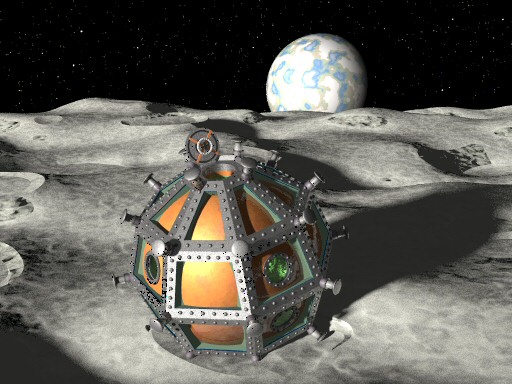
Subject: Cavorite Sphere (off the shelf) [~105K JPG]
Date: 15 Apr 2004 01:57:28
Message: <407e2448@news.povray.org>
|
|
|
| |
| |
|
|
Subject line says "off the shelf" because it was first made almost two years
ago and then left to sit idle. Now trying it in the 3.6 beta and making some
texture and environment changes. It will definitely need a realistic Earth
mapped onto that sphere at the horizon.
:-)
Getting black areas and specks on it from something, can't figure out why.
The max_trace_level is at a low 9 but there's not much reason for it to be
higher. Wouldn't expect so. In fact, I was finding a really odd black
splotch on the ground plane (other grass earth one) when using radiosity,
however this one doesn't use that. But it does have a isosurface instead of
plane for the ground. This model caused trouble last time I was working with
it too, with the inside apparently leaking through to the outside. Whether
my fault or POVs...? I sure hope to figure that out someday.

Oh yeah, someone might ask what function the Moon surface is made from. It's
a f_ridge() from functions.inc. If anyone wants to ask or say anything, I'll
reply back eventually.

Bob H.
Post a reply to this message
Attachments:
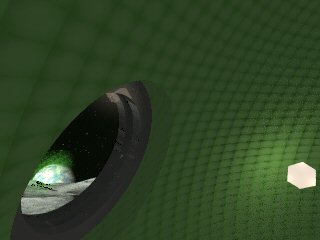
Download 'Cavorite Sphere outside window.jpg' (11 KB)
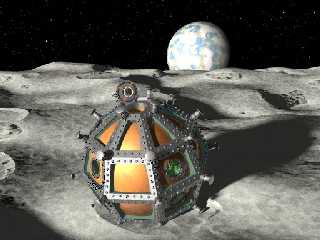
Download 'Cavorite Sphere on Moon.jpg' (67 KB)
Preview of image 'Cavorite Sphere outside window.jpg'
Preview of image 'Cavorite Sphere on Moon.jpg'
|
|
| |
| |
|
|
From: Dan P
Subject: Re: Cavorite Sphere (off the shelf) [~105K JPG]
Date: 15 Apr 2004 19:42:29
Message: <407f1de5@news.povray.org>
|
|
|
| |
| |
|
|
Hughes, B. wrote:
> Subject line says "off the shelf" because it was first made almost two years
> ago and then left to sit idle. Now trying it in the 3.6 beta and making some
> texture and environment changes. It will definitely need a realistic Earth
> mapped onto that sphere at the horizon.
> :-)
> Getting black areas and specks on it from something, can't figure out why.
> The max_trace_level is at a low 9 but there's not much reason for it to be
> higher. Wouldn't expect so. In fact, I was finding a really odd black
> splotch on the ground plane (other grass earth one) when using radiosity,
> however this one doesn't use that. But it does have a isosurface instead of
> plane for the ground. This model caused trouble last time I was working with
> it too, with the inside apparently leaking through to the outside. Whether
> my fault or POVs...? I sure hope to figure that out someday.
>
> Oh yeah, someone might ask what function the Moon surface is made from. It's
> a f_ridge() from functions.inc. If anyone wants to ask or say anything, I'll
> reply back eventually.

Oh YEAH -- fantastic!
It reminds me of Wallace and Grommit.
"Cheese, Grommit! We need cheese! Cheese!!!!"

Another parallel light at low intensity pointing down from behind the
object will bring out the details of the shadow and add depth.
Post a reply to this message
|
|
| |
| |
|
|
|
|
| |
| |
|
|
"Dan P" <dan### [at] yahoo com> wrote in message
news:407f1de5@news.povray.org...
> Hughes, B. wrote:
> > Subject line says "off the shelf" because it was first made almost two
years
> > ago and then left to sit idle.
>
> Oh YEAH -- fantastic!
> It reminds me of Wallace and Grommit.
> "Cheese, Grommit! We need cheese! Cheese!!!!"
Ha ha! Thanks Daniel, that's a compliment. Someone said that last time I
posted it, IIRC.
> Another parallel light at low intensity pointing down from behind the
> object will bring out the details of the shadow and add depth.
Ahh, an oversight. I haven't added a light shining back from the Earth yet!
That might do it. Although, probably not high up enough to illuminate the
upper parts of the CS. There already is a shadowless light directly above
but it's extremely dim. Originally I was never intending to have any other
illumination besides the sunlight, and moon surface diffusing onto it by
using radiosity.
The Earth doesn't really add anything by radiosity alone so I'll add a light
source to it.
Bob H. com> wrote in message
news:407f1de5@news.povray.org...
> Hughes, B. wrote:
> > Subject line says "off the shelf" because it was first made almost two
years
> > ago and then left to sit idle.
>
> Oh YEAH -- fantastic!
> It reminds me of Wallace and Grommit.
> "Cheese, Grommit! We need cheese! Cheese!!!!"
Ha ha! Thanks Daniel, that's a compliment. Someone said that last time I
posted it, IIRC.
> Another parallel light at low intensity pointing down from behind the
> object will bring out the details of the shadow and add depth.
Ahh, an oversight. I haven't added a light shining back from the Earth yet!
That might do it. Although, probably not high up enough to illuminate the
upper parts of the CS. There already is a shadowless light directly above
but it's extremely dim. Originally I was never intending to have any other
illumination besides the sunlight, and moon surface diffusing onto it by
using radiosity.
The Earth doesn't really add anything by radiosity alone so I'll add a light
source to it.
Bob H.
Post a reply to this message
|
|
| |
| |
|
|
|
|
| |
| |
|
|
Hughes, B. nous apporta ses lumieres ainsi en ce 2004/04/16 16:10... :

>"Dan P" <dan### [at] yahoocom> wrote in message
>news:407f1de5@news.povray.org...
>
>
>>Hughes, B. wrote:
>>
>>
>>>Subject line says "off the shelf" because it was first made almost two
>>>
>>>
>years
>
>
>>>ago and then left to sit idle.
>>>
>>>
>>Oh YEAH -- fantastic!
>>It reminds me of Wallace and Grommit.
>>"Cheese, Grommit! We need cheese! Cheese!!!!"
>>
>>
>
>Ha ha! Thanks Daniel, that's a compliment. Someone said that last time I
>posted it, IIRC.
>
>
>
>>Another parallel light at low intensity pointing down from behind the
>>object will bring out the details of the shadow and add depth.
>>
>>
>
>Ahh, an oversight. I haven't added a light shining back from the Earth yet!
>That might do it. Although, probably not high up enough to illuminate the
>upper parts of the CS. There already is a shadowless light directly above
>but it's extremely dim. Originally I was never intending to have any other
>illumination besides the sunlight, and moon surface diffusing onto it by
>using radiosity.
>
>The Earth doesn't really add anything by radiosity alone so I'll add a light
>source to it.
>
>Bob H.
>
>
>
>
You're on the moon, that mean NO air -> shadows are SUPOSED to be pitch
black. I remember the Apolo lunar expeditions, unless there is something
nearby to reflect light into a shadowed area, there was absolutely
nothing to be seen but black.
The shadowless light must be extremely dim, it represent star's light,
globaly, that's less than about 0.001% that of the sun.

Alain
Post a reply to this message
|
|
| |
| |
|
|
|
|
| |
| |
|
|
In article <408097cb$1@news.povray.org>, Alain <aze### [at] qwertygov>
wrote:

> You're on the moon, that mean NO air -> shadows are SUPOSED to be pitch
> black. I remember the Apolo lunar expeditions, unless there is something
> nearby to reflect light into a shadowed area, there was absolutely
> nothing to be seen but black.

Your argument has actually been used to claim the moon photos were
fake...but it's wrong. There *was* something to reflect the light...the
ground, which happens to be covered in dust which is unusually good at
reflecting light back in the general direction it came from. In most of
the images I've seen, this was quite clear...the surrounding brightly
lit surface would diffuse light onto the shadowing object, which would
diffuse light onto the shadowed part of the surface. The shadowed side
of the object would be fairly well lit, and the ground shadow dimly lit.
Only areas shadowed both from the sun and from the ground were really
dark.

http://www.iangoddard.net/moon01.htm


> The shadowless light must be extremely dim, it represent star's light,
> globaly, that's less than about 0.001% that of the sun.

Starlight would be negligible, even without the atmosphere to block it.
Earthlight could be quite bright at night, however. Think of how bright
nights with full moons can be, and consider that Earth is about 3.67
times as big as the moon. (though the lower albedo will compensate
somewhat)

--
Christopher James Huff <cja### [at] earthlinknet>
http://home.earthlink.net/~cjameshuff/
POV-Ray TAG: <chr### [at] tagpovrayorg>
http://tag.povray.org/
Post a reply to this message
|
|
| |
| |
|
|
|
|
| |
| |
|
|
Hughes, B. wrote:

> "Dan P" <dan### [at] yahoocom> wrote in message

<snip/>

>>Oh YEAH -- fantastic!
>>It reminds me of Wallace and Grommit.
>>"Cheese, Grommit! We need cheese! Cheese!!!!"
>
>
> Ha ha! Thanks Daniel, that's a compliment. Someone said that last time I
> posted it, IIRC.

Heh! Cool!

>>Another parallel light at low intensity pointing down from behind the
>>object will bring out the details of the shadow and add depth.

> Ahh, an oversight. I haven't added a light shining back from the Earth yet!
> That might do it. Although, probably not high up enough to illuminate the
> upper parts of the CS. There already is a shadowless light directly above
> but it's extremely dim. Originally I was never intending to have any other
> illumination besides the sunlight, and moon surface diffusing onto it by
> using radiosity.

Sweet.

> The Earth doesn't really add anything by radiosity alone so I'll add a light
> source to it.

Right; it's too far away.
Very cool scene!

> Bob H.
>
>
Post a reply to this message
|
|
| |
| |
|
|
|
|
| |
| |
|
|
Alain wrote:

> Hughes, B. nous apporta ses lumieres ainsi en ce 2004/04/16 16:10... :

<snip/>

> You're on the moon, that mean NO air -> shadows are SUPOSED to be pitch
> black. I remember the Apolo lunar expeditions, unless there is something
> nearby to reflect light into a shadowed area, there was absolutely
> nothing to be seen but black.
> The shadowless light must be extremely dim, it represent star's light,
> globaly, that's less than about 0.001% that of the sun.
>
> Alain

Ack, forget accuracy. Did Lucas let the tiny detail that ships can't
bank in space because there's no air stop him? No, man, he said, like,
"It's my freekin' universe and I'll phyisicalize it as I want!" :-)

--
Dan P
http://<broken link>
Post a reply to this message
|
|
| |
| |
|
|
|
|
| |
| |
|
|
In article <4081ceec$1@news.povray.org>,
 Dan P <dan### [at] yahoocom> wrote:

> > The Earth doesn't really add anything by radiosity alone so I'll add a light
> > source to it.
>
> Right; it's too far away.

Distance has little to do with it, it is the area of sky covered and
brightness per unit area that counts. The diameter is about 3.6 times
that of the moon, the sky area covered is almost 13.5 times greater. The
moon's albedo is less than Earth's, between 7% and 12% compared to 30%.
(The lunar surface reflects light preferentially in the direction it
came from, so it appears brighter when nearly full.)

This all means that Earthlight is much brighter than moonlight. It's
still very little in comparison to direct sunlight, but it can
contribute to shadowed areas if the viewer's not looking at a bright
object, and will be very significant at night on the near side. And it's
practically all due to radiosity, diffusely scattered sunlight, though
an area light might be more accurate than any but very high radiosity
settings.

--
Christopher James Huff <cja### [at] earthlinknet>
http://home.earthlink.net/~cjameshuff/
POV-Ray TAG: <chr### [at] tagpovrayorg>
http://tag.povray.org/
Post a reply to this message
|
|
| |
| |
|
|
From: Jellby
Subject: Re: Cavorite Sphere (off the shelf) [~105K JPG]
Date: 19 Apr 2004 16:15:10
Message: <4084334d@news.povray.org>
|
|
|
| |
| |
|
|
Among other things, Christopher James Huff wrote:

>> > The Earth doesn't really add anything by radiosity alone so I'll add a
>> > light source to it.
>>
>> Right; it's too far away.
>
> Distance has little to do with it, it is the area of sky covered and
> brightness per unit area that counts.

Is this true? I mean, in POV world, doesn't distance really matter when
computing radiosity?

> This all means that Earthlight is much brighter than moonlight. It's
> still very little in comparison to direct sunlight, but it can
> contribute to shadowed areas if the viewer's not looking at a bright
> object, and will be very significant at night on the near side. And it's
> practically all due to radiosity, diffusely scattered sunlight, though
> an area light might be more accurate than any but very high radiosity
> settings.

Yes. When the moon is very thin, you can clearly see the dark side lit by
"earthlight". Even in a Moon eclipse, when all the moon is in shadow, and
the earth face it sees is at night, the Moon is notably lit with a red
glow, which comes from scattering in the Earth's atmosphere (all the dawns
and twilights).

--
light_source{9+9*x,1}camera{orthographic look_at(1-y)/4angle 30location
9/4-z*4}light_source{-9*z,1}union{box{.9-z.1+x clipped_by{plane{2+y-4*x
0}}}box{z-y-.1.1+z}box{-.1.1+x}box{.1z-.1}pigment{rgb<.8.2,1>}}//Jellby
Post a reply to this message
|
|
| |
| |
|
|
|
|
| |
| |
|
|
In article <4084334d@news.povray.org>, Jellby <jel### [at] M-yahoocom>
wrote:

> Is this true? I mean, in POV world, doesn't distance really matter when
> computing radiosity?

As far as I know, it does so only when it comes to selecting previously
taken samples to interpolate...you want to use samples taken from
nearby, and probably reduce the importance of samples from more distant
points. I don't know in detail how POV-Ray's radiosity algorithm works,
though.

--
Christopher James Huff <cja### [at] earthlinknet>
http://home.earthlink.net/~cjameshuff/
POV-Ray TAG: <chr### [at] tagpovrayorg>
http://tag.povray.org/
Post a reply to this message
|
|
| |
| |
|
|
|
|
| |
| |
|
|
Christopher James Huff wrote:

> In article <4081ceec$1@news.povray.org>,
>  Dan P <dan### [at] yahoocom> wrote:
>
>
>>>The Earth doesn't really add anything by radiosity alone so I'll add a light
>>>source to it.
>>
>>Right; it's too far away.
>
> Distance has little to do with it, it is the area of sky covered and
> brightness per unit area that counts. The diameter is about 3.6 times
> that of the moon, the sky area covered is almost 13.5 times greater. The
> moon's albedo is less than Earth's, between 7% and 12% compared to 30%.
> (The lunar surface reflects light preferentially in the direction it
> came from, so it appears brighter when nearly full.)

I must be misunderstanding radiosity -- I figured because it was so far
away, it wasn't close enough to the moon to reflect any light to it
because of fall-off.

<snip/>
--
Respectfully,
Dan P
http://<broken link>
Post a reply to this message
|
|
| |
| |
|
|
|
|
| |
| |
|
|
"Dan P" <dan### [at] yahoocom> wrote in message
news:408498ee$1@news.povray.org...
>
> I must be misunderstanding radiosity -- I figured because it was so far
> away, it wasn't close enough to the moon to reflect any light to it
> because of fall-off.

Nice to see people discussing this here.  ;-)

Well, um, hey... isn't sky_sphere considered infinitely remote? And yet that
still affects everything else when it comes to radiosity. Okay, wait, bad
example there; considering it usually affects things globally anyhow without
having a finish property, that might not have any true distance.

I've used looks_like (sphere) for making the Sun before, on the assumption
radiosity of a very diffuse object will add to the other objects no matter
how far away. Likewise, false window panes meant to be oversaturated with
outdoor lighting, or light panels in the ceiling, even though closer in to
the scene subjects. Thing is, without skylight the blackness of space can
overwhelm the scene due to darkness also being factored into the radiosity.
Or at least I always thought of it in that way.

I just never considered there to be a distance limitation for radiosity,
other than proximity having weight in the calculation, perhaps because it
isn't really a light source and is more of a color effect which could be
seen from any distance based on it's size and diffuseness and/or ambience.
Much more related to object presence rather than illumination.

--
Bob H.
http://www.3digitaleyes.com
Post a reply to this message
|
|
| |
| |
|
|
|
|
| |
| |
|
|
"Dan P" <dan### [at] yahoocom> wrote in message
news:407f1de5@news.povray.org...

> Oh YEAH -- fantastic!
> It reminds me of Wallace and Grommit.
> "Cheese, Grommit! We need cheese! Cheese!!!!"

     Heheh...  Yes, I can see it.  :)

>
> Another parallel light at low intensity pointing down from behind
the
> object will bring out the details of the shadow and add depth.

 You're doin' my head in you are, Mr. DP! How do you know all this
stuff?!   ;)

   Anyways, I'm glad people like you and Bob are around.

    ~Steve~
Post a reply to this message
|
|
| |
| |
|
|
|
|
| |
| |
|
|
St. wrote:

> "Dan P" <dan### [at] yahoocom> wrote in message
> news:407f1de5@news.povray.org...
>
>>Oh YEAH -- fantastic!
>>It reminds me of Wallace and Grommit.
>>"Cheese, Grommit! We need cheese! Cheese!!!!"
>
>      Heheh...  Yes, I can see it.  :)

God, I loved that penguin too. :-)

>>Another parallel light at low intensity pointing down from behind
>
> the
>
>>object will bring out the details of the shadow and add depth.
>
>  You're doin' my head in you are, Mr. DP! How do you know all this
> stuff?!   ;)

I learn it from the guys like Tek and Warp and Chris and all the rest.
If it weren't for this newsgroup, I'd still just be making logos! :-)
I'm one of the least knowledgeable on the group, really; guys like Tek,
Warp, the Chris's, Thorsten, Ken -- the list goes on; all those are far
knowledgeable than I. I just like to post a lot -- they're really busy
right now with the next version of POV-Ray coming soon or making scene
files instead of writing papers about topics like www.hibernate.org for
hungry profs :-)

>    Anyways, I'm glad people like you and Bob are around.
>
>     ~Steve~

Right back atchya!!
--
Respectfully,
Dan P
http://<broken link>
Post a reply to this message
|
|
| |
| |
|
|
|
|
| |
| |
|
|
In article <408498ee$1@news.povray.org>,
 Dan P <dan### [at] yahoocom> wrote:

> I must be misunderstanding radiosity -- I figured because it was so far
> away, it wasn't close enough to the moon to reflect any light to it
> because of fall-off.

Light doesn't magically become less intense with distance, it spreads
out. The inverse square law comes from the area of the surface of a
sphere around the origin point. The moon reflects light from many points
on its sunlit surface. At the distance from it of Earth, the inverse
square law approximates the falloff pretty well, but nearer the surface,
most of the surface area is hidden, and you can only be really near a
small area, unlike a true point source where all light comes from a
single point. Yes, the earth only intercepts a small portion of the
reflected light, but the moon reflects a lot of light. Haven't you ever
been outside on a night with a full moon?

In the case of an object like the moon, an object twice as far away
would have to be twice the radius to cover the same area of sky. At
twice the radius, it would have four times the visible area, exactly
compensating for the fact that one fourth the reflected light per unit
of surface area will reach an observer on Earth. From the lunar surface,
the Earth is much bigger and brighter, and it lights the surface
brightly enough to be seen on the dark side from earth. (That is, enough
light reflects off Earth onto the moon, and back to earth again, to be
visible with the naked eye.)

--
Christopher James Huff <cja### [at] earthlinknet>
http://home.earthlink.net/~cjameshuff/
POV-Ray TAG: <chr### [at] tagpovrayorg>
http://tag.povray.org/
Post a reply to this message
|
|
| |
| |
|
|
|
|
| |
| |
|
|
In article <4084c0a7$1@news.povray.org>,
 "Hughes, B." <omn### [at] charternet> wrote:

> Well, um, hey... isn't sky_sphere considered infinitely remote? And yet that
> still affects everything else when it comes to radiosity. Okay, wait, bad
> example there; considering it usually affects things globally anyhow without
> having a finish property, that might not have any true distance.

Whether it has a distance or not does not matter...but it does not have
a finite distance. The sky_sphere is just a background effect, not an
object. In a given direction, you see a given color, no matter what
point you are viewing from. Features on it only have angular area.


> I've used looks_like (sphere) for making the Sun before, on the assumption
> radiosity of a very diffuse object will add to the other objects no matter
> how far away. Likewise, false window panes meant to be oversaturated with
> outdoor lighting, or light panels in the ceiling, even though closer in to
> the scene subjects. Thing is, without skylight the blackness of space can
> overwhelm the scene due to darkness also being factored into the radiosity.
> Or at least I always thought of it in that way.

It's not that the dark is factored in, it's that there isn't any light
to be included. A white wall is much better at reflecting light than
empty space.


> I just never considered there to be a distance limitation for radiosity,
> other than proximity having weight in the calculation, perhaps because it
> isn't really a light source and is more of a color effect which could be
> seen from any distance based on it's size and diffuseness and/or ambience.
> Much more related to object presence rather than illumination.

No...radiosity simply calculates diffusely scattered light. There is
nothing special about this light. Brightness and the visible size are
the important quantities.

--
Christopher James Huff <cja### [at] earthlinknet>
http://home.earthlink.net/~cjameshuff/
POV-Ray TAG: <chr### [at] tagpovrayorg>
http://tag.povray.org/
Post a reply to this message
|
|
| |
| |
|
|
|
|
| |
| |
|
|
Christopher James Huff wrote:
> [...]
>
> In the case of an object like the moon, an object twice as far away
> would have to be twice the radius to cover the same area of sky. At
> twice the radius, it would have four times the visible area, exactly
> compensating for the fact that one fourth the reflected light per unit
> of surface area will reach an observer on Earth. From the lunar surface,
> the Earth is much bigger and brighter, and it lights the surface
> brightly enough to be seen on the dark side from earth. (That is, enough
> light reflects off Earth onto the moon, and back to earth again, to be
> visible with the naked eye.)
>

Note that the same effect causes the moon to be visible during a lunar
eclipse as well, just that in this case the earth faces its dark side to
the moon so the light reaching the moon and making it visible to us is
mostly scattered light.  Therefore the appearance of the moon during a
lunar eclipse strongly varies depending on the amount of dust in the
atmosphere.

Christoph

--
POV-Ray tutorials, include files, Sim-POV,
HCR-Edit and more: http://www.tu-bs.de/~y0013390/
Last updated 21 Mar. 2004 _____./\/^>_*_<^\/\.______
Post a reply to this message
|
|
| |
| |
|
|
|
|
| |
| |
|
|
Christopher James Huff wrote:

> In article <408498ee$1@news.povray.org>,
>  Dan P <dan### [at] yahoocom> wrote:
>
>>I must be misunderstanding radiosity -- I figured because it was so far
>>away, it wasn't close enough to the moon to reflect any light to it
>>because of fall-off.
>
> Light doesn't magically become less intense with distance, it spreads
> out.

Yes, in this case,
you speak of space,
but in the air,
you must take care,
to remember the particle,
(he's quite the article!),
his friends and foes,
and others he knows,
absorbs the light,
with all its might,
its effort made,
light seems to fade!

> The inverse square law comes from the area of the surface of a
> sphere around the origin point.

Bah, I consider that more a guideline than a law :-)

> The moon reflects light from many points
> on its sunlit surface.  At the distance from it of Earth, the inverse
> square law approximates the falloff pretty well, but nearer the surface,
> most of the surface area is hidden, and you can only be really near a
> small area, unlike a true point source where all light comes from a
> single point. Yes, the earth only intercepts a small portion of the
> reflected light, but the moon reflects a lot of light. Haven't you ever
> been outside on a night with a full moon?

What you are describing is called the "albedo" of an object. This
website[1] defines albedo as, "the fraction of light that is reflected
by a body or surface." This site contains some albedos that illustrate
your point:

(higher = brighter)
Venus: 0.76
Earth: 0.33
  Moon: 0.12

The Earth is 21% brighter than the moon (as you've said), probably
because of all the water on the surface and in the clouds. Venus is 43%
brighter because it has a lot more clouds to reflect the light. Venus
has been so bright to us that people have mistaken it for the light of
an on-coming train!

> In the case of an object like the moon, an object twice as far away
> would have to be twice the radius to cover the same area of sky. At
> twice the radius, it would have four times the visible area, exactly
> compensating for the fact that one fourth the reflected light per unit
> of surface area will reach an observer on Earth. From the lunar surface,
> the Earth is much bigger and brighter, and it lights the surface
> brightly enough to be seen on the dark side from earth. (That is, enough
> light reflects off Earth onto the moon, and back to earth again, to be
> visible with the naked eye.)

Lemme get out my slide-rule (hmmm... carry the three)... sounds good to
me! :-)

[1] http://zebu.uoregon.edu/~js/glossary/albedo.html
--
Respectfully,
Dan P
http://<broken link>
Post a reply to this message
|
|
| |
| |
|
|
From: Jellby
Subject: Re: Cavorite Sphere (off the shelf) [~105K JPG]
Date: 22 Apr 2004 09:08:51
Message: <4087c3e2@news.povray.org>
|
|
|
| |
| |
|
|
Among other things, Dan P wrote:

>> The moon reflects light from many points
>> on its sunlit surface.  At the distance from it of Earth, the inverse
>> square law approximates the falloff pretty well, but nearer the surface,
>> most of the surface area is hidden, and you can only be really near a
>> small area, unlike a true point source where all light comes from a
>> single point. Yes, the earth only intercepts a small portion of the
>> reflected light, but the moon reflects a lot of light. Haven't you ever
>> been outside on a night with a full moon?
>
> What you are describing is called the "albedo" of an object. This
> website[1] defines albedo as, "the fraction of light that is reflected
> by a body or surface."

There are different factors: the albedo, the apparent size, the distance to
the sun (or the apparent size of the sun as seen from the body)...

The body gets some light -> distance from the sun
The body reflects some of this light -> albedo
The observer sees a fraction of this light -> apparent size
... and there might be some losses in between due to cosmic dust, atmosphere
interaction, etc.

> Venus
> has been so bright to us that people have mistaken it for the light of
> an on-coming train!

It may be seen in daylight (if you know exactly where to find it), and on a
night without moon, it can cast shadows.

--
light_source{9+9*x,1}camera{orthographic look_at(1-y)/4angle 30location
9/4-z*4}light_source{-9*z,1}union{box{.9-z.1+x clipped_by{plane{2+y-4*x
0}}}box{z-y-.1.1+z}box{-.1.1+x}box{.1z-.1}pigment{rgb<.8.2,1>}}//Jellby
Post a reply to this message
|
|
| |
| |
|
|
|
|
| |
| |
|
|
Dan P wrote:
>
> What you are describing is called the "albedo" of an object. This
> website[1] defines albedo as, "the fraction of light that is reflected
> by a body or surface." This site contains some albedos that illustrate
> your point:
>
> (higher = brighter)
> Venus: 0.76
> Earth: 0.33
>  Moon: 0.12
>
> The Earth is 21% brighter than the moon (as you've said), probably
> because of all the water on the surface and in the clouds. Venus is 43%
> brighter [...]

What?

I don't know where you learned math but this can't be meant seriously.

If earth reflects a fraction of 0.33 of the incoming light and the moon
0.12 that means the earth surface reflects 2.75 times the amount of
light the moon surface reflects per surface area.  I don't even want to
try to imagine how you came to '21% brighter'...

Christoph

--
POV-Ray tutorials, include files, Sim-POV,
HCR-Edit and more: http://www.tu-bs.de/~y0013390/
Last updated 21 Mar. 2004 _____./\/^>_*_<^\/\.______
Post a reply to this message
|
|
| |
| |
|
|
|
|
| |
| |
|
|
In article <408719ff$1@news.povray.org>,
 Dan P <dan### [at] yahoocom> wrote:

> What you are describing is called the "albedo" of an object. This
> website[1] defines albedo as, "the fraction of light that is reflected
> by a body or surface." This site contains some albedos that illustrate
> your point:

Yes, I know. I mentioned this in some of the messages I posted
previously. Such as the one a couple steps up this thread posted in
response to one of your messages. Which you replied to. It'd help if you
read them first...

The Moon's albedo varies drastically with angle because of glass beads
in the regolith (surface debris formed by impacting bodies...lunar dirt,
basically) which tend to reflect light back in the direction it came
from. The apparent albedo from earth is usually closer to 7%, but it
reaches about 12% at full moon. It'd be interesting to simulate this in
POV...


> The Earth is 21% brighter than the moon (as you've said), probably
> because of all the water on the surface and in the clouds. Venus is 43%
> brighter because it has a lot more clouds to reflect the light. Venus
> has been so bright to us that people have mistaken it for the light of
> an on-coming train!

Venus is also closer to the Sun, about 0.7 AU, which means it intercepts
twice as much sunlight. Approximating the Sun as a point source. ;-)
Still, I think you'd have to be pretty confused to mistake it for a
train light.

--
Christopher James Huff <cja### [at] earthlinknet>
http://home.earthlink.net/~cjameshuff/
POV-Ray TAG: <chr### [at] tagpovrayorg>
http://tag.povray.org/
Post a reply to this message
|
|
| |
| |
|
|
|
|
| |
| |
|
|
"Christopher James Huff" <cja### [at] earthlinknet> wrote in message

> The Moon's albedo varies drastically with angle because of glass
beads
> in the regolith (surface debris formed by impacting bodies...lunar
dirt,
> basically)

   Glass beads?  Seriously, is this a known fact? I can see that it
could be, because sand (silica) as we know it, will form into the same
glass beads under intense heat here on earth.

   Interesting, and I hadn't heard of 'albedo' before now.

   ~Steve~


> Christopher James Huff <cja### [at] earthlinknet>
> http://home.earthlink.net/~cjameshuff/
> POV-Ray TAG: <chr### [at] tagpovrayorg>
> http://tag.povray.org/
Post a reply to this message
|
|
| |
| |
|
|
|
|
| |
| |
|
|
In article <40880ec5@news.povray.org>, "St." <dot### [at] dotcom> wrote:

>    Glass beads?  Seriously, is this a known fact? I can see that it
> could be, because sand (silica) as we know it, will form into the same
> glass beads under intense heat here on earth.

We've been there, remember? ;-)
There are some micrographs on the net of samples brought back by the
Apollo missions...here's a page with some good ones from Apollo 17:
<http://www.union.edu/PUBLIC/GEODEPT/COURSES/petrology/moon_rocks/74220.h
tm>
Similar glass beads are found here on Earth around volcanos and impact
craters. Impact-melted rock or magma gets blasted into the sky and
solidifies into more or less spherical shapes before it lands.

--
Christopher James Huff <cja### [at] earthlinknet>
http://home.earthlink.net/~cjameshuff/
POV-Ray TAG: <chr### [at] tagpovrayorg>
http://tag.povray.org/
Post a reply to this message
|
|
| |
| |
|
|
From: Jellby
Subject: Re: Cavorite Sphere (off the shelf) [~105K JPG]
Date: 22 Apr 2004 16:14:06
Message: <4088278e@news.povray.org>
|
|
|
| |
| |
|
|
Among other things, Christoph Hormann wrote:

>> (higher = brighter)
>> Venus: 0.76
>> Earth: 0.33
>>  Moon: 0.12
>>
>> The Earth is 21% brighter than the moon (as you've said), probably
>> because of all the water on the surface and in the clouds. Venus is 43%
>> brighter [...]
>
> If earth reflects a fraction of 0.33 of the incoming light and the moon
> 0.12 that means the earth surface reflects 2.75 times the amount of
> light the moon surface reflects per surface area.  I don't even want to
> try to imagine how you came to '21% brighter'...

The moon reflects 12%
The earth reflects 33%

33-12 = 21

The earth reflects 21% more than the moon. Now, 21% is a relative measure,
so the question is 21% of what? Daniel meant 21% of the whole original
light income, while you're thinking of 21% of the amount of light reflected
by the moon (which, obviously, is not correct in this case, as you say).

Talking about percents can easily be ambiguous. We often hear in the news
things like "this year the inflation has been 0.5% higher than last
year's", meaning that it was 1% last year and 1.5% this year (and not
1.005%).

--
light_source{9+9*x,1}camera{orthographic look_at(1-y)/4angle 30location
9/4-z*4}light_source{-9*z,1}union{box{.9-z.1+x clipped_by{plane{2+y-4*x
0}}}box{z-y-.1.1+z}box{-.1.1+x}box{.1z-.1}pigment{rgb<.8.2,1>}}//Jellby
Post a reply to this message
|
|
| |
| |
|
|
|
|
| |
| |
|
|
Christoph Hormann wrote:

> Dan P wrote:

<snip:description of albedo />

>> The Earth is 21% brighter than the moon (as you've said), probably
>> because of all the water on the surface and in the clouds. Venus is
>> 43% brighter [...]
>
>
> What?
>
> I don't know where you learned math but this can't be meant seriously.
>
> If earth reflects a fraction of 0.33 of the incoming light and the moon
> 0.12 that means the earth surface reflects 2.75 times the amount of
> light the moon surface reflects per surface area.  I don't even want to
> try to imagine how you came to '21% brighter'...

I just subtracted the percentages, 0.33 - 0.12. I'm saying that, on a
scale of 0 to 1 (0% to 100%), the value 0.33 (33%) is (0.33 - 0.12) =
0.21 (21%) more than 0.12 (12%). You're thinking I said "times". You're
right; 0.33 / 0.12 = 2.75, which is another way to think of it. However,
I also compared the brightness of Venus, so we are not comparing two
albedos, but instead, a set of albedo values, bound within the range of
  0 < x < 1 (exact 0 and 1 are impossible because a surface cannot
reflect 0 light in reality and no surface can reflect all light, not
even a mirror).

Try substituting the word "brighter" with "more bright" and it may sound
more clear.

> Christoph

--
Respectfully,
Dan P
http://<broken link>
Post a reply to this message
|
|
| |
| |
|
|
|
|
| |
| |
|
|
Jellby wrote:

> Among other things, Christoph Hormann wrote:
>
<snip />

> 3-12 = 21
>
> The earth reflects 21% more than the moon. Now, 21% is a relative measure,
> so the question is 21% of what? Daniel meant 21% of the whole original
> light income, while you're thinking of 21% of the amount of light reflected
> by the moon (which, obviously, is not correct in this case, as you say).
>
> Talking about percents can easily be ambiguous. We often hear in the news
> things like "this year the inflation has been 0.5% higher than last
> year's", meaning that it was 1% last year and 1.5% this year (and not
> 1.005%).

Thanks Jellby! I just read this after writing the other message so I'm
not trying to be redundant; I'm not trying to repeat myself. :-P
--
Respectfully,
Dan P
http://<broken link>
Post a reply to this message
|
|
| |
| |
|
|
|
|
| |
| |
|
|
Christopher James Huff wrote:

> In article <408719ff$1@news.povray.org>,
>  Dan P <dan### [at] yahoocom> wrote:
>
>>What you are describing is called the "albedo" of an object. This
>>website[1] defines albedo as, "the fraction of light that is reflected
>>by a body or surface." This site contains some albedos that illustrate
>>your point:
>
> Yes, I know. I mentioned this in some of the messages I posted
> previously. Such as the one a couple steps up this thread posted in
> response to one of your messages. Which you replied to. It'd help if you
> read them first...

... perhaps I am misreading this message. Are you feeling threatened by
my explanation of albedo, which is causing you to become confrontational?

> The Moon's albedo varies drastically with angle because of glass beads
> in the regolith (surface debris formed by impacting bodies...lunar dirt,
> basically) which tend to reflect light back in the direction it came
> from. The apparent albedo from earth is usually closer to 7%, but it
> reaches about 12% at full moon. It'd be interesting to simulate this in
> POV...

I'd like to see that too!

>>The Earth is 21% brighter than the moon (as you've said), probably
>>because of all the water on the surface and in the clouds. Venus is 43%
>>brighter because it has a lot more clouds to reflect the light. Venus
>>has been so bright to us that people have mistaken it for the light of
>>an on-coming train!
>
> Venus is also closer to the Sun, about 0.7 AU, which means it intercepts
> twice as much sunlight. Approximating the Sun as a point source. ;-)

Well, true; the amount of light that hits a surface does not change its
albedo, though, but I see your point; I shouldn't have used "brightness"
there without saying "all things being equal".

 > Still, I think you'd have to be pretty confused to mistake it for a
 > train light.

Indeed. People get like that, though.
--
Respectfully,
Dan P
http://<broken link>
Post a reply to this message
|
|
| |
| |
|
|
|
|
| |
| |
|
|
In article <40885de1$1@news.povray.org>,
 Dan P <dan### [at] yahoocom> wrote:

> > Yes, I know. I mentioned this in some of the messages I posted
> > previously. Such as the one a couple steps up this thread posted in
> > response to one of your messages. Which you replied to. It'd help if you
> > read them first...
>
> ... perhaps I am misreading this message. Are you feeling threatened by
> my explanation of albedo, which is causing you to become confrontational?

No, I'm being annoyed by the way you explained something to me as if I
knew nothing about it, immediately after I wrote about it, and you are
doing so in a reply to the message in which I wrote about it. (Well, it
was actually in a reply to my reply to your reply to the message in
which I wrote about relative albedos of the Earth and Moon.)

It means you either didn't read what I wrote before responding (mainly
frustrating), or are for some reason pretending I didn't write it or
even know about it (slightly insulting).

--
Christopher James Huff <cja### [at] earthlinknet>
http://home.earthlink.net/~cjameshuff/
POV-Ray TAG: <chr### [at] tagpovrayorg>
http://tag.povray.org/
Post a reply to this message
|
|
| |
| |
|
|
|
|
| |
| |
|
|
Christopher James Huff wrote:

> In article <40885de1$1@news.povray.org>,
>  Dan P <dan### [at] yahoocom> wrote:
>
>>>Yes, I know. I mentioned this in some of the messages I posted
>>>previously. Such as the one a couple steps up this thread posted in
>>>response to one of your messages. Which you replied to. It'd help if you
>>>read them first...
>>
>>... perhaps I am misreading this message. Are you feeling threatened by
>>my explanation of albedo, which is causing you to become confrontational?
>
> No, I'm being annoyed by the way you explained something to me as if I
> knew nothing about it, immediately after I wrote about it, and you are
> doing so in a reply to the message in which I wrote about it. (Well, it
> was actually in a reply to my reply to your reply to the message in
> which I wrote about relative albedos of the Earth and Moon.)

Ah, I traced back in the thread and saw you used the word "albedo"; it
must not have registered in my head that you used the word and I was
thinking, "Isn't there a word for that," and looked it up and decided to
share it to try and add value to the thread.

I don't mean to demean your feelings because, as a human, you have them,
just like the rest of us, and it is okay to have them. I just ask that
you consider that, perhaps, you stand back, take a deep breath, and
think to yourself, "Is this something worth getting so upset over?"
That, perhaps in my message, I was only trying to add to the
conversation and not challenge your knowledge.

To base our self worth on our knowledge is both hopelessly frustrating
and ultimately self-defeating. It is frustrating because we will always
consider ourselves inferior to somebody and it will drive us mad - often
we'll even manage to convince ourselves that everybody is inferior to
us, but deep down, we know that isn't true, and that will tear us up inside.

We will always seek out people who are inferior to us to try and balance
our feelings of inferiority. Soon, we will become jaded, because there
is so much knowledge to know and no way we can possibly know it all, no
matter how much we try, no matter how much we want to, no matter how
much time we spend on learning. Our drive is not to feel superior, but
to avoid feeling inferior. Avoidance is in our very nature; we don't
like to confront and if somebody confronts, we assume that they must be
really angry. To some of us, this "knowledge thing" is all we have, and
if we aren't tops at this, we feel we are nothing, which is so tragic,
because our knowledge and intelligence is such a small part of our human
existance.

Needing not to feel inferior is self-defeating. We will attack anything
that might make us feel inferior, often forcing others to attack back,
forcing them to do the very thing we most fear to try and "save face".
The need is so strong we will actually try to convince others that they
are inferior by demeaning them, particularly in public. The more
miserable we get, the more we try to interpret what others say as an
insult to our superiority, driving us even more mad. We will go out of
our way to say, "Look at me, I'm better than you," and than brace
ourselves for anyone else like ourselves that might challenge it. What a
great place to do this; on newsgroups, where nobody can see the manic
look in our eyes as we pound away our insults, all the while doing the
very thing we fear most that others will do to us. Ultimately, we spend
so much time building our attacks and defenses that we stop spending
time on learning, deepening our feelings of inferiority, and our madness.

When we get really frustrated, which is inevitable for all and more than
the reasons I have written, we grasp at any power we have to fight the
feeling. For many of us, that means control over a computer, which is
really no more than a really neat pencil! With the Internet, this
control extends to control over the users of the computer, which are
people; joy, rapture, we never had that before, drink deeply,
clickity-clack! We make threats with our fragile power, which we know to
be insignificant deep down, so we spend time trying to intimidate others
and convince them not to look behind the big green curtain and see the
little man.

If there is a better description of a personal hell, please write it!

> It means you either didn't read what I wrote before responding (mainly
> frustrating), or are for some reason pretending I didn't write it or
> even know about it (slightly insulting).

You are internalizing me. I am not you. You cannot predict my behavior
or my intentions based on what you estimate you would do in the same
situation, even if we do share personality types. We haven't had the
same needs nor experiences, Christoph.

As a general rule, the overwhelming amount of time, we don't mean to
insult others. If you feel insulted, consider first that you did not
understand what the person meant. Then, if you confirm that they
actually insulting you, beat the crap out of them.
--
Respectfully,
Dan P
http://<broken link>
Post a reply to this message
|
|
| |
| |
|
|
|
|
| |
| |
|
|
"Christopher James Huff" <cja### [at] earthlinknet> wrote in message
news:cjameshuff-4EC0B0.15182322042004@news.povray.org...
> In article <40880ec5@news.povray.org>, "St." <dot### [at] dotcom> wrote:
>
> >    Glass beads?  Seriously, is this a known fact? I can see that
it
> > could be, because sand (silica) as we know it, will form into the
same
> > glass beads under intense heat here on earth.
>
> We've been there, remember? ;-)

    Heh, yes, I think I was about 6-7yo, cross-legged, wearing grey
shorts, grey socks, in our sports-hall, watching a black and white TV
when they touched down. A nice memory.  :)


> There are some micrographs on the net of samples brought back by the
> Apollo missions...here's a page with some good ones from Apollo 17:
>
<http://www.union.edu/PUBLIC/GEODEPT/COURSES/petrology/moon_rocks/7422
0.h
> tm>

    Aargh! 404 even when pasting the URL directly.


> Similar glass beads are found here on Earth around volcanos and
impact
> craters. Impact-melted rock or magma gets blasted into the sky and
> solidifies into more or less spherical shapes before it lands.

 Yes, I used to walk our defunct railway lines when I was younger, and
believe that I found samples of magma - I'm not sure, but that was
what I was told. It was a dark substance with a golden
sheen/iridescence to it, but it definitely looked molten and was round
in shape when solidified. It was very 'glassy', and would break in
half very cleanly, leaving a very reflective surface. I don't know if
it was magma, it could have been anything native I guess, but I
wouldn't know what.

   I found many shell fossils too, if that's a clue?

   ~Steve~


>
> --
> Christopher James Huff <cja### [at] earthlinknet>
> http://home.earthlink.net/~cjameshuff/
> POV-Ray TAG: <chr### [at] tagpovrayorg>
> http://tag.povray.org/
Post a reply to this message
|
|
| |
| |
|
|
|
|
| |
| |
|
|
Dan P wrote:
> [...]
>
> Try substituting the word "brighter" with "more bright" and it may sound
> more clear.

Earth is neither 21% brighter nor 21% more bright than moon assuming the
given albedo values.  If you want to give percentual values you have to
do it correctly, otherwise simply say the albedo of earth is 0.21 higher
than that of earth (which of course isn't a very useful information).

The whole thing is probably a bit confusing because the unit of albedo
is 1 (it is a ratio between two values of the same unit.  If you have
two people, one 1,60m tall and one 1,90m you also would not say one is
30% taller/more tall than the other...

Christoph

--
POV-Ray tutorials, include files, Sim-POV,
HCR-Edit and more: http://www.tu-bs.de/~y0013390/
Last updated 21 Mar. 2004 _____./\/^>_*_<^\/\.______
Post a reply to this message
|
|
| |
| |
|
|
|
|
| |
| |
|
|
In article <40889a54@news.povray.org>, "St." <dot### [at] dotcom> wrote:

> > We've been there, remember? ;-)
>
>     Heh, yes, I think I was about 6-7yo, cross-legged, wearing grey
> shorts, grey socks, in our sports-hall, watching a black and white TV
> when they touched down. A nice memory.  :)

Er...well, I didn't mean personally remembering the landing (I wasn't
even alive yet), but remembering that we have landed.


> <http://www.union.edu/PUBLIC/GEODEPT/COURSES/petrology/moon_rocks/7422
> 0.h
> > tm>
>
>     Aargh! 404 even when pasting the URL directly.

Damn...try this:
http://tinyurl.com/34weg


>  Yes, I used to walk our defunct railway lines when I was younger, and
> believe that I found samples of magma - I'm not sure, but that was
> what I was told. It was a dark substance with a golden
> sheen/iridescence to it, but it definitely looked molten and was round
> in shape when solidified. It was very 'glassy', and would break in
> half very cleanly, leaving a very reflective surface. I don't know if
> it was magma, it could have been anything native I guess, but I
> wouldn't know what.

Technically, magma is the still molten stuff under the crust. It becomes
lava when it leaks out onto the surface, and some form of igneous rock
when it solidifies. Solidified lava is often called just "lava rock".
What you describe sounds like some kind of obsidian (volcanic glass)
rich lava rock.


>    I found many shell fossils too, if that's a clue?

Shells are found in sedimentary rock, lava rock is igneous. Though it
could be from lava that flowed into sedimentary rock, or sedimentary
rock formed from ash and volcanic debris falling on a body of water.
Perhaps beach sand partially melted by lava? (That would explain the
glassiness and the shells.)

--
Christopher James Huff <cja### [at] earthlinknet>
http://home.earthlink.net/~cjameshuff/
POV-Ray TAG: <chr### [at] tagpovrayorg>
http://tag.povray.org/
Post a reply to this message
|
|
| |
| |
|
|
|
|
| |
| |
|
|
Christoph Hormann wrote:

> Dan P wrote:
>
>> [...]
>>
>> Try substituting the word "brighter" with "more bright" and it may
>> sound more clear.
>
> Earth is neither 21% brighter nor 21% more bright than moon assuming the
> given albedo values.  If you want to give percentual values you have to
> do it correctly, otherwise simply say the albedo of earth is 0.21 higher
> than that of earth (which of course isn't a very useful information).

The values are between 0 and 1. If they were between 0 and two, the
percentage would be half of what I said and so forth.

> The whole thing is probably a bit confusing because the unit of albedo
> is 1 (it is a ratio between two values of the same unit.  If you have
> two people, one 1,60m tall and one 1,90m you also would not say one is
> 30% taller/more tall than the other...

True; but that is a different set that does not map to a range between
zero and one because it constantly changes. If you took a snapshot in
time, say the shortest person is A and the tallest person is B, then you
could normalize the number and, indeed, use percentages.

> Christoph
--
Respectfully,
Dan P
http://<broken link>
Post a reply to this message
|
|
| |
| |
|
|
From: Dan P
Subject: Re: Cavorite Sphere (off the shelf) [~105K JPG]
Date: 23 Apr 2004 19:32:32
Message: <4089a790@news.povray.org>
|
|
|
| |
| |
|
|
St. wrote:

> "Christopher James Huff" <cja### [at] earthlinknet> wrote in message
> news:cjameshuff-4EC0B0.15182322042004@news.povray.org...
>
<snip />

>  Yes, I used to walk our defunct railway lines when I was younger, and
> believe that I found samples of magma - I'm not sure, but that was
> what I was told. It was a dark substance with a golden
> sheen/iridescence to it, but it definitely looked molten and was round
> in shape when solidified. It was very 'glassy', and would break in
> half very cleanly, leaving a very reflective surface. I don't know if
> it was magma, it could have been anything native I guess, but I
> wouldn't know what.
>
>    I found many shell fossils too, if that's a clue?

Interesting! Where did you live when you were younger? Was it near any
volcanic activity?
--
Respectfully,
Dan P
http://<broken link>
Post a reply to this message
|
|
| |
| |
|
|
|
|
| |
| |
|
|
Dan P wrote:

> Christoph Hormann wrote:
>
>> Dan P wrote:

<snip />

> The values are between 0 and 1. If they were between 0 and two, the
> percentage would be half of what I said and so forth.
>
>> The whole thing is probably a bit confusing because the unit of albedo
>> is 1 (it is a ratio between two values of the same unit.  If you have
>> two people, one 1,60m tall and one 1,90m you also would not say one is
>> 30% taller/more tall than the other...
>
> True; but that is a different set that does not map to a range between
> zero and one because it constantly changes. If you took a snapshot in
> time, say the shortest person is A and the tallest person is B, then you
> could normalize the number and, indeed, use percentages.

I just had a thought: the real question here is, "Is the function of an
albedo value linear?" If we were to plot it on a graph from zero to one,
would the line be straight or curved? If straight, you we can relate the
values to each other using percentages. If not, we cannot.
--
Respectfully,
Dan P
http://<broken link>
Post a reply to this message
|
|
| |
| |
|
|
|
|
| |
| |
|
|
Dan P wrote:
>>
>> Earth is neither 21% brighter nor 21% more bright than moon assuming
>> the given albedo values.  If you want to give percentual values you
>> have to do it correctly, otherwise simply say the albedo of earth is
>> 0.21 higher than that of earth (which of course isn't a very useful
>> information).
>
>
> The values are between 0 and 1. If they were between 0 and two, the
> percentage would be half of what I said and so forth.

That's nonsense - in fact the albedo isn't even limited to [0..1] by
definition.  Anyway i am not really interested in convincing you from
using correct formulations if you don't want to, my arguments were clear
and easy to understand IMO, the rest is up to you.

Christoph

--
POV-Ray tutorials, include files, Sim-POV,
HCR-Edit and more: http://www.tu-bs.de/~y0013390/
Last updated 21 Mar. 2004 _____./\/^>_*_<^\/\.______
Post a reply to this message
|
|
| |
| |
|
|
|
|
| |
| |
|
|
Dan P nous apporta ses lumieres ainsi en ce 2004/04/23 19:46... :

> <snip>
> I just had a thought: the real question here is, "Is the function of
> an albedo value linear?" If we were to plot it on a graph from zero to
> one, would the line be straight or curved? If straight, you we can
> relate the values to each other using percentages. If not, we cannot.

Albedo is linear. A planet with an albedo of 0.50 reflect 50% (2/4) of
the incident lignt, albedo 0.25 mean 25% (1/4) of incident light, albedo
0.75 = 3/4.

Alain
Post a reply to this message
|
|
| |
| |
|
|
From: Jellby
Subject: Re: Cavorite Sphere (off the shelf) [~105K JPG]
Date: 24 Apr 2004 09:47:11
Message: <408a6fde@news.povray.org>
|
|
|
| |
| |
|
|
Among other things, Alain tuvo wrote:

> Albedo is linear. A planet with an albedo of 0.50 reflect 50% (2/4) of
> the incident lignt, albedo 0.25 mean 25% (1/4) of incident light, albedo
> 0.75 = 3/4.

But it's not necessarily constant, is it?

A planet's albedo could be 0.25 with a certain amount of incident light, but
maybe, with twice as much incident light, its albedo would be only 0.21
(not talking about changes in the planet's surface, angle of incidence,
etc.)

--
light_source{9+9*x,1}camera{orthographic look_at(1-y)/4angle 30location
9/4-z*4}light_source{-9*z,1}union{box{.9-z.1+x clipped_by{plane{2+y-4*x
0}}}box{z-y-.1.1+z}box{-.1.1+x}box{.1z-.1}pigment{rgb<.8.2,1>}}//Jellby
Post a reply to this message
|
|
| |
| |
|
|
|
|
| |
| |
|
|
Jellby nous apporta ses lumieres ainsi en ce 2004/04/24 09:47... :

>Among other things, Alain tuvo wrote:
>
>
>
>>Albedo is linear. A planet with an albedo of 0.50 reflect 50% (2/4) of
>>the incident lignt, albedo 0.25 mean 25% (1/4) of incident light, albedo
>>0.75 = 3/4.
>>
>>
>
>But it's not necessarily constant, is it?
>
>A planet's albedo could be 0.25 with a certain amount of incident light, but
>maybe, with twice as much incident light, its albedo would be only 0.21
>(not talking about changes in the planet's surface, angle of incidence,
>etc.)
>
>
>
Albedo is the fraction of the total light, from low infrared to the
hardest UVs, faling onto a celestial body that is sent back into space.
Depending on the caracteristics of the surface, the body can be more
reflective along prevelieged directions, but the amount of incident
light won't chage it. Taking the moon closer to the sun, like at the
same distance as Mercury, will have no effect on it's albedo, altough it
will looks much brighter if you are to look at it from the same distance
as you look at it now.
The albedo depend entirely and only on the nature of the surface. Take
Venus and bring it on earth orbit, then most of it's clouds will rain
down, giving a lower albedo. Bring it down to Mercury orbit and it's
clouds will completely vaporize, maybe escaping into space, also
lowering it's albedo.
 From my past time in amateur astronomy, my physics cources and tons of
reading on the subject...

Alain
Post a reply to this message
|
|
| |
| |
|
|
|
|
| |
| |
|
|
Alain wrote:
> Jellby nous apporta ses lumieres ainsi en ce 2004/04/24 09:47... :
>
>> Among other things, Alain tuvo wrote:
>>
>>> Albedo is linear. A planet with an albedo of 0.50 reflect 50% (2/4) of
>>> the incident lignt, albedo 0.25 mean 25% (1/4) of incident light, albedo
>>> 0.75 = 3/4.
>>
>> But it's not necessarily constant, is it?
>>
>> A planet's albedo could be 0.25 with a certain amount of incident
>> light, but maybe, with twice as much incident light, its albedo would
>> be only 0.21 (not talking about changes in the planet's surface, angle
>> of incidence, etc.)
>>
> Albedo is the fraction of the total light, from low infrared to the
> hardest UVs, faling onto a celestial body that is sent back into space.
> Depending on the caracteristics of the surface, the body can be more
> reflective along prevelieged directions, but the amount of incident
> light won't chage it. Taking the moon closer to the sun, like at the
> same distance as Mercury, will have no effect on it's albedo, altough it
> will looks much brighter if you are to look at it from the same distance
> as you look at it now.
> The albedo depend entirely and only on the nature of the surface. Take
> Venus and bring it on earth orbit, then most of it's clouds will rain
> down, giving a lower albedo. Bring it down to Mercury orbit and it's
> clouds will completely vaporize, maybe escaping into space, also
> lowering it's albedo.
>  From my past time in amateur astronomy, my physics cources and tons of
> reading on the subject...

Then it's settled! Because the albedo of a surface is linear, then it
can be expressed in terms of percentages :-)
--
Respectfully,
Dan P
http://<broken link>
Post a reply to this message
|
|
| |
| |
|
|
From: Dan P
Subject: Re: Cavorite Sphere (off the shelf) [~105K JPG]
Date: 24 Apr 2004 19:21:46
Message: <408af68a@news.povray.org>
|
|
|
| |
| |
|
|
Christoph Hormann wrote:

> Dan P wrote:
>
>>> Earth is neither 21% brighter nor 21% more bright than moon assuming
>>> the given albedo values.  If you want to give percentual values you
>>> have to do it correctly, otherwise simply say the albedo of earth is
>>> 0.21 higher than that of earth (which of course isn't a very useful
>>> information).
>>
>> The values are between 0 and 1. If they were between 0 and two, the
>> percentage would be half of what I said and so forth.
>
> That's nonsense - in fact the albedo isn't even limited to [0..1] by
> definition.  Anyway i am not really interested in convincing you from
> using correct formulations if you don't want to, my arguments were clear
> and easy to understand IMO, the rest is up to you.

You may be right. This is what I understand about albedo values:

0 = Reflects no light.
1 = Reflects all light.

An surface cannot reflect a negative amount of light.
An surface cannot reflect more light than is provided to it.

This understanding may be incorrect; I'm wrong a lot!
My ego is not invested in being right here -- for the good of the group,
please set us straight, Christoph! (The last sentence is actually not
being sarcastic).
--
Respectfully,
Dan P
http://<broken link>
Post a reply to this message
|
|
| |
| |
|
|
|
|
| |
| |
|
|
Dan P wrote:

> Christoph Hormann wrote:
>
>> Dan P wrote:

<snip />

> This understanding may be incorrect; I'm wrong a lot!
> My ego is not invested in being right here -- for the good of the group,
> please set us straight, Christoph! (The last sentence is actually not
> being sarcastic).

Another thing; when I speak of an albedo value, I only speak of the
value itself, not the application of the value. As you have mentioned,
the albedo value depends on the angle the viewer observes it. If you
bring in time, a body like Venus rotates over time and, thus, the albedo
value changes because the surface the light is exposed to changes. So,
an albedo value like the ones the web site provided are averages at best
and are only useful for quantifying, somehow, the relative albedos of a
set of objects; for example, how much more bright the object appears
from earth compared to some other body in the set. It may also be useful
for detecting changes on a surface. There are all kinds of APPLICATIONS
for an albedo value, but this does not change the NATURE of an albedo value.

If an albedo value is not from 0 to 1, then it is bound within some
arbitrary range described by the object with the highest albedo value we
have observed at some moment in time. The definition, "the fraction of
light that is reflected by a body or surface." can support this: a
fraction can be 2+1/2, for example, or 250%. So, if we were to observe
an albedo value of Venus at some moment in time, then we could say at
some future moment in time that the albedo value is 250% higher than before.

I thought this was interesting:

"At BRW and MLO, albedo values above 1.0 are due to instrument noise at
low aerosol concentration. These high albedo values are not present in
daily averaged data. Furthermore, these high albedo values are not
present if data are excluded where ?sp is below 1 Mm-1. Hence, the high
albedo values result from an instrument detection limitation problem."
http://www.cmdl.noaa.gov/publications/annrpt26/3_1_3.pdf

So, an albedo value can be above 1, but is it valid?

I'm finding it hard to find albedo values above 1. Take the following
example of snow albedos:

http://www.agu.org/pubs/sample_articles/cr/2001JD001160/figures.shtml#fig15

They assume from 0 to 1 on their graphs. Same for this site:

http://cires.colorado.edu/~maurerj/albedo/albedo.htm


So, the crux: the definition itself does not specify that an albedo must
be from 0 to 1, but I believe that to be axiomatic (self-evident). I
will attempt to create a proof:

Truth: A surface may not reflect less light than is applied to it.
Truth: A surface may not reflect more light than is applied to it.
Truth: A body cannot reflect less light than is applied to it.
Truth: A body cannot reflect more light than is applied to it.

Therefore

A minimum albedo means a surface reflects no light.
A minimum albedo means a body reflects no light.

A maximum albedo means a surface reflects all light.
A maximum albedo means a body reflects all light.

0% of light means no light.
100% of light means all light.

0% may be represented as 0.
100% may be represetnted as 1.

Therefore

A minimum albedo is 0
A maximum albedo is 1


If you have some further truths to add to this proof to disprove my
claim, please add them; it will help mine and other's understanding of
this interesting subject!

Some more web-sites of interest:
http://www.experimentarium.dk/uk/naturvidenskab_og_teknik/artikler/artikel.118.html
http://en.wikipedia.org/wiki/Albedo


(See, Mom, I can sound smart too!)
--
Respectfully,
Dan P
http://<broken link>
Post a reply to this message
|
|
| |
| |
|
|
|
|
| |
| |
|
|
"Christopher James Huff" <cja### [at] earthlinknet> wrote in message
news:cjameshuff-253827.19080523042004@news.povray.org...
> In article <40889a54@news.povray.org>, "St." <dot### [at] dotcom> wrote:
>
> > > We've been there, remember? ;-)
> >
> >     Heh, yes, I think I was about 6-7yo, cross-legged, wearing
grey
> > shorts, grey socks, in our sports-hall, watching a black and white
TV
> > when they touched down. A nice memory.  :)
>
> Er...well, I didn't mean personally remembering the landing (I
wasn't
> even alive yet), but remembering that we have landed.

    Ah yes, but it was still a nice memory...  :)

>

> Damn...try this:
> http://tinyurl.com/34weg

   Thanks! Amazing images. Almost PoV-like.

>
>... I don't know if
> > it was magma, it could have been anything native I guess, but I
> > wouldn't know what.
>
> Technically, magma is the still molten stuff under the crust. It
becomes
> lava when it leaks out onto the surface, and some form of igneous
rock
> when it solidifies. Solidified lava is often called just "lava
rock".
> What you describe sounds like some kind of obsidian (volcanic glass)
> rich lava rock.

> >    I found many shell fossils too, if that's a clue?
>
> Shells are found in sedimentary rock, lava rock is igneous. Though
it
> could be from lava that flowed into sedimentary rock, or sedimentary
> rock formed from ash and volcanic debris falling on a body of water.
> Perhaps beach sand partially melted by lava? (That would explain the
> glassiness and the shells.)

Lava rock is what someone else called it back then too - I'd forgotten
that. Yes, it was very 'glassy' and would break cleanly, so I also
like the melted beach sand theory too - I guess that it actually
happens somewhere on earth.

    ~Steve~


>
> --
> Christopher James Huff <cja### [at] earthlinknet>
> http://home.earthlink.net/~cjameshuff/
> POV-Ray TAG: <chr### [at] tagpovrayorg>
> http://tag.povray.org/
Post a reply to this message
|
|
| |
| |
|
|
|
|
| |
| |
|
|
"Dan P" <dan### [at] yahoocom> wrote in message
news:4089a790@news.povray.org...
> St. wrote:

> >  Yes, I used to walk our defunct railway lines when I was younger,
and
> > believe that I found samples of magma - I'm not sure, but that was
> > what I was told. It was a dark substance with a golden
> > sheen/iridescence to it, but it definitely looked molten and was
round
> > in shape when solidified. It was very 'glassy', and would break in
> > half very cleanly, leaving a very reflective surface. I don't know
if
> > it was magma, it could have been anything native I guess, but I
> > wouldn't know what.
> >
> >    I found many shell fossils too, if that's a clue?
>
> Interesting! Where did you live when you were younger? Was it near
any
> volcanic activity?

    Near Swindon, Wiltshire? No, I don't think so. ;)

   The aggregate was probably imported, but from where, I wouldn't
know. One of the other 'stones' that was common, was a very 'spongy'
looking mineral, very light in weight with zillions of holes and
bubbles in it - I've no idea what that was, but probably an indication
of intense heat too.

   Another one was a beige coloured solid stone that smelled of
sulphur - I really liked this one, but it was the wildlife that I was
looking for that really interested me, lizards, mice, slow-worms, etc.

  The fossils were great too. There were plenty of "Devils Toenails",
with which I would scare the life out of my sister...

     ;)

 ~Steve~


> --
> Respectfully,
> Dan P
> http://<broken link>
Post a reply to this message
|
|
| |
| |
|
|
From: Jellby
Subject: Re: Cavorite Sphere (off the shelf) [~105K JPG]
Date: 25 Apr 2004 05:27:05
Message: <408b8468@news.povray.org>
|
|
|
| |
| |
|
|
Among other things, Alain wrote:

> Albedo is the fraction of the total light, from low infrared to the
> hardest UVs, faling onto a celestial body that is sent back into space.
> Depending on the caracteristics of the surface, the body can be more
> reflective along prevelieged directions, but the amount of incident
> light won't chage it. Taking the moon closer to the sun, like at the
> same distance as Mercury, will have no effect on it's albedo, altough it
> will looks much brighter if you are to look at it from the same distance
> as you look at it now.

OK, If you say so I believe you.

BUT, from other scientific courses and past experience I've learnt that
things are often not so simple. Sometimes it is convenient to express
quantities as quotients between other quantities, so that you have a number
which will, hopefully, remain constant. Sometimes this number is constant
only in a certain range of conditions (for example, the "rate constant" of
chemical reactions is not constant, it changes with the Temperature; the
"absorption coefficient" of Lambert-Beer's Law is constant in a range of
concentrations, but not outside it).

So, I believe this could well be the case of albedo. Maybe, given the set of
conditions usually found in the solar system, we can take the fraction of
the incident radiation being reflected as constant for a given body. But
this doesn't mean it *has* to be constant, it could change with extremely
high or low light intensities. I believe this is a valid concern, given the
way the real world behaves.

--
light_source{9+9*x,1}camera{orthographic look_at(1-y)/4angle 30location
9/4-z*4}light_source{-9*z,1}union{box{.9-z.1+x clipped_by{plane{2+y-4*x
0}}}box{z-y-.1.1+z}box{-.1.1+x}box{.1z-.1}pigment{rgb<.8.2,1>}}//Jellby
Post a reply to this message
|
|
| |
| |
|
|
From: Jellby
Subject: Re: Cavorite Sphere (off the shelf) [~105K JPG]
Date: 25 Apr 2004 05:30:37
Message: <408b853c@news.povray.org>
|
|
|
| |
| |
|
|
Among other things, Dan P wrote:

> Truth: A body cannot reflect less light than is applied to it.

Huh?

--
light_source{9+9*x,1}camera{orthographic look_at(1-y)/4angle 30location
9/4-z*4}light_source{-9*z,1}union{box{.9-z.1+x clipped_by{plane{2+y-4*x
0}}}box{z-y-.1.1+z}box{-.1.1+x}box{.1z-.1}pigment{rgb<.8.2,1>}}//Jellby
Post a reply to this message
|
|
| |
| |
|
|
|
|
| |
| |
|
|
In article <408b492d@news.povray.org>, "St." <dot### [at] dotcom> wrote:

> > Damn...try this:
> > http://tinyurl.com/34weg
>
>    Thanks! Amazing images. Almost PoV-like.

Pretty realistic, huh?
Oh, wait... ;-)


> Lava rock is what someone else called it back then too - I'd forgotten
> that. Yes, it was very 'glassy' and would break cleanly, so I also
> like the melted beach sand theory too - I guess that it actually
> happens somewhere on earth.

Well, obsidian is usually formed from the lava itself, from flows rich
in silica, not from sand melted by it (though underground quartz may be
the actual source). It's just the combination of glassy rock and shells
that made me think of that possibility...shells aren't likely to stand
immersion in lava for long, but a lava flow onto a beach may cool
quickly enough to preserve them.

--
Christopher James Huff <cja### [at] earthlinknet>
http://home.earthlink.net/~cjameshuff/
POV-Ray TAG: <chr### [at] tagpovrayorg>
http://tag.povray.org/
Post a reply to this message
|
|
| |
| |
|
|
|
|
| |
| |
|
|
In article <408b492e@news.povray.org>, "St." <dot### [at] dotcom> wrote:

>    The aggregate was probably imported, but from where, I wouldn't
> know. One of the other 'stones' that was common, was a very 'spongy'
> looking mineral, very light in weight with zillions of holes and
> bubbles in it - I've no idea what that was, but probably an indication
> of intense heat too.

That was probably pumice, formed from lava containing a lot of dissolved
gasses. It can often float due to its low density. It's often used as an
abrasive, either ground into a powder or as solid blocks.


>    Another one was a beige coloured solid stone that smelled of
> sulphur - I really liked this one, but it was the wildlife that I was
> looking for that really interested me, lizards, mice, slow-worms, etc.

Don't know what that was...but native sulfur is often yellow-amber in
color, that might have been an impure form.


>   The fossils were great too. There were plenty of "Devils Toenails",
> with which I would scare the life out of my sister...

Devil's Toenails...trilobites?

--
Christopher James Huff <cja### [at] earthlinknet>
http://home.earthlink.net/~cjameshuff/
POV-Ray TAG: <chr### [at] tagpovrayorg>
http://tag.povray.org/
Post a reply to this message
|
|
| |
| |
|
|
|
|
| |
| |
|
|
Jellby wrote:
> Among other things, Dan P wrote:
>
>>Truth: A body cannot reflect less light than is applied to it.
>
> Huh?

Yep; strange to think that way, I know, but that is a truth!
(Please don't bring up black holes either -- we aren't modelling those)
--
Respectfully,
Dan P
http://<broken link>
Post a reply to this message
|
|
| |
| |
|
|
|
|
| |
| |
|
|
Dan P nous apporta ses lumieres ainsi en ce 2004/04/25 13:04... :

> Jellby wrote:
>
>> Among other things, Dan P wrote:
>>
>>> Truth: A body cannot reflect less light than is applied to it.
>>
>>
>> Huh?
>
>
> Yep; strange to think that way, I know, but that is a truth!
> (Please don't bring up black holes either -- we aren't modelling those)

Receive visible light, absorbs it and transform it to heat, re-emit it
as thermal infrared light. Energy in = energy out.

Alain
Post a reply to this message
|
|
| |
| |
|
|
|
|
| |
|
|