|
|
|
|
|
|
| |
| |
|
|
|
|
| |
| |
|
|
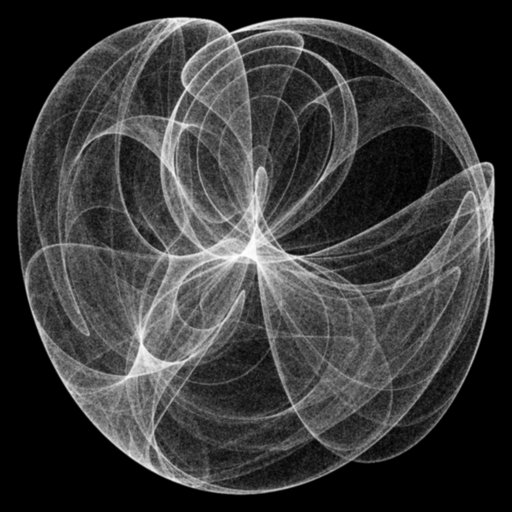
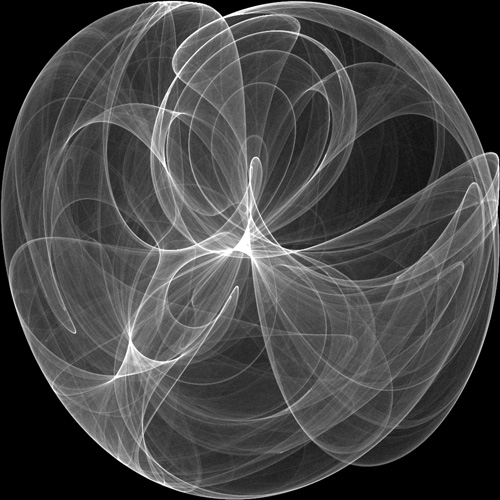
The code for this image is by Manuel Kasten, who posted it in
povray.general. The scene contains 2.000.000 little white spheres. He
couldn't render it himself though, because of heavy swapping.

Now, I don't have enough memory either, but what I did was to reduce the
memory usage by rendering the image over 20 passes each with 100.000
spheres, each time using the previous frame as a background image_map
for the current frame. The result looks nice. It's attached. Well, I
blurred it in Paint Shop Pro before posting in order to reduce
graininess and jpeg-artifacts. The original really isn't blurred at all
despite the multiple times applied antialiasing that is a side effect
from the multiple pass technique I used.

Rune
--
3D images and anims, include files, tutorials and more:
rune|vision:  http://runevision.com **updated Mar 9**
POV-Ray Ring: http://webring.povray.co.uk
Post a reply to this message
Attachments:
Download 'attractors.jpg' (55 KB)
Preview of image 'attractors.jpg'
|
|
| |
| |
|
|
|
|
| |
| |
|
|
"Rune" <run### [at] runevision com> wrote in message
news:4054f58c@news.povray.org...
> The code for this image is by Manuel Kasten, who posted it in
> povray.general. The scene contains 2.000.000 little white spheres. He
> couldn't render it himself though, because of heavy swapping.
>
> Now, I don't have enough memory either, but what I did was to reduce the
> memory usage by rendering the image over 20 passes each with 100.000
> spheres, each time using the previous frame as a background image_map
> for the current frame. The result looks nice. It's attached. Well, I
> blurred it in Paint Shop Pro before posting in order to reduce
> graininess and jpeg-artifacts. The original really isn't blurred at all
> despite the multiple times applied antialiasing that is a side effect
> from the multiple pass technique I used.
AWESOME technique!!!
--
- Respectfully,
Dan
http://<broken link> com> wrote in message
news:4054f58c@news.povray.org...
> The code for this image is by Manuel Kasten, who posted it in
> povray.general. The scene contains 2.000.000 little white spheres. He
> couldn't render it himself though, because of heavy swapping.
>
> Now, I don't have enough memory either, but what I did was to reduce the
> memory usage by rendering the image over 20 passes each with 100.000
> spheres, each time using the previous frame as a background image_map
> for the current frame. The result looks nice. It's attached. Well, I
> blurred it in Paint Shop Pro before posting in order to reduce
> graininess and jpeg-artifacts. The original really isn't blurred at all
> despite the multiple times applied antialiasing that is a side effect
> from the multiple pass technique I used.
AWESOME technique!!!
--
- Respectfully,
Dan
http://<broken link>
Post a reply to this message
|
|
| |
| |
|
|
|
|
| |
| |
|
|
> The original really isn't blurred at all
> despite the multiple times applied antialiasing that is a side effect
> from the multiple pass technique I used.


If you used no interpolation (the default) and aligned the background image
properly, then the AA'ing shouldn't have caused any blurring.

 - Slime
 [ http://www.slimeland.com/ ]
Post a reply to this message
|
|
| |
| |
|
|
|
|
| |
| |
|
|
Slime wrote:
> If you used no interpolation (the default) and aligned
> the background image properly, then the AA'ing shouldn't
> have caused any blurring.

Now that I think a bit more about it, I think you're right. And it does
indeed seem like there was no blurring at all. (And yes, I did use no
interpolation and aligned the background image properly.)

Rune
--
3D images and anims, include files, tutorials and more:
rune|vision:  http://runevision.com **updated Mar 9**
POV-Ray Ring: http://webring.povray.co.uk
Post a reply to this message
|
|
| |
| |
|
|
From: Timothy Cook
Subject: Re: Strange Attractors by Manuel Kasten
Date: 15 Mar 2004 01:03:17
Message: <40554725@news.povray.org>
|
|
|
| |
| |
|
|
Dan P wrote:
> AWESOME technique!!!

Shouldn't that be 'AWESUM ROLEX'?  ;)

--
Tim Cook
http://home.bellsouth.net/p/PWP-empyrean

-----BEGIN GEEK CODE BLOCK-----
Version: 3.12
GFA dpu- s: a?-- C++(++++) U P? L E--- W++(+++)>$
N++ o? K- w(+) O? M-(--) V? PS+(+++) PE(--) Y(--)
PGP-(--) t* 5++>+++++ X+ R* tv+ b++(+++) DI
D++(---) G(++) e*>++ h+ !r--- !y--
------END GEEK CODE BLOCK------
Post a reply to this message
|
|
| |
| |
|
|
From: Manuel Kasten
Subject: Re: Strange Attractors by Manuel Kasten
Date: 15 Mar 2004 01:42:29
Message: <40555055@news.povray.org>
|
|
|
| |
| |
|
|
> The code for this image is by Manuel Kasten, who posted it in
> povray.general. The scene contains 2.000.000 little white spheres. He
> couldn't render it himself though, because of heavy swapping.

The code is based on Paul Bourkes scc3 entry.

> Now, I don't have enough memory either, but what I did was to reduce the
> memory usage by rendering the image over 20 passes each with 100.000
> spheres, each time using the previous frame as a background image_map
> for the current frame. The result looks nice. It's attached. Well, I
> blurred it in Paint Shop Pro before posting in order to reduce
> graininess and jpeg-artifacts. The original really isn't blurred at all
> despite the multiple times applied antialiasing that is a side effect
> from the multiple pass technique I used.

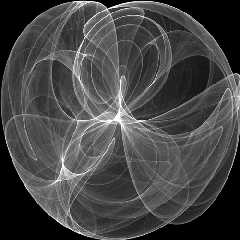
Thank you! That's a great idea. Because I couldn't get around that problem
for myself, but wanted to play with attractors more, I wrote a Java program
(so the following picture is _NOT POVRAY CREATED_). It consits of merely
50 mio. points and was created in less than 2 minutes with a memory usage of
approx. 4 MB.

again: this is not povray generated, but related to the topic...
Post a reply to this message
Attachments:
Download 'attractor.jpg' (88 KB)
Preview of image 'attractor.jpg'
|
|
| |
| |
|
|
From: Florian Brucker
Subject: Re: Strange Attractors by Manuel Kasten
Date: 15 Mar 2004 01:58:11
Message: <40555403@news.povray.org>
|
|
|
| |
| |
|
|
> I wrote a Java program
> (so the following picture is _NOT POVRAY CREATED_). It consits of merely
> 50 mio. points and was created in less than 2 minutes with a memory usage of
> approx. 4 MB.

Cool! Looks much smoother than the POV one. No create some colorful
gradients within the attractor, add a "create random attractor"-button
and there goes the new wallpaper-machine :)

Do I understand it correctly that the attractor is a surface (or could
be represented as one)? It looks like it, so you could try to build a
(smooth) mesh from it. Then you could also do fancy stuff like nice
finishes etc. Of course you'd need POV again to do so.

Florian
Post a reply to this message
|
|
| |
| |
|
|
From: Manuel Kasten
Subject: Re: Strange Attractors by Manuel Kasten
Date: 15 Mar 2004 07:20:43
Message: <40559f9b@news.povray.org>
|
|
|
| |
| |
|
|
> Cool! Looks much smoother than the POV one. No create some colorful
> gradients within the attractor, add a "create random attractor"-button
> and there goes the new wallpaper-machine :)

Hmm, I don't have any idea how to colour them.
Plus I think they look much more artistic in 2 colors.
(I have some black attractors on light blue background as wallpaper)

> Do I understand it correctly that the attractor is a surface (or could
> be represented as one)? It looks like it, so you could try to build a
> (smooth) mesh from it. Then you could also do fancy stuff like nice
> finishes etc. Of course you'd need POV again to do so.

No, it's not a surface. It's a bunch of points on a 2D-coordinate system.
They look 3D, but they aren't.

Manuel Kasten
Post a reply to this message
|
|
| |
| |
|
|
From: Edward Coffey
Subject: Re: Strange Attractors by Manuel Kasten
Date: 15 Mar 2004 08:13:05
Message: <4055abe1@news.povray.org>
|
|
|
| |
| |
|
|
>>Do I understand it correctly that the attractor is a surface (or could
>>be represented as one)? It looks like it, so you could try to build a
>>(smooth) mesh from it. Then you could also do fancy stuff like nice
>>finishes etc. Of course you'd need POV again to do so.
>
>
> No, it's not a surface. It's a bunch of points on a 2D-coordinate system.
> They look 3D, but they aren't.

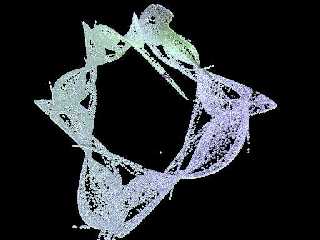
Which is not to say that you can't have 3D attractors. I wrote a quick
and dirty hack to search for sets of coefficients for a 3D quadratic
that produce nice attractors a while ago, I've been meaning to work on
it, perhaps I'll clean it up and post it here if anyone's interested.

The trouble with rendering it as a solid object is that you have no more
information than the location of each point - other than simple
proximity there is no way of knowing whether two points should be
connected forming part of a surface, or whether there is a gap between
them that should not be filled. In the end you either just plot so many
points that it looks like a single surface, or use a guessing algorithm
designed to form a surface from a collection of points.

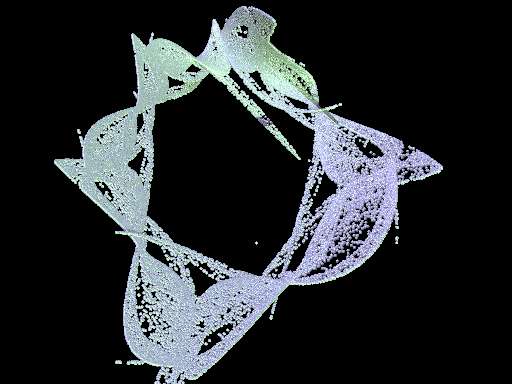
The sample attaced is rendered by plotting each of the 65536 points as a
sphere. It looks a little flat, but you can see where a bit of it sticks
in front of the rest at around 8 o'clock, and a bit of twisting from
around 11 o'clock to 2 o'clock.
Post a reply to this message
Attachments:
Download 'attractor3d.jpg' (25 KB)
Preview of image 'attractor3d.jpg'
|
|
| |
| |
|
|
From: Zeger Knaepen
Subject: Re: Strange Attractors by Manuel Kasten
Date: 15 Mar 2004 10:17:02
Message: <4055c8ee@news.povray.org>
|
|
|
| |
| |
|
|
"Timothy Cook" <z99### [at] bellsouthnet> schreef in bericht
news:40554725@news.povray.org...
> Dan P wrote:
> > AWESOME technique!!!
>
> Shouldn't that be 'AWESUM ROLEX'?  ;)

IIRC it was "AWSOME ROLEX" :)

btw, Rune, nice image as always, but I believe in this case raytracing isn't
the way to go.  Using scanline, you don't have to store all the points in
memory, only the one you're currently drawing, so it wouldn't be any problem
to draw millions or billions of points :)
(Unless there's something about this strange attractors that I don't know...
maybe you need every previous point to compute the next? :-/ :-))

cu!
--
ZK AKA Gaeriel
http://www.povplace.be.tf
"If we ain't outta here in ten minutes, we won't need no rocket to fly
through space."
Post a reply to this message
|
|
| |
| |
|
|
|
|
| |
| |
|
|
in news:40555055@news.povray.org Manuel Kasten wrote:

> but wanted to play with attractors more, I wrote a Java
> program [...]

Are these "attractors" 3-dimensional? If so, how about the idea to have
your program output 3df's, and render them in POV-Ray?


Ingo
Post a reply to this message
|
|
| |
| |
|
|
|
|
| |
| |
|
|
> Are these "attractors" 3-dimensional? If so, how about the idea to have
> your program output 3df's, and render them in POV-Ray?


No, the aren't. They are just millions of points on a 2-d coordinate system.
But it is possible to make 3-dimensional attractors.


Manuel
Post a reply to this message
|
|
| |
| |
|
|
|
|
| |
| |
|
|
How much memory are we talking about for
the all-pov-version ?

--
Steven Pigeon, Ph. D.
pig### [at] iroumontrealca
"Manuel Kasten" <kas### [at] gmxde> wrote in message
news:40555055@news.povray.org...
> > The code for this image is by Manuel Kasten, who posted it in
> > povray.general. The scene contains 2.000.000 little white spheres. He
> > couldn't render it himself though, because of heavy swapping.
>
> The code is based on Paul Bourkes scc3 entry.
>
> > Now, I don't have enough memory either, but what I did was to reduce the
> > memory usage by rendering the image over 20 passes each with 100.000
> > spheres, each time using the previous frame as a background image_map
> > for the current frame. The result looks nice. It's attached. Well, I
> > blurred it in Paint Shop Pro before posting in order to reduce
> > graininess and jpeg-artifacts. The original really isn't blurred at all
> > despite the multiple times applied antialiasing that is a side effect
> > from the multiple pass technique I used.
>
> Thank you! That's a great idea. Because I couldn't get around that problem
> for myself, but wanted to play with attractors more, I wrote a Java
program
> (so the following picture is _NOT POVRAY CREATED_). It consits of merely
> 50 mio. points and was created in less than 2 minutes with a memory usage
of
> approx. 4 MB.
>
> again: this is not povray generated, but related to the topic...
>
>
>
Post a reply to this message
|
|
| |
| |
|
|
|
|
| |
| |
|
|
> (...the following picture is _NOT POVRAY CREATED_)
Post a reply to this message
|
|
| |
| |
|
|
|
|
| |
| |
|
|
Rune wrote:
>
> Now, I don't have enough memory either, but what I did was to reduce
> the memory usage by rendering the image over 20 passes each with
> 100.000 spheres, each time using the previous frame as a background
> image_map for the current frame.

BRAIN:  "Pinky, are you pondering what I'm pondering?"

PINKY:  "I think so, Brain.  But what are we going to do with our
spare time if we can emulate a z-buffer in POV-Ray?"
Post a reply to this message
|
|
| |
| |
|
|
From: Timothy Cook
Subject: Re: Strange Attractors by Manuel Kasten
Date: 15 Mar 2004 23:01:14
Message: <40567c0a@news.povray.org>
|
|
|
| |
| |
|
|
Zeger Knaepen wrote:
> btw, Rune, nice image as always, but I believe in this case raytracing isn't
> the way to go.  Using scanline, you don't have to store all the points in
> memory, only the one you're currently drawing, so it wouldn't be any problem
> to draw millions or billions of points :)

Does raytracing necessarily have to load all points into memory?

--
Tim Cook
http://home.bellsouth.net/p/PWP-empyrean

-----BEGIN GEEK CODE BLOCK-----
Version: 3.12
GFA dpu- s: a?-- C++(++++) U P? L E--- W++(+++)>$
N++ o? K- w(+) O? M-(--) V? PS+(+++) PE(--) Y(--)
PGP-(--) t* 5++>+++++ X+ R* tv+ b++(+++) DI
D++(---) G(++) e*>++ h+ !r--- !y--
------END GEEK CODE BLOCK------
Post a reply to this message
|
|
| |
| |
|
|
|
|
| |
| |
|
|
ing### [at] tagpovrayorg news:Xns94ADD20507BEDseed7@news.povray.org

> Are these "attractors" 3-dimensional? If so, how about the idea to have
> your program output 3df's, and render them in POV-Ray?

800x800x800 - its a lot of memory ;)

--
http://www.raf256.com/3d/
Rafal Maj 'Raf256', home page - http://www.raf256.com/me/
Computer Graphics
Post a reply to this message
|
|
| |
| |
|
|
|
|
| |
| |
|
|
z99### [at] bellsouthnet news:40567c0a@news.povray.org

> Does raytracing necessarily have to load all points into memory?

I think oct-tree would be best here

--
http://www.raf256.com/3d/
Rafal Maj 'Raf256', home page - http://www.raf256.com/me/
Computer Graphics
Post a reply to this message
|
|
| |
| |
|
|
From: Manuel Kasten
Subject: Re: Strange Attractors by Manuel Kasten
Date: 16 Mar 2004 01:49:25
Message: <4056a375@news.povray.org>
|
|
|
| |
| |
|
|
> How much memory are we talking about for
> the all-pov-version ?

The original povray-version needed beetween 400 - 500 MB of RAM for
2 mio spheres. Runes version needs as low memory as you want, depending
on how much passes you do.

My Java version's memory consumption is independent from the number of
points, so I can easily go as high as say 350 mio. Thats why the Java version
looks that much smoother than the POV version. ( Memory usage can be
approximated by     image_size*image_size*3 byte  )

Manuel
Post a reply to this message
|
|
| |
| |
|
|
|
|
| |
| |
|
|
> Are these "attractors" 3-dimensional? If so, how about the idea to have
> your program output 3df's, and render them in POV-Ray?

No they are not, which is interesting because they often look 3D.
For further examples see
   http://astronomy.swin.edu.au/~pbourke/fractals/peterdejong/
   http://astronomy.swin.edu.au/~pbourke/fractals/clifford/
   http://astronomy.swin.edu.au/~pbourke/fractals/lyapunov/
--
Paul Bourke
pdb_NOSPAMswin.edu.au
Post a reply to this message
|
|
| |
| |
|
|
|
|
| |
| |
|
|
Edward Coffey wrote:

> The trouble with rendering it as a solid object is that you have no more
> information than the location of each point - other than simple
> proximity there is no way of knowing whether two points should be
> connected forming part of a surface, or whether there is a gap between
> them that should not be filled. In the end you either just plot so many
> points that it looks like a single surface, or use a guessing algorithm
> designed to form a surface from a collection of points.

i don't think you need a guessing algorithm. maybe you could simply keep
the last three points in memory and create a triangle for a mesh with
it. then find the next point and create a triangle that uses two points
from the last one and the new point. if i am wrong here, just tell me
why, i don't know much about attractors...
bye,
	Marc
Post a reply to this message
|
|
| |
| |
|
|
|
|
| |
| |
|
|
> No they are not, which is interesting because they often look 3D.
> For further examples see
>    http://astronomy.swin.edu.au/~pbourke/fractals/peterdejong/
>    http://astronomy.swin.edu.au/~pbourke/fractals/clifford/
>    http://astronomy.swin.edu.au/~pbourke/fractals/lyapunov/


Hi

As you are the one I got the idea from, how do you generate your attractors?
How much points, what program, memory usage, runtime...

Thanks a lot for your scc entry (which brought me to attractors), I really have
a lot of fun playing with these.


Manuel
Post a reply to this message
|
|
| |
| |
|
|
|
|
| |
| |
|
|
Marc Roth wrote:
...
> i don't think you need a guessing algorithm. maybe you could simply keep
> the last three points in memory and create a triangle for a mesh with
> it. then find the next point and create a triangle that uses two points
> from the last one and the new point. if i am wrong here, just tell me
> why, i don't know much about attractors...

These attractors are generated by starting at some initial point in
space, then applying a function to that point to generate the next
point, repeating for as many iterations as you care to plot. The really
interesting thing about them (well, for me at-least) is that though the
points end up forming complex and intricate surfaces in three
dimensions, they aren't generated in a nice progressive sequence from
one end of the surface to the other. Instead they appear in a chaotic
pattern, jumping in a seemingly random sequence from one place to the next.

Put simply, you can't use the order of generation to decide how to
approximate the surface because while for any given point, n, it is
possible that point n+1 is right next to it, it is just as likely to be
over the other side of the object.
Post a reply to this message
|
|
| |
| |
|
|
|
|
| |
| |
|
|
Edward Coffey wrote:
> Put simply, you can't use the order of generation to decide how to
> approximate the surface because while for any given point, n, it is
> possible that point n+1 is right next to it, it is just as likely to be
> over the other side of the object.

ah, i didn't know that. instead of a guessing-algorithm one could also
use several steps to create a surface:
1) create all points and store them in a file
2) create triangles from them by taking one point and finding the 2
closest point

step two would be very cpu-time-consuming, as far as i know, so it's not
a very efficient way.
ciao,
	Marc
Post a reply to this message
|
|
| |
| |
|
|
|
|
| |
| |
|
|
pdb### [at] swineduau news:pdb_NOSPAM-
26E623.17592116032004@news.povray.org

>    http://astronomy.swin.edu.au/~pbourke/fractals/peterdejong/
>    http://astronomy.swin.edu.au/~pbourke/fractals/clifford/
>    http://astronomy.swin.edu.au/~pbourke/fractals/lyapunov/

Realy, realy, nice :)

--
http://www.raf256.com/3d/
Rafal Maj 'Raf256', home page - http://www.raf256.com/me/
Computer Graphics
Post a reply to this message
|
|
| |
| |
|
|
|
|
| |
| |
|
|
Just in case anyone is interested in a free online versions of a book
about "Strange Attractors":

http://sprott.physics.wisc.edu/sa.htm

"Strange Attractors: Creating Patterns in Chaos (ISBN 1-55851-298-5)"
by Julien C. Sprott


--
Tor Olav
http://subcube.com
http://subcube.net
Post a reply to this message
|
|
| |
| |
|
|
|
|
| |
| |
|
|
Hi,

I had a lot of fun during the last days, playing with strange attractors.
I have put some of the most interesting ones here:

http://home.arcor.de/mad_onion/attractors/


My Java program which generated these is available here:

http://madonion.homeip.net/attractors/


Have fun!

Manuel
Post a reply to this message
|
|
| |
| |
|
|
|
|
| |
| |
|
|
> > No they are not, which is interesting because they often look 3D.
> > For further examples see
> >    http://astronomy.swin.edu.au/~pbourke/fractals/peterdejong/
> >    http://astronomy.swin.edu.au/~pbourke/fractals/clifford/
> >    http://astronomy.swin.edu.au/~pbourke/fractals/lyapunov/
> As you are the one I got the idea from, how do you generate your attractors?
> How much points, what program, memory usage, runtime...

Since these aren't 3D I simply draw points on an image plane with
my own custom software. To get the nice grey/misty look I render
to a very large image, say 4k square and then scale it down with
antialiasing. I render millions, billions, ..... points, there is
no penalty except time because I don't need to keep anything in
memory except the final image which "evolves".

> Thanks a lot for your scc entry (which brought me to attractors), I really
> have a lot of fun playing with these.

There is something about them.....too bad no one voting in the scc3
thought much of my entry. :-)
--
Paul Bourke
pdb_NOSPAMswin.edu.au
Post a reply to this message
|
|
| |
| |
|
|
|
|
| |
| |
|
|
Manuel Kasten wrote:

>>each time using the previous frame as a background image_map
>>for the current frame. The result looks nice.
>>
How did you do that? I know it's an animation topic, but I've been
trying to do that unsuccessfully for a while.
Please help.

Bill

>
>
>
Post a reply to this message
|
|
| |
| |
|
|
|
|
| |
| |
|
|
> "Strange Attractors: Creating Patterns in Chaos (ISBN 1-55851-298-5)"
> by Julien C. Sprott

Excellent Tor!  I've started reading this at my job (in secret since I
shouldn't use the internet for personnal use!) and I found it extremely
interesting...

Actually, I decided to try to create a PHP script that will render one
of these Chaotic attractors and I will try to work toward a more fractal
attractor.  Eventually, I guess it will be pretty easy to port this PHP
code to OpenGL and have an interactive animation of it.  I could even
add a function that would output a povray code to render it...

Now, I haven't read much of the book, but I wonder if it's possible to
make nice looking strange att. in 3D?  Then POV-Ray will come handy to
make nice stereographs of the object.

Thanks,
   Simon
Post a reply to this message
|
|
| |
| |
|
|
|
|
| |
| |
|
|
"Xilo Musimene" <xil### [at] cainternet> wrote in message
news:405d1dbc$1@news.povray.org...
> > "Strange Attractors: Creating Patterns in Chaos (ISBN 1-55851-298-5)"
> > by Julien C. Sprott
>
> Excellent Tor!  I've started reading this at my job (in secret since I
> shouldn't use the internet for personnal use!) and I found it extremely
> interesting...


I read this at my job too. Is this really personal use, though? If you are a
computer scientist, this newsgroup ranks up there with on-the-job research
because of the technical aspect, particularly if you do any graphical art.
As long as it is computer related, doesn't accessing a site consititute
normal use, keeping up with the field? It's hard to imagine that a company
would have a problem with joining a community of interest to keep your edge
sharp. I know that reading this group has definitely improved my ability to
create 3D images because of all the stuff I've learned from people smarter
than I (and lucky for me that is darned-near everyone!)

--
- Respectfully,
Dan
http://<broken link>
Post a reply to this message
|
|
| |
| |
|
|
|
|
| |
| |
|
|
On Sat, 20 Mar 2004 23:44:43 -0500, Xilo Musimene
<xil### [at] cainternet> wrote:

>> "Strange Attractors: Creating Patterns in Chaos (ISBN 1-55851-298-5)"
>> by Julien C. Sprott
>
> Excellent Tor!  I've started reading this at my job (in secret since I
> shouldn't use the internet for personnal use!) and I found it extremely
> interesting...
>
> Actually, I decided to try to create a PHP script that will render one
> of these Chaotic attractors and I will try to work toward a more fractal
> attractor.  Eventually, I guess it will be pretty easy to port this PHP
> code to OpenGL and have an interactive animation of it.  I could even
> add a function that would output a povray code to render it...


I've whipped up a little program myself that can render these attractors
(among others).
Here are some results:

Manual Kasten's attractor (sin/cos-based):
http://hem.bredband.net/b230591/attractor/attractor1.png

 From the book (EAGHNFODVNJCP):
http://hem.bredband.net/b230591/attractor/attractor_2.png

 From the book (ETJUBWEDNRORR):
http://hem.bredband.net/b230591/attractor/attractor_3.png

Sierpinski triangle (random-based):
http://hem.bredband.net/b230591/attractor/sierpinski.png


> Now, I haven't read much of the book, but I wonder if it's possible to
> make nice looking strange att. in 3D?  Then POV-Ray will come handy to
> make nice stereographs of the object.
>
> Thanks,
>    Simon
>


3D-attractors (and even higher orders) are described in the book. Maybe
I'll do some experiments with them; just to see if the extra dimension is
worth the extra effort.


---
FE
Post a reply to this message
|
|
| |
| |
|
|
From: Edward Coffey
Subject: Re: Strange Attractors by Manuel Kasten
Date: 21 Mar 2004 08:00:32
Message: <405d91f0@news.povray.org>
|
|
|
| |
| |
|
|
Xilo Musimene wrote:
...
> Now, I haven't read much of the book, but I wonder if it's possible to
> make nice looking strange att. in 3D?
...

Isn't mine (posted to this thread) nice looking enough for you?
:-)
Post a reply to this message
|
|
| |
| |
|
|
|
|
| |
| |
|
|
As promised (or at least hinted at) I have given 3D attractors a go.

These were done with POV-Ray (3.5 for Windows).
They all use quadratic functions.
All of them have 500000 points, except quadratic_2_1m.jpg which has one
million points.

One million points is as high as I can go with individually colored
points. Even then I have to disable light- & vista-buffers to conserve
memory (these consume huge amounts of memory, and take forever to generate
with 1M points).


---
FE
Post a reply to this message
Attachments:
Download 'quadratic_1.jpg' (70 KB)
Download 'quadratic_2.jpg' (70 KB)
Download 'quadratic_2_1m.jpg' (70 KB)
Download 'quadratic_3.jpg' (48 KB)
Download 'quadratic_4.jpg' (62 KB)
Download 'quadratic_5.jpg' (93 KB)
Download 'quadratic_6.jpg' (67 KB)
Preview of image 'quadratic_1.jpg'

Preview of image 'quadratic_2.jpg'

Preview of image 'quadratic_2_1m.jpg'

Preview of image 'quadratic_3.jpg'

Preview of image 'quadratic_4.jpg'

Preview of image 'quadratic_5.jpg'

Preview of image 'quadratic_6.jpg'

|
|
| |
| |
|
|
|
|
| |
| |
|
|
"Fredrik Eriksson" <noo### [at] nowherecom> wrote in message
news:opr48epnpgzjc5hb@news.povray.org...
>
> As promised (or at least hinted at) I have given 3D attractors a go.
>
> These were done with POV-Ray (3.5 for Windows).
> They all use quadratic functions.
> All of them have 500000 points, except quadratic_2_1m.jpg which has one
> million points.
>
> One million points is as high as I can go with individually colored
> points. Even then I have to disable light- & vista-buffers to conserve
> memory (these consume huge amounts of memory, and take forever to generate
> with 1M points).


KICK-ASS!

--
- Respectfully,
Dan
http://<broken link>
Post a reply to this message
|
|
| |
| |
|
|
|
|
| |
| |
|
|
what formulas did you use to create these? and how the hell did you get
1M spheres to render in povray? i tried it myself and the furthest i got
where ~250k before i ran out of memory (512mb availabe), with all but
povray closed...
really nice, especially number 1 & 5!
bye,
	Marc
Post a reply to this message
|
|
| |
| |
|
|
|
|
| |
| |
|
|
On Mon, 22 Mar 2004 00:45:53 +0100, Marc Roth <mar### [at] rothconsultcom> wrote:
> what formulas did you use to create these?

The formulas are the simple quadratic polynomials:

x = a[ 0] + a[ 1]*x + a[ 2]*x*x + a[ 3]*x*y + a[ 4]*x*z + a[ 5]*y
+ a[ 6]*y*y + a[ 7]*y*z + a[ 8]*z + a[ 9]*z*z
y = a[10] + a[11]*x + a[12]*x*x + a[13]*x*y + a[14]*x*z + a[15]*y
+ a[16]*y*y + a[17]*y*z + a[18]*z + a[19]*z*z
z = a[20] + a[21]*x + a[22]*x*x + a[23]*x*y + a[24]*x*z + a[25]*y
+ a[26]*y*y + a[27]*y*z + a[28]*z + a[29]*z*z

The actual coefficients (a[0] -> a[29]) are derived at parse time from the
strings given in the book by Sprott.


> and how the hell did you get 1M spheres to render in povray? i tried it
> myself and the furthest i got where ~250k before i ran out of memory
> (512mb availabe), with all but povray closed...

1. I have 1 GB of memory.

2. For the 1M sphere render, I disable light- & vista buffers. With
7-digit object counts, they can require several hundred MB of memory, and
take far longer to create than it takes to render without them.
They don't seem to cause much trouble for the 0.5M renders though.


Also note that I was able to render Manuel Kasten's original scene (the
one with 2M spheres) without difficulty, but those spheres did not have
individual textures.


> really nice, especially number 1 & 5!
> bye,
> 	Marc


---
FE
Post a reply to this message
|
|
| |
| |
|
|
|
|
| |
| |
|
|
> I read this at my job too. Is this really personal use, though? If you are a
> computer scientist, this newsgroup ranks up there with on-the-job research
> because of the technical aspect, particularly if you do any graphical art.
> As long as it is computer related, doesn't accessing a site consititute
> normal use, keeping up with the field? It's hard to imagine that a company
> would have a problem with joining a community of interest to keep your edge
> sharp. I know that reading this group has definitely improved my ability to
> create 3D images because of all the stuff I've learned from people smarter
> than I (and lucky for me that is darned-near everyone!)

The company for which I work for doesn't share your point of view.

Unfortunately, things have been going a little more crazy than average
over there, I hope things will settle in some time!...

Simon
Post a reply to this message
|
|
| |
| |
|
|
|
|
| |
| |
|
|
> I've whipped up a little program myself that can render these attractors
> (among others).
> Here are some results:

Nice ones!

I'm currently working on a search-and-study kind of program...  Though
I'm having trouble with the analysis part.

The analysis should decide if the current render is nice or not and
mutate the render to make it nicier.

Right now I test for:
1) finite and non-periodic attractors. Ie. chaotic ones!
2) Number of viewport-visible points
3) Fractal dimension

Though I think I misunderstood the fractal dimension calculus...  I'll
continue the analysis-tweak tomorrow with a fresh mind! ;)

> 3D-attractors (and even higher orders) are described in the book. Maybe
> I'll do some experiments with them; just to see if the extra dimension
> is worth the extra effort.

I've read to section, it doesn't seem much better than the usual 2D one,
except it's good for adding some depth-culling effect (ie. fog).

Simon
Post a reply to this message
|
|
| |
| |
|
|
|
|
| |