|
|
|
|
|
|
| |
| |
|
|
From: Tim Nikias v2 0
Subject: Indoor Radiosity Experiments (24kb + 25kb + 25kb)
Date: 12 Jul 2003 20:52:00
Message: <3f10ad30@news.povray.org>
|
|
|
| |
| |
|
|
I've had a course in Computer-Graphics this Semester, and
got all excited about all the kind of approaches and ideas
that there are in order to render an image.

Anyways, the last session was about global illumination,
local vs global lighting techniques etc. This got me started
in understanding the technique of POV-Ray in detail...

The basic idea: Create several passes to generate the
different effects. So, one pass for gathering detailed and
blotchy radiosity data. This is later loaded and smoothened
by using a higher error_bound when loading as compared
to when saving.
Another pass for gathering the photons. Since these stay
unaffected of everything all the time when loaded, I could
gather photons in one pass, and load them, even without
the lightsource, a special criteria when combining pure
radiosity lighting with photons.

So, I've just made successive experiments: pure radiosity,
with no lightsource. Then, photons (since POV's radiosity
doesn't do light reflection/refraction very detailed), but these
were loaded into the radiosity scene, no lightsource present.
Finally, lightsource AND photons. For testing purposes,
I've sometimes calculated the radiosity samples with photons,
sometimes without, to look for differences.

Anyways, I've noticed that photons DO make a difference,
but its very small, but it DOES take longer to generate the
radiosity data. So unless there's heavy "photonizing", its
not really needed.
Additionally, it might be of interest to know that using
actual lightsources gives sharper shadows (though using
area-lights to get soft shadows is a must for realistic lighting,
somewhat paradox). BUT, it must be said that shadows
produced by pure radiosity lighting are VERY soft.
Lightsources also generate specular highlights, which are
hard to come by with pure rad-lighting. Using reflection
values with high exponents does the job, but slows down
the entire raytracing of the final pass (should be switched
off when gathering radiosity data).

I just thought I'd share these few images. I've got some dozens
more (most of em in 320x240) and will likely create a new
page on my website which'll cover the experiments and obtained
results.

Also note that outdoor scenes will most likely require different
setups, but I've found this very entertaining and educating. Expect
some of my next images to be Radiosity-Filled. :-)

Regards,
Tim

--
Tim Nikias v2.0
Homepage: http://www.digitaltwilight.de/no_lights


---
Outgoing mail is certified Virus Free.
Checked by AVG anti-virus system (http://www.grisoft.com).
Version: 6.0.495 / Virus Database: 294 - Release Date: 30.06.2003
Post a reply to this message
Attachments:
Download '1_rad_r2b1p1_largeAA.jpg' (24 KB)
Download '3_rad_r2b1p1_largeAA.jpg' (26 KB)
Download '4_rad_r2b2p1_g00_largeAA.jpg' (25 KB)
Preview of image '1_rad_r2b1p1_largeAA.jpg'
Preview of image '3_rad_r2b1p1_largeAA.jpg'
Preview of image '4_rad_r2b2p1_g00_largeAA.jpg'
|
|
| |
| |
|
|
From: Apache
Subject: Re: Indoor Radiosity Experiments (24kb + 25kb + 25kb)
Date: 12 Jul 2003 20:59:57
Message: <3f10af0d$1@news.povray.org>
|
|
|
| |
| |
|
|
What images show what? I have three here, but I don't know which one is
supposed to show radiosity and/or photons....
Post a reply to this message
|
|
| |
| |
|
|
From: Tim Nikias v2 0
Subject: Re: Indoor Radiosity Experiments (24kb + 25kb + 25kb)
Date: 12 Jul 2003 21:08:47
Message: <3f10b11f@news.povray.org>
|
|
|
| |
| |
|
|
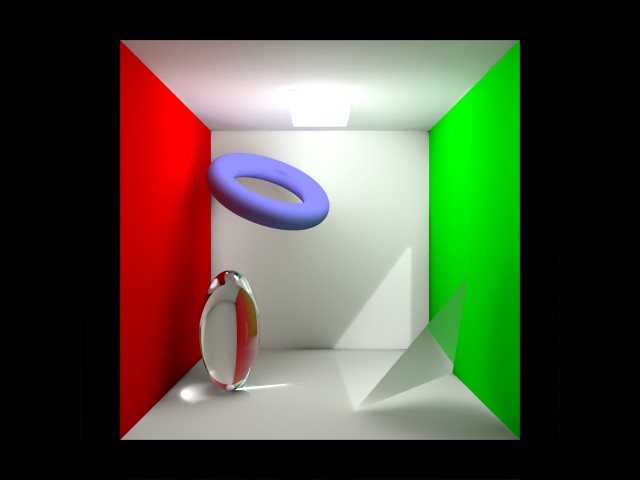
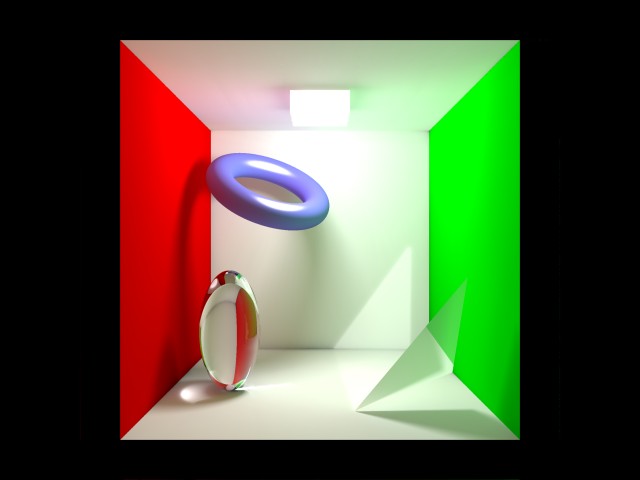
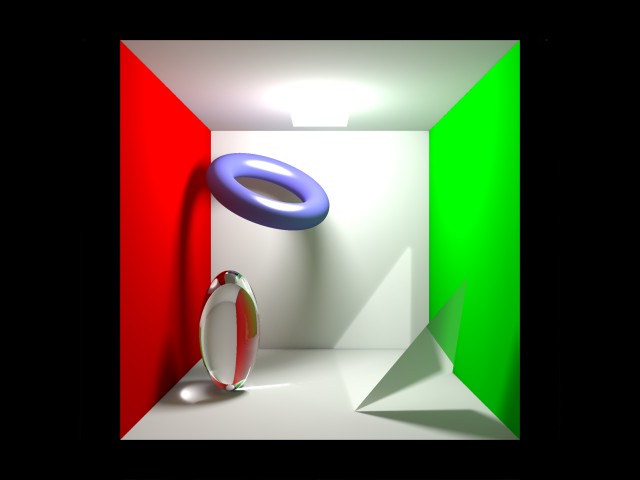
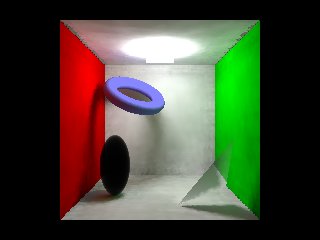
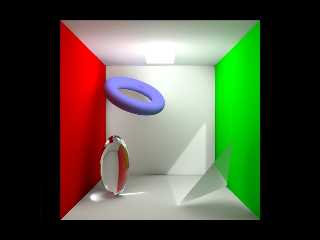
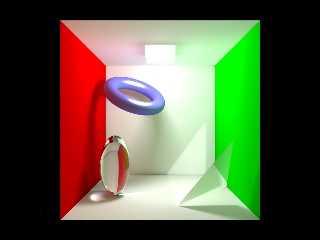
Oh, ok. All of them have photons.

There is one image where the glowing box
throws a shadow on the ceiling. That's
lightsource and radiosity combined.

There are two images where the glowing box
doesn't have a shadow. The one with the
VERY smooth shadows is pure radiosity,
with photons loaded AFTER the radiosity
was generated.
The other image is almost the same setup,
but the glowing box has a no_shadow-tag,
and uses a lightsource.

Note that the last image (lightsource+no_shadow)
uses a different brightness value, its .5 compared
to the others using 1.25.

The results are VERY different when using no_shadow
or not.

Which one do you like best?

--
Tim Nikias v2.0
Homepage: http://www.digitaltwilight.de/no_lights


> What images show what? I have three here, but I don't know which one is
> supposed to show radiosity and/or photons....
>
>


---
Outgoing mail is certified Virus Free.
Checked by AVG anti-virus system (http://www.grisoft.com).
Version: 6.0.495 / Virus Database: 294 - Release Date: 30.06.2003
Post a reply to this message
|
|
| |
| |
|
|
From: Apache
Subject: Re: Indoor Radiosity Experiments (24kb + 25kb + 25kb)
Date: 12 Jul 2003 21:46:30
Message: <3f10b9f6$1@news.povray.org>
|
|
|
| |
| |
|
|
> All of them have photons
That's too bad! I'd like to do the same with radiosity as one would normally
do with photons. Addiotionally I would be really happy if media would with
ambient light-sources into account: no light source, but just a(n) object(s)
with high ambient value, using radiosity.


I like 4_rad_r2b2p1_g00_largeAA best. It has no light bleeding at the bottom
of the triangle (see 1_rad_r2b1p1_largeAA), and the light source doesn't
reflect the wall colors (3_rad_r2b1p1_largeAA).
Post a reply to this message
|
|
| |
| |
|
|
From: Tim Nikias v2 0
Subject: Re: Indoor Radiosity Experiments (24kb + 25kb + 25kb)
Date: 13 Jul 2003 04:09:18
Message: <3f1113ae$1@news.povray.org>
|
|
|
| |
| |
|
|
> That's too bad! I'd like to do the same with radiosity as one would
normally
> do with photons. Addiotionally I would be really happy if media would with
> ambient light-sources into account: no light source, but just a(n)
object(s)
> with high ambient value, using radiosity.

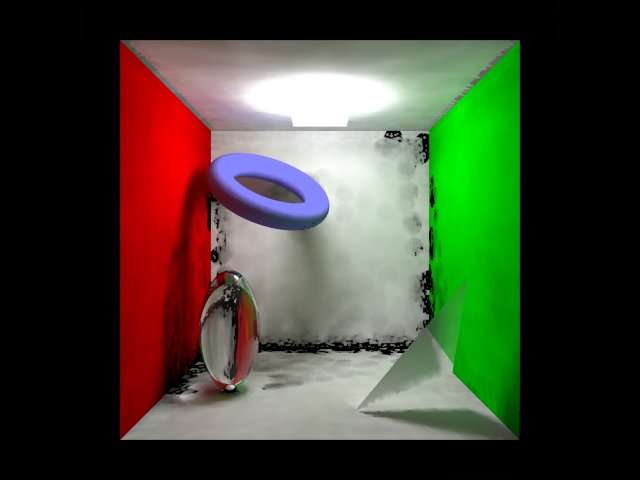
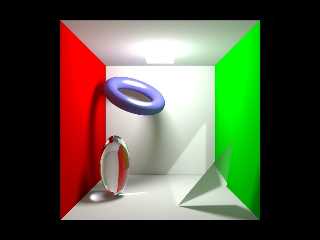
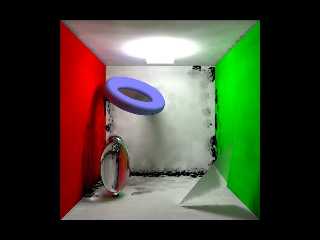
I've attached an image showing how the first pass using radiosity
looks like: its rather blotchy and patchy. Notice though that we do
get a little refracted/reflected light underneath the sphere.
Still, radiosity is more of a diffuse reflection function, than photons,
which does specular reflection. They both complement each other
pretty well, and you shouldn't attempt doing photon effects with
pure radiosity unless you've got waaaay too much time on your
hands. But I guess its far from practical.
AFAIR someone had posted a reflecting torus, where radiosity
was used to create that light-focussed effect which occurs on the
inside of that obect. I'm not too sure who did it, and when though.
Still, it shows that it IS possible if you're desperate.

About that media interaction: I'll just make some tests. AFAIK
"media on" in the radiosity statement should take care of that,
but I hadn't experimented with that yet. I'll notify in this thread.


> I like 4_rad_r2b2p1_g00_largeAA best. It has no light bleeding at the
bottom
> of the triangle (see 1_rad_r2b1p1_largeAA), and the light source doesn't
> reflect the wall colors (3_rad_r2b1p1_largeAA).

Thanks for the feedback. Yeah, a shadowing lightsource doesn't
look too good. But IMHO, the lightbleeding may be a desired
effect when using radiosity, and it may be toned down using
gray_threshold.

--
Tim Nikias v2.0
Homepage: http://www.digitaltwilight.de/no_lights


---
Outgoing mail is certified Virus Free.
Checked by AVG anti-virus system (http://www.grisoft.com).
Version: 6.0.495 / Virus Database: 294 - Release Date: 30.06.2003
Post a reply to this message
|
|
| |
| |
|
|
From: Tim Nikias v2 0
Subject: Re: Indoor Radiosity Experiments (25kb)
Date: 13 Jul 2003 04:41:51
Message: <3f111b4f@news.povray.org>
|
|
|
| |
| |
|
|
Well, here's the pic I've forgotten to attach...
Notie that all those artifacts get smoothened
out later when using a higher error_bound.

Anyways, I've also found the thread the with radiosity
I mentioned earlier:
http://news.povray.org/povray.binaries.images/29501/


--
Tim Nikias v2.0
Homepage: http://www.digitaltwilight.de/no_lights


---
Outgoing mail is certified Virus Free.
Checked by AVG anti-virus system (http://www.grisoft.com).
Version: 6.0.495 / Virus Database: 294 - Release Date: 30.06.2003
Post a reply to this message
Attachments:
Download '1_rad_r1b0p0_largeAA.jpg' (25 KB)
Preview of image '1_rad_r1b0p0_largeAA.jpg'
|
|
| |
| |
|
|
From: Tim Nikias v2 0
Subject: Media Experiments - Indoor Radiosity (9kb)
Date: 13 Jul 2003 05:06:50
Message: <3f11212a@news.povray.org>
|
|
|
| |
| |
|
|
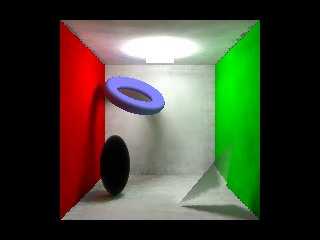
Scattering media doesn't take ambient lightsources
from radiosity calculations into account. After reading
the docs carefully I should have expected that, as it
says

6.11.11.2.9 Media and Radiosity
Radiosity estimation can be affected by media.

It doesn't say that its vice versa.

But its always better to experiment and find out
yourself...


---
Outgoing mail is certified Virus Free.
Checked by AVG anti-virus system (http://www.grisoft.com).
Version: 6.0.495 / Virus Database: 294 - Release Date: 30.06.2003
Post a reply to this message
Attachments:
Download '6_rad_r1b0p0.jpg' (9 KB)
Preview of image '6_rad_r1b0p0.jpg'
|
|
| |
| |
|
|
From: Zeger Knaepen
Subject: Re: Indoor Radiosity Experiments (24kb + 25kb + 25kb)
Date: 13 Jul 2003 05:14:09
Message: <3f1122e1$1@news.povray.org>
|
|
|
| |
| |
|
|
> which does specular reflection. They both complement each other
> pretty well, and you shouldn't attempt doing photon effects with
> pure radiosity unless you've got waaaay too much time on your
> hands. But I guess its far from practical.
> AFAIR someone had posted a reflecting torus, where radiosity
> was used to create that light-focussed effect which occurs on the
> inside of that obect. I'm not too sure who did it, and when though.
> Still, it shows that it IS possible if you're desperate.

I did, and actually it shows that it is NOT possible to get decent caustics
using pure radiosity.  It would be possible if you could use more samples
for radiosity though.

cu!
--
ZK AKA SaD
http://www.povplace.be.tf
"Use the instrumentpanel, Luke!"
Post a reply to this message
|
|
| |
| |
|
|
From: Tim Nikias v2 0
Subject: Re: Indoor Radiosity Experiments (24kb + 25kb + 25kb)
Date: 13 Jul 2003 05:28:06
Message: <3f112626@news.povray.org>
|
|
|
| |
| |
|
|
I stand corrected. Then, at least, it is theoretically
possible. But in theory, what isn't? :-)


--
Tim Nikias v2.0
Homepage: http://www.digitaltwilight.de/no_lights


>
> I did, and actually it shows that it is NOT possible to get decent
caustics
> using pure radiosity.  It would be possible if you could use more samples
> for radiosity though.
>
> cu!


---
Outgoing mail is certified Virus Free.
Checked by AVG anti-virus system (http://www.grisoft.com).
Version: 6.0.495 / Virus Database: 294 - Release Date: 30.06.2003
Post a reply to this message
|
|
| |
| |
|
|
From: Apache
Subject: Re: Indoor Radiosity Experiments (24kb + 25kb + 25kb)
Date: 13 Jul 2003 05:50:53
Message: <3f112b7d@news.povray.org>
|
|
|
| |
| |
|
|
ratiosity will take media into account with "media on". But what about the
other way around: media taking ambient light sources or diffused light into
account?
Post a reply to this message
|
|
| |
| |
|
|
From: Christoph Hormann
Subject: Re: Indoor Radiosity Experiments (25kb)
Date: 13 Jul 2003 08:03:11
Message: <3F114A7F.36AB7A04@gmx.de>
|
|
|
| |
| |
|
|
"Tim Nikias v2.0" wrote:
>
> Well, here's the pic I've forgotten to attach...
> Notie that all those artifacts get smoothened
> out later when using a higher error_bound.

This image strongly indicates a not high enough max_trace_level.  For
radiosity with reflection and refraction it is usually advisable to turn
off reflection and refraction for the pretrace.  For this you usually need
three renders:

1) generate photons with correct finishes/interiors
2) generate radiosity data without reflection and refraction.
3) do the final render using both previously generated data files.

Christoph

--
POV-Ray tutorials, include files, Sim-POV,
HCR-Edit and more: http://www.tu-bs.de/~y0013390/
Last updated 17 Jun. 2003 _____./\/^>_*_<^\/\.______
Post a reply to this message
|
|
| |
| |
|
|
From: Xplo Eristotle
Subject: Re: Indoor Radiosity Experiments (24kb + 25kb + 25kb)
Date: 15 Jul 2003 14:30:55
Message: <3f14485f@news.povray.org>
|
|
|
| |
| |
|
|
Tim Nikias v2.0 wrote:

> Additionally, it might be of interest to know that using
> actual lightsources gives sharper shadows (though using
> area-lights to get soft shadows is a must for realistic lighting,
> somewhat paradox). BUT, it must be said that shadows
> produced by pure radiosity lighting are VERY soft.

It really depends on the circumstances. With a sufficiently low
error_bound and high count, and the right environment, I have seen
radiosity produce some pretty sharp shadows. The "problem" is that the
scenes where radiosity typically has the greatest obvious impact vs.
normal point lighting are those where there are large lit areas (skies,
well-lit rooms with white walls, etc) and naturally when light is coming
from everywhere, you're going to have some pretty soft shadows.

If you want sharper shadows in such a scene, you'll have to set it up so
that the "main" light sources in the scene are much brighter than the
lit objects around them (or else reduce the radiosity brightness, which
provides much the same effect). I think you'll see this as you start
playing with outdoor scenes with full sun, although an indoor
environment could also work if you're using a bright, naked light bulb
for lighting.

-Xplo
Post a reply to this message
|
|
| |
| |
|
|
From: Tim Nikias v2 0
Subject: Re: Indoor Radiosity Experiments (24kb + 25kb + 25kb)
Date: 15 Jul 2003 14:52:50
Message: <3f144d82@news.povray.org>
|
|
|
| |
| |
|
|
Well, not much to say to that, you've got straight
A's on your radiosity-examn. :-)

Seriously though: I was just analyzing indoor scenes
with pure radiosity, especially scenes where the lightsource
is more or less a lightbulb or something similiar. Shadows
produced by those are very soft, as said before.
But sure, with the right settings, one could get crisper
shadows. Still, I'd go so far and say that for the majority
of scenes where radiosity is used indoors, shadows
produced thereby are very soft.


--
Tim Nikias v2.0
Homepage: http://www.digitaltwilight.de/no_lights


>
> > Additionally, it might be of interest to know that using
> > actual lightsources gives sharper shadows (though using
> > area-lights to get soft shadows is a must for realistic lighting,
> > somewhat paradox). BUT, it must be said that shadows
> > produced by pure radiosity lighting are VERY soft.
>
> It really depends on the circumstances. With a sufficiently low
> error_bound and high count, and the right environment, I have seen
> radiosity produce some pretty sharp shadows. The "problem" is that the
> scenes where radiosity typically has the greatest obvious impact vs.
> normal point lighting are those where there are large lit areas (skies,
> well-lit rooms with white walls, etc) and naturally when light is coming
> from everywhere, you're going to have some pretty soft shadows.
>
> If you want sharper shadows in such a scene, you'll have to set it up so
> that the "main" light sources in the scene are much brighter than the
> lit objects around them (or else reduce the radiosity brightness, which
> provides much the same effect). I think you'll see this as you start
> playing with outdoor scenes with full sun, although an indoor
> environment could also work if you're using a bright, naked light bulb
> for lighting.
>
> -Xplo
>


---
Outgoing mail is certified Virus Free.
Checked by AVG anti-virus system (http://www.grisoft.com).
Version: 6.0.501 / Virus Database: 299 - Release Date: 14.07.2003
Post a reply to this message
|
|
| |
| |
|
|
From: Xplo Eristotle
Subject: Re: Indoor Radiosity Experiments (24kb + 25kb + 25kb)
Date: 17 Jul 2003 12:07:46
Message: <3f16c9d2@news.povray.org>
|
|
|
| |
| |
|
|
Tim Nikias v2.0 wrote:
>
> Seriously though: I was just analyzing indoor scenes
> with pure radiosity, especially scenes where the lightsource
> is more or less a lightbulb or something similiar. Shadows
> produced by those are very soft, as said before.
> But sure, with the right settings, one could get crisper
> shadows. Still, I'd go so far and say that for the majority
> of scenes where radiosity is used indoors, shadows
> produced thereby are very soft.

As they probably should be.

Next time you're in a room with a radiosity-ish light source (say, a
lamp with a large shade that blocks out most of the direct light) take a
look at the shadows. My own room is like that, and looking around, even
objects a dozen feet from the lamp and a few inches from the wall have
rather soft shadows.

I doubt you have any viable pure radiosity scenes that accurately
simulate a naked lightbulb in a room; the lightbulb would be so small
that even with count 1600, the vast majority of those tests would miss
it entirely, resulting in massive artifacting; increasing recursion to 2
or 3 (as appropriate for such an environment) would only increase this,
as would setting error_bound low enough to make the radiosity capable of
producing sharp shadows (say, .1 or less).

If a method is found and implemented to allow significantly higher count
values, the naked light scene would make an interesting experiment.
However, AFAIK, no one is working on it (and I have no ideas).

-Xplo
Post a reply to this message
|
|
| |
| |
|
|
|
|
| |
| |
|
|
On Sun, 13 Jul 2003 11:50:52 +0200, Apache wrote:

> ratiosity will take media into account with "media on". But what about the
> other way around: media taking ambient light sources or diffused light into
> account?

Radiosity depends on 2 dimensional surfaces by nature making it impossible
(someone prove me wrong!) to render multiple scattering with it. It IS
possible to render multiple scattering with photons so I stand by my
opinion that radiosity should be done in and diffuse reflection should be
calculated using photons.

PS. Hey everyone! It's been a while since my last post but I haven't given
up. ;-)

--
light_source#macro G(E)sphere{z+E*y*5e-3.04rotate-z*E*6pigment{rgbt#end{
20*y-10#local n=162;1}#while(n)#local n=n-.3;G(n)x}}G(-n).7}}#end//GregE
Post a reply to this message
|
|
| |
| |
|
|
From: Christoph Hormann
Subject: Re: Indoor Radiosity Experiments (24kb + 25kb + 25kb)
Date: 26 Jul 2003 07:04:57
Message: <3F226058.78DA276@gmx.de>
|
|
|
| |
| |
|
|
Greg Edwards wrote:
>
> Radiosity depends on 2 dimensional surfaces by nature making it impossible
> (someone prove me wrong!) to render multiple scattering with it. It IS
> possible to render multiple scattering with photons so I stand by my
> opinion that radiosity should be done in and diffuse reflection should be
> calculated using photons.

I am not really sure what you are talking about here but i have the
impression that you got something seriously wrong.

Christoph

--
POV-Ray tutorials, include files, Sim-POV,
HCR-Edit and more: http://www.tu-bs.de/~y0013390/
Last updated 17 Jun. 2003 _____./\/^>_*_<^\/\.______
Post a reply to this message
|
|
| |
| |
|
|
|
|
| |
| |
|
|
On Sat, 26 Jul 2003 13:04:56 +0200, Christoph Hormann wrote:

>
>
> Greg Edwards wrote:
>>
>> Radiosity depends on 2 dimensional surfaces by nature making it impossible
>> (someone prove me wrong!) to render multiple scattering with it. It IS
>> possible to render multiple scattering with photons so I stand by my
>> opinion that radiosity should be done in and diffuse reflection should be
>> calculated using photons.
>
> I am not really sure what you are talking about here but i have the
> impression that you got something seriously wrong.
>
> Christoph

What I meant to say was that, by my understanding, the radiosity system is
incompatible with multiple scattering. I then went on to ramble how I
believe it should be replaced with photon mapping.

--
light_source#macro G(E)sphere{z+E*y*5e-3.04rotate-z*E*6pigment{rgbt#end{
20*y-10#local n=162;1}#while(n)#local n=n-.3;G(n)x}}G(-n).7}}#end//GregE
Post a reply to this message
|
|
| |
| |
|
|
From: Christoph Hormann
Subject: Re: Indoor Radiosity Experiments (24kb + 25kb + 25kb)
Date: 27 Jul 2003 07:38:46
Message: <3F23B9C6.5C443213@gmx.de>
|
|
|
| |
| |
|
|
Greg Edwards wrote:
>
> [...]
>
> What I meant to say was that, by my understanding, the radiosity system is
> incompatible with multiple scattering.

What makes you think this?

Christoph

--
POV-Ray tutorials, include files, Sim-POV,
HCR-Edit and more: http://www.tu-bs.de/~y0013390/
Last updated 17 Jun. 2003 _____./\/^>_*_<^\/\.______
Post a reply to this message
|
|
| |
| |
|
|
|
|
| |
| |
|
|
On Sun, 27 Jul 2003 13:38:46 +0200, Christoph Hormann wrote:

>
>
> Greg Edwards wrote:
>>
>> [...]
>>
>> What I meant to say was that, by my understanding, the radiosity system is
>> incompatible with multiple scattering.
>
> What makes you think this?
>
> Christoph

I could easily be mistaken, but AFAIK, radiosity takes only a few samples
for many pixels (count) to speed up the render process and when finding the
colour for a given pixel, finds the nearest calculated samples
(nearest_count) on the same surface and does a weighted average. This is
kinda hard to do when there are no surfaces (3d media). If I'm wrong, just
say so and I'll shut up. ;-)

--
light_source#macro G(E)sphere{z+E*y*5e-3.04rotate-z*E*6pigment{rgbt#end{
20*y-10#local n=162;1}#while(n)#local n=n-.3;G(n)x}}G(-n).7}}#end//GregE
Post a reply to this message
|
|
| |
| |
|
|
From: Christoph Hormann
Subject: Re: Indoor Radiosity Experiments (24kb + 25kb + 25kb)
Date: 29 Jul 2003 06:21:48
Message: <3F264ABB.C579C193@gmx.de>
|
|
|
| |
| |
|
|
Greg Edwards wrote:
>
> [...]
>
> I could easily be mistaken, but AFAIK, radiosity takes only a few samples
> for many pixels (count) to speed up the render process and when finding the
> colour for a given pixel, finds the nearest calculated samples
> (nearest_count) on the same surface and does a weighted average. This is
> kinda hard to do when there are no surfaces (3d media). If I'm wrong, just
> say so and I'll shut up. ;-)

Ah, so you don't mean there is a problem for radiosity taking into account
media but media being illuminated by diffuse light.  This is indeed not
handled in POV-Ray radiosity at the moment - it is not impossible to do
this with monte carlo radiosity though.

It all comes down to an effect quite rarely needed (since diffuse light
rarely creates a very clearly defined effect on media) and that would be
quite slow to compute.

Christoph

--
POV-Ray tutorials, include files, Sim-POV,
HCR-Edit and more: http://www.tu-bs.de/~y0013390/
Last updated 17 Jun. 2003 _____./\/^>_*_<^\/\.______
Post a reply to this message
|
|
| |
| |
|
|
|
|
| |