|
|
|
|
|
|
| |
| |
|
|
|
|
| |
| |
|
|
--------------( oo )--------------

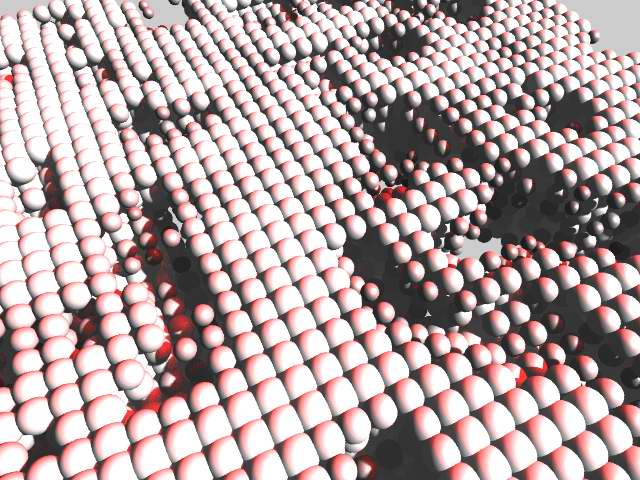
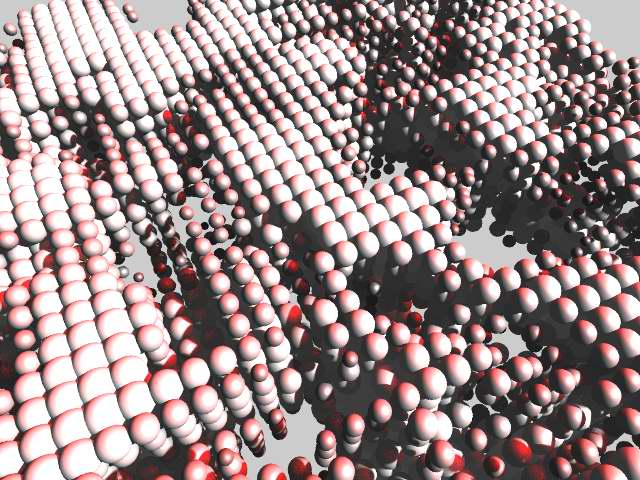
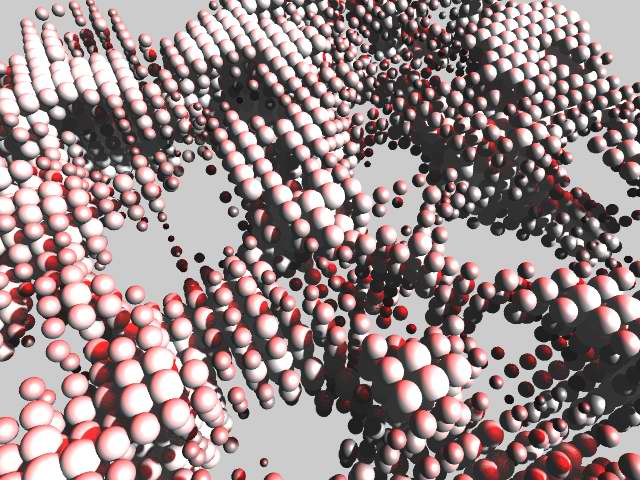
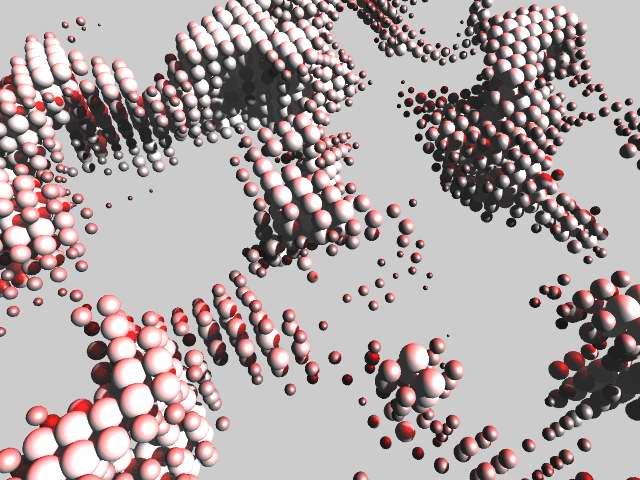
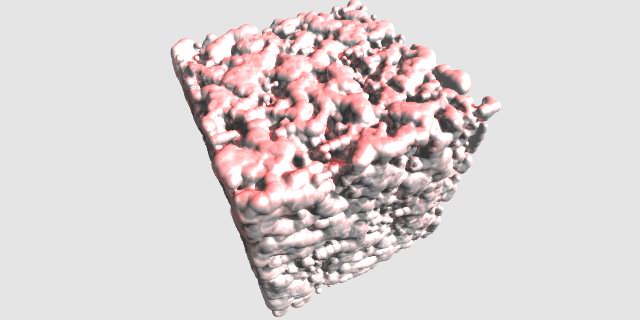
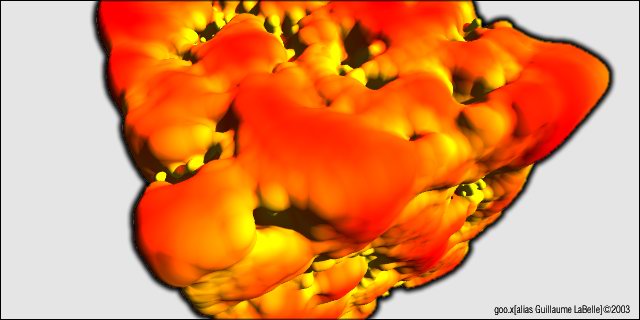
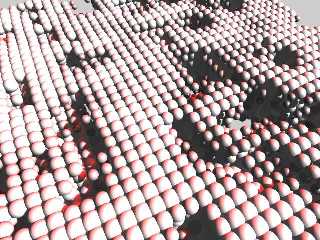
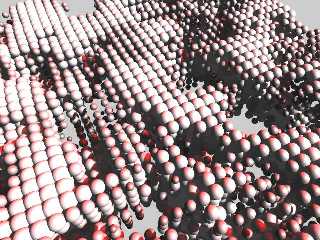
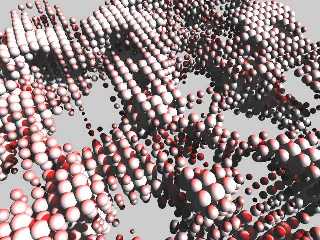
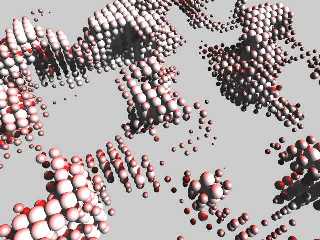
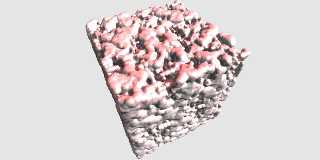
Here's a some experiment with the Cellular Automata. I made a 3D grid
instead of usually a 2D grid. The rules are more complex when It is in
Multidimentional Environnement. If you have links to some works on 3D
cellular Automatas rules, your suggestions will be appreciated. I'm planning
adding memory to the cells and make simulations more like ants models.

Thanks to ABX and Tim Nikias v2.0

--------------( oo )--------------
guillaumeLaBelle [alias goo©]
Architecture CAAO
http://ps.dgtic.umontreal.ca:2050/data/p0034/site
Post a reply to this message
Attachments:
Download 'GooPov15h-Sphere007.jpg' (72 KB)
Download 'GooPov15h-Sphere008.jpg' (73 KB)
Download 'GooPov15h-Sphere009.jpg' (74 KB)
Download 'GooPov15h-Sphere010.jpg' (57 KB)
Preview of image 'GooPov15h-Sphere007.jpg'
Preview of image 'GooPov15h-Sphere008.jpg'
Preview of image 'GooPov15h-Sphere009.jpg'
Preview of image 'GooPov15h-Sphere010.jpg'
|
|
| |
| |
|
|
|
|
| |
| |
|
|
These images do look interesting, but an animation
might show better what's happening. Of course
you'd have to introduce interpolation then, like
while tracing 10 frames, only one step of the
system's laws are applied, and dying spheres shrink
till they vanish, etc.
This way, you could maybe even spread the calculation
of new steps across several frames... But that might
be too complicated. After all, such an algorithm would
only make sense if you're after animations, and what
smooth moving from one state to the next...
Anyways, how much did I add? Its nice being thanked
for, but I'm not sure what you actually did with these
macros of mine. I'm just curious...
And what about the parsing times? Must be pretty
high, right? My current project, water-surfaces, is
already pretty slow, and that's only 2D-Arrays...
--
Tim Nikias v2.0
Homepage: http://www.digitaltwilight.de/no_lights
Email: Tim### [at] gmx de
>
> --------------( oo )--------------
>
> Here's a some experiment with the Cellular Automata. I made a 3D grid
> instead of usually a 2D grid. The rules are more complex when It is in
> Multidimentional Environnement. If you have links to some works on 3D
> cellular Automatas rules, your suggestions will be appreciated. I'm
planning
> adding memory to the cells and make simulations more like ants models.
>
> Thanks to ABX and Tim Nikias v2.0
>
> --------------( oo )--------------
> guillaumeLaBelle [alias goo©]
> Architecture CAAO
> http://ps.dgtic.umontreal.ca:2050/data/p0034/site
>
>
>
>
> de
>
> --------------( oo )--------------
>
> Here's a some experiment with the Cellular Automata. I made a 3D grid
> instead of usually a 2D grid. The rules are more complex when It is in
> Multidimentional Environnement. If you have links to some works on 3D
> cellular Automatas rules, your suggestions will be appreciated. I'm
planning
> adding memory to the cells and make simulations more like ants models.
>
> Thanks to ABX and Tim Nikias v2.0
>
> --------------( oo )--------------
> guillaumeLaBelle [alias goo©]
> Architecture CAAO
> http://ps.dgtic.umontreal.ca:2050/data/p0034/site
>
>
>
>
>
Post a reply to this message
|
|
| |
| |
|
|
|
|
| |
| |
|
|
--------------( oo )--------------

I made some of .AVI with DivX, but I do not have server to publish them.
Over a long period, it is really coherent. I'll publish a small version soon
on the bin.animations.

To render thoses images, It tooks 6min per images for a 80x80x80 matrix,
wich is quite ok. I'm working with someone on that project and we use an
expirimental Solid modeler in Scheme and it is really rapid. It is in real
time with 20x20x20 (with shadows). I don't know why it tooks so much time to
parse with povray.

I was planning to play with the levels of sampling the Neiberhood. But, for
each cells it get 3 times exponentinal. This is prohibitive.

I'm still working on that. I'm planning publishing something when it will be
readable and more genereal.

--------------( oo )--------------
guillaumeLaBelle [alias goo©] -
Architecture CAAO

"Tim Nikias v2.0" <tim### [at] gmxde> wrote in message
news:3e8220c1@news.povray.org...
> These images do look interesting, but an animation
> might show better what's happening. Of course
> you'd have to introduce interpolation then, like
> while tracing 10 frames, only one step of the
> system's laws are applied, and dying spheres shrink
> till they vanish, etc.
> This way, you could maybe even spread the calculation
> of new steps across several frames... But that might
> be too complicated. After all, such an algorithm would
> only make sense if you're after animations, and what
> smooth moving from one state to the next...
>
> Anyways, how much did I add? Its nice being thanked
> for, but I'm not sure what you actually did with these
> macros of mine. I'm just curious...
>
> And what about the parsing times? Must be pretty
> high, right? My current project, water-surfaces, is
> already pretty slow, and that's only 2D-Arrays...
>
> --
> Tim Nikias v2.0
> Homepage: http://www.digitaltwilight.de/no_lights
> Email: Tim### [at] gmxde
>
> >
> > --------------( oo )--------------
> >
> > Here's a some experiment with the Cellular Automata. I made a 3D grid
> > instead of usually a 2D grid. The rules are more complex when It is in
> > Multidimentional Environnement. If you have links to some works on 3D
> > cellular Automatas rules, your suggestions will be appreciated. I'm
> planning
> > adding memory to the cells and make simulations more like ants models.
> >
> > Thanks to ABX and Tim Nikias v2.0
> >
> > --------------( oo )--------------
> > guillaumeLaBelle [alias goo©]
> > Architecture CAAO
> > http://ps.dgtic.umontreal.ca:2050/data/p0034/site
> >
> >
> >
> >
> >
>
>
Post a reply to this message
|
|
| |
| |
|
|
|
|
| |
| |
|
|
Very cool, but could really use some radiosity...

"-g00t©-" <Ano### [at] Hotmailcom> wrote in message
news:3e821111@news.povray.org...
>
> --------------( oo )--------------
>
> Here's a some experiment with the Cellular Automata. I made a 3D grid
> instead of usually a 2D grid. The rules are more complex when It is in
> Multidimentional Environnement. If you have links to some works on 3D
> cellular Automatas rules, your suggestions will be appreciated. I'm
planning
> adding memory to the cells and make simulations more like ants models.
>
> Thanks to ABX and Tim Nikias v2.0
>
> --------------( oo )--------------
> guillaumeLaBelle [alias goo©]
> Architecture CAAO
> http://ps.dgtic.umontreal.ca:2050/data/p0034/site
>
>
>
>
>
Post a reply to this message
|
|
| |
| |
|
|
|
|
| |
| |
|
|
On Wed, 26 Mar 2003 15:44:02 -0500, -g00t©- wrote:

>
> --------------( oo )--------------
>
> Here's a some experiment with the Cellular Automata. I made a 3D grid
> instead of usually a 2D grid. The rules are more complex when It is in
> Multidimentional Environnement. If you have links to some works on 3D
> cellular Automatas rules, your suggestions will be appreciated. I'm planning
> adding memory to the cells and make simulations more like ants models.
>
> Thanks to ABX and Tim Nikias v2.0
>
> --------------( oo )--------------
> guillaumeLaBelle [alias goo©]
> Architecture CAAO
> http://ps.dgtic.umontreal.ca:2050/data/p0034/site

That's really awesome! An idea would be to use blob components for each of
the cells. :-)

--
light_source#macro G(E)sphere{z+E*y*5e-3.04rotate-z*E*6pigment{rgbt#end{
20*y-10#local n=162;1}#while(n)#local n=n-.3;G(n)x}}G(-n).7}}#end//GregE
Post a reply to this message
|
|
| |
| |
|
|
|
|
| |
| |
|
|
hey folks

i did something similar a while ago when i was preparing a presentation
about cellular automatas for school.

i'll post the animation to p.b.a.

those automatas are really interesting. i even found a whole turing machine
built only with these rules. there is a own science just about rule sets and
stuff...

greetings:florian
Post a reply to this message
|
|
| |
| |
|
|
|
|
| |
| |
|
|
--------------( oo )--------------

The turing test in this case is a great question. Does it look intelligent?

--------------( oo )--------------
guillaumeLaBelle [alias goo©] -
Architecture CAAO Website[UDM

"-g00t©-" <Ano### [at] Hotmailcom> wrote in message
news:3e821111@news.povray.org...
>
> --------------( oo )--------------
>
> Here's a some experiment with the Cellular Automata. I made a 3D grid
> instead of usually a 2D grid. The rules are more complex when It is in
> Multidimentional Environnement. If you have links to some works on 3D
> cellular Automatas rules, your suggestions will be appreciated. I'm
planning
> adding memory to the cells and make simulations more like ants models.
>
> Thanks to ABX and Tim Nikias v2.0
>
> --------------( oo )--------------
> guillaumeLaBelle [alias goo©]
> Architecture CAAO
> http://ps.dgtic.umontreal.ca:2050/data/p0034/site
>
>
>
>
>
Post a reply to this message
Attachments:
Download 'GooPov18b-BLOB000.jpg' (29 KB)
Preview of image 'GooPov18b-BLOB000.jpg'
|
|
| |
| |
|
|
|
|
| |
| |
|
|
"-g00t©-" wrote:

> If you have links to some works on 3D  cellular Automatas rules, your suggestions
> will be appreciated.

http://www.innerx.net/personal/tsmith/ficw.html

--
Ken Tyler
Post a reply to this message
|
|
| |
| |
|
|
|
|
| |
| |
|
|
On Sat, 29 Mar 2003 17:47:42 -0800, Ken wrote:

>
>
> "-g00t©-" wrote:
>
>> If you have links to some works on 3D  cellular Automatas rules, your suggestions
>> will be appreciated.
>
> http://www.innerx.net/personal/tsmith/ficw.html

Brain... going... to... ... EXPLODE!!!

--
light_source#macro G(E)sphere{z+E*y*5e-3.04rotate-z*E*6pigment{rgbt#end{
20*y-10#local n=162;1}#while(n)#local n=n-.3;G(n)x}}G(-n).7}}#end//GregE
Post a reply to this message
|
|
| |
| |
|
|
|
|
| |
| |
|
|
--------------( oo )--------------

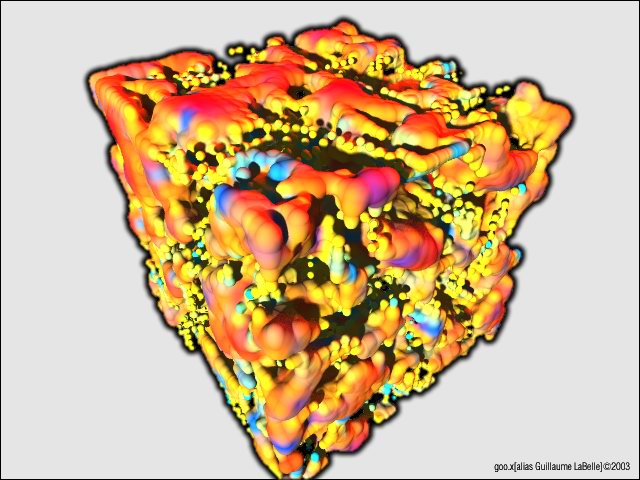
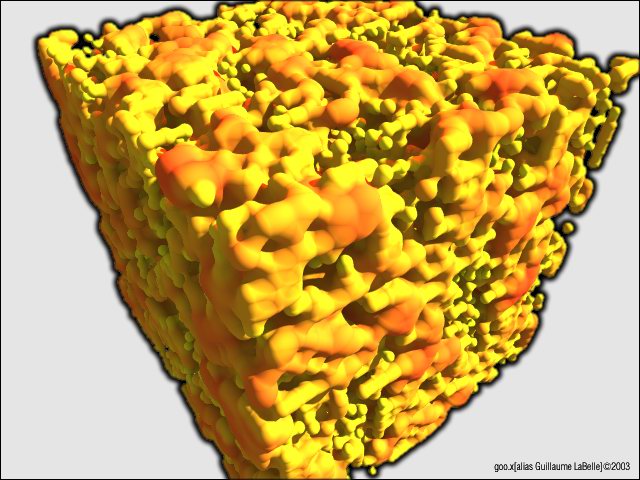
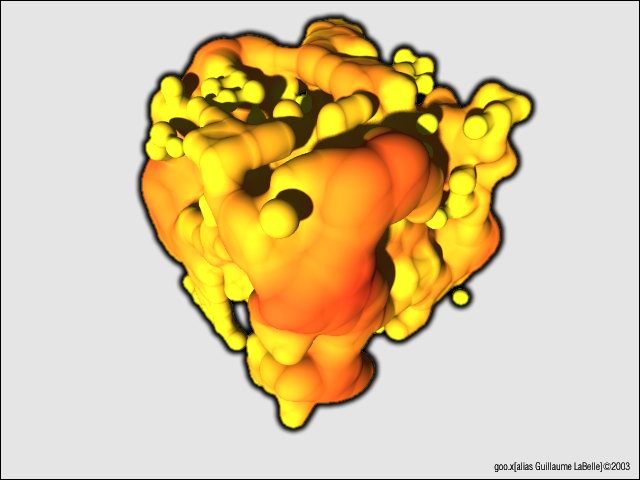
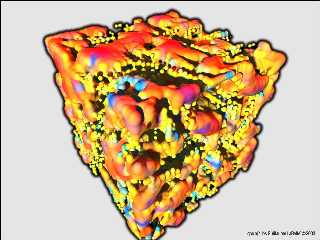
Here's new Simulations. Yellow cells are alone and red cells are the core. I
have made .AVI, I'll post that soon. Old cells going Blue, New cells from
white and Dying cells turning black.

povray.binaries.animations


--------------( oo )--------------
guillaumeLaBelle [alias goo©] -
Architecture CAAO

>
> --------------( oo )--------------
>
> Here's a some experiment with the Cellular Automata. I made a 3D grid
> instead of usually a 2D grid. The rules are more complex when It is in
> Multidimentional Environnement. If you have links to some works on 3D
> cellular Automatas rules, your suggestions will be appreciated. I'm
planning
> adding memory to the cells and make simulations more like ants models.
>
> Thanks to ABX and Tim Nikias v2.0
>
> --------------( oo )--------------
> guillaumeLaBelle [alias goo©]
> Architecture CAAO
> http://ps.dgtic.umontreal.ca:2050/data/p0034/site
>
>
>
>
>
Post a reply to this message
Attachments:
Download 'GooPov21b-SIMULATION-30x048.jpg' (69 KB)
Preview of image 'GooPov21b-SIMULATION-30x048.jpg'
|
|
| |
| |
|
|
|
|
| |
| |
|
|
--------------( oo )--------------

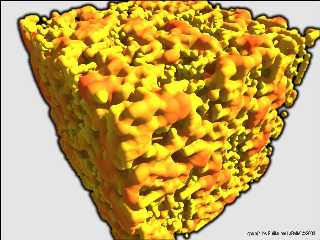
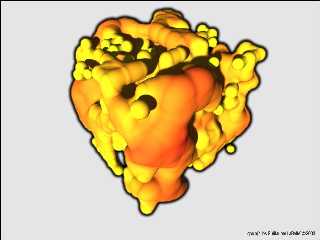
Here's new Simulations. Yellow cells are alone and red cells are the core. I
have made .AVI, I'll post that soon.

povray.binaries.animations


--------------( oo )--------------
guillaumeLaBelle [alias goo©] -
Architecture CAAO

>
> --------------( oo )--------------
>
> Here's a some experiment with the Cellular Automata. I made a 3D grid
> instead of usually a 2D grid. The rules are more complex when It is in
> Multidimentional Environnement. If you have links to some works on 3D
> cellular Automatas rules, your suggestions will be appreciated. I'm
planning
> adding memory to the cells and make simulations more like ants models.
>
> Thanks to ABX and Tim Nikias v2.0
>
> --------------( oo )--------------
> guillaumeLaBelle [alias goo©]
> Architecture CAAO
> http://ps.dgtic.umontreal.ca:2050/data/p0034/site
>
>
>
>
>
Post a reply to this message
Attachments:
Download 'GooPov20b-RadiosityB.jpg' (75 KB)
Preview of image 'GooPov20b-RadiosityB.jpg'
|
|
| |
| |
|
|
|
|
| |
| |
|
|
--------------( oo )--------------

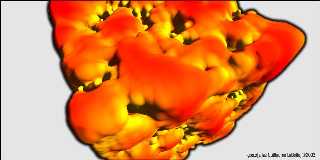
Here's new Simulations. Yellow cells are alone and red cells are the core. I
have made .AVI, I'll post that soon.

povray.binaries.animations


--------------( oo )--------------
guillaumeLaBelle [alias goo©] -
Architecture CAAO

>
> --------------( oo )--------------
>
> Here's a some experiment with the Cellular Automata. I made a 3D grid
> instead of usually a 2D grid. The rules are more complex when It is in
> Multidimentional Environnement. If you have links to some works on 3D
> cellular Automatas rules, your suggestions will be appreciated. I'm
planning
> adding memory to the cells and make simulations more like ants models.
>
> Thanks to ABX and Tim Nikias v2.0
>
> --------------( oo )--------------
> guillaumeLaBelle [alias goo©]
> Architecture CAAO
> http://ps.dgtic.umontreal.ca:2050/data/p0034/site
>
>
>
>
>
Post a reply to this message
Attachments:
Download 'GooPov21b-SIMULATION-10xRADB.jpg' (38 KB)
Download 'GooPov18c-BLOB001B.jpg' (33 KB)
Preview of image 'GooPov21b-SIMULATION-10xRADB.jpg'
Preview of image 'GooPov18c-BLOB001B.jpg'
|
|
| |
| |
|
|
From: Johan De Messemaeker
Subject: Re: --( v2)--( Cellular Automata )--(2/4)--
Date: 1 Apr 2003 06:51:24
Message: <3e897d3c@news.povray.org>
|
|
|
| |
| |
|
|
-g00t©- wrote:

> Here's new Simulations. Yellow cells are alone and red cells are the core.
> I have made .AVI, I'll post that soon.

These are great !!!! Since i'm a beginner at Povay, i really don't have a
clue how you created these images. Could you elaborate a bit ? :-)
Post a reply to this message
|
|
| |
| |
|
|
|
|
| |
| |
|
|
--------------( oo )--------------
Here's An example of the arrays.
--------------( oo )--------------
guillaumeLaBelle [alias goo©] -
Architecture CAAO

"Johan De Messemaeker" <joh### [at] advalvasbe> wrote in message
news:3e897d3c@news.povray.org...
> -g00t©- wrote:
>
> > Here's new Simulations. Yellow cells are alone and red cells are the
core.
> > I have made .AVI, I'll post that soon.
>
> These are great !!!! Since i'm a beginner at Povay, i really don't have a
> clue how you created these images. Could you elaborate a bit ? :-)
Post a reply to this message
Attachments:
Download 'GooPov21b-SIMULATION-20xBlack.zip' (12 KB)
|
|
| |
| |
|
|
|
|
| |
| |
|
|
--------------( oo )--------------

For the Cellular Automata, go see the software Cellular Automata Viewer 2.0.
You could play rules in 2D. I used the same system of rules, exept that I
used a 3D grid. For the rules, that's completly different. For the grid, I
guess this is the same system.

For the Grid, I create three Sub loops to obtain the definition of each rows
and cols. I used Arrays. I obtain a 3D array. For each cells, I make a test
to see the cells around in the proximity of one cell. I constitute a new sub
array of the neiberhood (the function is generalized to be able to make
simulations using more than the first level of proximity.) When a cell
detect more than 9 neiber, a new cell is born.

--------------( oo )--------------

You could have a look at;

--( IDENTIFIER - RValue )-- in povray.advanced-users

--------------( oo )--------------

#declare gMaNZ = 30;  //Nomabre d'étages [Zow]
#declare gMaNH = 30;  //Nombres de Rangées [Row]
#declare gMaNC = 30;  //Nombres de colones [Col]

blob {  threshold 0.6

        #declare Zow = 0;
        #while (Zow < gMaNZ)

                #declare Row = 0;
                #while (Row < gMaNH)

                        #declare Col = 0;
                        #while (Col < gMaNC)

////////////////////////////////////////////////////////////

                                #if (gMa[Zow][Row][Col] != 0)
                                        sphere { <(Row-(gMaNH/2)),
(Zow-(gMaNZ/2)),(Col-(gMaNC/2))>,
                                                (ray/26 )/0.5
                                                , 1 pigment { color rgb
gColor}} #end


///////////////////////////////////////////////////////////
                          #declare Col = Col+1;
                        #end

                  #declare Row = Row+1;
                #end

          #declare Zow = Zow+1;
        #end
}

    #debug "--------------------------------------------------(ok)\n"


--------------( oo )--------------
guillaumeLaBelle [alias goo©] -
Architecture CAAO

"Johan De Messemaeker" <joh### [at] advalvasbe> wrote in message
news:3e897d3c@news.povray.org...
> -g00t©- wrote:
>
> > Here's new Simulations. Yellow cells are alone and red cells are the
core.
> > I have made .AVI, I'll post that soon.
>
> These are great !!!! Since i'm a beginner at Povay, i really don't have a
> clue how you created these images. Could you elaborate a bit ? :-)
Post a reply to this message
|
|
| |
| |
|
|
|
|
| |
| |
|
|
Say, which is your native language? I'm just curious,
because you sometimes lack an s where it would
be needed, and have s (which indicates a plural) in
other places.
I'm not a native english speaker either, but I'm
just wondering what your original language is.

And I don't wanna nitpick, just trying to help you with
your english:
its neighbour, neighbourhood.

--
Tim Nikias v2.0
Homepage: http://www.digitaltwilight.de/no_lights
Email: Tim### [at] gmxde

>
> --------------( oo )--------------
>
> For the Cellular Automata, go see the software Cellular Automata Viewer
2.0.
> You could play rules in 2D. I used the same system of rules, exept that I
> used a 3D grid. For the rules, that's completly different. For the grid, I
> guess this is the same system.
>
> For the Grid, I create three Sub loops to obtain the definition of each
rows
> and cols. I used Arrays. I obtain a 3D array. For each cells, I make a
test
> to see the cells around in the proximity of one cell. I constitute a new
sub
> array of the neiberhood (the function is generalized to be able to make
> simulations using more than the first level of proximity.) When a cell
> detect more than 9 neiber, a new cell is born.
>
> --------------( oo )--------------
>
> You could have a look at;
>
> --( IDENTIFIER - RValue )-- in povray.advanced-users
>
> --------------( oo )--------------
>
> #declare gMaNZ = 30;  //Nomabre d'étages [Zow]
> #declare gMaNH = 30;  //Nombres de Rangées [Row]
> #declare gMaNC = 30;  //Nombres de colones [Col]
>
> blob {  threshold 0.6
>
>         #declare Zow = 0;
>         #while (Zow < gMaNZ)
>
>                 #declare Row = 0;
>                 #while (Row < gMaNH)
>
>                         #declare Col = 0;
>                         #while (Col < gMaNC)
>
> ////////////////////////////////////////////////////////////
>
>                                 #if (gMa[Zow][Row][Col] != 0)
>                                         sphere { <(Row-(gMaNH/2)),
> (Zow-(gMaNZ/2)),(Col-(gMaNC/2))>,
>                                                 (ray/26 )/0.5
>                                                 , 1 pigment { color rgb
> gColor}} #end
>
>
> ///////////////////////////////////////////////////////////
>                           #declare Col = Col+1;
>                         #end
>
>                   #declare Row = Row+1;
>                 #end
>
>           #declare Zow = Zow+1;
>         #end
> }
>
>     #debug "--------------------------------------------------(ok)\n"
>
>
> --------------( oo )--------------
> guillaumeLaBelle [alias goo©] -
> Architecture CAAO
>
> "Johan De Messemaeker" <joh### [at] advalvasbe> wrote in message
> news:3e897d3c@news.povray.org...
> > -g00t©- wrote:
> >
> > > Here's new Simulations. Yellow cells are alone and red cells are the
> core.
> > > I have made .AVI, I'll post that soon.
> >
> > These are great !!!! Since i'm a beginner at Povay, i really don't have
a
> > clue how you created these images. Could you elaborate a bit ? :-)
>
>
>
Post a reply to this message
|
|
| |
| |
|
|
|
|
| |
| |
|
|
--------------( oo )--------------
Enigma  Eins; Wie kann ich dieser landen finden? Antwort eins; Vieleicht mit
mein name? LaBelle? Antwort Zwei; Französisher sind nicht gut mit English,
entshuldigung sie. Antwort drei; UDM=Universität von Montréal.
Franco-Kanadisher auch... Lustig, neh?

Thanks for your precisions on my English.
--------------( oo )--------------
guillaumeLaBelle [alias goo©] -
Architecture CAAO Website[UDM

"Tim Nikias v2.0" <tim### [at] gmxde> wrote in message
news:3e89a8a3@news.povray.org...
> Say, which is your native language? I'm just curious,
> because you sometimes lack an s where it would
> be needed, and have s (which indicates a plural) in
> other places.
> I'm not a native english speaker either, but I'm
> just wondering what your original language is.
>
> And I don't wanna nitpick, just trying to help you with
> your english:
> its neighbour, neighbourhood.
>
> --
> Tim Nikias v2.0
> Homepage: http://www.digitaltwilight.de/no_lights
> Email: Tim### [at] gmxde
>
> >
> > --------------( oo )--------------
> >
> > For the Cellular Automata, go see the software Cellular Automata Viewer
> 2.0.
> > You could play rules in 2D. I used the same system of rules, exept that
I
> > used a 3D grid. For the rules, that's completly different. For the grid,
I
> > guess this is the same system.
> >
> > For the Grid, I create three Sub loops to obtain the definition of each
> rows
> > and cols. I used Arrays. I obtain a 3D array. For each cells, I make a
> test
> > to see the cells around in the proximity of one cell. I constitute a new
> sub
> > array of the neiberhood (the function is generalized to be able to make
> > simulations using more than the first level of proximity.) When a cell
> > detect more than 9 neiber, a new cell is born.
> >
> > --------------( oo )--------------
> >
> > You could have a look at;
> >
> > --( IDENTIFIER - RValue )-- in povray.advanced-users
> >
> > --------------( oo )--------------
> >
> > #declare gMaNZ = 30;  //Nomabre d'étages [Zow]
> > #declare gMaNH = 30;  //Nombres de Rangées [Row]
> > #declare gMaNC = 30;  //Nombres de colones [Col]
> >
> > blob {  threshold 0.6
> >
> >         #declare Zow = 0;
> >         #while (Zow < gMaNZ)
> >
> >                 #declare Row = 0;
> >                 #while (Row < gMaNH)
> >
> >                         #declare Col = 0;
> >                         #while (Col < gMaNC)
> >
> > ////////////////////////////////////////////////////////////
> >
> >                                 #if (gMa[Zow][Row][Col] != 0)
> >                                         sphere { <(Row-(gMaNH/2)),
> > (Zow-(gMaNZ/2)),(Col-(gMaNC/2))>,
> >                                                 (ray/26 )/0.5
> >                                                 , 1 pigment { color rgb
> > gColor}} #end
> >
> >
> > ///////////////////////////////////////////////////////////
> >                           #declare Col = Col+1;
> >                         #end
> >
> >                   #declare Row = Row+1;
> >                 #end
> >
> >           #declare Zow = Zow+1;
> >         #end
> > }
> >
> >     #debug "--------------------------------------------------(ok)\n"
> >
> >
> > --------------( oo )--------------
> > guillaumeLaBelle [alias goo©] -
> > Architecture CAAO
> >
> > "Johan De Messemaeker" <joh### [at] advalvasbe> wrote in
message
> > news:3e897d3c@news.povray.org...
> > > -g00t©- wrote:
> > >
> > > > Here's new Simulations. Yellow cells are alone and red cells are the
> > core.
> > > > I have made .AVI, I'll post that soon.
> > >
> > > These are great !!!! Since i'm a beginner at Povay, i really don't
have
> a
> > > clue how you created these images. Could you elaborate a bit ? :-)
> >
> >
> >
>
>
Post a reply to this message
|
|
| |
| |
|
|
|
|
| |