|
|
|
|
|
|
| |
| |
|
|
|
|
| |
| |
|
|
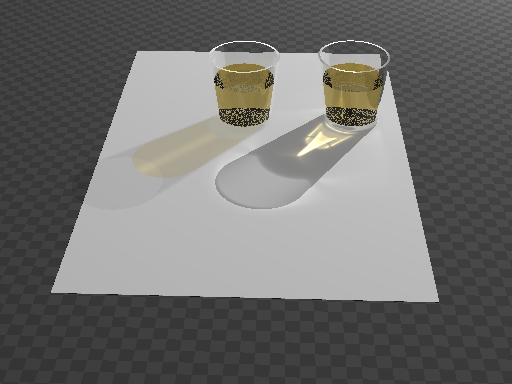
I do like a wee dram but I noticed that when I turned on photons the
whisky colour of the shadow went. I have posted an almost minimal
scene below in p.g. It was modelled in Moray for those of you that
don't recognise the coordinate system.
The leftmost glass has photons {pass_through} to simulate not using
photons.
Any help appreciated.


Regards
        Stephen
Post a reply to this message
Attachments:
Download 'a02a_1xb2.png' (54 KB)
Preview of image 'a02a_1xb2.png'
|
|
| |
| |
|
|
From: Slime
Subject: Re: Loss of colour in shadow when using photons. - a02a_1xb2.png
Date: 12 Nov 2004 14:39:34
Message: <41951176$1@news.povray.org>
|
|
|
| |
| |
|
|
> I do like a wee dram but I noticed that when I turned on photons the
> whisky colour of the shadow went.

This is physically correct. Any light passing through the glass becomes a
photon. Notice that the photon-covered areas *are* colored, since that light
is filtered by the color of the drink. The rest of the shadow is uncolored
because none of the light hitting that area has passed through the glass.

In fact, the only reason the unlit area of the shadow isn't completely black
is probably because of "ambient" light, which has a constant value
everywhere (unless you use radiosity).

 - Slime
 [ http://www.slimeland.com/ ]
Post a reply to this message
|
|
| |
| |
|
|
|
|
| |
| |
|
|
On Fri, 12 Nov 2004 14:39:32 -0500, "Slime" <fak### [at] email address>
wrote:
>
>In fact, the only reason the unlit area of the shadow isn't completely black
>is probably because of "ambient" light, which has a constant value
>everywhere (unless you use radiosity).
Blow me down! You're right. What sort of photon settings would I have
to use to get a coloured shadow? I think as many as there are in RL,
gulp! The photons are there to get the caustics from the cut glass
(missed out in this rendering) I suppose I can live with it. Thanks a
lot.
Regards
Stephen address>
wrote:
>
>In fact, the only reason the unlit area of the shadow isn't completely black
>is probably because of "ambient" light, which has a constant value
>everywhere (unless you use radiosity).
Blow me down! You're right. What sort of photon settings would I have
to use to get a coloured shadow? I think as many as there are in RL,
gulp! The photons are there to get the caustics from the cut glass
(missed out in this rendering) I suppose I can live with it. Thanks a
lot.
Regards
Stephen
Post a reply to this message
|
|
| |
| |
|
|
From: Slime
Subject: Re: Loss of colour in shadow when using photons. - a02a_1xb2.png
Date: 12 Nov 2004 15:24:07
Message: <41951be7$1@news.povray.org>
|
|
|
| |
| |
|
|
> Blow me down! You're right. What sort of photon settings would I have
> to use to get a coloured shadow? I think as many as there are in RL,
> gulp!

It looks to me like you have as many photons as you need; adding more
photons will only increase the resolution of the bright spots, it won't
brighten the dark areas at all.

If it looks different in real life, then maybe you have your ior set
incorrectly (too high?) or maybe it's due to scattering of the light within
the liquid, which could possibly be simulated by adding a small-scaled
normal to the liquid's surface.

 - Slime
 [ http://www.slimeland.com/ ]
Post a reply to this message
|
|
| |
| |
|
|
|
|
| |
| |
|
|
On Fri, 12 Nov 2004 15:23:55 -0500, "Slime" <fak### [at] emailaddress>
wrote:

>If it looks different in real life, then maybe you have your ior set
>incorrectly (too high?) or maybe it's due to scattering of the light within
>the liquid, which could possibly be simulated by adding a small-scaled
>normal to the liquid's surface.

Hmm, ior was set too low for both liquid and glass. The liquid is a
solid :-) so I'll try a ripple noise pattern wank up the photons for
caustics and let it run overnight.
The thing is I've drank all my whisky and I can't view it in RL.
Thanks for your help.


Regards
        Stephen
Post a reply to this message
|
|
| |
| |
|
|
|
|
| |
| |
|
|
mca### [at] aolcom news:8g9ap0p5b48db4qi39789e7h4dvfbr9sek@4ax.com

> Hmm, ior was set too low for both liquid and glass. The liquid is a
> solid :-) so I'll try a ripple noise pattern wank up the photons for
> caustics and let it run overnight.

Also YOu might
1) turn on radiosity
2) add scattering media to water and set media on in radiosity{}

--
http://www.raf256.com/3d/
Rafal Maj 'Raf256', home page - http://www.raf256.com/me/
Computer Graphics
Post a reply to this message
|
|
| |
| |
|
|
From: Andy Cocker
Subject: Re: Loss of colour in shadow when using photons. - a02a_1xb2.png
Date: 12 Nov 2004 16:21:04
Message: <41952940@news.povray.org>
|
|
|
| |
| |
|
|
"Stephen McAvoy" <mca### [at] aolcom> wrote in message
news:8g9ap0p5b48db4qi39789e7h4dvfbr9sek@4ax.com...
> On Fri, 12 Nov 2004 15:23:55 -0500, "Slime" <fak### [at] emailaddress>
> wrote:

>....wank up the photons ....

<snigger>

Andy Cocker
Post a reply to this message
|
|
| |
| |
|
|
From: Ross
Subject: Re: Loss of colour in shadow when using photons. - a02a_1xb2.png
Date: 12 Nov 2004 16:40:46
Message: <41952dde$1@news.povray.org>
|
|
|
| |
| |
|
|
"Rafal 'Raf256' Maj" <spa### [at] raf256com> wrote in message
news:Xns959FE37EC56A3raf256com@203.29.75.35...
> mca### [at] aolcom news:8g9ap0p5b48db4qi39789e7h4dvfbr9sek@4ax.com
>
> > Hmm, ior was set too low for both liquid and glass. The liquid is a
> > solid :-) so I'll try a ripple noise pattern wank up the photons for
> > caustics and let it run overnight.
>
> Also YOu might
> 1) turn on radiosity
> 2) add scattering media to water and set media on in radiosity{}
>
> --

3) buy more whiskey.
Post a reply to this message
|
|
| |
| |
|
|
From: Nathan Kopp
Subject: Re: Loss of colour in shadow when using photons. - a02a_1xb2.png
Date: 12 Nov 2004 23:36:28
Message: <41958f4c$1@news.povray.org>
|
|
|
| |
| |
|
|
"Slime" <fak### [at] emailaddress> wrote...
> > I do like a wee dram but I noticed that when I turned on photons the
> > whisky colour of the shadow went.
>
> This is physically correct. Any light passing through the glass becomes a
> photon. Notice that the photon-covered areas *are* colored, since that
light
> is filtered by the color of the drink. The rest of the shadow is uncolored
> because none of the light hitting that area has passed through the glass.

Correct.  It is interesting how our perception of our world often differs
from reality.  When I started working on the photon code, I started looking
more closely at real items in the real world, and I noticed that many
shadows of clear objects (such as a glass of water) looked very different
than how I thought they "should" look.  The reality is that much of the
shadow area is almost completely black.  However, when we casually view
something like a glass of water, if we don't look carefully, our brains have
a tendency to fill in details that really aren't there.

-Nathan
Post a reply to this message
|
|
| |
| |
|
|
From: Andrew the Orchid
Subject: Re: Loss of colour in shadow when using photons. - a02a_1xb2.png
Date: 13 Nov 2004 04:15:25
Message: <4195d0ad@news.povray.org>
|
|
|
| |
| |
|
|
> Correct.  It is interesting how our perception of our world often differs
> from reality.  When I started working on the photon code, I started looking
> more closely at real items in the real world, and I noticed that many
> shadows of clear objects (such as a glass of water) looked very different
> than how I thought they "should" look.  The reality is that much of the
> shadow area is almost completely black.  However, when we casually view
> something like a glass of water, if we don't look carefully, our brains have
> a tendency to fill in details that really aren't there.

Ah yes - the mind does not always perceive what is before the eye...
(See any optical illusion for a simple proof of this concept.)

Personally, I would suggest that maybe the lightsource is in the wrong
place (and/or should be an area light - do photons respond to those?)

Andrew.
Post a reply to this message
|
|
| |
| |
|
|
|
|
| |
| |
|
|
On Fri, 12 Nov 2004 21:21:13 -0000, "Andy Cocker"
<mai### [at] andrewcockercouk> wrote:

>>....wank up the photons ....
>
><snigger>
>
>Andy Cocker

Freudian slip or just getting senile :-)
Of course I meant "crank up the photons"


Regards
        Stephen
Post a reply to this message
|
|
| |
| |
|
|
|
|
| |
| |
|
|
On Fri, 12 Nov 2004 16:40:40 -0500, "Ross" <rli### [at] everestkcnet>
wrote:

>3) buy more whiskey.

That was the correct solution. By doing that I could see that Slime is
right on both counts. The unlit shadow (?) should be uncoloured and if
I reduce the ior to 1 then all of the shadow is coloured.
I would have bet a mars bar that the shadow should have been coloured
with intense caustics.
I'll do a bit more experimenting and post later.


Regards
        Stephen
Post a reply to this message
|
|
| |
| |
|
|
From: Alain
Subject: Re: Loss of colour in shadow when using photons. - a02a_1xb2.png
Date: 14 Nov 2004 15:37:20
Message: <4197c200$1@news.povray.org>
|
|
|
| |
| |
|
|
Andrew the Orchid nous apporta ses lumieres ainsi en ce 2004-11-13
04:14... :

>> Correct.  It is interesting how our perception of our world often
>> differs
>> from reality.  When I started working on the photon code, I started
>> looking
>> more closely at real items in the real world, and I noticed that many
>> shadows of clear objects (such as a glass of water) looked very
>> different
>> than how I thought they "should" look.  The reality is that much of the
>> shadow area is almost completely black.  However, when we casually view
>> something like a glass of water, if we don't look carefully, our
>> brains have
>> a tendency to fill in details that really aren't there.
>
>
> Ah yes - the mind does not always perceive what is before the eye...
> (See any optical illusion for a simple proof of this concept.)
>
> Personally, I would suggest that maybe the lightsource is in the wrong
> place (and/or should be an area light - do photons respond to those?)
>
> Andrew.

You need to add "area_light on" in the light's photons block in addition
to the area_light in the light's deffinition. Otherwise, it will act as
a point light for the photons.

Alain
Post a reply to this message
|
|
| |
| |
|
|
|
|
| |
| |
|
|
On Sat, 13 Nov 2004 09:14:49 +0000, Andrew the Orchid <voi### [at] devnull>
wrote:

>Personally, I would suggest that maybe the lightsource is in the wrong
>place (and/or should be an area light - do photons respond to those?)

Whilst I now agree that the shadow should be black/grey I am still
trying to fake it, out of perversity. Where do you suggest that the
light source should be situated? Why use an area light?


Regards
        Stephen
Post a reply to this message
|
|
| |
| |
|
|
|
|
| |
| |
|
|
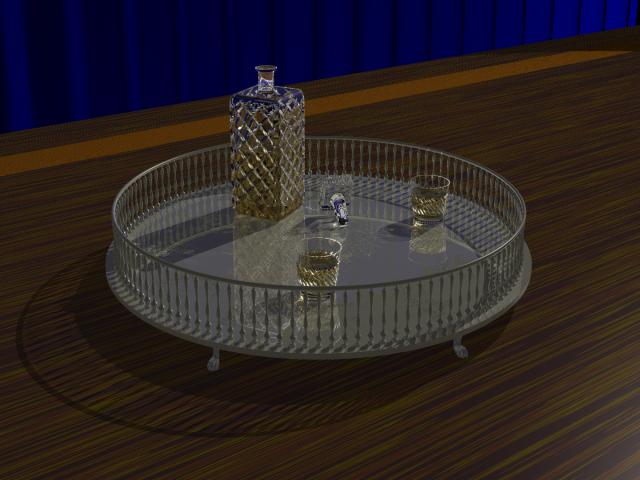
Thanks for all your help, so have a little drink on me.

Regards
        Stephen
Post a reply to this message
Attachments:
Download 'tray02j.jpg' (37 KB)
Preview of image 'tray02j.jpg'
|
|
| |
| |
|
|
|
|
| |