|
|
|
|
|
|
| |
| |
|
|
|
|
| |
| |
|
|
Hey folks!

It was about June last year that I discovered how Single Image Sterograms
work (aka "magic eye pictures"). Since then I've done no end of text-based
ones using Notepad. (I had no idea you could do it with plain text as well
as images! That's how I found out how they work by the way...) If you're one
of those people who can't see these images, you probably won't be very
excited by this thread!

I'll reply to my own post in a mo with some example images attached. The
images are fairly big (800x600), and unfortunately I can't use lossy
compression, because it messes up the 3D effect (which IS the entire point
of the post!)

Stand by...
Andrew.
Post a reply to this message
|
|
| |
| |
|
|
|
|
| |
| |
|
|
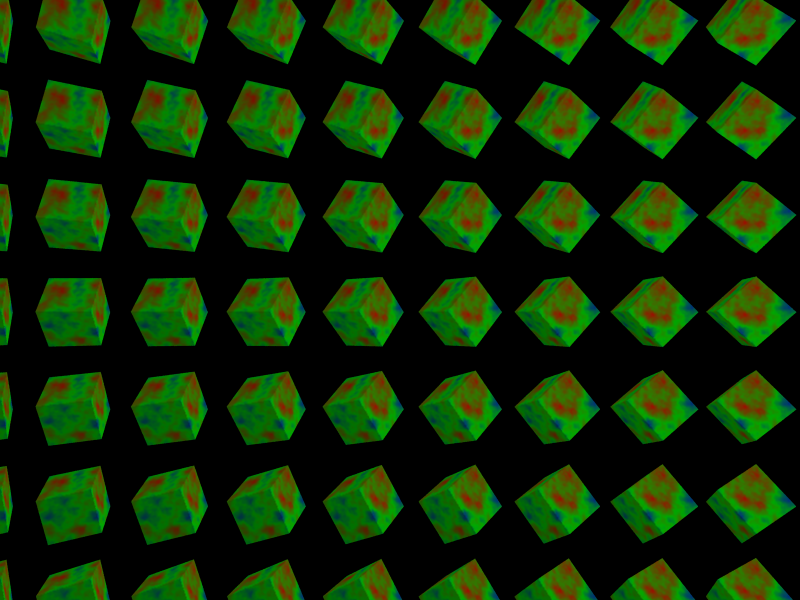
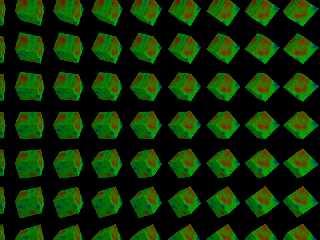
Here is the first example... The 3D effect is a little extreme.

Andrew.
Post a reply to this message
Attachments:
Download 'Cube1-Diffuse2.png' (321 KB)
Preview of image 'Cube1-Diffuse2.png'
|
|
| |
| |
|
|
|
|
| |
| |
|
|
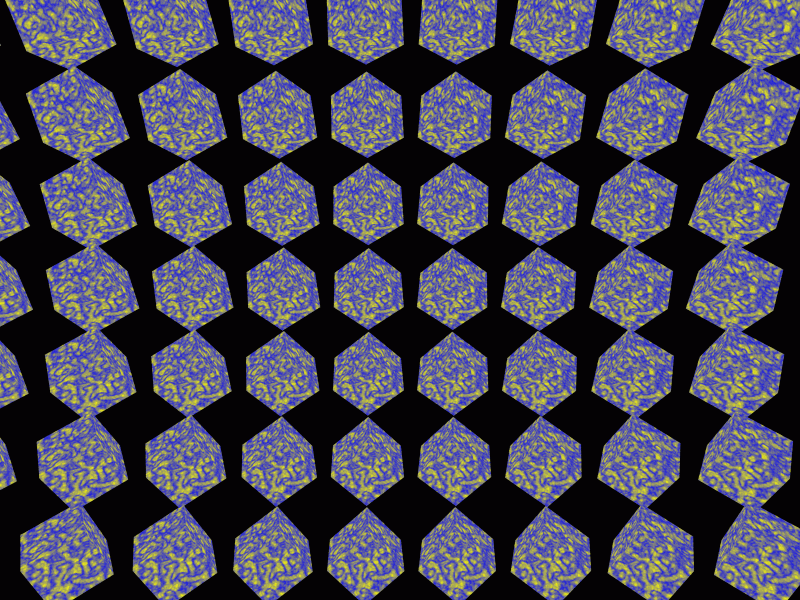
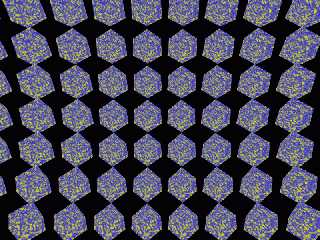
Here is the second one... The entire image has a very slight overall
curvature that I don't know how to get rid of. The 3D depth is less extreme
and more realistic that the other example.

Andrew.

PS. Forgot to say... I'm posting a thread in povray.advanced-users about
this...
Post a reply to this message
Attachments:
Download 'SIPS3-Real-Small.png' (210 KB)
Preview of image 'SIPS3-Real-Small.png'
|
|
| |
| |
|
|
|
|
| |
| |
|
|
I think you use the isomorphic camera for that.

Cheers!

Chip Shults
My robotics, space and CGI web page - http://home.cfl.rr.com/aichip
Post a reply to this message
|
|
| |
| |
|
|
|
|
| |
| |
|
|
move the camera ver far away and lower the angle. A smaller angle value
zooms the camera, so there will be less perspective.
Post a reply to this message
|
|
| |
| |
|
|
|
|
| |
| |
|
|
"Andrew Coppin" <orp### [at] btinternet com> wrote in message
news:3e16eb31@news.povray.org...
> Here is the first example... The 3D effect is a little extreme.
They're fun in crossed eye viewing too. com> wrote in message
news:3e16eb31@news.povray.org...
> Here is the first example... The 3D effect is a little extreme.
They're fun in crossed eye viewing too.
Post a reply to this message
|
|
| |
| |
|
|
|
|
| |
| |
|
|
"Andrew Coppin" <orp### [at] btinternetcom> wrote in message
news:3e16f133@news.povray.org...
> I've posted a couple of images - see povray.binaries.images.
>
> It was about June time last year that I discovered how Single Image
> Sterograms ("magic eye pictures") work. You can actually make 'em out of
> plain ordinary text! I've done so with Notepad many times...
> <snip>
 > The basic idea is to have similar-but-no-identical repartitions in the
> image. If you take a cube and duplicate it across the screen, then owing to
> the perspective effect, you see each cube from a slightly different angle.
> If you view the thing as a sterogram (i.e., look at it cross-eyed), you get
> a 3D effect.
>
> However...
>
> The 3D bit comes out backwards! (That is, the front-most part is at the
> back, with the back edges at the front. It looks really odd!)

Your are mixing up two different Stereograms systems.
1. "magic eye pictures"
    For this you must stare at the picture, that will say you look behind the
picture.
    If you wait, your eyes look at different pictures. Your right eye takes an
object
    to the right of that of your left eye. Your brain makes a 3D image off these
    slightly different pictures.
    Exaggerated this is what you do:

    Left                                 |                               Right
    Object                            |                               Object
                        Position       |            Position
                        Left eye       |            Right eye

    If the left and right object are placed in the same orientation (not rotated
to
    each other), then your left eye sees the right side of the object a bit and
your
    right eye sees the left side of the object a bit.
    This is just the wrong way around. Your right eye should see a bit of the
right
    side of the object and your left eye a bit from the left side.

2. Crossing eye method.
    By crossing your eyes you look before the picture and your left eye now
    looks at the right object and your right eye looks at the left object.
    Exaggerated this is what you do:
        Left                               |                                 Right
    Object                               |                                Object
                        Position          |         Position
                        Right eye        |         Left eye

    This is precisely what a 3D picture should be.
    Now you can understand that the "magic eye pictures" were flipped
    forward - backwards. Your eyes saw the wrong side of the object.
    By the way:
    The strain for your eyes is the wrong focusing and your brain must be
    learned to do this. My experience is that young people do have
    difficulties with the crossing eyes method. Older people strangely can
    learn it faster.

Tip: Put the identical objects at a considerable distance and use a camera
        with an angle of about 6 - 8 degrees, else the effect is exaggerated.

<snip>
>
> Thanks!
> Andrew.
>
> PS. Can anyone here see sterograms btw? Kinda pointless if you can't :P

I've made even videos for the crossing eye method and can now look at
them for hours without effort. Indoctrination of the brain works!!

Greetings,

Jaap Frank

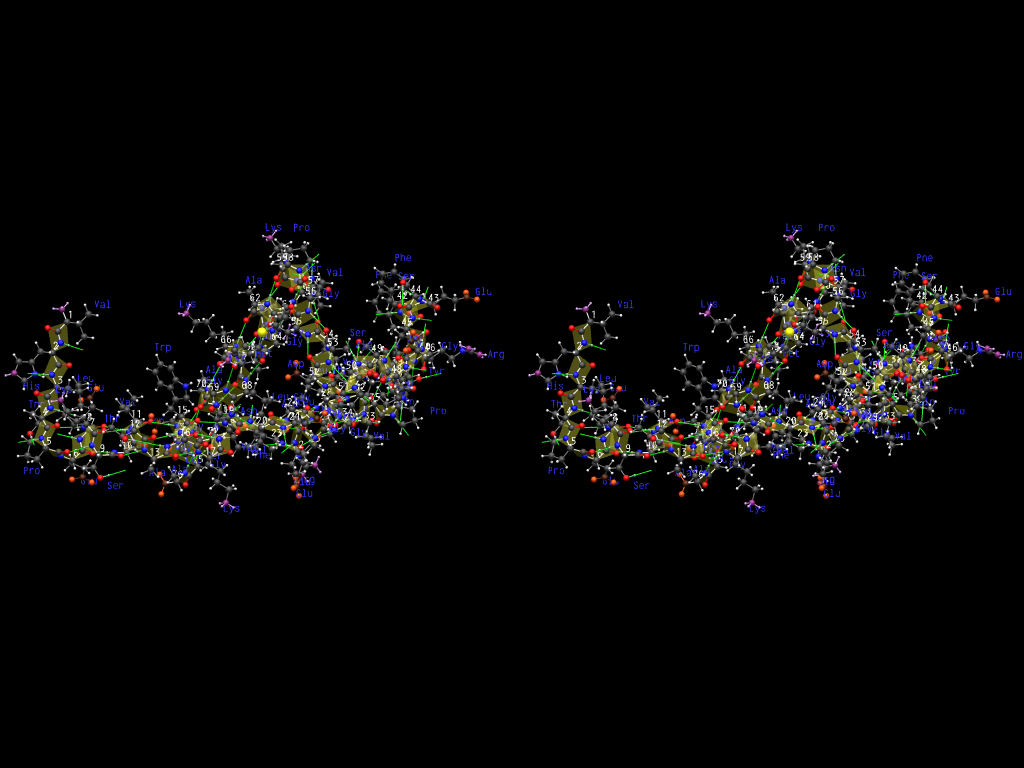
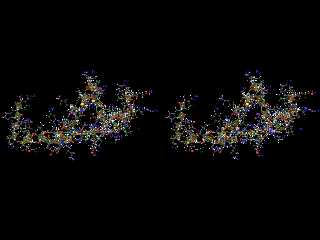
PS: I've attached an example. This is a part of a hemoglobine protein chain.
      Happy crossing your eyes.


--------------------------------------------------------------------------------
Post a reply to this message
Attachments:
Download 'Hemoglob1.png' (238 KB)
Preview of image 'Hemoglob1.png'
|
|
| |
| |
|
|
|
|
| |
| |
|
|
> Your are mixing up two different Stereograms systems.
> 1. "magic eye pictures"
>     For this you must stare at the picture, that will say you look behind
the
> picture.
>     If you wait, your eyes look at different pictures. Your right eye
takes an
> object
>     to the right of that of your left eye. Your brain makes a 3D image off
these
>     slightly different pictures.
>     Exaggerated this is what you do:
>
>     Left                                 |
Right
>     Object                            |
Object
>                         Position       |            Position
>                         Left eye       |            Right eye
>
>     If the left and right object are placed in the same orientation (not
rotated
> to
>     each other), then your left eye sees the right side of the object a
bit and
> your
>     right eye sees the left side of the object a bit.
>     This is just the wrong way around. Your right eye should see a bit of
the
> right
>     side of the object and your left eye a bit from the left side.
>
> 2. Crossing eye method.
>     By crossing your eyes you look before the picture and your left eye
now
>     looks at the right object and your right eye looks at the left object.
>     Exaggerated this is what you do:
>         Left                               |
Right
>     Object                               |
Object
>                         Position          |         Position
>                         Right eye        |         Left eye
>
>     This is precisely what a 3D picture should be.
>     Now you can understand that the "magic eye pictures" were flipped
>     forward - backwards. Your eyes saw the wrong side of the object.

I'm no expert by any means, but the "random dot sterograms" you see feature
repeating sections of random dots. If you cross your eyes so that the
repertitions line up on top of each other, your brain interprets the repeat
length as 3D depth. Amazingly, you can do this with text too:

00300000300000300000300000300000300000300000300000300
12345612345612345612345612345612345612345612345612345
12345612345612345612345612345612345612345612345612345
12345612346123461234561234512345123456123456123456123
12345612346123456134561234512345612456123456123456123
12345612346123461234561234512345123456123456123456123
12345612346123456123456123461234562345612345612345612
12345612346123456123456123461234561345612345612345612
12345612346123456123456123461234561345612345612345612
12345612345612345612345612345612345612345612345612345
12345612345612345612345612345612345612345612345612345
00300000300000300000300000300000300000300000300000300

Be careful not to "over converge", but you should be able to make out the
letters "PR". (It helps if you view it with a fixed-width font!) By skipping
or adding dots (or in this case digits) you can change the 3D depth. Anyway,
my images use normal effects of perspective to change the rate at which the
pattern repeats, that's all. (Getting a high-contrast random-ish texture
makes it work best.)

Of course, you can "cross" your eyes in two directions - you can make them
more parrallel then they should be by rotating them away from each other (as
if looking "behind" the image), or make them too diagonal by rotating them
towards each other (as if looking "in front of" the image). I myself am
quite good at doing the latter, but not so good at doing the former. If I
could do the former, the first uncorrected image I did would presumable look
correct.

> > PS. Can anyone here see sterograms btw? Kinda pointless if you can't :P
>
> I've made even videos for the crossing eye method and can now look at
> them for hours without effort. Indoctrination of the brain works!!

Mmm... I'm thinking animation 8-) Of course, question is, can you get your
eyes to converge right before the animation is over? lol

> Greetings,
>
> Jaap Frank
>
> PS: I've attached an example. This is a part of a hemoglobine protein
chain.
>       Happy crossing your eyes.

Oooo dear me... I have to shrink the image down several times before I can
cross my eyes far enough... hehehe

Thanks.
Andrew.
Post a reply to this message
|
|
| |
| |
|
|
|
|
| |
| |
|
|
Jaap Frank wrote:
> The strain for your eyes is the wrong focusing and
> your brain must be learned to do this.

Or rather, your brain must unlearn what it has learned about the
relation between the angles of the eyes, and the correct focusing.
Normally, there is a constant relation between these, where a certain
distance to an object (which means a certain angle between the eyes)
corresponds to a certain focus depth. This is very much a reflex we
have, and thus it is difficult to make our brain use a different focus
for a certain depth, than the brain is used to.

The danger of training the brain to be able to focus incorrectly is that
the natural reflex is weakened. With the ability to focus incorrectly,
as it is needed to see stereograms, also comes the ability to focus
incorrectly in general (or unfocusing, rather). Some years back I was
very much into stereograms and learned to focus incorrectly with ease,
but ever since, I have suffered from the unfortunate side-effect, that
when I have to concentrate on something, but am a bit tired, my eyes
every so often go out of focus involuntarily, and also don't focus at
the same point. Not a huge problem of course, but still pretty annoying.

Rune
--
3D images and anims, include files, tutorials and more:
rune|vision:  http://runevision.com (updated Oct 19)
POV-Ray Ring: http://webring.povray.co.uk
Post a reply to this message
|
|
| |
| |
|
|
|
|
| |
| |
|
|
Rune wrote:
> [...] but ever since, I have suffered from the unfortunate
> side-effect, that when I have to concentrate on something, but am a
> bit tired, my eyes every so often go out of focus involuntarily, and
> also don't focus at the same point. Not a huge problem of course, but
> still pretty annoying.

 :) I've suffered from this as old as I can remember... much before
seing my first stereogram. This must explain why I can see so easy any
stereogram (I can even browse a stereograms book without the needed to
refocus on each page!)

--
Jaime Vives Piqueres

La Persistencia de la Ignorancia
http://www.ignorancia.org
Post a reply to this message
|
|
| |
| |
|
|
|
|
| |
| |
|
|
hi Andrew, hi Jaap (this is your first name, i guess?)

Jaap Frank wrote:
> Your are mixing up two different Stereograms systems.
> 1. "magic eye pictures"
>     For this you must stare at the picture, that will say you look behind the
> picture.

[...]

> 2. Crossing eye method.
>     By crossing your eyes you look before the picture and your left eye now
>     looks at the right object and your right eye looks at the left object.

which is basically the same method to obtain the same effect,
the only difference is the "point of view" (POV.. duh ;), which
is either in front or behind the image. this difference in turn
results in the "image" (that you perceive) being flipped
back-to-front, for the reasons Jaap explained well already.

but there is another main difference you did not make clear:
there are (real) stereograms consisting of two separate images
to be viewed by either eye, and "Single Image [Random] Dot
Stereograms" (SI[R]DS), which, as the name implies, result
from a single picture - which contains information for both
of your eyes.

the pictures that Andrew posted, including the ascii example,
are SIDS, whereas Jaap posted a (double image) stereogram
combined in a single picture file..

i like your pictures very much, no matter if i have to cross
my eyes or look thru them ;) , and i was reminded of the many
experiments i have done. but i must admit that it did not occur
to me that i could also try this using povray..

i have written a SIRDS generator a long time ago (in AmigaBasic),
i think i don't have that .bas file anymore. but it is not very
hard to do. - if someone wants it, and if no "HOWTO" can be found
on google, i will be happy to re-write it in povray or so. ;)


> Tip: Put the identical objects at a considerable distance and use a camera
>         with an angle of about 6 - 8 degrees, else the effect is exaggerated.

so you approximate a parallel projection for either of the two
objects in order to avoid the "curvature" that andrew mentioned.
- did you try using orthographic projection instead?
i think that it would work very well. you just have to rotate
the two objects a little to get different angles for each eye;
then you can get both "crossing eye" and "magic eye" pictures,
as you call them, depending on which way you rotate them.


g.

--
mailto:gim### [at] psicoch
http://www.psico.ch/
http://psico.servehttp.com/
Post a reply to this message
|
|
| |
| |
|
|
|
|
| |
| |
|
|
"Jaap Frank" <jjf### [at] xs4allnl> wrote :
>
> I've attached an animation of an alpha helix of 20 amino acids.

    Nice, if you watch it diverged eyed, it turns one way, crossed, it turns
the other.
Post a reply to this message
|
|
| |
| |
|
|
|
|
| |
| |
|
|
"gimi" <gim### [at] psicoch> wrote in message news:3E1### [at] psicoch...

Hallo gimi,

> hi Andrew, hi Jaap (this is your first name, i guess?)

Yes, Jaap is my first name and Frank is my family name.
(Anne Frank is not family, there have been many Frank's
which were not related.)

> which is basically the same method to obtain the same effect,
> the only difference is the "point of view" (POV.. duh ;), which
> is either in front or behind the image. this difference in turn
> results in the "image" (that you perceive) being flipped
> back-to-front, for the reasons Jaap explained well already.
>
> but there is another main difference you did not make clear:
> there are (real) stereograms consisting of two separate images
> to be viewed by either eye, and "Single Image [Random] Dot
> Stereograms" (SI[R]DS), which, as the name implies, result
> from a single picture - which contains information for both
> of your eyes.

I think the SIRDS are the same principle as the red-green
double pictures that you have to view with a red and a green
glass for your eyes. Only the different colors are replaced
with a spaced random dot pattern and then superimposed.
Am I correct?

> the pictures that Andrew posted, including the ascii example,
> are SIDS, whereas Jaap posted a (double image) stereogram
> combined in a single picture file..
[..]
> so you approximate a parallel projection for either of the two
> objects in order to avoid the "curvature" that andrew mentioned.
> - did you try using orthographic projection instead?

It's one picture with two identical objects placed beside each
other without overlap and then viewed with one camera with a
small viewing angle. The camera is a normal perspective one.
You can do it yourself easily.
There's one drawback with this method. You can't make a
3D picture from inside an object, because the objects will
overlap then.

> i think that it would work very well. you just have to rotate
> the two objects a little to get different angles for each eye;
> then you can get both "crossing eye" and "magic eye" pictures,
> as you call them, depending on which way you rotate them.

If you use an orthographic camera, indeed you have to rotate
the objects to get the right configurations. I've never done
that, but it's another possibility. As long as you get the correct
differences it's oke. Maybe the 'perspective method' gives
you the normal distortions and the 'orthographic method'
will not give the right distortions for depth, but you can try
both with the same object and compare then.
If the orthographic camera doesn't work, you can rotate
the objects to make "magic eye" pictures.

Regards,

Jaap Frank
Post a reply to this message
|
|
| |
| |
|
|
|
|
| |
| |
|
|
> With some difficulty I can see this, but I prefer the double objects.
> That's much easier to hold steady.

Fair enough.

> > Mmm... I'm thinking animation 8-) Of course, question is, can you get
your
> > eyes to converge right before the animation is over? lol
>
> :)
> I've attached an animation of an alpha helix of 20 amino acids. It's
cyclic, so
> you have all the time to get it steady. It's made of two identical objects
> placed at a far distance and viewed with an small camera angle.
> What's your opinion about that?

Hey, that is actually pretty cool. Once again, my eyes won't converge that
far... In principle, if I could get the image the right size, I could put my
head real close to the screen and just look straight ahead I suppose. Tryed
it and I can't seem to manage it though!

> > Oooo dear me... I have to shrink the image down several times before I
can
> > cross my eyes far enough... hehehe
>
> Better sit back further from your display, because the resolution of
> your display may become to small to give all the details.

Yes, that would also make a lot of sense...

Btw, does anyone know the cost of VR headsets that display two seperate
images?

Thanks!
Andrew.
Post a reply to this message
|
|
| |
| |
|
|
|
|
| |
| |
|
|
Cool!  The ends of your lysines are even spinning!

Cheers!

Chip Shults
My robotics, space and CGI web page - http://home.cfl.rr.com/aichip
Post a reply to this message
|
|
| |
| |
|
|
|
|
| |
| |
|
|
Jaap Frank wrote:
> I think the SIRDS are the same principle as the red-green
> double pictures that you have to view with a red and a green
> glass for your eyes. Only the different colors are replaced
> with a spaced random dot pattern and then superimposed.
> Am I correct?

nope. with rg-stereograms, you don't use the exact same
information for both eyes, but the results from the "filter
process", which makes red spots look black when seen through
the green glass and vice versa. - you do not look at a different
spot in the image with each eye!

[...]
>>so you approximate a parallel projection for either of the two
>>objects in order to avoid the "curvature" that andrew mentioned.
>>- did you try using orthographic projection instead?
>
> It's one picture with two identical objects placed beside each
> other without overlap and then viewed with one camera with a
> small viewing angle. The camera is a normal perspective one.
> You can do it yourself easily.
> There's one drawback with this method. You can't make a
> 3D picture from inside an object, because the objects will
> overlap then.

i understood well how you do it! - but do you see how you
can make your "crossed-eye" into a "non-crossed-eye" stereo-
gram? - the angle from which an eye sees the object does
not have to be the result of it's position, but you can rotate
it instead, so that you don't have to cross your eyes..!

 > If you use an orthographic camera, indeed you have to rotate
 > the objects to get the right configurations. I've never done
 > that, but it's another possibility. As long as you get the correct
 > differences it's oke. Maybe the 'perspective method' gives
 > you the normal distortions and the 'orthographic method'
 > will not give the right distortions for depth, but you can try
 > both with the same object and compare then.
 > If the orthographic camera doesn't work, you can rotate
 > the objects to make "magic eye" pictures.

yes, the reason why i proposed the orthographic camera is
exactly that it will not distort the image if you choose
the "magic eye" variant.

but the orthographic camera will *only* work *if* you rotate
the object!

ok, maybe this shows what i mean (this is not intended to be
a stereogram of any kind - don't hurt your eyes! ;) :

       ----        ----
      /   /|      |\   \
      ---- |      | ----
      |  |/        \|  |
      ----          ----

this is how you do it - the same object looks different,
because one is to the left and thus seen from a different
angle as the one to the right. like when you look at the
object in real space. - you could cross your eyes and...
"hey! this looks like 3D!" (don't try it! ;)

note that the difference between both images is the result
of both their position and the kind of projection used
(like a normal camera does).


      ----           ----
     |\   \         /   /|
     | ----         ---- |
      \|  |         |  |/
       ----         ----

now if you rotate the left one counterclockwise and the right
one clockwise a little, you get the opposite effect. when
you use it as a stereogram, you won't have to cross your eyes,
but look "through" the image instead to get the effect.

this will look "wrong" when used with a "normal" camera,
however.

       ----       ----
       |  |       |  |
       ----       ----
       |  |       |  |
       ----       ----

and finally, this is how the objects would look with orthographic
projection but without any rotation; namely the exact same object
twice. - ok?


i guess we all agree now - so lets go and render some!! :D


g.

--
mailto:gim### [at] psicoch
http://www.psico.ch/
http://psico.servehttp.com/
Post a reply to this message
|
|
| |
| |
|
|
|
|
| |
| |
|
|
That's cool.  How are those kinds of images different from the kind
you'd see in those stereo-opticon devices from a while back?
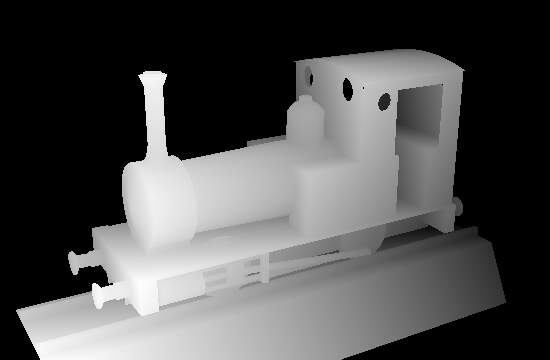
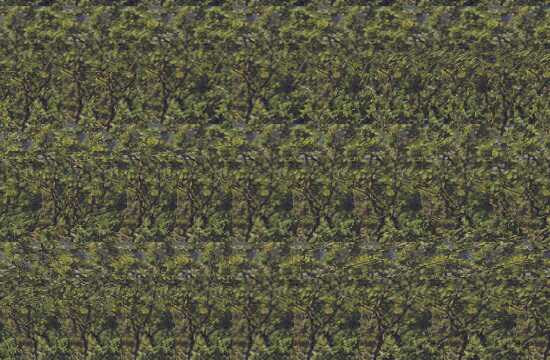
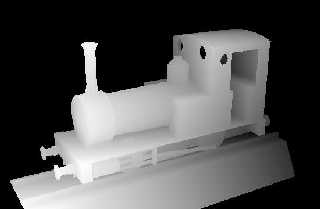
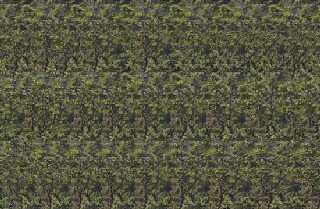
    Also, I found a program that allows you to create magic eye type images
if you have a texture file and a 3D image rendered as a depth map.  Does
anyone know how to render a scene that way?  I attached a sample of the
input and output.  The program is called Sisgen.

-Ben Scheele
Post a reply to this message
Attachments:
Download 'DOLDEMO.jpg' (10 KB)
Download 'train.jpg' (36 KB)
Download 'TREEPT85.jpg' (4 KB)
Preview of image 'DOLDEMO.jpg'
Preview of image 'train.jpg'
Preview of image 'TREEPT85.jpg'
|
|
| |
| |
|
|
|
|
| |
| |
|
|
"Ben T. Scheele" <sch### [at] tcumnedu> wrote in message
news:3e18e1e6@news.povray.org...
>     That's cool.  How are those kinds of images different from the kind
> you'd see in those stereo-opticon devices from a while back?
>     Also, I found a program that allows you to create magic eye type
images
> if you have a texture file and a 3D image rendered as a depth map.  Does
> anyone know how to render a scene that way?  I attached a sample of the
> input and output.  The program is called Sisgen.

The difference is probably in just that the effect is done by repetition of
an identical object which is shifted a little from each other. In the case
of the cubes they are rotated, a lone pair of them would be like a
stereo-optic photo.

You can see a somewhat 3D plus 2D effect in any repeated pattern, such as
wallpaper, without there being any shifts.

The way you'd do a depth map in POV-Ray 3.5 is by applying a universal
pigment gradient to the scene objects that goes from rgb 1 to rgb 0 with
only ambient 1 finish and no light sources. The orientation being aligned
with the camera. It has been done before. In fact, MegaPOV 0.7 has a feature
to make it a little easier except you still need to know the nearest and
farthest points of the scene objects. In 3.5 there is min_extent and
max_extent to find a measure of a unioned scene by extracting one of the
axes, unfortunately it isn't accurate for complex objects and you'd still
have to do some orientation to the camera.

Rune Johannsen has a tutorial on this
http://runevision.com/graphics/stereo/depthmap/depthmap.asp
Post a reply to this message
|
|
| |
| |
|
|
|
|
| |
| |
|
|
hi

hughes, b. wrote:
 > "Ben T. Scheele" <sch### [at] tcumnedu> wrote in message
 > news:3e18e1e6@news.povray.org...
 >>    That's cool.  How are those kinds of images different from
 >>the kind you'd see in those stereo-opticon devices from a while back?
 >>    Also, I found a program that allows you to create magic eye type
 >>images if you have a texture file and a 3D image rendered as a depth
 >>map.
 >>Does anyone know how to render a scene that way?  I attached a sample
 >>of the input and output.  The program is called Sisgen.

i don't know the devices mentioned. - do they use one or two images?
what are they doing, anyway?

sisgen is for "Single Image Stereogram GENnerator", right?

 > The difference is probably in just that the effect is done by
 > repetition of an identical object which is shifted a little from
 > each other. In the case of the cubes they are rotated, a lone
 > pair of them would be like a stereo-optic photo.

the difference from what?

anyway, to get the same results as with sisgen, or most "magic
eye"-pictures, only a few additions have to be made to the perl
code i have posted: you would have to replace the call to "rand()"
with something that picks the next color value from your texture
instead. - this could be a little tricky however, because this
texture can not just be "shifted" or "rotated" as in the cube
example. the current color actually depends on the depth map and
some additional parameters like the eye distance...

if you look at one of these magic-eye pictures, you will see
that the texture is getting more distorted towards one side of
the image. this is because of the way the algorithm works.

from the perspective of creating stereoscopic pictures, this
of course is a completely different story than just showing
the same object from two different angles...

if anyone is insterested, i'll post another piece of perl
code which is able to use "textures" to create SI[D]S.
i'm thinking of doing it with ascii first, so you could
maybe use your name as a texture.. ;)

- in any case, this has been done before, too, so you can probably
find the solution on google as well. ;)

 > You can see a somewhat 3D plus 2D effect in any repeated pattern,
 > such as wallpaper, without there being any shifts.

hmm... i don't quite get what you mean here. - you really mean
you see 3D effects when looking at your wall and crossing your
eyes? :)

 > The way you'd do a depth map in POV-Ray 3.5 is by applying a universal
 > pigment gradient to the scene objects that goes from rgb 1 to rgb 0
 > with only ambient 1 finish and no light sources. The orientation being
 > aligned with the camera. It has been done before. In fact, MegaPOV 0.7
 > has a feature to make it a little easier except you still need to know
 > the nearest and farthest points of the scene objects. In 3.5 there is
 > min_extent and max_extent to find a measure of a unioned scene by
 > extracting one of the axes, unfortunately it isn't accurate for
 > complex objects and you'd still have to do some orientation to the
 > camera.
 >
 > Rune Johannsen has a tutorial on this
 > http://runevision.com/graphics/stereo/depthmap/depthmap.asp

thanks! i knew there must be some simple way to do it!
and this sounds *brilliantly* simple!! :)


g.
Post a reply to this message
|
|
| |
| |
|
|
|
|
| |
| |
|
|
"master of psico" <roo### [at] psicoch> wrote in message
news:3E1### [at] psicoch...
>
> hughes, b. wrote:
>
> i don't know the devices mentioned. - do they use one or two images?
> what are they doing, anyway?

I believe Ben T. Scheele was talking of those stereoscopes which were, and
are, used to see stereo pair photos. Or like the ViewMaster which used a
wheel of images. That kind of thing in general.

> sisgen is for "Single Image Stereogram GENnerator", right?

Yes, apparently so  :-)

>  > The difference is probably in just that the effect is done by
>  > repetition of an identical object which is shifted a little from
>  > each other. In the case of the cubes they are rotated, a lone
>  > pair of them would be like a stereo-optic photo.
>
> the difference from what?

From single image stereograms or random dot stereograms or other such
non-paired 3D images. Those cube renders are similar to stereo pairs but the
subject object has been repeated many times across the whole image abd it
isn't of just two views unlike the left/right eye kind.

> anyway, to get the same results as with sisgen, or most "magic
> eye"-pictures, only a few additions have to be made to the perl
> code i have posted: you would have to replace the call to "rand()"
> with something that picks the next color value from your texture
> instead. - this could be a little tricky however, because this
> texture can not just be "shifted" or "rotated" as in the cube
> example. the current color actually depends on the depth map and
> some additional parameters like the eye distance...
---snip---
> if anyone is insterested, i'll post another piece of perl
> code which is able to use "textures" to create SI[D]S.
> i'm thinking of doing it with ascii first, so you could
> maybe use your name as a texture.. ;)

Sounds interesting, but I failed to find where you might have already posted
anything of this. And I never used Perl so this is probably lost on me.
Guess others can follow okay.

>  > You can see a somewhat 3D plus 2D effect in any repeated pattern,
>  > such as wallpaper, without there being any shifts.
>
> hmm... i don't quite get what you mean here. - you really mean
> you see 3D effects when looking at your wall and crossing your
> eyes? :)

Yes. If you look at any repeating pattern cross-eyed or parallel-eyed it
will separate from the background (inbetween spaces of pattern). So the
effect is that of a two layer 3D scene, or more descriptively it looks like
a window with decals stuck on it with a wall or infinite space behind them.

--
Farewell,
Bob
Post a reply to this message
|
|
| |
| |
|
|
|
|
| |
|
|