|
|
|
|
|
|
| |
| |
|
|
|
|
| |
| |
|
|
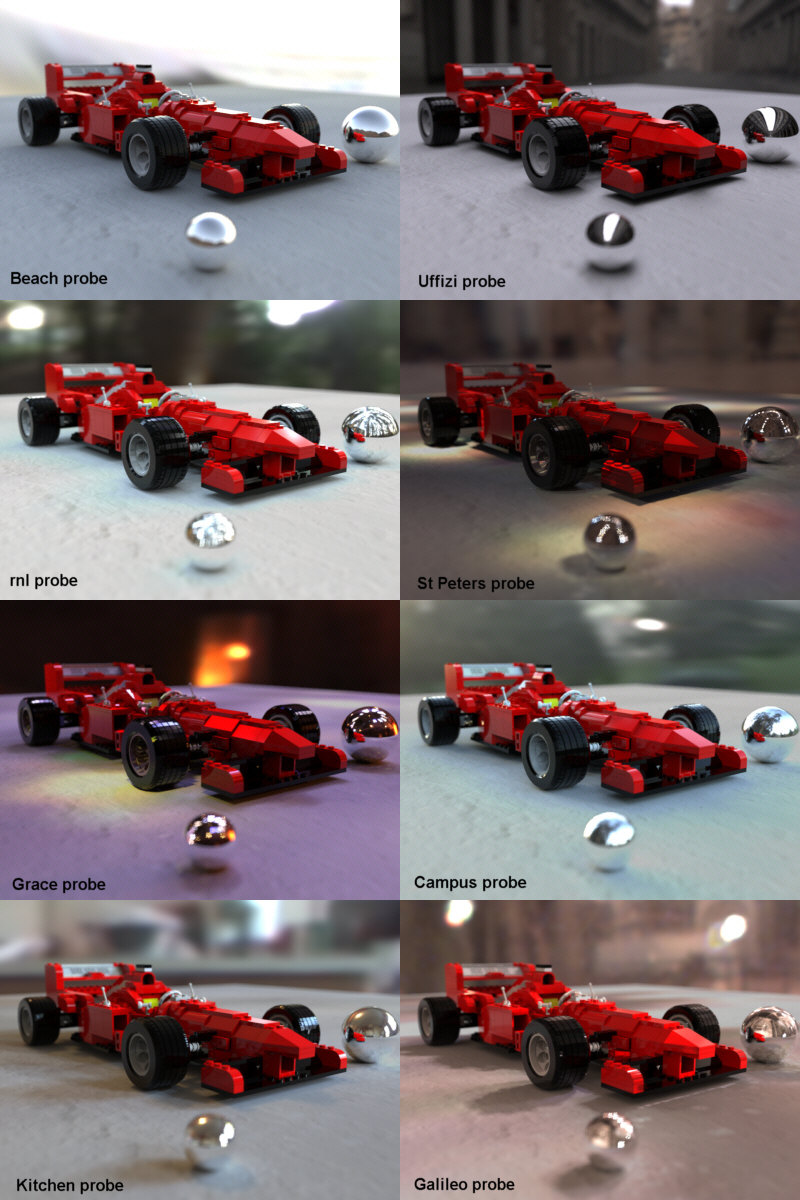
Here are some tests of the HDRI (high dynamic range illumination) patch by
Mael.
The model is the Lego Ferrari by Kenneth Storm (see  the p.b.i thread "Lego
Ferrari" on Sept 2).
The HDR maps are those available at Paul Devebec's site (I put the probes
name for reference) http://www.debevec.org
There's nothing much to it actually : just the HDR map, no lights, same
standard radiosity parameters. There are some visible artefacts in the maps
that have many strong light sources (like the Galileo probe), but the way
the HDR map seems to replace light sources is really amazing (apart the lack
of specular highlights, of course).
I still have to test it on "real" scenes though, where the illumination also
comes from regular objects. I really can't take credit for anything in these
tests ! Before I tested it, I couldn't figure out whether HDRI was really
better than plain radiosity, but it really is.
Important note : the patch is not publicly available yet (there's a Megapov
version somewhere) but I hope that Mael will release it soon.

G.

--
**********************
http://www.oyonale.com
**********************
- Graphic experiments
- POV-Ray and Poser computer images
- Posters
Post a reply to this message
Attachments:
Download 'lego_3hdrall.jpg' (194 KB)
Preview of image 'lego_3hdrall.jpg'
|
|
| |
| |
|
|
|
|
| |
| |
|
|
Gilles Tran wrote:
> Here are some tests of the HDRI (high dynamic range illumination) patch by
> Mael.
> The model is the Lego Ferrari by Kenneth Storm (see  the p.b.i thread "Lego
> Ferrari" on Sept 2).
> The HDR maps are those available at Paul Devebec's site (I put the probes
> name for reference) http://www.debevec.org
> There's nothing much to it actually : just the HDR map, no lights, same
> standard radiosity parameters. There are some visible artefacts in the maps
> that have many strong light sources (like the Galileo probe), but the way
> the HDR map seems to replace light sources is really amazing (apart the lack
> of specular highlights, of course).
> I still have to test it on "real" scenes though, where the illumination also
> comes from regular objects. I really can't take credit for anything in these
> tests ! Before I tested it, I couldn't figure out whether HDRI was really
> better than plain radiosity, but it really is.
> Important note : the patch is not publicly available yet (there's a Megapov
> version somewhere) but I hope that Mael will release it soon.
>
> G.
>


Those are sweet. Some higher resolution versions would be noce to see. :o)

-peter

--
Texturing Monk:
"Ballet pour ma fille."
http://www.applesnake.net
Post a reply to this message
|
|
| |
| |
|
|
|
|
| |
| |
|
|
Wow, those look good!

I might be misunderstanding the technique, but how do you get the coloured light
spots on the ground in the st peters image? I thought an HDR map was just based
on a photo sampled from 1 point in the environment, so your scene shouldn't be
able to get this effect, though it looks much more realistic with it :)

--
Tek
http://www.evilsuperbrain.com
Post a reply to this message
|
|
| |
| |
|
|
|
|
| |
| |
|
|
"Tek" <tek### [at] evilsuperbrain com> a écrit dans le message de news:
3e051083@news.povray.org...
> Wow, those look good!
>
> I might be misunderstanding the technique, but how do you get the coloured
light
> spots on the ground in the st peters image? I thought an HDR map was just
based
> on a photo sampled from 1 point in the environment, so your scene
shouldn't be
> able to get this effect, though it looks much more realistic with it :)
In fact it was a nice surprise to me too ! I didn't expect the light maps to
project light the way they do. It looks like the "hot spots" in the map act
like real lights after all (without creating specular highlights). There are
lots of artefacts here, but more testing (or a different implementation of
HDRI support) could perhaps solve them.
G.
--
**********************
http://www.oyonale.com
**********************
- Graphic experiments
- POV-Ray and Poser computer images
- Posters com> a écrit dans le message de news:
3e051083@news.povray.org...
> Wow, those look good!
>
> I might be misunderstanding the technique, but how do you get the coloured
light
> spots on the ground in the st peters image? I thought an HDR map was just
based
> on a photo sampled from 1 point in the environment, so your scene
shouldn't be
> able to get this effect, though it looks much more realistic with it :)
In fact it was a nice surprise to me too ! I didn't expect the light maps to
project light the way they do. It looks like the "hot spots" in the map act
like real lights after all (without creating specular highlights). There are
lots of artefacts here, but more testing (or a different implementation of
HDRI support) could perhaps solve them.
G.
--
**********************
http://www.oyonale.com
**********************
- Graphic experiments
- POV-Ray and Poser computer images
- Posters
Post a reply to this message
|
|
| |
| |
|
|
|
|
| |
| |
|
|
Gilles Tran wrote:
> Here are some tests of the HDRI (high dynamic range illumination)
> patch by Mael.

They are seriously impressive - I cannot wait for the patch! - lets just
hope I can munge Moray into making it work :P
--

Rick

Kitty5 NewMedia http://Kitty5.co.uk
POV-Ray News & Resources http://Povray.co.uk
TEL : +44 (01270) 501101 - FAX : +44 (01270) 251105 - ICQ : 15776037

PGP Public Key
http://pgpkeys.mit.edu:11371/pks/lookup?op=get&search=0x231E1CEA
Post a reply to this message
|
|
| |
| |
|
|
|
|
| |
| |
|
|
Gilles Tran wrote:

Hi Gilles!

> Important note : the patch is not publicly available yet (there's a
> Megapov version somewhere) but I hope that Mael will release it soon.

HDRI in POV-Ray or Megapov would be great! A view weeks ago I visited Paul
Devebec's site and decided to try this feature some day. Than I realized
that POV-Ray (well, I'm new to POV) doesn't support this feature and I
thought that I have to learn to use Radiance. Now I can't await to get a
patched version. :-)

Your test images look amazing!

Regards,
Xtra
Post a reply to this message
|
|
| |
| |
|
|
|
|
| |
| |
|
|
"Andreas Kreisig" <ank### [at] gmxde> a écrit dans le message de news:
3e05f2a7@news.povray.org...
>
> HDRI in POV-Ray or Megapov would be great!

Be happy, I found the Megapov version here :
http://martial.rameaux.free.fr/mael/MLPov.html#Download

G.


--
**********************
http://www.oyonale.com
**********************
- Graphic experiments
- POV-Ray and Poser computer images
- Posters
Post a reply to this message
|
|
| |
| |
|
|
|
|
| |
| |
|
|
Try painting a probe in photoshop, I found that the resolution did not have
to be very high so long as the parts of the image had natural colors and
the correct density. It may be different on POV, I used 3dMax to do it
about a year ago so the renderers are totally different.

There was one other issue I noted at the time, the HDRI source sphere needs
to be scaled correctly for the lighting to work correctly for small
objects. Try the St Peters probe again with the scale being closer to the
size ratio between that huge building and the tiny toy car.
If my words are not making any sense, tell me and I will draw what I am
thinking.
:o)

Gilles Tran wrote:

> Here are some tests of the HDRI (high dynamic range illumination) patch by
> Mael.
> The model is the Lego Ferrari by Kenneth Storm (see  the p.b.i thread
> "Lego Ferrari" on Sept 2).
> The HDR maps are those available at Paul Devebec's site (I put the probes
> name for reference) http://www.debevec.org
> There's nothing much to it actually : just the HDR map, no lights, same
> standard radiosity parameters. There are some visible artefacts in the
> maps that have many strong light sources (like the Galileo probe), but the
> way the HDR map seems to replace light sources is really amazing (apart
> the lack of specular highlights, of course).
> I still have to test it on "real" scenes though, where the illumination
> also comes from regular objects. I really can't take credit for anything
> in these tests ! Before I tested it, I couldn't figure out whether HDRI
> was really better than plain radiosity, but it really is.
> Important note : the patch is not publicly available yet (there's a
> Megapov version somewhere) but I hope that Mael will release it soon.
>
> G.
>
> --
> **********************
> http://www.oyonale.com
> **********************
> - Graphic experiments
> - POV-Ray and Poser computer images
> - Posters

--
Your connection failed because: Not enough interrupts
Post a reply to this message
|
|
| |
| |
|
|
|
|
| |
| |
|
|
Do you know if this patch supports the type of "texture transfer" that is
described in the paper that is linked at the MLPov site (Image Quilting for
Texture Synthesis and Transfer
Alexei A. Efros and Willian T. Freeman)?

thanks very much,
Dennis


"Gilles Tran" <git### [at] wanadoofr> wrote in message
news:3e0627cb@news.povray.org...
>
> "Andreas Kreisig" <ank### [at] gmxde> a écrit dans le message de news:
> 3e05f2a7@news.povray.org...
> >
> > HDRI in POV-Ray or Megapov would be great!
>
> Be happy, I found the Megapov version here :
> http://martial.rameaux.free.fr/mael/MLPov.html#Download
>
> G.
>
>
> --
> **********************
> http://www.oyonale.com
> **********************
> - Graphic experiments
> - POV-Ray and Poser computer images
> - Posters
>
>
>
Post a reply to this message
|
|
| |
| |
|
|
|
|
| |
| |
|
|
in news:3e066c02$1@news.povray.org Dennis Miller wrote:

> Do you know if this patch supports the type of "texture transfer"
> that is described in the paper that is linked at the MLPov site
> (Image Quilting for Texture Synthesis and Transfer
>

Yes it's the "Synthese Patch" section.

Ingo
Post a reply to this message
|
|
| |
| |
|
|
|
|
| |
| |
|
|
"ingo" <ing### [at] tagpovrayorg> a écrit dans le message de news:
Xns### [at] povrayorg...

> Yes it's the "Synthese Patch" section

Btw, I've tested this feature too. It works, but it's a little disappointing
: it's OK for small maps made of smaller maps, like those in the examples,
but computing a not very large map (1200*1200) took several hours on my P4
and getting a "synthese" map right requires a lot of trial and error. There
goes my hope of creating 4000*4000 realistic wall and bark maps out of
500*500 samples...

G.


--

**********************
http://www.oyonale.com
**********************
- Graphic experiments
- POV-Ray and Poser computer images
- Posters
Post a reply to this message
|
|
| |
| |
|
|
|
|
| |
| |
|
|
"Gilles Tran" <tra### [at] inapginrafr> wrote in message news:3e0746c0$1@news.povray.org...
> Btw, I've tested this feature too. It works, but it's a little disappointing
> : it's OK for small maps made of smaller maps, like those in the examples,
> but computing a not very large map (1200*1200) took several hours on my P4
> and getting a "synthese" map right requires a lot of trial and error. There
> goes my hope of creating 4000*4000 realistic wall and bark maps out of
> 500*500 samples...

Ahh....

I was going to try that too. But now I'll not bother.

All the best,

Andy Cocker
Post a reply to this message
|
|
| |
| |
|
|
|
|
| |
| |
|
|
in news:3e0746c0$1@news.povray.org Gilles Tran wrote:

> Btw, I've tested this feature too. It works, but it's a little
> disappointing ...

I like it a lot, but the results depend a lot on the input material.

Actually, I think it would be more usefull as a little stand-alone
application, instead of a pov-patch.


Ingo
Post a reply to this message
|
|
| |
| |
|
|
|
|
| |
| |
|
|
Gilles Tran wrote:

>
> "Andreas Kreisig" <ank### [at] gmxde> a écrit dans le message de news:
> 3e05f2a7@news.povray.org...
>>
>> HDRI in POV-Ray or Megapov would be great!
>
> Be happy, I found the Megapov version here :
> http://martial.rameaux.free.fr/mael/MLPov.html#Download

Thanks Gilles.

Do I need MegaPov 0.7 *and* POV-Ray 3.1 in order to work with this patch?

Thanks & Regards,
Andreas

--
http://www.render-zone.com
Post a reply to this message
|
|
| |
| |
|
|
|
|
| |
| |
|
|
"Andreas Kreisig" <ank### [at] gmxde> wrote in message news:3e077929@news.povray.org...
>
> Do I need MegaPov 0.7 *and* POV-Ray 3.1 in order to work with this patch?

Just 3.1 (might be possible without, but I tried it with 3.5 and it complained about
not
having HOME variable set)

All the best,

Andy Cocker
Post a reply to this message
|
|
| |
| |
|
|
|
|
| |
| |
|
|
Is there a way to coerce POV-Ray 3.5 into doing this without the patch?
Perhaps a pre-processing step on the HDR image and then the appropriate
radiosity parameters?

JP

"Gilles Tran" <git### [at] wanadoofr> wrote in message
news:3e04e8bf@news.povray.org...
> Here are some tests of the HDRI (high dynamic range illumination) patch by
> Mael.
> The model is the Lego Ferrari by Kenneth Storm (see  the p.b.i thread
"Lego
> Ferrari" on Sept 2).
> The HDR maps are those available at Paul Devebec's site (I put the probes
> name for reference) http://www.debevec.org
> There's nothing much to it actually : just the HDR map, no lights, same
> standard radiosity parameters. There are some visible artefacts in the
maps
> that have many strong light sources (like the Galileo probe), but the way
> the HDR map seems to replace light sources is really amazing (apart the
lack
> of specular highlights, of course).
> I still have to test it on "real" scenes though, where the illumination
also
> comes from regular objects. I really can't take credit for anything in
these
> tests ! Before I tested it, I couldn't figure out whether HDRI was really
> better than plain radiosity, but it really is.
> Important note : the patch is not publicly available yet (there's a
Megapov
> version somewhere) but I hope that Mael will release it soon.
>
> G.
>
> --
> **********************
> http://www.oyonale.com
> **********************
> - Graphic experiments
> - POV-Ray and Poser computer images
> - Posters
>
>
>
>
Post a reply to this message
|
|
| |
| |
|
|
|
|
| |
| |
|
|
Thanks Gilles,
Yesterday on the #chan povfr with Dr_peer I
had not understood how work
with the rounded  map  ......


blatant #difference pov3.5 and mlpov
http://cathemline.org/z/teste/hdri.html
convert in tga for pov3.5 with hrdshop

I have a yen to take again my povbouf !

--
Martial
Post a reply to this message
|
|
| |
| |
|
|
|
|
| |
| |
|
|
> Just 3.1 (might be possible without, but I tried it with 3.5 and it
complained about not
> having HOME variable set)
No  it'nt possible without 3.1 !
put mlpov.exe in the bin repertory !

--
Martial
Post a reply to this message
|
|
| |
| |
|
|
|
|
| |
| |
|
|
Something more complex than mapping the image to a sky sphere?
Such as converting the image to an array of light sources distributed over a
sphere? There are examples of both pixel data to object conversions and
spherical distribution of objects, you will need to look through the older
news post to find them, both are in the last 6 months.
There is also a Lighting inc that could be upgraded to perform such
lighting.

John Pallett wrote:

>
> Is there a way to coerce POV-Ray 3.5 into doing this without the patch?
> Perhaps a pre-processing step on the HDR image and then the appropriate
> radiosity parameters?
>
> JP
>
> "Gilles Tran" <git### [at] wanadoofr> wrote in message
> news:3e04e8bf@news.povray.org...
>> Here are some tests of the HDRI (high dynamic range illumination) patch
>> by Mael.
>> The model is the Lego Ferrari by Kenneth Storm (see  the p.b.i thread
> "Lego
>> Ferrari" on Sept 2).
>> The HDR maps are those available at Paul Devebec's site (I put the probes
>> name for reference) http://www.debevec.org
>> There's nothing much to it actually : just the HDR map, no lights, same
>> standard radiosity parameters. There are some visible artefacts in the
> maps
>> that have many strong light sources (like the Galileo probe), but the way
>> the HDR map seems to replace light sources is really amazing (apart the
> lack
>> of specular highlights, of course).
>> I still have to test it on "real" scenes though, where the illumination
> also
>> comes from regular objects. I really can't take credit for anything in
> these
>> tests ! Before I tested it, I couldn't figure out whether HDRI was really
>> better than plain radiosity, but it really is.
>> Important note : the patch is not publicly available yet (there's a
> Megapov
>> version somewhere) but I hope that Mael will release it soon.
>>
>> G.
>>
>> --
>> **********************
>> http://www.oyonale.com
>> **********************
>> - Graphic experiments
>> - POV-Ray and Poser computer images
>> - Posters
>>
>>
>>
>>

--
Your connection failed because: Lightning strikes.
Post a reply to this message
|
|
| |
| |
|
|
|
|
| |
| |
|
|
That's a good idea - though I'd hate to think of the number of lights
created for a 1024x768 image... :)

I'm wondering if there's a way to crank up the ambient value of the sky
sphere, perhaps after darkening the 'dark' parts of the image, so that the
end result is an approximation of an HDR radiosity solution.  Right now when
I use a sky sphere, it gives a nice effect, but the effect is too subtle.

Perhaps adjusting the contrast (keep the bright parts bright, darken the
rest) of an image, then setting its ambient value to 10, would do the trick
and could simulate an HDR image.  I'll have to experiment, it probably
depends upon which image is used.

JP


"Daniel Matthews" <dan#@3-e.net> wrote in message
news:100### [at] 3-enet...
> Something more complex than mapping the image to a sky sphere?
> Such as converting the image to an array of light sources distributed over
a
> sphere? There are examples of both pixel data to object conversions and
> spherical distribution of objects, you will need to look through the older
> news post to find them, both are in the last 6 months.
> There is also a Lighting inc that could be upgraded to perform such
> lighting.
>
> John Pallett wrote:
>
> >
> > Is there a way to coerce POV-Ray 3.5 into doing this without the patch?
> > Perhaps a pre-processing step on the HDR image and then the appropriate
> > radiosity parameters?
> >
> > JP
> >
> > "Gilles Tran" <git### [at] wanadoofr> wrote in message
> > news:3e04e8bf@news.povray.org...
> >> Here are some tests of the HDRI (high dynamic range illumination) patch
> >> by Mael.
> >> The model is the Lego Ferrari by Kenneth Storm (see  the p.b.i thread
> > "Lego
> >> Ferrari" on Sept 2).
> >> The HDR maps are those available at Paul Devebec's site (I put the
probes
> >> name for reference) http://www.debevec.org
> >> There's nothing much to it actually : just the HDR map, no lights, same
> >> standard radiosity parameters. There are some visible artefacts in the
> > maps
> >> that have many strong light sources (like the Galileo probe), but the
way
> >> the HDR map seems to replace light sources is really amazing (apart the
> > lack
> >> of specular highlights, of course).
> >> I still have to test it on "real" scenes though, where the illumination
> > also
> >> comes from regular objects. I really can't take credit for anything in
> > these
> >> tests ! Before I tested it, I couldn't figure out whether HDRI was
really
> >> better than plain radiosity, but it really is.
> >> Important note : the patch is not publicly available yet (there's a
> > Megapov
> >> version somewhere) but I hope that Mael will release it soon.
> >>
> >> G.
> >>
> >> --
> >> **********************
> >> http://www.oyonale.com
> >> **********************
> >> - Graphic experiments
> >> - POV-Ray and Poser computer images
> >> - Posters
> >>
> >>
> >>
> >>
>
> --
> Your connection failed because: Lightning strikes.
>
Post a reply to this message
|
|
| |
| |
|
|
|
|
| |
| |
|
|
For lighting (rather than reflection mapping) you would not need more than
the brightest 10% of pixels in the image, these could be lights behind a
translucent sphere that held the matching image map so that you still had
reflection/environment mapping. The lights would need to be directed at the
center of the sphere so as to avoid them illuminating the dark parts of the
map/sky.

John Pallett wrote:

> That's a good idea - though I'd hate to think of the number of lights
> created for a 1024x768 image... :)
>
> I'm wondering if there's a way to crank up the ambient value of the sky
> sphere, perhaps after darkening the 'dark' parts of the image, so that the
> end result is an approximation of an HDR radiosity solution.  Right now
> when I use a sky sphere, it gives a nice effect, but the effect is too
> subtle.
>
> Perhaps adjusting the contrast (keep the bright parts bright, darken the
> rest) of an image, then setting its ambient value to 10, would do the
> trick
> and could simulate an HDR image.  I'll have to experiment, it probably
> depends upon which image is used.
>
> JP
>
>
> "Daniel Matthews" <dan#@3-e.net> wrote in message
> news:100### [at] 3-enet...
>> Something more complex than mapping the image to a sky sphere?
>> Such as converting the image to an array of light sources distributed
>> over
> a
>> sphere? There are examples of both pixel data to object conversions and
>> spherical distribution of objects, you will need to look through the
>> older news post to find them, both are in the last 6 months.
>> There is also a Lighting inc that could be upgraded to perform such
>> lighting.
>>
>> John Pallett wrote:
>>
>> >
>> > Is there a way to coerce POV-Ray 3.5 into doing this without the patch?
>> > Perhaps a pre-processing step on the HDR image and then the appropriate
>> > radiosity parameters?
>> >
>> > JP
>> >
>> > "Gilles Tran" <git### [at] wanadoofr> wrote in message
>> > news:3e04e8bf@news.povray.org...
>> >> Here are some tests of the HDRI (high dynamic range illumination)
>> >> patch by Mael.
>> >> The model is the Lego Ferrari by Kenneth Storm (see  the p.b.i thread
>> > "Lego
>> >> Ferrari" on Sept 2).
>> >> The HDR maps are those available at Paul Devebec's site (I put the
> probes
>> >> name for reference) http://www.debevec.org
>> >> There's nothing much to it actually : just the HDR map, no lights,
>> >> same standard radiosity parameters. There are some visible artefacts
>> >> in the
>> > maps
>> >> that have many strong light sources (like the Galileo probe), but the
> way
>> >> the HDR map seems to replace light sources is really amazing (apart
>> >> the
>> > lack
>> >> of specular highlights, of course).
>> >> I still have to test it on "real" scenes though, where the
>> >> illumination
>> > also
>> >> comes from regular objects. I really can't take credit for anything in
>> > these
>> >> tests ! Before I tested it, I couldn't figure out whether HDRI was
> really
>> >> better than plain radiosity, but it really is.
>> >> Important note : the patch is not publicly available yet (there's a
>> > Megapov
>> >> version somewhere) but I hope that Mael will release it soon.
>> >>
>> >> G.
>> >>
>> >> --
>> >> **********************
>> >> http://www.oyonale.com
>> >> **********************
>> >> - Graphic experiments
>> >> - POV-Ray and Poser computer images
>> >> - Posters
>> >>
>> >>
>> >>
>> >>
>>
>> --
>> Your connection failed because: Lightning strikes.
>>

--
Your connection failed because: Redundant ACLs.
Post a reply to this message
|
|
| |
| |
|
|
|
|
| |
| |
|
|
I know it can do the tiling, but I couldn't tell from the French
documentation how to "map" the texture of one image on to another, which is
what the "texture transfer" effect is. Can you tell me the syntax for this?
Thanks much,
D.

"Gilles Tran" <tra### [at] inapginrafr> wrote in message
news:3e0746c0$1@news.povray.org...
> "ingo" <ing### [at] tagpovrayorg> a écrit dans le message de news:
> Xns### [at] povrayorg...
>
> > Yes it's the "Synthese Patch" section
>
> Btw, I've tested this feature too. It works, but it's a little
disappointing
> : it's OK for small maps made of smaller maps, like those in the examples,
> but computing a not very large map (1200*1200) took several hours on my P4
> and getting a "synthese" map right requires a lot of trial and error.
There
> goes my hope of creating 4000*4000 realistic wall and bark maps out of
> 500*500 samples...
>
> G.
>
>
> --
>
> **********************
> http://www.oyonale.com
> **********************
> - Graphic experiments
> - POV-Ray and Poser computer images
> - Posters
>
>
>
Post a reply to this message
|
|
| |
| |
|
|
|
|
| |
| |
|
|
Hello,

> documentation how to "map" the texture of one image on to another, which is
> what the "texture transfer" effect is. Can you tell me the syntax for this?

the patch doesn't implement the texture transfert, only the synthese (which
is, i agree, quite slow and has nothing to do in a ray tracer :)

M
Post a reply to this message
|
|
| |
| |
|
|
|
|
| |
| |
|
|
Smart thinking - I'll have to give that a try.  :)

JP

"Daniel Matthews" <dan#@3-e.net> wrote in message
news:197### [at] 3-enet...
> For lighting (rather than reflection mapping) you would not need more than
> the brightest 10% of pixels in the image, these could be lights behind a
> translucent sphere that held the matching image map so that you still had
> reflection/environment mapping. The lights would need to be directed at
the
> center of the sphere so as to avoid them illuminating the dark parts of
the
> map/sky.
>
> John Pallett wrote:
>
> > That's a good idea - though I'd hate to think of the number of lights
> > created for a 1024x768 image... :)
> >
> > I'm wondering if there's a way to crank up the ambient value of the sky
> > sphere, perhaps after darkening the 'dark' parts of the image, so that
the
> > end result is an approximation of an HDR radiosity solution.  Right now
> > when I use a sky sphere, it gives a nice effect, but the effect is too
> > subtle.
> >
> > Perhaps adjusting the contrast (keep the bright parts bright, darken the
> > rest) of an image, then setting its ambient value to 10, would do the
> > trick
> > and could simulate an HDR image.  I'll have to experiment, it probably
> > depends upon which image is used.
> >
> > JP
> >
> >
> > "Daniel Matthews" <dan#@3-e.net> wrote in message
> > news:100### [at] 3-enet...
> >> Something more complex than mapping the image to a sky sphere?
> >> Such as converting the image to an array of light sources distributed
> >> over
> > a
> >> sphere? There are examples of both pixel data to object conversions and
> >> spherical distribution of objects, you will need to look through the
> >> older news post to find them, both are in the last 6 months.
> >> There is also a Lighting inc that could be upgraded to perform such
> >> lighting.
> >>
> >> John Pallett wrote:
> >>
> >> >
> >> > Is there a way to coerce POV-Ray 3.5 into doing this without the
patch?
> >> > Perhaps a pre-processing step on the HDR image and then the
appropriate
> >> > radiosity parameters?
> >> >
> >> > JP
> >> >
> >> > "Gilles Tran" <git### [at] wanadoofr> wrote in message
> >> > news:3e04e8bf@news.povray.org...
> >> >> Here are some tests of the HDRI (high dynamic range illumination)
> >> >> patch by Mael.
> >> >> The model is the Lego Ferrari by Kenneth Storm (see  the p.b.i
thread
> >> > "Lego
> >> >> Ferrari" on Sept 2).
> >> >> The HDR maps are those available at Paul Devebec's site (I put the
> > probes
> >> >> name for reference) http://www.debevec.org
> >> >> There's nothing much to it actually : just the HDR map, no lights,
> >> >> same standard radiosity parameters. There are some visible artefacts
> >> >> in the
> >> > maps
> >> >> that have many strong light sources (like the Galileo probe), but
the
> > way
> >> >> the HDR map seems to replace light sources is really amazing (apart
> >> >> the
> >> > lack
> >> >> of specular highlights, of course).
> >> >> I still have to test it on "real" scenes though, where the
> >> >> illumination
> >> > also
> >> >> comes from regular objects. I really can't take credit for anything
in
> >> > these
> >> >> tests ! Before I tested it, I couldn't figure out whether HDRI was
> > really
> >> >> better than plain radiosity, but it really is.
> >> >> Important note : the patch is not publicly available yet (there's a
> >> > Megapov
> >> >> version somewhere) but I hope that Mael will release it soon.
> >> >>
> >> >> G.
> >> >>
> >> >> --
> >> >> **********************
> >> >> http://www.oyonale.com
> >> >> **********************
> >> >> - Graphic experiments
> >> >> - POV-Ray and Poser computer images
> >> >> - Posters
> >> >>
> >> >>
> >> >>
> >> >>
> >>
> >> --
> >> Your connection failed because: Lightning strikes.
> >>
>
> --
> Your connection failed because: Redundant ACLs.
>
Post a reply to this message
|
|
| |
| |
|
|
|
|
| |
| |
|
|
"Daniel Matthews" <dan#@3-e.net> a écrit dans le message de news:
197### [at] 3-enet...
> For lighting (rather than reflection mapping) you would not need more than
> the brightest 10% of pixels in the image, these could be lights behind a
> translucent sphere that held the matching image map so that you still had
> reflection/environment mapping. The lights would need to be directed at
the
> center of the sphere so as to avoid them illuminating the dark parts of
the
> map/sky.

In fact before I tested HDRI I tried the following method with radiosity (to
use with an environment sphere):
texture{
    image_pattern{jpg "mymap"} // grayscale map used to create variations in
light intensity
    texture_map{
        [0 T_Sky {finish{ambient 0}
        ....
        [i T_Sky {finish{ambient j}
        ....
        [1 T_Sky {finish{ambient 10}
    }
}

I didn't manage to get good results though. HDRI is much easier to set up
(of course having HDR maps helps a lot...).

G.


--
**********************
http://www.oyonale.com
**********************
- Graphic experiments
- POV-Ray and Poser computer images
- Posters
Post a reply to this message
|
|
| |
| |
|
|
|
|
| |
| |
|
|
Gilles Tran wrote:

> I didn't manage to get good results though. HDRI is much easier to set up
> (of course having HDR maps helps a lot...).
>
I bet it does! I just found the stuff I was doing ages ago,
3d Max -> MaxMan -> BMRT
It was very tedious.

Did you get that scale issue worked out, or was that really a giant lego car
in St Peters?

:o)
--
Your connection failed because: overflow error in /dev/null
Post a reply to this message
|
|
| |
| |
|
|
|
|
| |
| |
|
|
> In fact before I tested HDRI I tried the following method with radiosity (to
> use with an environment sphere):
> texture{
>     image_pattern{jpg "mymap"} // grayscale map used to create variations in
> light intensity
>     texture_map{
>         [0 T_Sky {finish{ambient 0}
>         ....
>         [i T_Sky {finish{ambient j}
>         ....
>         [1 T_Sky {finish{ambient 10}
>     }
> }

This is the same method  I have used for my vermeer things, but you should raise the
ambient value. The dynamic range for daylight images covers a much higher range
as 0.0 to 10.0. Go up 'till 500 or even 1000. In fact this is the same as using a High
Dynamic Range Image as a backdrop. BTW the I in HDRI stands simply for Image
and those images are among many other things useful for global illumination.
The probes from Paul Devebec's page are in the Radiance format wich uses usually
the extension .rgbe or .pic (not to be confused with the mac pic format) so if you are
looking for light probes you can also use files with this extensions. (But I do not
know
how this is implemented in mlpov so maybe you have to rename the files.)

so long
-Ive
Post a reply to this message
|
|
| |
| |
|
|
|
|
| |
| |
|
|
Hi all,

I've been trying to use the same technique with beach probe, and so far the
results are not good.

Here is the relevant part of the pov file


#declare QUAL = 3;  // Quality level, 0=BBox, 1=no refr, 2=normal,
3=studlogo

#declare SW = 0.5;  // Width of seam between two bricks

#declare STUDS = 1;  // 1=on 0=off

#declare BUMPS = 1;  // 1=on 0=off


#declare BUMPNORMAL = normal { bumps 0.01 scale 20 }
#declare AMB = 0.0;
#declare DIF = .9;


#version unofficial mlpov 0.8;

global_settings {
  radiosity {
    pretrace_start 0.08           // start pretrace at this size
    pretrace_end   0.04           // end pretrace at this size
    count 100                      // higher -> higher quality (1..1600)
[35]
    nearest_count 5               // higher -> higher quality (1..10) [5]
    error_bound 1.8               // higher -> smoother, less accurate [1.8]
    recursion_limit 3             // how much interreflections are
calculated (1..5+) [3]
    low_error_factor .5           // reduce error_bound during last pretrace
step
    gray_threshold 0.0            // increase for weakening colors (0..1)
[0]
    minimum_reuse 0.015           // reuse of old radiosity samples [0.015]
    brightness 1                  // brightness of radiosity effects (0..1)
[1]

    adc_bailout 0.01/2
    normal on                     // take surface normals into account [off]
  }
}


sphere {
  0,1350
  pigment { image_map { hdr "beach_probe.hdr" once interpolate 2 map_type 7
} }
  finish { ambient .8 diffuse 0.8 }
  hollow
}


// create a box that extends between the 2 specified points
box {
  <-500, -500, -500>  // one corner position <X1 Y1 Z1>
  < 500,  500,  500>  // other corner position <X2 Y2 Z2>
  translate 515*y

  texture {
  pigment { color rgb <0.9,0.9,0.9> }
  finish { ambient 0.2 diffuse 0.9 }
 }


}
...... (part of the lego car is here, without the lights and the camera and
global settings of its file)


Any idea of what's wrong?


Best regards and Merry Xmas / Fernando
Post a reply to this message
|
|
| |
| |
|
|
|
|
| |
| |
|
|
"Daniel Matthews" <dan#@3-e.net> a écrit dans le message de news:
130### [at] 3-enet...
> Did you get that scale issue worked out, or was that really a giant lego
car
> in St Peters?

After checking, it's big. Hmm, looks like JP2 developed a particular liking
in mammoth models of toy cars. I wonder about that 40m-tall Barbie (TM) doll
in Castelgandolfo. I'm not sure what this means for the future of
Christendom.

On other news, when HDR doesn't work it gives the *** worse *** radiosity
artefacts ever.

G.


--
**********************
http://www.oyonale.com
**********************
- Graphic experiments
- POV-Ray and Poser computer images
- Posters
Post a reply to this message
|
|
| |
| |
|
|
|
|
| |
| |
|
|
Gilles Tran wrote:
>On other news, when HDR doesn't work it gives the *** worse *** radiosity
>artefacts ever.

Nah, worse than a scene lit by a lilliputian -ambient 1000- sphere?
But I have to agree that the galileo_probe pic gave me the worst artefacts I
have ever got. And I still have to get over it...

--
Jonathan.
Post a reply to this message
|
|
| |
| |
|
|
|
|
| |