|
|
|
|
|
|
| |
| |
|
|
|
|
| |
| |
|
|
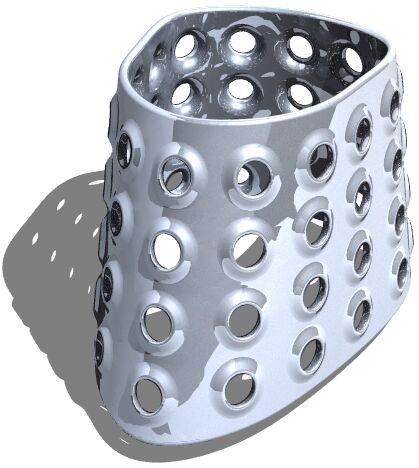
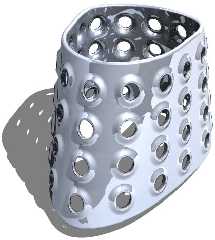
This is about 34K triangles lovingly placed by hand. I wanted to demonstrate
the kind of awesome control that scripting can provide. Something similar
could have been done much simpler, but if you look closely at the model you
will notice that the peaks of the curves at the holes follow the curve of
the main body and that the curves all merge smoothly into the body.

I would also like to know what y'all think of my texture. I put as much time
into getting that look as I did the modeling.

The first person to show me how this could have been done in 5 minutes with
an iso-blob wins a free video tape of me screaming and pulling out my
hair.<g>

 -Shay
Post a reply to this message
Attachments:
Download 'PoV_Model.jpg' (33 KB)
Preview of image 'PoV_Model.jpg'
|
|
| |
| |
|
|
|
|
| |
| |
|
|
> This is about 34K triangles lovingly placed by hand. I wanted to
demonstrate
> the kind of awesome control that scripting can provide.

Wow! Did you use macros for this? How did you get that much control over
shape, plus having normals.... I don't see an easy pattern to this... Is it
a heightfield lathe?

The texture is good but looks a bit confusing. It would benefit from blurred
reflection! Have you tried this? Since your model is triangle based, it
renders very fast so it won't be killed by blurred reflection .. and soft
shadows of course!

Very good work.  :o)

Hugo
Post a reply to this message
|
|
| |
| |
|
|
|
|
| |
| |
|
|
Shay wrote:
>
> The first person to show me how this could have been done in 5 minutes with
> an iso-blob wins a free video tape of me screaming and pulling out my
> hair.<g>

Why didn't you just use the included "thingy full of holes" function?

;)

-Xplo
Post a reply to this message
|
|
| |
| |
|
|
|
|
| |
| |
|
|
Sorry for asking, but what is it?

	Andrel

Shay wrote:
>
> This is about 34K triangles lovingly placed by hand. I wanted to demonstrate
> the kind of awesome control that scripting can provide. Something similar
> could have been done much simpler, but if you look closely at the model you
> will notice that the peaks of the curves at the holes follow the curve of
> the main body and that the curves all merge smoothly into the body.
>
> I would also like to know what y'all think of my texture. I put as much time
> into getting that look as I did the modeling.
>
> The first person to show me how this could have been done in 5 minutes with
> an iso-blob wins a free video tape of me screaming and pulling out my
> hair.<g>
>
>  -Shay
>
>  [Image]
Post a reply to this message
|
|
| |
| |
|
|
|
|
| |
| |
|
|
> Sorry for asking, but what is it?

Why can't you tell? A combination napkin ring/cheese grater;-)
Post a reply to this message
|
|
| |
| |
|
|
|
|
| |
| |
|
|
> > Sorry for asking, but what is it?
>
> Why can't you tell? A combination napkin ring/cheese grater;-)

Nooo it's a trashcan!
Of course!

Hugo
Post a reply to this message
|
|
| |
| |
|
|
|
|
| |
| |
|
|
> > > Sorry for asking, but what is it?
> >
> > Why can't you tell? A combination napkin ring/cheese grater;-)
>
> Nooo it's a trashcan!
> Of course!

you must be blind, its obviously part of a darlek


--

Rick

Kitty5 WebDesign - http://Kitty5.com
POV-Ray News & Resources - http://Povray.co.uk
TEL : +44 (01270) 501101 - FAX : +44 (01270) 251105 - ICQ : 15776037

PGP Public Key
http://pgpkeys.mit.edu:11371/pks/lookup?op=get&search=0x231E1CEA
Post a reply to this message
|
|
| |
| |
|
|
|
|
| |
| |
|
|
The child of a tarlik and a blowfish.
--
Oliver Wood
University Of Durham
aka : adm### [at] coldclimate couk
[home] - www.coldclimate.co.uk
[cold][wet][durham] - a daily blog - www.coldclimate.co.uk/blog
[cold][wet][world] - a communal blogwww.coldclimate.co.uk/glog couk
[home] - www.coldclimate.co.uk
[cold][wet][durham] - a daily blog - www.coldclimate.co.uk/blog
[cold][wet][world] - a communal blogwww.coldclimate.co.uk/glog
Post a reply to this message
|
|
| |
| |
|
|
|
|
| |
| |
|
|
Hugo <hua### [at] post3teledk> wrote in message news:3c826231@news.povray.org...

> Wow! Did you use macros for this? How did you get that much control over
> shape, plus having normals.... I don't see an easy pattern to this... Is
it
> a heightfield lathe?

Thanks. I did use macros, but there is no easy pattern. The shape is made up
of 56 unique sets of radially arranged vertices. Each row of vertices starts
at the side of a set, heads towards the center, and then heads back out to
another side of the set on the inside wall.

A heightfield would have the problem that the vertices are arranged in a
grid. This is not optimal because so many of the vertices would be on
flat(ish) areas. Arranging the vertices in a radial pattern allows you put
more of the vertices where they are needed. Also, a heigtfield would not
have holes.

> The texture is good but looks a bit confusing. It would benefit from
blurred
> reflection! Have you tried this? Since your model is triangle based, it
> renders very fast so it won't be killed by blurred reflection .. and soft
> shadows of course!

I tried blurred-reflection as you suggested. The realism drastically
increased! Thanks! I will use blurred-reflection when I use this in a
scene.The texture I posted is only for showing the details and looking a
little like a catalogue shot (I tried.) The render time did go from 3
seconds to 30 minutes, but I used a 10x10 area light as well.

 -Shay
Post a reply to this message
|
|
| |
| |
|
|
|
|
| |
| |
|
|
Clever ideas, guys, but what did you think of the modeling?

Rick [Kitty5] <ric### [at] kitty5com> wrote in message
news:3c834ea9$1@news.povray.org...
Post a reply to this message
|
|
| |
| |
|
|
|
|
| |
| |
|
|
> Thanks. I did use macros, but there is no easy pattern. The shape is made
up
> of 56 unique sets of radially arranged vertices. Each row of vertices
starts
> at the side of a set, heads towards the center, and then heads back out to
> another side of the set on the inside wall.

That's something I never considered (I think).. I'm not even sure I fully
understand it.. But the more I look at the shape, the more impressed I
become.. How versalite do you think these macros could become? I think, one
of POVs big limitations at the moment, is the few tools there exsist to
create / modify triangles shapes.. Isosurfaces are great and so are a lot of
other things.. But triangles are very popular in commerical modellers, with
good reason.. You can model on them forever, and they remain fast.

Some of the triangle-tools people use with a mouse, could also (at least in
my imagination) work in Povray for hand-coders.. There are some people here
who experiment with it.. You took things to a new level, with that shape of
yours.. :o)  It's probably not a trashcan.. I'm working on something with
heightfields myself (but currently I'm stuck).. I could mention other people
too.. But sometimes it would be nice with more teamwork here.. I know it's
not easy to help other people with their code, but sharing ideas and
combining efforts, is nevertheless an efficient way to develop something ...
or try out ideas, if nothing else.

> I tried blurred-reflection as you suggested. The realism drastically
> increased!

I'm glad I could help! Please show us sometime.

Hugo
Post a reply to this message
|
|
| |
| |
|
|
|
|
| |
| |
|
|
"Shay" <sah### [at] simcopartscom> wrote in message
news:3c839d71@news.povray.org...
> Clever ideas, guys, but what did you think of the modeling?

Nice idea. Have you used splines(and if so, what kind) for it?
As for the question "what is it", this thing could be useful
in kitchen with handle on the top, smaller sharp-edged holes
of different shapes for every side.

Gleb
Post a reply to this message
|
|
| |
| |
|
|
|
|
| |
| |
|
|
Hugo <hua### [at] post3teledk> wrote in message news:3c83b17d@news.povray.org...

> That's something I never considered (I think).. I'm not even sure I fully
> understand it..

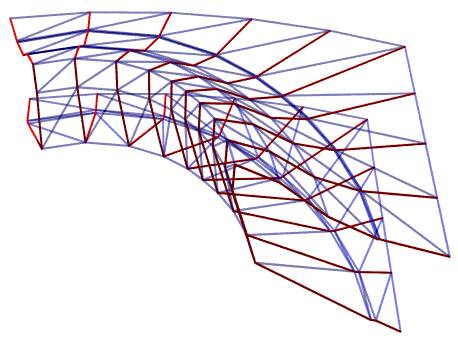
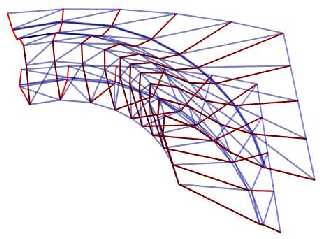
I attached a piece of wire frame to show what I'm talking about.


>But the more I look at the shape, the more impressed I
> become..

Wow, thanks.


>How versalite do you think these macros could become? ... I'm working on
something with
> heightfields myself (but currently I'm stuck)..

The macros I made for this aren't very versatile. The vertices require from
three to as many as 12 triangles to figure their normals, so unless a mesh
is constructed exactly like mine, they will not help much.
I wrote a macro that takes an n-by-n array (mesh_array[columns][rows]) and
writes out a #mesh2 macro with normals. If this would help with your
heightfield work, I would be glad to clean it up and send it to you tonight.
Let me know.

 -Shay
Post a reply to this message
Attachments:
Download 'WF.jpg' (28 KB)
Preview of image 'WF.jpg'
|
|
| |
| |
|
|
|
|
| |
| |
|
|
Gleb <gk1### [at] sotonacuk> wrote in message news:3c83c338@news.povray.org...

> Have you used splines(and if so, what kind) for it?

I used the natural spline in the #declare spline function to trace to top
and bottom curves. The piece has to fit perfectly with several other pieces,
so this allows a perfect fit through the control points.

 -Shay
Post a reply to this message
|
|
| |
| |
|
|
|
|
| |
| |
|
|
> I attached a piece of wire frame to show what I'm talking about.

This really shows what you've done.. great work..  :o)

> I wrote a macro that takes an n-by-n array (mesh_array[columns][rows]) and
> writes out a #mesh2 macro with normals. If this would help with your
> heightfield work, I would be glad to clean it up and send it to you
tonight.
> Let me know.

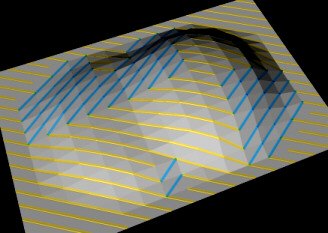
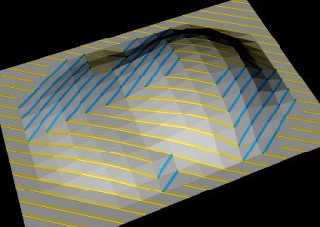
I too have attached a picture that hopefully demonstrates what I'm doing..
It's a heightfield (a bit boring one) traced within POV.. The idea is that
people can use my macros as modelling tools.. People may use well-known and
easy primitives to make a shape.. My macro will then transform it to a
heightfield, and another macro will smooth out the vertices (remove hard
edges that primitives usually have) and a third macro sweeps the grid around
a lathe, spline, etc.. It will be easy to put in a forth or fifth macro,
with other deformation features.

Each square in the grid consist of 2 triangles. As shown with yellow and
blue lines, these "qaud faces" (double faces) are connected in either one
way - the way that suits the curvature best.. Ordinary HF's don't seem to
have this feature, but it improves the shape when there's not a lot of
triangles.

My problem is to average the normals in this "matrix".. Each vertex is
surrounded by 4 squares, and each square consist of 2 triangles, but
sometimes only 1 of them should be averaged because only 1 of them are
directly connected to the vertex.. It's no problem to store this pattern in
an array with either 0 or 1.. But I battle to get this averaging to work
correctly.. Buggy code and it may sound rediculous.. But I'd like to get it
working.

Your code does not take this swapping of quad-faces into consideration, so
it won't solve my problem.  :o)  But thanks for your offer, anyway!  I don't
know if you could use my long explanation to anything, I tried to be
concise, and anyone is welcome to take a look at my code, of course.

Regards,
Hugo
Post a reply to this message
|
|
| |
| |
|
|
|
|
| |
| |
|
|
> I too have attached a picture

Forgot the picture.
Post a reply to this message
Attachments:
Download 'Hf_example.JPG' (19 KB)
Preview of image 'Hf_example.JPG'
|
|
| |
| |
|
|
|
|
| |
| |
|
|
I see now what you are doing. This will be very useful for animation where
the goal is to use as few triangles as possible.

 I have an idea for how to adapt my macro for what you are doing. I think
that the best way to do this would be to store the normals in a
3-dimentional array (Normal_Array[Columns][Rows][8]). Then, write two
macros, one for each case of division. Each of the two macros will figure
the normal of each triangle as it is made and then file that normal with
each of the vertices of the triangle.

The normal of each vertex could then later be found with something like
this:

#declare Triangle_Normal_Sum = 0;
 #declare  Counter = 0;
 #while (Counter < 8)
  #ifdef ( Normal_Array[Column][Row][Counter] )
   #declare Triangle_Normal_Sum = Triangle_Normal_Sum +
Normal_Array[Column][Row][Counter];
  #end             // #ifdef ( Normal_Array[Column][Row][Counter] )
  #declare Counter = Counter + 1;
 #end             // #while (Counter < 8)


#declare Vertex_Normal = vnormalize {Triangle_Normal_Sum}

I think I will try to test this tonight. Let me know if I understood
corectly what you are trying to do.

 -Shay


Hugo <hua### [at] post3teledk> wrote in message news:3c83ef1f@news.povray.org...
Post a reply to this message
|
|
| |
| |
|
|
|
|
| |
| |
|
|
Better idea. Just make an array (Normal_Array[Columns][Rows][1]) and set
every value to <0,0,0>. Then, keep adding normals to the <0,0,0> when
appropriate. This will make the macro adaptable to more meshes.

 -Shay

Shay <sah### [at] simcopartscom> wrote in message
news:3c83f484$1@news.povray.org...
Post a reply to this message
|
|
| |
| |
|
|
|
|
| |
| |
|
|
The modelling is great, if you understand modelling as
creating any object. For me modelling is also creating
a model of something. Hence the question what it is,
just to know what to compare it with. So my verdict:
technical achievement: 9.5
artistic merit: 7
conformity to real object: NA
conversation piece: 8.5

Is that what you wanted to hear? More serious: for some
obscure reason I am interested in working with patches,
their scaling properties, connecting different patches
together, etc. An object like this could be an interesting
object to test what to achieve with patches for me, except
that I do not have a reference, other than your image :)

	Andrel

Shay wrote:
>
> Clever ideas, guys, but what did you think of the modeling?
>
> Rick [Kitty5] <ric### [at] kitty5com> wrote in message
> news:3c834ea9$1@news.povray.org...
Post a reply to this message
|
|
| |
| |
|
|
|
|
| |
| |
|
|
> Let me know if I understood
> corectly what you are trying to do.

Yes you have.  :o)

> Better idea. Just make an array (Normal_Array[Columns][Rows][1]) and set
> every value to <0,0,0>. Then, keep adding normals to the <0,0,0> when
> appropriate. This will make the macro adaptable to more meshes.

Yes, true.. I will clean up my code cause I keep getting confused, but it
should be possible that it just calls your macro once for each grid - then
ends with the final normals to each vertex.

I'll be back tomorrow.
:o)

Hugo
Post a reply to this message
|
|
| |
| |
|
|
|
|
| |
| |
|
|
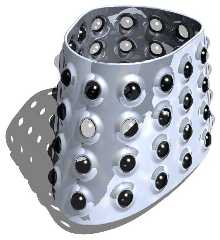
Rick and oliWood posted this, but I guess I need to confirm it. This is the
bottom of a Dalek.
Really it isn't even that because I am redesigning the Dalek to my own
tastes. The dimentions are identical, however.
I have attached a picture of a Dalek for any who are unfamiliar with it and
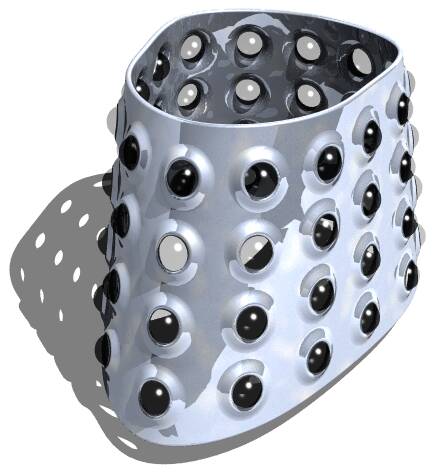
a second picture of my model which shows how snugly the spheres (Not sure
what to do with those yet) will fit into my model. This is partly a product
of my imagination, but it is still very precise.

 -Shay
Post a reply to this message
Attachments:
Download 'dalek-1j.jpg' (19 KB)
Download 'Dal_Bodyj.jpg' (27 KB)
Preview of image 'dalek-1j.jpg'

Preview of image 'Dal_Bodyj.jpg'
|
|
| |
| |
|
|
|
|
| |
| |
|
|
Is a darlek a female dalek?  I guess that's why it's full of holes...
proper interfacing.

Cheers!

Chip Shults
My robotics, space and CGI web page - http://home.cfl.rr.com/aichip
Post a reply to this message
|
|
| |
| |
|
|
|
|
| |
| |
|
|
> Rick and oliWood posted this, but I guess I need to confirm it. This is
the
> bottom of a Dalek.

:)


--

Rick

Kitty5 WebDesign - http://Kitty5.com
POV-Ray News & Resources - http://Povray.co.uk
TEL : +44 (01270) 501101 - FAX : +44 (01270) 251105 - ICQ : 15776037

PGP Public Key
http://pgpkeys.mit.edu:11371/pks/lookup?op=get&search=0x231E1CEA
Post a reply to this message
|
|
| |
| |
|
|
|
|
| |