|
|
|
|
|
|
| |
| |
|
|
From: Warp
Subject: A different approach to blurred reflection (PNG, 80kbu)
Date: 19 Oct 2001 03:59:56
Message: <3bcfdd7a@news.povray.org>
|
|
|
| |
| |
|
|
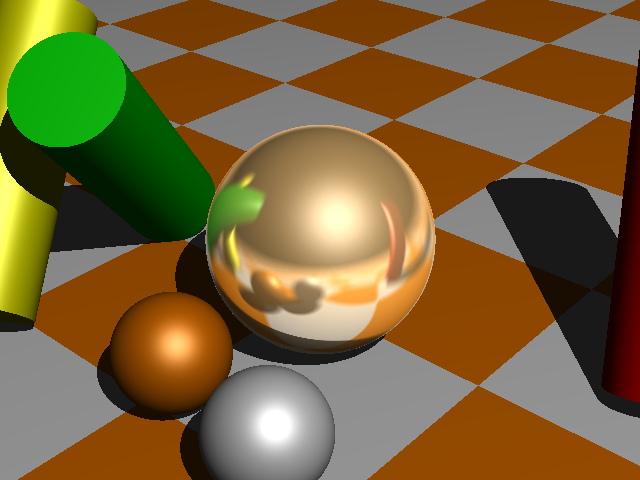
I tried a different approach to blurred reflection. Didn't work extremely
well (which isn't a surprise knowing the algorithm...). Sorry for the PNG,
but I didn't want JPG artifacts to destroy anything, and it isn't that big.

  Now you can start guessing how I did it. As you can see, I did not use
antialiasing (I deliberately rendered the image without antialiasing to show
that I did not use the antialiasing trick). And yes, I rendered it completely
with POV-Ray 3.5beta in one run (ie, I did not use any external programs, just
POV-Ray and one single .pov file).
  You can also watch for what is wrong in the reflection... Something that
just cannot be corrected with this technique :)
Post a reply to this message
Attachments:
Download 'brtest.png' (83 KB)
Preview of image 'brtest.png'
|
|
| |
| |
|
|
From: ARTis
Subject: Re: A different approach to blurred reflection (PNG, 80kbu)
Date: 19 Oct 2001 04:13:23
Message: <3bcfe0a3@news.povray.org>
|
|
|
| |
| |
|
|
>   You can also watch for what is wrong in the reflection... Something that
> just cannot be corrected with this technique :)

I think the shadows in the reflection are wrong.
Post a reply to this message
|
|
| |
| |
|
|
From: Nekar Xenos
Subject: Re: A different approach to blurred reflection (PNG, 80kbu)
Date: 19 Oct 2001 04:42:41
Message: <3bcfe781@news.povray.org>
|
|
|
| |
| |
|
|
Different sized transparent reflective spheres?
- Nekar
"Warp" <war### [at] tag povrayorg> wrote in message news:3bcfdd7a@news.povray.org...
> I tried a different approach to blurred reflection. Didn't work extremely
> well (which isn't a surprise knowing the algorithm...). Sorry for the PNG,
> but I didn't want JPG artifacts to destroy anything, and it isn't that big.
>
> Now you can start guessing how I did it. As you can see, I did not use
> antialiasing (I deliberately rendered the image without antialiasing to show
> that I did not use the antialiasing trick). And yes, I rendered it completely
> with POV-Ray 3.5beta in one run (ie, I did not use any external programs, just
> POV-Ray and one single .pov file).
> You can also watch for what is wrong in the reflection... Something that
> just cannot be corrected with this technique :)
>
>
--------------------------------------------------------------------------------
>
>
> --
> #macro N(D,I)#if(I<6)cylinder{M()#local D[I]=div(D[I],104);M().5,2pigment{
> rgb M()}}N(D,(D[I]>99?I:I+1))#end#end#macro M()<mod(D[I],13)-6,mod(div(D[I
> ],13),8)-3,10>#end blob{N(array[6]{11117333955,
> 7382340,3358,3900569407,970,4254934330},0)}// - Warp -
---
Outgoing mail is certified Virus Free.
Checked by AVG anti-virus system (http://www.grisoft.com).
Version: 6.0.282 / Virus Database: 150 - Release Date: 2001/09/25 povrayorg> wrote in message news:3bcfdd7a@news.povray.org...
> I tried a different approach to blurred reflection. Didn't work extremely
> well (which isn't a surprise knowing the algorithm...). Sorry for the PNG,
> but I didn't want JPG artifacts to destroy anything, and it isn't that big.
>
> Now you can start guessing how I did it. As you can see, I did not use
> antialiasing (I deliberately rendered the image without antialiasing to show
> that I did not use the antialiasing trick). And yes, I rendered it completely
> with POV-Ray 3.5beta in one run (ie, I did not use any external programs, just
> POV-Ray and one single .pov file).
> You can also watch for what is wrong in the reflection... Something that
> just cannot be corrected with this technique :)
>
>
--------------------------------------------------------------------------------
>
>
> --
> #macro N(D,I)#if(I<6)cylinder{M()#local D[I]=div(D[I],104);M().5,2pigment{
> rgb M()}}N(D,(D[I]>99?I:I+1))#end#end#macro M()<mod(D[I],13)-6,mod(div(D[I
> ],13),8)-3,10>#end blob{N(array[6]{11117333955,
> 7382340,3358,3900569407,970,4254934330},0)}// - Warp -
---
Outgoing mail is certified Virus Free.
Checked by AVG anti-virus system (http://www.grisoft.com).
Version: 6.0.282 / Virus Database: 150 - Release Date: 2001/09/25
Post a reply to this message
|
|
| |
| |
|
|
From: Warp
Subject: Re: A different approach to blurred reflection (PNG, 80kbu)
Date: 19 Oct 2001 05:08:35
Message: <3bcfed93@news.povray.org>
|
|
|
| |
| |
|
|
ARTis <art### [at] aaaapollolv> wrote:
: I think the shadows in the reflection are wrong.

  No, not really. (I mean that they aren't any wronger than anything else.)

--
#macro N(D,I)#if(I<6)cylinder{M()#local D[I]=div(D[I],104);M().5,2pigment{
rgb M()}}N(D,(D[I]>99?I:I+1))#end#end#macro M()<mod(D[I],13)-6,mod(div(D[I
],13),8)-3,10>#end blob{N(array[6]{11117333955,
7382340,3358,3900569407,970,4254934330},0)}//                     - Warp -
Post a reply to this message
|
|
| |
| |
|
|
From: Warp
Subject: Re: A different approach to blurred reflection (PNG, 80kbu)
Date: 19 Oct 2001 05:08:53
Message: <3bcfeda5@news.povray.org>
|
|
|
| |
| |
|
|
Nekar Xenos <j-p### [at] citywalkcoza> wrote:
: Different sized transparent reflective spheres?

  Not even close... :)

--
#macro N(D,I)#if(I<6)cylinder{M()#local D[I]=div(D[I],104);M().5,2pigment{
rgb M()}}N(D,(D[I]>99?I:I+1))#end#end#macro M()<mod(D[I],13)-6,mod(div(D[I
],13),8)-3,10>#end blob{N(array[6]{11117333955,
7382340,3358,3900569407,970,4254934330},0)}//                     - Warp -
Post a reply to this message
|
|
| |
| |
|
|
From: Nekar Xenos
Subject: Re: A different approach to blurred reflection (PNG, 80kbu)
Date: 19 Oct 2001 05:23:55
Message: <3bcff12b@news.povray.org>
|
|
|
| |
| |
|
|
A reflective sphere inside a slightly larger transparent sphere filled with
scattering media?

- Nekar

"Warp" <war### [at] tagpovrayorg> wrote in message news:3bcfeda5@news.povray.org...
> Nekar Xenos <j-p### [at] citywalkcoza> wrote:
> : Different sized transparent reflective spheres?
>
>   Not even close... :)
>
> --
> #macro N(D,I)#if(I<6)cylinder{M()#local D[I]=div(D[I],104);M().5,2pigment{
> rgb M()}}N(D,(D[I]>99?I:I+1))#end#end#macro M()<mod(D[I],13)-6,mod(div(D[I
> ],13),8)-3,10>#end blob{N(array[6]{11117333955,
> 7382340,3358,3900569407,970,4254934330},0)}//                     - Warp -


---
Outgoing mail is certified Virus Free.
Checked by AVG anti-virus system (http://www.grisoft.com).
Version: 6.0.282 / Virus Database: 150 - Release Date: 2001/09/25
Post a reply to this message
|
|
| |
| |
|
|
|
|
| |
| |
|
|
in news:3bcfdd7a@news.povray.org Warp wrote:

>   Now you can start guessing how I did it.

a clever setup of flat and spherical mirrors and using focal blurr?

Ingo

--
Photography: http://members.home.nl/ingoogni/
Pov-Ray    : http://members.home.nl/seed7/
Post a reply to this message
|
|
| |
| |
|
|
From: Christoph Hormann
Subject: Re: A different approach to blurred reflection (PNG, 80kbu)
Date: 19 Oct 2001 06:30:30
Message: <3BD000DB.B5AD14C0@gmx.de>
|
|
|
| |
| |
|
|
Warp wrote:
>
> [...]
>   You can also watch for what is wrong in the reflection... Something that
> just cannot be corrected with this technique :)
>

The reflection geometry looks a bit wrong, i would say an image map
applied to the sphere...

Christoph

--
Christoph Hormann <chr### [at] gmxde>
IsoWood include, radiosity tutorial, TransSkin and other
things on: http://www.schunter.etc.tu-bs.de/~chris/
Post a reply to this message
|
|
| |
| |
|
|
From: Warp
Subject: Re: A different approach to blurred reflection (PNG, 80kbu)
Date: 19 Oct 2001 07:13:31
Message: <3bd00adb@news.povray.org>
|
|
|
| |
| |
|
|
Nekar Xenos <j-p### [at] citywalkcoza> wrote:
: A reflective sphere inside a slightly larger transparent sphere filled with
: scattering media?

  Nope, nothing like that.

--
#macro N(D,I)#if(I<6)cylinder{M()#local D[I]=div(D[I],104);M().5,2pigment{
rgb M()}}N(D,(D[I]>99?I:I+1))#end#end#macro M()<mod(D[I],13)-6,mod(div(D[I
],13),8)-3,10>#end blob{N(array[6]{11117333955,
7382340,3358,3900569407,970,4254934330},0)}//                     - Warp -
Post a reply to this message
|
|
| |
| |
|
|
From: Warp
Subject: Re: A different approach to blurred reflection (PNG, 80kbu)
Date: 19 Oct 2001 07:14:22
Message: <3bd00b0e@news.povray.org>
|
|
|
| |
| |
|
|
ingo <ing### [at] homenl> wrote:
: a clever setup of flat and spherical mirrors and using focal blurr?

  You are getting a bit closer, but not quite.

--
#macro N(D,I)#if(I<6)cylinder{M()#local D[I]=div(D[I],104);M().5,2pigment{
rgb M()}}N(D,(D[I]>99?I:I+1))#end#end#macro M()<mod(D[I],13)-6,mod(div(D[I
],13),8)-3,10>#end blob{N(array[6]{11117333955,
7382340,3358,3900569407,970,4254934330},0)}//                     - Warp -
Post a reply to this message
|
|
| |
| |
|
|
From: Warp
Subject: Re: A different approach to blurred reflection (PNG, 80kbu)
Date: 19 Oct 2001 07:16:29
Message: <3bd00b8d@news.povray.org>
|
|
|
| |
| |
|
|
Christoph Hormann <chr### [at] gmxde> wrote:
: The reflection geometry looks a bit wrong,

  You are right.

: i would say an image map
: applied to the sphere...

  Nope. The sphere is truely reflective and has just a
pigment { rgb <1,.8,.6> }

  And besides, an image map applied to the sphere whouldn't look like that
(unless it was an extremely cleverly calculated image map, which I myself
don't know how to do).
  However, you are getting closer...

--
#macro N(D,I)#if(I<6)cylinder{M()#local D[I]=div(D[I],104);M().5,2pigment{
rgb M()}}N(D,(D[I]>99?I:I+1))#end#end#macro M()<mod(D[I],13)-6,mod(div(D[I
],13),8)-3,10>#end blob{N(array[6]{11117333955,
7382340,3358,3900569407,970,4254934330},0)}//                     - Warp -
Post a reply to this message
|
|
| |
| |
|
|
From: Daniel Schwen
Subject: Re: A different approach to blurred reflection (PNG, 80kbu)
Date: 19 Oct 2001 07:48:47
Message: <3bd0131f@news.povray.org>
|
|
|
| |
| |
|
|
Motion Blur?
Post a reply to this message
|
|
| |
| |
|
|
From: Trevor Quayle
Subject: Re: A different approach to blurred reflection (PNG, 80kbu)
Date: 19 Oct 2001 08:09:23
Message: <3bd017f3$1@news.povray.org>
|
|
|
| |
| |
|
|
The reflected image seems brighter.

-tgq
Post a reply to this message
|
|
| |
| |
|
|
From: Ruy
Subject: Re: A different approach to blurred reflection (PNG, 80kbu)
Date: 19 Oct 2001 08:32:21
Message: <3bd01d55@news.povray.org>
|
|
|
| |
| |
|
|
"Warp" <war### [at] tagpovrayorg> escreveu na mensagem
news:3bcfdd7a@news.povray.org...
>   You can also watch for what is wrong in the reflection... Something that
> just cannot be corrected with this technique :)

The reflective sphere's shadow does not seem to be blurred in the
reflection. Is that it?
Post a reply to this message
|
|
| |
| |
|
|
From: Trevor Quayle
Subject: Re: A different approach to blurred reflection (PNG, 80kbu)
Date: 19 Oct 2001 08:36:19
Message: <3bd01e43$1@news.povray.org>
|
|
|
| |
| |
|
|
"Ruy" <ruy### [at] hipernetcombr> wrote in message
news:3bd01d55@news.povray.org...
> "Warp" <war### [at] tagpovrayorg> escreveu na mensagem
> news:3bcfdd7a@news.povray.org...
> >   You can also watch for what is wrong in the reflection... Something
that
> > just cannot be corrected with this technique :)
>
> The reflective sphere's shadow does not seem to be blurred in the
> reflection. Is that it?
>
>

It shouldn't be, at least not very much compared to objects further from the
sphere.

-tgq
Post a reply to this message
|
|
| |
| |
|
|
From: Nekar Xenos
Subject: Re: A different approach to blurred reflection (PNG, 80kbu)
Date: 19 Oct 2001 09:06:07
Message: <3bd0253f@news.povray.org>
|
|
|
| |
| |
|
|
"Warp" <war### [at] tagpovrayorg> wrote in message news:3bd00adb@news.povray.org...
> Nekar Xenos <j-p### [at] citywalkcoza> wrote:
> : A reflective sphere inside a slightly larger transparent sphere filled with
> : scattering media?
>
>   Nope, nothing like that.

Do you think it might work with scattering media?

- Nekar

>
> --
> #macro N(D,I)#if(I<6)cylinder{M()#local D[I]=div(D[I],104);M().5,2pigment{
> rgb M()}}N(D,(D[I]>99?I:I+1))#end#end#macro M()<mod(D[I],13)-6,mod(div(D[I
> ],13),8)-3,10>#end blob{N(array[6]{11117333955,
> 7382340,3358,3900569407,970,4254934330},0)}//                     - Warp -


---
Outgoing mail is certified Virus Free.
Checked by AVG anti-virus system (http://www.grisoft.com).
Version: 6.0.282 / Virus Database: 150 - Release Date: 2001/09/25
Post a reply to this message
|
|
| |
| |
|
|
|
|
| |
| |
|
|
Warp wrote:
>
> Christoph Hormann <chr### [at] gmxde> wrote:
> : The reflection geometry looks a bit wrong,
>
>   You are right.
>
> : i would say an image map
> : applied to the sphere...
>
>   Nope. The sphere is truely reflective and has just a
> pigment { rgb <1,.8,.6> }

I would say :
each blurred object has an alter-ego slightly bigger, but
nearly transparent, with no_image and no_shadow,
maybe with an IOR, at the same place as the object.

Just like adding a glass surface to the blured object ?
Post a reply to this message
|
|
| |
| |
|
|
From: Warp
Subject: Re: A different approach to blurred reflection (PNG, 80kbu)
Date: 19 Oct 2001 11:28:54
Message: <3bd046b6@news.povray.org>
|
|
|
| |
| |
|
|
Nekar Xenos <j-p### [at] citywalkcoza> wrote:
: Do you think it might work with scattering media?

  I don't think so. You can only diminish the visibility of things with it,
not blur.

--
#macro N(D,I)#if(I<6)cylinder{M()#local D[I]=div(D[I],104);M().5,2pigment{
rgb M()}}N(D,(D[I]>99?I:I+1))#end#end#macro M()<mod(D[I],13)-6,mod(div(D[I
],13),8)-3,10>#end blob{N(array[6]{11117333955,
7382340,3358,3900569407,970,4254934330},0)}//                     - Warp -
Post a reply to this message
|
|
| |
| |
|
|
From: Warp
Subject: Re: A different approach to blurred reflection (PNG, 80kbu)
Date: 19 Oct 2001 11:29:53
Message: <3bd046f0@news.povray.org>
|
|
|
| |
| |
|
|
Jérôme Grimbert <jer### [at] atosorigincom> wrote:
: I would say :
: each blurred object has an alter-ego slightly bigger, but
: nearly transparent, with no_image and no_shadow,
: maybe with an IOR, at the same place as the object.

: Just like adding a glass surface to the blured object ?

  Eh... No :)

--
#macro N(D,I)#if(I<6)cylinder{M()#local D[I]=div(D[I],104);M().5,2pigment{
rgb M()}}N(D,(D[I]>99?I:I+1))#end#end#macro M()<mod(D[I],13)-6,mod(div(D[I
],13),8)-3,10>#end blob{N(array[6]{11117333955,
7382340,3358,3900569407,970,4254934330},0)}//                     - Warp -
Post a reply to this message
|
|
| |
| |
|
|
From: Warp
Subject: Re: A different approach to blurred reflection (PNG, 80kbu)
Date: 19 Oct 2001 11:30:21
Message: <3bd0470d@news.povray.org>
|
|
|
| |
| |
|
|
Daniel Schwen <sch### [at] geocitiescom> wrote:
: Motion Blur?

  In pov3.5? I don't think so.

--
#macro N(D,I)#if(I<6)cylinder{M()#local D[I]=div(D[I],104);M().5,2pigment{
rgb M()}}N(D,(D[I]>99?I:I+1))#end#end#macro M()<mod(D[I],13)-6,mod(div(D[I
],13),8)-3,10>#end blob{N(array[6]{11117333955,
7382340,3358,3900569407,970,4254934330},0)}//                     - Warp -
Post a reply to this message
|
|
| |
| |
|
|
From: Warp
Subject: Re: A different approach to blurred reflection (PNG, 80kbu)
Date: 19 Oct 2001 11:31:47
Message: <3bd04763@news.povray.org>
|
|
|
| |
| |
|
|
Trevor Quayle <Tin### [at] hotmailcom> wrote:
: The reflected image seems brighter.

  That's not the problem with it. And it looks brighter because the sphere
has a non-black color (specifically rgb <1,.8,.6>).

--
#macro N(D,I)#if(I<6)cylinder{M()#local D[I]=div(D[I],104);M().5,2pigment{
rgb M()}}N(D,(D[I]>99?I:I+1))#end#end#macro M()<mod(D[I],13)-6,mod(div(D[I
],13),8)-3,10>#end blob{N(array[6]{11117333955,
7382340,3358,3900569407,970,4254934330},0)}//                     - Warp -
Post a reply to this message
|
|
| |
| |
|
|
From: Warp
Subject: Re: A different approach to blurred reflection (PNG, 80kbu)
Date: 19 Oct 2001 11:33:15
Message: <3bd047bb@news.povray.org>
|
|
|
| |
| |
|
|
Ruy <ruy### [at] hipernetcombr> wrote:
: The reflective sphere's shadow does not seem to be blurred in the
: reflection.

  That's how it should be. It's very close to the sphere and thus minimally
blurred.
  Blurred reflection means that objects which are closer are blurred less
than objects that are farther away.

--
#macro N(D,I)#if(I<6)cylinder{M()#local D[I]=div(D[I],104);M().5,2pigment{
rgb M()}}N(D,(D[I]>99?I:I+1))#end#end#macro M()<mod(D[I],13)-6,mod(div(D[I
],13),8)-3,10>#end blob{N(array[6]{11117333955,
7382340,3358,3900569407,970,4254934330},0)}//                     - Warp -
Post a reply to this message
|
|
| |
| |
|
|
From: Richard Dault
Subject: Re: A different approach to blurred reflection (PNG, 80kbu)
Date: 19 Oct 2001 12:55:02
Message: <3bd05ae6$1@news.povray.org>
|
|
|
| |
| |
|
|
Hmm... In the reflective sphere, you can see a highlight on the spheres in
front of it but yet from this angle, it doesn't appear like there is a
highlight on the back side of the front spheres.

Similarly with the green cylinder.  It has no highlights on this side of the
sphere but yet in the reflection, you can see a highlight.

Despite finding these errors, I have no clue how you did it.
Post a reply to this message
|
|
| |
| |
|
|
From: David Heys
Subject: Re: A different approach to blurred reflection (PNG, 80kbu)
Date: 19 Oct 2001 12:58:38
Message: <3bd05bbe$1@news.povray.org>
|
|
|
| |
| |
|
|
Did you use an inverse focal blur? i.e., blur where it would normally be
crisp clarity, and clarity where it would normally be blurry?

David
Post a reply to this message
|
|
| |
| |
|
|
From: Trevor Quayle
Subject: Re: A different approach to blurred reflection (PNG, 80kbu)
Date: 19 Oct 2001 13:14:28
Message: <3bd05f74$1@news.povray.org>
|
|
|
| |
| |
|
|
No, this is correct behavior.  Highlights aren't actual markings on the
objects but depend are a reflection of the light sources (and others), so
you shouldn't expect the hightlights in the reflection to show up in the
same place as they arfe on the real objects.

-tgq


"Richard Dault" <rda### [at] NOSPAMentredeacom> wrote in message
news:3bd05ae6$1@news.povray.org...
> Hmm... In the reflective sphere, you can see a highlight on the spheres in
> front of it but yet from this angle, it doesn't appear like there is a
> highlight on the back side of the front spheres.
>
> Similarly with the green cylinder.  It has no highlights on this side of
the
> sphere but yet in the reflection, you can see a highlight.
>
> Despite finding these errors, I have no clue how you did it.
>
>
Post a reply to this message
|
|
| |
| |
|
|
From: JRG
Subject: Re: A different approach to blurred reflection (PNG, 80kbu)
Date: 19 Oct 2001 13:19:18
Message: <3bd06096@news.povray.org>
|
|
|
| |
| |
|
|
The objects have no_reflection and the sphere is reflecting a bigger version
of the scene with focal_blur? (does it make any sense?)

--
Jonathan.

"Warp" <war### [at] tagpovrayorg> ha scritto nel messaggio
news:3bcfdd7a@news.povray.org...
>   I tried a different approach to blurred reflection. Didn't work
extremely
> well (which isn't a surprise knowing the algorithm...). Sorry for the PNG,
> but I didn't want JPG artifacts to destroy anything, and it isn't that
big.
>
>   Now you can start guessing how I did it. As you can see, I did not use
> antialiasing (I deliberately rendered the image without antialiasing to
show
> that I did not use the antialiasing trick). And yes, I rendered it
completely
> with POV-Ray 3.5beta in one run (ie, I did not use any external programs,
just
> POV-Ray and one single .pov file).
>   You can also watch for what is wrong in the reflection... Something that
> just cannot be corrected with this technique :)
>
>


----------------------------------------------------------------------------
----


>
>
> --
> #macro N(D,I)#if(I<6)cylinder{M()#local D[I]=div(D[I],104);M().5,2pigment{
> rgb M()}}N(D,(D[I]>99?I:I+1))#end#end#macro M()<mod(D[I],13)-6,mod(div(D[I
> ],13),8)-3,10>#end blob{N(array[6]{11117333955,
> 7382340,3358,3900569407,970,4254934330},0)}//                     - Warp -
Post a reply to this message
|
|
| |
| |
|
|
From: JRG
Subject: Re: A different approach to blurred reflection (PNG, 80kbu)
Date: 19 Oct 2001 13:23:17
Message: <3bd06185@news.povray.org>
|
|
|
| |
| |
|
|
I mean, it looks like that sphere is not reflecting those very objects (just
have a look to the wrong reflections of the checkered plane).

"JRG" <jrg### [at] hotmailcom> ha scritto nel messaggio
news:3bd06096@news.povray.org...
> The objects have no_reflection and the sphere is reflecting a bigger
version
> of the scene with focal_blur? (does it make any sense?)
>
> --
> Jonathan.
>
> "Warp" <war### [at] tagpovrayorg> ha scritto nel messaggio
> news:3bcfdd7a@news.povray.org...
> >   I tried a different approach to blurred reflection. Didn't work
> extremely
> > well (which isn't a surprise knowing the algorithm...). Sorry for the
PNG,
> > but I didn't want JPG artifacts to destroy anything, and it isn't that
> big.
> >
> >   Now you can start guessing how I did it. As you can see, I did not use
> > antialiasing (I deliberately rendered the image without antialiasing to
> show
> > that I did not use the antialiasing trick). And yes, I rendered it
> completely
> > with POV-Ray 3.5beta in one run (ie, I did not use any external
programs,
> just
> > POV-Ray and one single .pov file).
> >   You can also watch for what is wrong in the reflection... Something
that
> > just cannot be corrected with this technique :)
> >
> >
>
>
> --------------------------------------------------------------------------
--
> ----
>
>
> >
> >
> > --
> > #macro N(D,I)#if(I<6)cylinder{M()#local
D[I]=div(D[I],104);M().5,2pigment{
> > rgb M()}}N(D,(D[I]>99?I:I+1))#end#end#macro
M()<mod(D[I],13)-6,mod(div(D[I
> > ],13),8)-3,10>#end blob{N(array[6]{11117333955,
> > 7382340,3358,3900569407,970,4254934330},0)}//                     -
Warp -
>
>
Post a reply to this message
|
|
| |
| |
|
|
From: Tom Bates
Subject: Re: A different approach to blurred reflection (PNG, 80kbu)
Date: 19 Oct 2001 13:40:11
Message: <3bd0657b$1@news.povray.org>
|
|
|
| |
| |
|
|
Richard Dault <rda### [at] NOSPAMentredeacom> wrote in message
news:3bd05ae6$1@news.povray.org...
> Hmm... In the reflective sphere, you can see a highlight on the spheres in
> front of it but yet from this angle, it doesn't appear like there is a
> highlight on the back side of the front spheres.
>
> Similarly with the green cylinder.  It has no highlights on this side of
the
> sphere but yet in the reflection, you can see a highlight.
>
> Despite finding these errors, I have no clue how you did it.
>

Speaking for myself, I think that those highlights that you
pointed out are correct.  The highlight in the reflection *is*
positioned differently than in the direct view, but that is as
it should be.

I'm still a pov novice, though, so I have no guesses as to
method.

--
Tom Bates
Post a reply to this message
|
|
| |
| |
|
|
|
|
| |
| |
|
|
Wasn't it Warp who wrote:
>  I tried a different approach to blurred reflection. Didn't work extremely
>well (which isn't a surprise knowing the algorithm...). Sorry for the PNG,
>but I didn't want JPG artifacts to destroy anything, and it isn't that big.
>
>  Now you can start guessing how I did it. As you can see, I did not use
>antialiasing (I deliberately rendered the image without antialiasing to show
>that I did not use the antialiasing trick). And yes, I rendered it completely
>with POV-Ray 3.5beta in one run (ie, I did not use any external programs, just
>POV-Ray and one single .pov file).
>  You can also watch for what is wrong in the reflection... Something that
>just cannot be corrected with this technique :)

My guess would be that there's a complicated optical illusion going on
here. Somehow the sphere is very much larger and further away than it
appears, and those reflections aren't reflections of the other objects,
but of a different set of similar, but larger, objects.

Could we be looking though an elliptical hole in the chequered plane?

The blur is achieved through focal blur.

There may be a small no_image sphere in the foreground which casts the
shadow.

--
Mike Williams
Gentleman of Leisure
Post a reply to this message
|
|
| |
| |
|
|
From: Richard Dault
Subject: Re: A different approach to blurred reflection (PNG, 80kbu)
Date: 19 Oct 2001 14:03:04
Message: <3bd06ad8@news.povray.org>
|
|
|
| |
| |
|
|
Yup, you're right.  I have no idea what I was thinking....  For a minute
there, my mind re-wrote the laws of physics.

"Trevor Quayle" <Tin### [at] hotmailcom> wrote in message
news:3bd05f74$1@news.povray.org...
> No, this is correct behavior.  Highlights aren't actual markings on the
> objects but depend are a reflection of the light sources (and others), so
> you shouldn't expect the hightlights in the reflection to show up in the
> same place as they arfe on the real objects.
>
> -tgq
Post a reply to this message
|
|
| |
| |
|
|
From: Warp
Subject: Re: A different approach to blurred reflection (PNG, 80kbu)
Date: 19 Oct 2001 15:15:13
Message: <3bd07bc1@news.povray.org>
|
|
|
| |
| |
|
|
David Heys <sou### [at] gcinet> wrote:
: Did you use an inverse focal blur? i.e., blur where it would normally be
: crisp clarity, and clarity where it would normally be blurry?

  Uh?

  (Meaning "no" and "I don't understand what do you mean"... :) )

--
#macro N(D,I)#if(I<6)cylinder{M()#local D[I]=div(D[I],104);M().5,2pigment{
rgb M()}}N(D,(D[I]>99?I:I+1))#end#end#macro M()<mod(D[I],13)-6,mod(div(D[I
],13),8)-3,10>#end blob{N(array[6]{11117333955,
7382340,3358,3900569407,970,4254934330},0)}//                     - Warp -
Post a reply to this message
|
|
| |
| |
|
|
From: Warp
Subject: Re: A different approach to blurred reflection (PNG, 80kbu)
Date: 19 Oct 2001 15:18:22
Message: <3bd07c7d@news.povray.org>
|
|
|
| |
| |
|
|
Mike Williams <mik### [at] nospamplease> wrote:
: My guess would be that there's a complicated optical illusion going on
: here. Somehow the sphere is very much larger and further away than it
: appears, and those reflections aren't reflections of the other objects,
: but of a different set of similar, but larger, objects.

  Nope. The sphere is truely located where it appears to be and of the size
it appears to be. No trick there.
  But your idea sounds interesting anyways (although I'm not sure if it can
be achieved in practice...).

--
#macro N(D,I)#if(I<6)cylinder{M()#local D[I]=div(D[I],104);M().5,2pigment{
rgb M()}}N(D,(D[I]>99?I:I+1))#end#end#macro M()<mod(D[I],13)-6,mod(div(D[I
],13),8)-3,10>#end blob{N(array[6]{11117333955,
7382340,3358,3900569407,970,4254934330},0)}//                     - Warp -
Post a reply to this message
|
|
| |
| |
|
|
From: Warp
Subject: Re: A different approach to blurred reflection (PNG, 80kbu)
Date: 19 Oct 2001 15:23:19
Message: <3bd07da7@news.povray.org>
|
|
|
| |
| |
|
|
JRG <jrg### [at] hotmailcom> wrote:
: The objects have no_reflection and the sphere is reflecting a bigger version
: of the scene with focal_blur? (does it make any sense?)

  You are very, very close, but still not the correct answer.
  Note that using focal blur would have smoothed at least some of the jagged
lines, no matter how long the area of sharpness is.
  However your idea could work quite well. You could test that.

  I'll post the answer to the problem to this thread as a separate article.

--
#macro N(D,I)#if(I<6)cylinder{M()#local D[I]=div(D[I],104);M().5,2pigment{
rgb M()}}N(D,(D[I]>99?I:I+1))#end#end#macro M()<mod(D[I],13)-6,mod(div(D[I
],13),8)-3,10>#end blob{N(array[6]{11117333955,
7382340,3358,3900569407,970,4254934330},0)}//                     - Warp -
Post a reply to this message
|
|
| |
| |
|
|
From: Warp
Subject: The answer (Was: A different approach to blurred reflection (PNG, 80kbu))
Date: 19 Oct 2001 15:42:53
Message: <3bd0823b@news.povray.org>
|
|
|
| |
| |
|
|
I used a technique pretty common in scanline-rendering for "faking" fast
reflections: Environment mapping.
  In environment mapping a spherical view of the scene from the point of view
of the object is first created and then, when the object is rendered, its
surface color is blended with the environment map with an algorithm pretty
similar to raytracing (the environment map acts like a sky_sphere and "rays"
are reflected from the surface of the object to this sky sphere; of course
no real "rays" need to be shot, but just calculate the point where the
"reflected ray" would hit the sky sphere and take the proper color from the
environment map).
  Environment mapping works well only if the other objects in the scene are
far enough from the object. If there are objects too close, they will be
distorted in unnatural ways in the "reflection" (as can be seen for example
in the reflected checkered floor in my image).
  Also environment mapping in scanline rendering doesn't work well with
self-reflecting objects nor mutually reflecting objects (but it *does* work
in raytracing!).
  (A variant of this is to use cube mapping, which is basically the same thing,
but the "sky sphere" is a cube instead. The advantage of this is that the
environment map is much easier to calculate by scanline rendering.)

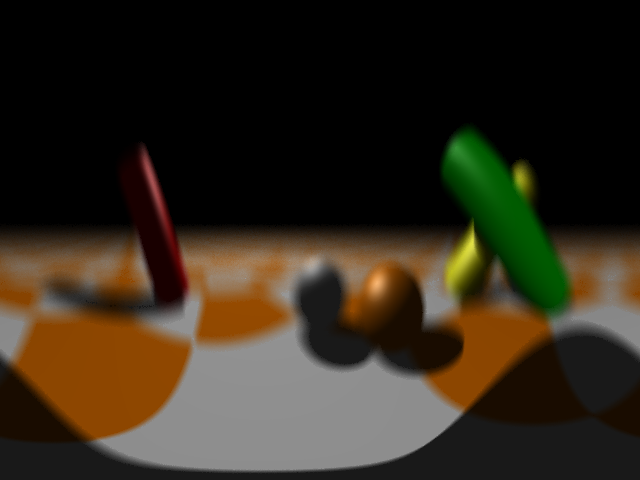
  What I did was to make a 2-frames animation: The first frame creates the
environment map using the spherical camera and focal blur (as many guessed).
(Of course focal blur doesn't work with the spherical camera in the current
POV-Ray, as I have reported in p.b-t, so I had to fix it before I could make
this image.) The camera was located in the center of the sphere and the
sphere just had a no_image specified to it (it had to be there for the
shadow).
  The second frame of this "animation" loads the first frame and puts it
as a sky_sphere (I could do this because the sky is not seen directly in the
image). All the other objects now get the no_reflection tag so that the sphere
will reflect the sky_sphere instead.
  And that's it.
  (If you wonder if this environment map trick would work with other objects
than just a sphere, the answer is yes. As I said before, this is a pretty
common technique used in scanline-rendering to add "reflections" to any
object. It's just that all the other objects have to be far enough for it
to look good.)

  And here is the first frame of the animation, ie. the environment map:
Post a reply to this message
Attachments:
Download 'envmap.png' (114 KB)
Preview of image 'envmap.png'
|
|
| |
| |
|
|
From: Slime
Subject: Re: The answer (Was: A different approach to blurred reflection (PNG, 80kbu))
Date: 19 Oct 2001 16:31:00
Message: <3bd08d84$1@news.povray.org>
|
|
|
| |
| |
|
|
Interesting idea. The major flaw being, it seems, that the reflection isn't
coming from the point where the ray from the camera intersected the sphere;
rather, it's always coming from the center of the sphere. Which is a good
enough approximation, I assume, if the reflected objects are far enough away
from the sphere that the diference isn't noticeable.

But does focal blur blur objects the same amount at the same distance that
regular reflection blur would do?

- Slime
[ http://www.slimeland.com/ ]
[ http://www.slimeland.com/images/ ]

"Warp" <war### [at] tagpovrayorg> wrote in message
news:3bd0823b@news.povray.org...
>   I used a technique pretty common in scanline-rendering for "faking" fast
> reflections: Environment mapping.
>   In environment mapping a spherical view of the scene from the point of
view
> of the object is first created and then, when the object is rendered, its
> surface color is blended with the environment map with an algorithm pretty
> similar to raytracing (the environment map acts like a sky_sphere and
"rays"
> are reflected from the surface of the object to this sky sphere; of course
> no real "rays" need to be shot, but just calculate the point where the
> "reflected ray" would hit the sky sphere and take the proper color from
the
> environment map).
>   Environment mapping works well only if the other objects in the scene
are
> far enough from the object. If there are objects too close, they will be
> distorted in unnatural ways in the "reflection" (as can be seen for
example
> in the reflected checkered floor in my image).
>   Also environment mapping in scanline rendering doesn't work well with
> self-reflecting objects nor mutually reflecting objects (but it *does*
work
> in raytracing!).
>   (A variant of this is to use cube mapping, which is basically the same
thing,
> but the "sky sphere" is a cube instead. The advantage of this is that the
> environment map is much easier to calculate by scanline rendering.)
>
>   What I did was to make a 2-frames animation: The first frame creates the
> environment map using the spherical camera and focal blur (as many
guessed).
> (Of course focal blur doesn't work with the spherical camera in the
current
> POV-Ray, as I have reported in p.b-t, so I had to fix it before I could
make
> this image.) The camera was located in the center of the sphere and the
> sphere just had a no_image specified to it (it had to be there for the
> shadow).
>   The second frame of this "animation" loads the first frame and puts it
> as a sky_sphere (I could do this because the sky is not seen directly in
the
> image). All the other objects now get the no_reflection tag so that the
sphere
> will reflect the sky_sphere instead.
>   And that's it.
>   (If you wonder if this environment map trick would work with other
objects
> than just a sphere, the answer is yes. As I said before, this is a pretty
> common technique used in scanline-rendering to add "reflections" to any
> object. It's just that all the other objects have to be far enough for it
> to look good.)
>
>   And here is the first frame of the animation, ie. the environment map:
>
>


----------------------------------------------------------------------------
----


>
>
> --
> #macro N(D,I)#if(I<6)cylinder{M()#local D[I]=div(D[I],104);M().5,2pigment{
> rgb M()}}N(D,(D[I]>99?I:I+1))#end#end#macro M()<mod(D[I],13)-6,mod(div(D[I
> ],13),8)-3,10>#end blob{N(array[6]{11117333955,
> 7382340,3358,3900569407,970,4254934330},0)}//                     - Warp -
Post a reply to this message
|
|
| |
| |
|
|
From: Trevor Quayle
Subject: Re: The answer (Was: A different approach to blurred reflection (PNG, 80kbu))
Date: 19 Oct 2001 16:45:11
Message: <3bd090d7$1@news.povray.org>
|
|
|
| |
| |
|
|
I thought maybe something like that, until you said it wasn't an image map.

-tgq
Post a reply to this message
|
|
| |
| |
|
|
From: Christoph Hormann
Subject: Re: The answer (Was: A different approach to blurred reflection (PNG, 80kbu))
Date: 19 Oct 2001 17:00:57
Message: <3BD094A1.A042397A@gmx.de>
|
|
|
| |
| |
|
|
Warp wrote:
>
>   I used a technique pretty common in scanline-rendering for "faking" fast
> reflections: Environment mapping.
> [...]

About what i said, just somehow the other way round... ;-)

Christoph

--
Christoph Hormann <chr### [at] gmxde>
IsoWood include, radiosity tutorial, TransSkin and other
things on: http://www.schunter.etc.tu-bs.de/~chris/
Post a reply to this message
|
|
| |
| |
|
|
From: David Fontaine
Subject: Re: The answer (Was: A different approach to blurred reflection (PNG, 80kbu))
Date: 20 Oct 2001 00:14:33
Message: <3BD0FAE6.8CD16B09@faricy.net>
|
|
|
| |
| |
|
|
Warp wrote:
>
>   What I did was to make a 2-frames animation: The first frame creates the
> environment map using the spherical camera and focal blur (as many guessed).

But, in a way, doesn't focal blur include aa?

--
David Fontaine  <dav### [at] faricynet>  ICQ 55354965
My raytracing gallery:  http://davidf.faricy.net/
Post a reply to this message
|
|
| |
| |
|
|
From: Ron Parker
Subject: Re: The answer (Was: A different approach to blurred reflection (PNG, 80kbu))
Date: 20 Oct 2001 00:34:51
Message: <slrn9t1veu.ipl.ron.parker@fwi.com>
|
|
|
| |
| |
|
|
On 19 Oct 2001 15:42:53 -0400, Warp wrote:
>  The second frame of this "animation" loads the first frame and puts it
>as a sky_sphere (I could do this because the sky is not seen directly in the
>image). All the other objects now get the no_reflection tag so that the sphere
>will reflect the sky_sphere instead.

Couldn't you just use the first frame as a pigment for the sphere?

--
#local R=rgb 99;#local P=R-R;#local F=pigment{gradient x}box{0,1pigment{gradient
y pigment_map{[.5F pigment_map{[.3R][.3F color_map{[.15red 99][.15P]}rotate z*45
translate x]}]#local H=pigment{gradient y color_map{[.5P][.5R]}scale 1/3}[.5F
pigment_map{[.3R][.3H][.7H][.7R]}]}}}camera{location.5-3*z}//only my opinions
Post a reply to this message
|
|
| |
| |
|
|
|
|
| |
| |
|
|
Trevor Quayle <Tin### [at] hotmailcom> wrote:
: I thought maybe something like that, until you said it wasn't an image map.

  I said that it wasn't an image map applied to the sphere and the sphere
is truely reflective and has just a pigment { rgb <1,.8,.6> }.

--
#macro N(D,I)#if(I<6)cylinder{M()#local D[I]=div(D[I],104);M().5,2pigment{
rgb M()}}N(D,(D[I]>99?I:I+1))#end#end#macro M()<mod(D[I],13)-6,mod(div(D[I
],13),8)-3,10>#end blob{N(array[6]{11117333955,
7382340,3358,3900569407,970,4254934330},0)}//                     - Warp -
Post a reply to this message
|
|
| |
| |
|
|
|
|
| |
| |
|
|
Christoph Hormann <chr### [at] gmxde> wrote:
: About what i said, just somehow the other way round... ;-)

  Yes, but the image map is not applied to the sphere (if you apply the image
map to the sphere, it doesn't look nothing like a reflection anymore).

--
#macro N(D,I)#if(I<6)cylinder{M()#local D[I]=div(D[I],104);M().5,2pigment{
rgb M()}}N(D,(D[I]>99?I:I+1))#end#end#macro M()<mod(D[I],13)-6,mod(div(D[I
],13),8)-3,10>#end blob{N(array[6]{11117333955,
7382340,3358,3900569407,970,4254934330},0)}//                     - Warp -
Post a reply to this message
|
|
| |
| |
|
|
|
|
| |
| |
|
|
Ron Parker <ron### [at] povrayorg> wrote:
: Couldn't you just use the first frame as a pigment for the sphere?

  Nope. If I did, then it wouldn't "reflect" its surroundings, but the
surroundings would be projected on the surface of the sphere, which is a
completely different thing (and looks like that).
  Also it would not work with any other object than the sphere. As I said,
the environment mapping technique works with other shapes as well.

--
#macro N(D,I)#if(I<6)cylinder{M()#local D[I]=div(D[I],104);M().5,2pigment{
rgb M()}}N(D,(D[I]>99?I:I+1))#end#end#macro M()<mod(D[I],13)-6,mod(div(D[I
],13),8)-3,10>#end blob{N(array[6]{11117333955,
7382340,3358,3900569407,970,4254934330},0)}//                     - Warp -
Post a reply to this message
|
|
| |
| |
|
|
|
|
| |
|
|