|
|
|
|
|
|
| |
| |
|
|
|
|
| |
| |
|
|
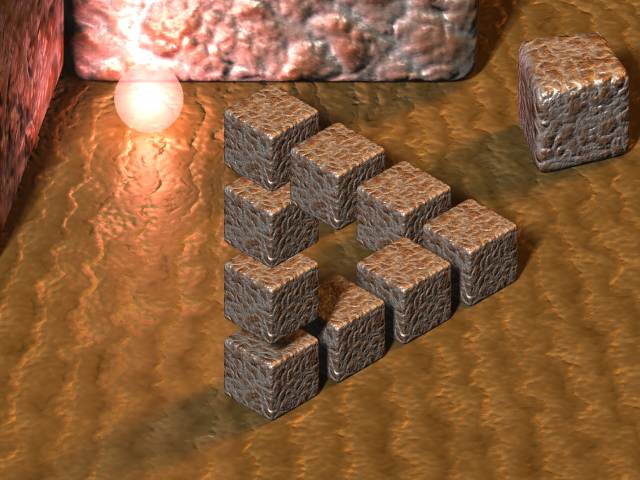
The impossible triangle with cubes was first invented by the
Swedish artist Oscar Reutersvard back in 1934.

  This image has two tricks. The first one is obvious (the triangle). But
there's another trick which may not be obvious. Can you guess what it is?
Post a reply to this message
Attachments:
Download 'ImpossibleTriangle.jpg' (48 KB)
Preview of image 'ImpossibleTriangle.jpg'
|
|
| |
| |
|
|
|
|
| |
| |
|
|
The boxes which are more distant from the camera are bigger (so that they
all look the same size)?
BTW great effect!
Jonathan
"Warp" <war### [at] tag povrayorg> ha scritto nel messaggio
news:3b45f0cf@news.povray.org...
> The impossible triangle with cubes was first invented by the
> Swedish artist Oscar Reutersvard back in 1934.
>
> This image has two tricks. The first one is obvious (the triangle). But
> there's another trick which may not be obvious. Can you guess what it is?
>
>
----------------------------------------------------------------------------
----
>
>
> --
> #macro N(D,I)#if(I<6)cylinder{M()#local D[I]=div(D[I],104);M().5,2pigment{
> rgb M()}}N(D,(D[I]>99?I:I+1))#end#end#macro M()<mod(D[I],13)-6,mod(div(D[I
> ],13),8)-3,10>#end blob{N(array[6]{11117333955,
> 7382340,3358,3900569407,970,4254934330},0)}// - Warp - povrayorg> ha scritto nel messaggio
news:3b45f0cf@news.povray.org...
> The impossible triangle with cubes was first invented by the
> Swedish artist Oscar Reutersvard back in 1934.
>
> This image has two tricks. The first one is obvious (the triangle). But
> there's another trick which may not be obvious. Can you guess what it is?
>
>
----------------------------------------------------------------------------
----
>
>
> --
> #macro N(D,I)#if(I<6)cylinder{M()#local D[I]=div(D[I],104);M().5,2pigment{
> rgb M()}}N(D,(D[I]>99?I:I+1))#end#end#macro M()<mod(D[I],13)-6,mod(div(D[I
> ],13),8)-3,10>#end blob{N(array[6]{11117333955,
> 7382340,3358,3900569407,970,4254934330},0)}// - Warp -
Post a reply to this message
|
|
| |
| |
|
|
|
|
| |
| |
|
|
The big block in the background is actually the same size as the blocks in
the triangle?

"Warp" <war### [at] tagpovrayorg> wrote in message
news:3b45f0cf@news.povray.org...
>   The impossible triangle with cubes was first invented by the
> Swedish artist Oscar Reutersvard back in 1934.
>
>   This image has two tricks. The first one is obvious (the triangle). But
> there's another trick which may not be obvious. Can you guess what it is?
>
>


----------------------------------------------------------------------------
----


>
>
> --
> #macro N(D,I)#if(I<6)cylinder{M()#local D[I]=div(D[I],104);M().5,2pigment{
> rgb M()}}N(D,(D[I]>99?I:I+1))#end#end#macro M()<mod(D[I],13)-6,mod(div(D[I
> ],13),8)-3,10>#end blob{N(array[6]{11117333955,
> 7382340,3358,3900569407,970,4254934330},0)}//                     - Warp -
Post a reply to this message
|
|
| |
| |
|
|
|
|
| |
| |
|
|
In article <3b45f0cf@news.povray.org>, Warp says...
>   The impossible triangle with cubes was first invented by the
> Swedish artist Oscar Reutersvard back in 1934.
>
>   This image has two tricks. The first one is obvious (the triangle). But
> there's another trick which may not be obvious. Can you guess what it is?
>
The image wasn't done with POV alone, but you used some image editor,
right??
--
Regards,  Sander
Post a reply to this message
|
|
| |
| |
|
|
|
|
| |
| |
|
|
Sander <san### [at] stolscom> wrote:
: The image wasn't done with POV alone, but you used some image editor,
: right??

  A suggestion like this is a great offence. I would never go that low!

  The image is made entirely with (hand-coded) POV-Ray code and one render,
and no external files. All the objects in the image are real 3D primitives
and all textures are regular POV-Ray procedural textures (eg. no image maps
nor anything).

--
#macro N(D,I)#if(I<6)cylinder{M()#local D[I]=div(D[I],104);M().5,2pigment{
rgb M()}}N(D,(D[I]>99?I:I+1))#end#end#macro M()<mod(D[I],13)-6,mod(div(D[I
],13),8)-3,10>#end blob{N(array[6]{11117333955,
7382340,3358,3900569407,970,4254934330},0)}//                     - Warp -
Post a reply to this message
|
|
| |
| |
|
|
|
|
| |
| |
|
|
JRG <jrg### [at] hotmailcom> wrote:
: The boxes which are more distant from the camera are bigger (so that they
: all look the same size)?

  Well, no. The second trick isn't related to that.

: BTW great effect!

  Thanks.

--
#macro N(D,I)#if(I<6)cylinder{M()#local D[I]=div(D[I],104);M().5,2pigment{
rgb M()}}N(D,(D[I]>99?I:I+1))#end#end#macro M()<mod(D[I],13)-6,mod(div(D[I
],13),8)-3,10>#end blob{N(array[6]{11117333955,
7382340,3358,3900569407,970,4254934330},0)}//                     - Warp -
Post a reply to this message
|
|
| |
| |
|
|
|
|
| |
| |
|
|
Thomas Lake <tla### [at] homecom> wrote:
: The big block in the background is actually the same size as the blocks in
: the triangle?

  Nope. It's truely bigger (in fact, exactly 6 times).

--
#macro N(D,I)#if(I<6)cylinder{M()#local D[I]=div(D[I],104);M().5,2pigment{
rgb M()}}N(D,(D[I]>99?I:I+1))#end#end#macro M()<mod(D[I],13)-6,mod(div(D[I
],13),8)-3,10>#end blob{N(array[6]{11117333955,
7382340,3358,3900569407,970,4254934330},0)}//                     - Warp -
Post a reply to this message
|
|
| |
| |
|
|
|
|
| |
| |
|
|
The shadows go the opposite direction to the visible light source??

Nice pic btw :)

Dave


"Warp" <war### [at] tagpovrayorg> wrote in message
news:3b45f0cf@news.povray.org...
>   The impossible triangle with cubes was first invented by the
> Swedish artist Oscar Reutersvard back in 1934.
>
>   This image has two tricks. The first one is obvious (the triangle). But
> there's another trick which may not be obvious. Can you guess what it is?
>
>


----------------------------------------------------------------------------
----


>
>
> --
> #macro N(D,I)#if(I<6)cylinder{M()#local D[I]=div(D[I],104);M().5,2pigment{
> rgb M()}}N(D,(D[I]>99?I:I+1))#end#end#macro M()<mod(D[I],13)-6,mod(div(D[I
> ],13),8)-3,10>#end blob{N(array[6]{11117333955,
> 7382340,3358,3900569407,970,4254934330},0)}//                     - Warp -
Post a reply to this message
|
|
| |
| |
|
|
|
|
| |
| |
|
|
Davey B <kry### [at] totalisecouk*nospam*> wrote:
: The shadows go the opposite direction to the visible light source??

  Nope. There are two light sources, and nothing special is related to them.

--
#macro N(D,I)#if(I<6)cylinder{M()#local D[I]=div(D[I],104);M().5,2pigment{
rgb M()}}N(D,(D[I]>99?I:I+1))#end#end#macro M()<mod(D[I],13)-6,mod(div(D[I
],13),8)-3,10>#end blob{N(array[6]{11117333955,
7382340,3358,3900569407,970,4254934330},0)}//                     - Warp -
Post a reply to this message
|
|
| |
| |
|
|
|
|
| |
| |
|
|
In article <3b463501@news.povray.org>, Warp says...
> Sander <san### [at] stolscom> wrote:
> : The image wasn't done with POV alone, but you used some image editor,
> : right??
>
>   A suggestion like this is a great offence. I would never go that low!
>
>   The image is made entirely with (hand-coded) POV-Ray code and one render,
> and no external files. All the objects in the image are real 3D primitives
> and all textures are regular POV-Ray procedural textures (eg. no image maps
> nor anything).
>
No offence meant and intended: I stupidly forgot the :) in my reply.
When I look at the left vertical vertices of the vertical stack of cubes
I get the impression that there is a lack of AA, as if these cubes have
been cut out and pasted. That made me make my offensive remark...
But I suppose there are other reasons for this to happen :))))
--
Regards,  Sander
Post a reply to this message
|
|
| |
| |
|
|
|
|
| |
| |
|
|
In article <3b463501@news.povray.org>, Warp says...
>   The image is made entirely with (hand-coded) POV-Ray code and one render,
> and no external files. All the objects in the image are real 3D primitives
> and all textures are regular POV-Ray procedural textures (eg. no image maps
> nor anything).
>
You have used an orthogonal camera?

--
Regards,  Sander
Post a reply to this message
|
|
| |
| |
|
|
|
|
| |
| |
|
|
In article <MPG### [at] NEWSPOVRAYORG>, Sander says...
> In article <3b463501@news.povray.org>, Warp says...
> >   The image is made entirely with (hand-coded) POV-Ray code and one render,
> > and no external files. All the objects in the image are real 3D primitives
> > and all textures are regular POV-Ray procedural textures (eg. no image maps
> > nor anything).
> >
> You have used an orthogonal camera?
>
If I draw a triangle called A aroud the "impossible triangle" and I
rotate a copy of this triangle, called B, 120 degrees, B nearly
perfectly overlaps A. This can only be so if you use an orthogonal
camera, right?
--
Regards,  Sander
Post a reply to this message
|
|
| |
| |
|
|
|
|
| |
| |
|
|
In article <3b463501@news.povray.org>, Warp says...
>   The image is made entirely with (hand-coded) POV-Ray code and one render,
> and no external files. All the objects in the image are real 3D primitives
> and all textures are regular POV-Ray procedural textures (eg. no image maps
> nor anything).
>
If you call the four "vertical" cubes for the sake of argument from top
to bottom a, b, c, and d, then c throws a shadow onto d, but a does not
onto b and b does not onto c. This is unreal, so here must lie the
sulution. I still don't see it, however. Clever!

--
Regards,  Sander
Post a reply to this message
|
|
| |
| |
|
|
|
|
| |
| |
|
|
Sander <san### [at] stolscom> wrote:
: If I draw a triangle called A aroud the "impossible triangle" and I
: rotate a copy of this triangle, called B, 120 degrees, B nearly
: perfectly overlaps A. This can only be so if you use an orthogonal
: camera, right?

  You are getting closer.

--
#macro N(D,I)#if(I<6)cylinder{M()#local D[I]=div(D[I],104);M().5,2pigment{
rgb M()}}N(D,(D[I]>99?I:I+1))#end#end#macro M()<mod(D[I],13)-6,mod(div(D[I
],13),8)-3,10>#end blob{N(array[6]{11117333955,
7382340,3358,3900569407,970,4254934330},0)}//                     - Warp -
Post a reply to this message
|
|
| |
| |
|
|
|
|
| |
| |
|
|
Sander <san### [at] stolscom> wrote:
: If you call the four "vertical" cubes for the sake of argument from top
: to bottom a, b, c, and d, then c throws a shadow onto d, but a does not
: onto b and b does not onto c. This is unreal, so here must lie the
: sulution. I still don't see it, however. Clever!

  I just applied no_shadow to some of the cubes to avoid annoying shadows.

--
#macro N(D,I)#if(I<6)cylinder{M()#local D[I]=div(D[I],104);M().5,2pigment{
rgb M()}}N(D,(D[I]>99?I:I+1))#end#end#macro M()<mod(D[I],13)-6,mod(div(D[I
],13),8)-3,10>#end blob{N(array[6]{11117333955,
7382340,3358,3900569407,970,4254934330},0)}//                     - Warp -
Post a reply to this message
|
|
| |
| |
|
|
|
|
| |
| |
|
|
"Warp" <war### [at] tagpovrayorg> wrote in message
news:3b46fdb6@news.povray.org...
> Sander <san### [at] stolscom> wrote:
> : If I draw a triangle called A aroud the "impossible triangle" and I
> : rotate a copy of this triangle, called B, 120 degrees, B nearly
> : perfectly overlaps A. This can only be so if you use an orthogonal
> : camera, right?
>
>   You are getting closer.


      From what I remember of this triangle, it's the angle that it's viewed
at that produces the illusion. I suspect that if you change the camera angle
on this image, you would have an entirely different view of it, ie,
something like two upright bars at opposing 45 degree(?) angles, at the end
of a horizontal bar at the base?

      Close Warp?  It's doing my head in!  ;)

       Great image though.

    ~Steve~


>
> --
> #macro N(D,I)#if(I<6)cylinder{M()#local D[I]=div(D[I],104);M().5,2pigment{
> rgb M()}}N(D,(D[I]>99?I:I+1))#end#end#macro M()<mod(D[I],13)-6,mod(div(D[I
> ],13),8)-3,10>#end blob{N(array[6]{11117333955,
> 7382340,3358,3900569407,970,4254934330},0)}//                     - Warp -
Post a reply to this message
|
|
| |
| |
|
|
|
|
| |
| |
|
|
The most obvious trick in the image is, of course, the triangle itself
(one of the cubes is clipped by a plane so that the cube right behind it
shows up; also some of the cubes have a no_shadow applied to them in order
to avoid annoying and even revealing shadows).

  The other trick is, however, more difficult to see, and it's the apparent
perspective of the image.
  The camera is orthographic, so the perspective is fake.
  The pattern on the floor is not a gradient pattern, as it may seem, but
actually a radial pattern. The other cubes in the image are rotated so that
the look like they were "distorted" by the perspective althought they aren't.
The cube on the right is actually the intersection of two superellipsoids.


--
#macro N(D,I)#if(I<6)cylinder{M()#local D[I]=div(D[I],104);M().5,2pigment{
rgb M()}}N(D,(D[I]>99?I:I+1))#end#end#macro M()<mod(D[I],13)-6,mod(div(D[I
],13),8)-3,10>#end blob{N(array[6]{11117333955,
7382340,3358,3900569407,970,4254934330},0)}//                     - Warp -
Post a reply to this message
|
|
| |
| |
|
|
|
|
| |
| |
|
|
Clever!

I was trying to work out how you'd corrected the perspective on the triangle, so
all cubes appeared the same, but it never occured to me that you'd done the
exact opposite!

BTW, what's the texture on the cubes? It's pretty interesting.

--
Tek
http://www.evilsuperbrain.com


Warp <war### [at] tagpovrayorg> wrote in message news:3b471b43@news.povray.org...
>
>   The most obvious trick in the image is, of course, the triangle itself
> (one of the cubes is clipped by a plane so that the cube right behind it
> shows up; also some of the cubes have a no_shadow applied to them in order
> to avoid annoying and even revealing shadows).
>
>   The other trick is, however, more difficult to see, and it's the apparent
> perspective of the image.
>   The camera is orthographic, so the perspective is fake.
>   The pattern on the floor is not a gradient pattern, as it may seem, but
> actually a radial pattern. The other cubes in the image are rotated so that
> the look like they were "distorted" by the perspective althought they aren't.
> The cube on the right is actually the intersection of two superellipsoids.
>
>
> --
> #macro N(D,I)#if(I<6)cylinder{M()#local D[I]=div(D[I],104);M().5,2pigment{
> rgb M()}}N(D,(D[I]>99?I:I+1))#end#end#macro M()<mod(D[I],13)-6,mod(div(D[I
> ],13),8)-3,10>#end blob{N(array[6]{11117333955,
> 7382340,3358,3900569407,970,4254934330},0)}//                     - Warp -
Post a reply to this message
|
|
| |
| |
|
|
|
|
| |
| |
|
|
Tek <tek### [at] evilsuperbraincom> wrote:
: BTW, what's the texture on the cubes? It's pretty interesting.

  It's just a granite pigment with the same granite normal with a "sine wave"
slope map..

--
#macro N(D,I)#if(I<6)cylinder{M()#local D[I]=div(D[I],104);M().5,2pigment{
rgb M()}}N(D,(D[I]>99?I:I+1))#end#end#macro M()<mod(D[I],13)-6,mod(div(D[I
],13),8)-3,10>#end blob{N(array[6]{11117333955,
7382340,3358,3900569407,970,4254934330},0)}//                     - Warp -
Post a reply to this message
|
|
| |
| |
|
|
|
|
| |
| |
|
|
Warp wrote:
>
>   The impossible triangle with cubes was first invented by the
> Swedish artist Oscar Reutersvard back in 1934.
>
>   This image has two tricks. The first one is obvious (the triangle). But
> there's another trick which may not be obvious. Can you guess what it is?

The triangle is orthographic and the rest is not?

--
David Fontaine  <dav### [at] faricynet>  ICQ 55354965
My raytracing gallery:  http://davidf.faricy.net/
Post a reply to this message
|
|
| |
| |
|
|
|
|
| |
| |
|
|
Warp wrote:
>
>   The other trick is, however, more difficult to see, and it's the apparent
> perspective of the image.
>   The camera is orthographic, so the perspective is fake.

I was right!  :)

--
David Fontaine  <dav### [at] faricynet>  ICQ 55354965
My raytracing gallery:  http://davidf.faricy.net/
Post a reply to this message
|
|
| |
| |
|
|
|
|
| |
| |
|
|
David Fontaine <dav### [at] faricynet> wrote:
: The triangle is orthographic and the rest is not?

  Everything in the image is orthographic.
  I can't imagine any way of creating an orthographic and a perspective image
at the same time with one render and no external files... :)

  The background looks like it has perspective, but that's the fake. Things
are only rotated so that they look like that, and the pattern in the floor
is the radial pattern.

--
#macro N(D,I)#if(I<6)cylinder{M()#local D[I]=div(D[I],104);M().5,2pigment{
rgb M()}}N(D,(D[I]>99?I:I+1))#end#end#macro M()<mod(D[I],13)-6,mod(div(D[I
],13),8)-3,10>#end blob{N(array[6]{11117333955,
7382340,3358,3900569407,970,4254934330},0)}//                     - Warp -
Post a reply to this message
|
|
| |
| |
|
|
|
|
| |
| |
|
|
In article <3B478BDD.C5C48896@faricy.net>, David Fontaine says...
> Warp wrote:
> >
> >   The impossible triangle with cubes was first invented by the
> > Swedish artist Oscar Reutersvard back in 1934.
> >
> >   This image has two tricks. The first one is obvious (the triangle). But
> > there's another trick which may not be obvious. Can you guess what it is?
>
> The triangle is orthographic and the rest is not?
>
>
I was right first: beat you with about 10h 54m 32 s :))
--
Regards,  Sander
Post a reply to this message
|
|
| |
| |
|
|
|
|
| |
| |
|
|
In article <3b471b43@news.povray.org>, Warp says...
>
>   The most obvious trick in the image is, of course, the triangle itself
> (one of the cubes is clipped by a plane so that the cube right behind it
> shows up; also some of the cubes have a no_shadow applied to them in order
> to avoid annoying and even revealing shadows).
>
>   The other trick is, however, more difficult to see, and it's the apparent
> perspective of the image.
>   The camera is orthographic, so the perspective is fake.
>   The pattern on the floor is not a gradient pattern, as it may seem, but
> actually a radial pattern. The other cubes in the image are rotated so that
> the look like they were "distorted" by the perspective althought they aren't.
> The cube on the right is actually the intersection of two superellipsoids.
>
I was looking for a sign on one of the shadowless cubes where there
would be a break: stupid not to have thought of clipping...

Cleverly done, though :)
--
Regards,  Sander
Post a reply to this message
|
|
| |
| |
|
|
|
|
| |
| |
|
|
Warp wrote:
>
> David Fontaine <dav### [at] faricynet> wrote:
> : The triangle is orthographic and the rest is not?
>
>   Everything in the image is orthographic.
>   I can't imagine any way of creating an orthographic and a perspective image
> at the same time with one render and no external files... :)
>
>   The background looks like it has perspective, but that's the fake. Things
> are only rotated so that they look like that, and the pattern in the floor
> is the radial pattern.

Well, obviously you can't have both perspectives in the same render...
I thought perhaps you did perspective and faked the orthographic part so
they'd line up, but your way sounds easier.

--
David Fontaine  <dav### [at] faricynet>  ICQ 55354965
My raytracing gallery:  http://davidf.faricy.net/
Post a reply to this message
|
|
| |
| |
|
|
|
|
| |
| |
|
|
Fantastic Image!

I've read the explanations, looked again and again at the picture
and still don't understand all that was done.

I would love to see the .pov code that did this, but understand
completely if you were a bit "possessives" of this. Would you at least
consider a rendering from a different camera angle so those as
dense as I could begin to understand how you are managing such
a deceptive image?
Post a reply to this message
|
|
| |
| |
|
|
|
|
| |
|
|