|
|
|
|
|
|
| |
| |
|
|
|
|
| |
| |
|
|
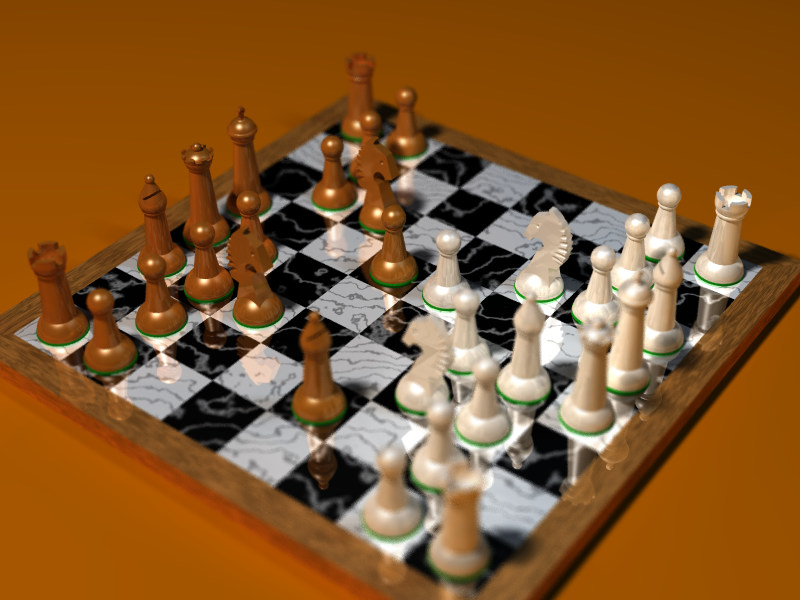
A chess set is not as classic as the reflective sphere on a checkered
plane, but it comes close. Thus I decided to make one myself.
  I made it completely from the scratch, all by hand and pure CSG (I have
played chess quite a lot and I know what the pieces look like, approximately
at least).

  Making a chess set is actually quite fun. I recommend it to everyone
who hasn't done one yet.
  It's not too difficult (the horse is the piece that requires most work,
as can see in my image as well).
  The set forms a very nice hierarcy of objects. In my set the base of each
piece is the same object; then I made colorless versions of each piece on
the base object, and then white and black versions of each piece. Then I
just copied the right number of pieces to the board.
  It's also easy to make a little macro that positions a piece on the board
given its coordinates. This way it's easy to actually "move" the pieces
on the board, as in actual playing.
Post a reply to this message
Attachments:
Download 'chess.jpg' (100 KB)
Preview of image 'chess.jpg'
|
|
| |
| |
|
|
|
|
| |
| |
|
|
what would be really cool is a macro that could translate from shorthand
chess notation to create a full on animation of an entire game. Add a
swooping camera, and some notation from famous games (deep blue vs issac
asimov)  and you got yourself a pretty cool pov script there.

Warp wrote:

>   A chess set is not as classic as the reflective sphere on a checkered
> plane, but it comes close. Thus I decided to make one myself.
>   I made it completely from the scratch, all by hand and pure CSG (I have
> played chess quite a lot and I know what the pieces look like, approximately
> at least).
>
>   Making a chess set is actually quite fun. I recommend it to everyone
> who hasn't done one yet.
>   It's not too difficult (the horse is the piece that requires most work,
> as can see in my image as well).
>   The set forms a very nice hierarcy of objects. In my set the base of each
> piece is the same object; then I made colorless versions of each piece on
> the base object, and then white and black versions of each piece. Then I
> just copied the right number of pieces to the board.
>   It's also easy to make a little macro that positions a piece on the board
> given its coordinates. This way it's easy to actually "move" the pieces
> on the board, as in actual playing.
>
>
> chess.jpg
>
> Content-Type:
>
> image/jpeg
> Content-Encoding:
>
> x-uuencode
>
>
> ------------------------------------------------------------------------
> attachment.txt
>
> Content-Type:
>
> text/plain
Post a reply to this message
|
|
| |
| |
|
|
|
|
| |
| |
|
|
ZenPsycho <Zen### [at] yahoo com> wrote:
: what would be really cool is a macro that could translate from shorthand
: chess notation to create a full on animation of an entire game.
That shouldn't be too hard.
: Add a swooping camera
I don't think a moving camera is a good idea in this kind of very long
animation unless you have hundreds of megabytes of free disk space :)
--
#macro N(D,I)#if(I<6)cylinder{M()#local D[I]=div(D[I],104);M().5,2pigment{
rgb M()}}N(D,(D[I]>99?I:I+1))#end#end#macro M()<mod(D[I],13)-6,mod(div(D[I
],13),8)-3,10>#end blob{N(array[6]{11117333955,
7382340,3358,3900569407,970,4254934330},0)}// - Warp -
Post a reply to this message
|
|
| |
| |
|
|
|
|
| |
| |
|
|
I really like this.  I'm not thrilled with the marble texture though, too
sharp and the lines are so continuous I think is why.  Those reflections
going into sharp focus due to the different camera to object distances is a
neat effect (or reality?).

Bob H.

"Warp" <war### [at] tagpovrayorg> wrote in message
news:3af5c7c9@news.povray.org...
>   A chess set is not as classic as the reflective sphere on a checkered
> plane, but it comes close. Thus I decided to make one myself.
>   I made it completely from the scratch, all by hand and pure CSG (I have
> played chess quite a lot and I know what the pieces look like,
approximately
> at least).
>
>   Making a chess set is actually quite fun. I recommend it to everyone
> who hasn't done one yet.
>   It's not too difficult (the horse is the piece that requires most work,
> as can see in my image as well).
>   The set forms a very nice hierarcy of objects. In my set the base of
each
> piece is the same object; then I made colorless versions of each piece on
> the base object, and then white and black versions of each piece. Then I
> just copied the right number of pieces to the board.
>   It's also easy to make a little macro that positions a piece on the
board
> given its coordinates. This way it's easy to actually "move" the pieces
> on the board, as in actual playing.
>
>


----------------------------------------------------------------------------
----


>
>
> --
> #macro N(D,I)#if(I<6)cylinder{M()#local D[I]=div(D[I],104);M().5,2pigment{
> rgb M()}}N(D,(D[I]>99?I:I+1))#end#end#macro M()<mod(D[I],13)-6,mod(div(D[I
> ],13),8)-3,10>#end blob{N(array[6]{11117333955,
> 7382340,3358,3900569407,970,4254934330},0)}//                     - Warp -
Post a reply to this message
|
|
| |
| |
|
|
|
|
| |
| |
|
|
"Warp" <war### [at] tagpovrayorg> wrote in message
news:3af5e0b5@news.povray.org...
> ZenPsycho <Zen### [at] yahoocom> wrote:
> : what would be really cool is a macro that could translate from shorthand
> : chess notation to create a full on animation of an entire game.
>
>   That shouldn't be too hard.

Depending on how long it takes to render I think you could make a chess game
out of this that povers could play.

Nekar
Post a reply to this message
|
|
| |
| |
|
|
|
|
| |
| |
|
|
5....(black)d7 to d6

Nice set.

--
Phil
...coffee?...yes please! extra sugar,extra cream...Thank you.
Post a reply to this message
|
|
| |
| |
|
|
|
|
| |
| |
|
|
I think the objects are nice but the focal-blur are overdriven and
annoys me.

Apart from that, let me use this chance to remind everyone to BACKUP
their files regulary as I just lost all my POV-work due to a harddisk
crash.

Hugo
Post a reply to this message
|
|
| |
| |
|
|
|
|
| |
| |
|
|
very nice - as with bob, think the marble needs work - maybe cracks


--
Rick

Kitty5 WebDesign - http://Kitty5.com
Hi-Impact database driven web site design & e-commerce
TEL : +44 (01625) 266358 - FAX : +44 (01625) 611913 - ICQ : 15776037
POV-Ray News & Resources - http://Povray.co.uk

PGP Public Key
http://pgpkeys.mit.edu:11371/pks/lookup?op=get&search=0x231E1CEA
Post a reply to this message
|
|
| |
| |
|
|
|
|
| |
| |
|
|
Warp:
That is a beautiful chess set. Very nice job on the Knight, which is of
course
the most challenging piece. I don't like the focal blur however, it is too
much.
You wouldn't get that much focal blur with a real camera unless you had a
bad lens with wide open aperture. From a purely aesthetic point it is too
noticeable and detracts from the image. Maybe you could just reduce it a
little.

Harold
Post a reply to this message
|
|
| |
| |
|
|
|
|
| |
| |
|
|
Warp wrote:
>
> ZenPsycho <Zen### [at] yahoocom> wrote:
> : Add a swooping camera
>
>   I don't think a moving camera is a good idea in this kind of very
> long animation unless you have hundreds of megabytes of free disk
> space :)

It depends on how quickly the camera moves.  In my IRTC anims, the
camera is often moved slowly (say 1 to 3 cm per second), just to keep
otherwise-still shots interesting.  It does boost the files size, but
not by very much.

Regards,
John
--
ICQ: 46085459
Post a reply to this message
|
|
| |
| |
|
|
|
|
| |
| |
|
|
I agree that animations take up large amounts of hard disk, but the limiting
factor is the number of frames you generate, not the camera movement.
Right?

Harold

"Warp" <war### [at] tagpovrayorg> wrote in message
news:3af5e0b5@news.povray.org...
> ZenPsycho <Zen### [at] yahoocom> wrote:
>
>   I don't think a moving camera is a good idea in this kind of very long
> animation unless you have hundreds of megabytes of free disk space :)
>
>- Warp -
Post a reply to this message
|
|
| |
| |
|
|
|
|
| |
| |
|
|
to give your game the human touch, randomly position each piece within
its square and give it a random twist on its vertical axis.  in other
words, no human could place all of the pieces in the exact center of
each square and facing exactly forward.  nice job btw. :)

Warp wrote:
>
>   A chess set is not as classic as the reflective sphere on a checkered
> plane, but it comes close. Thus I decided to make one myself.
>   I made it completely from the scratch, all by hand and pure CSG (I have
> played chess quite a lot and I know what the pieces look like, approximately
> at least).
>
>   Making a chess set is actually quite fun. I recommend it to everyone
> who hasn't done one yet.
>   It's not too difficult (the horse is the piece that requires most work,
> as can see in my image as well).
>   The set forms a very nice hierarcy of objects. In my set the base of each
> piece is the same object; then I made colorless versions of each piece on
> the base object, and then white and black versions of each piece. Then I
> just copied the right number of pieces to the board.
>   It's also easy to make a little macro that positions a piece on the board
> given its coordinates. This way it's easy to actually "move" the pieces
> on the board, as in actual playing.
>
>                 Name: chess.jpg
>    chess.jpg    Type: Postscript Document (application/postscript)
>             Encoding: x-uuencode
>
> --
> #macro N(D,I)#if(I<6)cylinder{M()#local D[I]=div(D[I],104);M().5,2pigment{
> rgb M()}}N(D,(D[I]>99?I:I+1))#end#end#macro M()<mod(D[I],13)-6,mod(div(D[I
> ],13),8)-3,10>#end blob{N(array[6]{11117333955,
> 7382340,3358,3900569407,970,4254934330},0)}//                     - Warp -
Post a reply to this message
|
|
| |
| |
|
|
|
|
| |
| |
|
|
I guess you don't play chess with obsessive compulsives very often ;-)
Harolddd


"Ryan Constantine" <rco### [at] yahoocom> wrote in message
news:3AF72E9A.2209030E@yahoo.com...
> to give your game the human touch, randomly position each piece within
> its square and give it a random twist on its vertical axis.  in other
> words, no human could place all of the pieces in the exact center of
> each square and facing exactly forward.  nice job btw. :)
>
Post a reply to this message
|
|
| |
| |
|
|
|
|
| |
| |
|
|
"Harold Baize" <bai### [at] itsaucsfedu> wrote in message
news:3af732a8@news.povray.org...
> I guess you don't play chess with obsessive compulsives very often ;-)

Ha! I wish I had said that.
I'm just such a person sometimes.  A chess set in particular must be exactly
aligned at the start.  I can lose to a 10 year old so unfortunately that
doesn't mean I can play well.

> "Ryan Constantine" <rco### [at] yahoocom> wrote in message
> news:3AF72E9A.2209030E@yahoo.com...
> > to give your game the human touch, randomly position each piece within
> > its square and give it a random twist on its vertical axis.  in other
> > words, no human could place all of the pieces in the exact center of
> > each square and facing exactly forward.  nice job btw. :)

I like both kinds of setup; erratic or immaculate, either way.  Yet another
reason to do 3D rendering.
About the focal blurring maybe being overdone, I think of that in the same
way.  Or it has something to do with my eyesight and not always wearing my
glasses.

Bob H.
Post a reply to this message
|
|
| |
| |
|
|
|
|
| |
| |
|
|
Harold Baize <bai### [at] itsaucsfedu> wrote:
: I agree that animations take up large amounts of hard disk, but the limiting
: factor is the number of frames you generate, not the camera movement.
: Right?

  Wrong. Most compressing animation formats take advantage of previous
(and sometimes next) frames in order to compress the current frame.
  This means that the less things change from frame to frame, the more
compression can be achieved.
  If you move the camera, virtually everything in the image changes, thus
resulting in less compression.

--
#macro N(D,I)#if(I<6)cylinder{M()#local D[I]=div(D[I],104);M().5,2pigment{
rgb M()}}N(D,(D[I]>99?I:I+1))#end#end#macro M()<mod(D[I],13)-6,mod(div(D[I
],13),8)-3,10>#end blob{N(array[6]{11117333955,
7382340,3358,3900569407,970,4254934330},0)}//                     - Warp -
Post a reply to this message
|
|
| |
| |
|
|
|
|
| |
| |
|
|
Well wrong is some respects, but not as most people who animate with
POV-Ray are concerned. I think most of us render all the frames before
compression, and that is what eats up disk space, not the final animation
file. I know how video compression works. I recently animated (with POV)
a rotating factor structure from a factor analysis of a children's mental
health outcomes measure. I made 360 640x480 frames, so it was about
to 330MB before making an AVI file. Some programs, like Hash
Animation:Master will render directly to an animation so you don't chew
up so much disk space in the process. It is the pre-compression phase that
makes disk space a limiting factor, not the relatively small difference in
final
file size that camera movement contributes, even if it increases the final
animation file by a factor of four.

Harold

>   Wrong. Most compressing animation formats take advantage of previous
> (and sometimes next) frames in order to compress the current frame.
>   This means that the less things change from frame to frame, the more
> compression can be achieved.
>   If you move the camera, virtually everything in the image changes, thus
> resulting in less compression.
Post a reply to this message
|
|
| |
| |
|
|
|
|
| |
| |
|
|
'perfectly aligned' by a human still isn't perfect.  iirc, we can see
down to about 4/1000 of an inch which is pretty small, but that doesn't
mean we can make our hands move things by such slight amounts.  you
would still need a robot to position the pieces 'exactly'.  so even the
obsessive compulsive couldn't position them exactly.  there would simply
be less jitter, in which case a positioning macro could have several
jitter settings: near perfect, regular, or sloppy.

"Bob H." wrote:
>
> "Harold Baize" <bai### [at] itsaucsfedu> wrote in message
> news:3af732a8@news.povray.org...
> > I guess you don't play chess with obsessive compulsives very often ;-)
>
> Ha! I wish I had said that.
> I'm just such a person sometimes.  A chess set in particular must be exactly
> aligned at the start.  I can lose to a 10 year old so unfortunately that
> doesn't mean I can play well.
>
> > "Ryan Constantine" <rco### [at] yahoocom> wrote in message
> > news:3AF72E9A.2209030E@yahoo.com...
> > > to give your game the human touch, randomly position each piece within
> > > its square and give it a random twist on its vertical axis.  in other
> > > words, no human could place all of the pieces in the exact center of
> > > each square and facing exactly forward.  nice job btw. :)
>
> I like both kinds of setup; erratic or immaculate, either way.  Yet another
> reason to do 3D rendering.
> About the focal blurring maybe being overdone, I think of that in the same
> way.  Or it has something to do with my eyesight and not always wearing my
> glasses.
>
> Bob H.
Post a reply to this message
|
|
| |
| |
|
|
|
|
| |
| |
|
|
"Ryan Constantine" <rcc### [at] ucdavisedu> wrote in message
news:3AF9699E.FCDBEA61@ucdavis.edu...
> 'perfectly aligned' by a human still isn't perfect.  iirc, we can see
> down to about 4/1000 of an inch which is pretty small, but that doesn't
> mean we can make our hands move things by such slight amounts.  you
> would still need a robot to position the pieces 'exactly'.

Okay, but for 3D modelling I'd be willing to bet the typical render
resolution disallows that accuracy with which you say a human can manage.
Or would I lose that bet?  Hmmm.  1/250 of an inch on a 19" screen at
1024x768 for example?  I think that's about 70 pixels per inch... maybe, or
something like 1/70 an inch of accuracy possible.

Bob H.
Post a reply to this message
|
|
| |
| |
|
|
|
|
| |
| |
|
|
unless you render higher than your screen resolution for print
purposes.  but, you did say 'typical' render resolutions.  my typical
final resolution is always print quality however.

"Bob H." wrote:
>
> "Ryan Constantine" <rcc### [at] ucdavisedu> wrote in message
> news:3AF9699E.FCDBEA61@ucdavis.edu...
> > 'perfectly aligned' by a human still isn't perfect.  iirc, we can see
> > down to about 4/1000 of an inch which is pretty small, but that doesn't
> > mean we can make our hands move things by such slight amounts.  you
> > would still need a robot to position the pieces 'exactly'.
>
> Okay, but for 3D modelling I'd be willing to bet the typical render
> resolution disallows that accuracy with which you say a human can manage.
> Or would I lose that bet?  Hmmm.  1/250 of an inch on a 19" screen at
> 1024x768 for example?  I think that's about 70 pixels per inch... maybe, or
> something like 1/70 an inch of accuracy possible.
>
> Bob H.
Post a reply to this message
|
|
| |
| |
|
|
|
|
| |
| |
|
|
Bob H. <omn### [at] msncom> wrote:
: Okay, but for 3D modelling I'd be willing to bet the typical render
: resolution disallows that accuracy with which you say a human can manage.

  That's what antialiasing is for. It calculates sub-pixel information.

--
#macro N(D,I)#if(I<6)cylinder{M()#local D[I]=div(D[I],104);M().5,2pigment{
rgb M()}}N(D,(D[I]>99?I:I+1))#end#end#macro M()<mod(D[I],13)-6,mod(div(D[I
],13),8)-3,10>#end blob{N(array[6]{11117333955,
7382340,3358,3900569407,970,4254934330},0)}//                     - Warp -
Post a reply to this message
|
|
| |
| |
|
|
|
|
| |
| |
|
|
I must agree with Bob here. A human could position the pieces precisely
enough to be indistinguishable from computer alignment as viewed by
another human. Even without taking rendering or screen resolution into
account.

I also like Ryan's idea of programing the POV animation to vary the
precision of piece placement. It could reflect the personality of the
virtual chess player ;-)

Harold

"Bob H." <omn### [at] msncom> wrote in message
news:3af970cc$1@news.povray.org...
> "Ryan Constantine" <rcc### [at] ucdavisedu> wrote in message
> news:3AF9699E.FCDBEA61@ucdavis.edu...
> > 'perfectly aligned' by a human still isn't perfect.  iirc, we can see
> > down to about 4/1000 of an inch which is pretty small, but that doesn't
> > mean we can make our hands move things by such slight amounts.  you
> > would still need a robot to position the pieces 'exactly'.
>
> Okay, but for 3D modelling I'd be willing to bet the typical render
> resolution disallows that accuracy with which you say a human can manage.
> Or would I lose that bet?  Hmmm.  1/250 of an inch on a 19" screen at
> 1024x768 for example?  I think that's about 70 pixels per inch... maybe,
or
> something like 1/70 an inch of accuracy possible.
>
> Bob H.
>
>
Post a reply to this message
|
|
| |
| |
|
|
|
|
| |
|
|