|
|
|
|
|
|
| |
| |
|
|
|
|
| |
| |
|
|
I decided I needed some atmospheric effects for my
irtc entry (which I will post once it's more than a few cylinders
and cones)
This is supposed to be the aurora borealis. It's an isosurface
containing media with a function used in the density.
For those who live far enough north to see the real thing, does
it look right?
For the iso experts, is there any way I can randomly vary the
distance between the peaks of a sine wave?
Comments? suggestions?
Gail
*************************************************************************
* gsh### [at] monotix coza * Step into the abyss, *
* http://www.rucus.ru.ac.za/~gail/ * and let go. Babylon 5 *
*************************************************************************
* The difficult we do immediately, the impossible takes a little longer *
*************************************************************************
Post a reply to this message
Attachments:
Download 'aurora.jpg' (7 KB)
Preview of image 'aurora.jpg'

|
|
| |
| |
|
|
|
|
| |
| |
|
|
Gail Shaw wrote:
>
> I decided I needed some atmospheric effects for my
> irtc entry (which I will post once it's more than a few cylinders
> and cones)
>
> This is supposed to be the aurora borealis.  It's an isosurface
> containing media with a function used in the density.
>
> For those who live far enough north to see the real thing, does
> it look right?

I don't know first hand, but i think you should vary the coloring.

>
> For the iso experts, is there any way I can randomly vary the
> distance between the peaks of a sine wave?
>

Well then it is no more a sine wave :-)

You could for example use a pigment function with a gradient pigment to
have full control over the shape.

You could also try a superposition of several sine waves scaled and
translated, but that would be mainly trial and error.

Christoph

--
Christoph Hormann <chr### [at] gmxde>
IsoWood include, radiosity tutorial, TransSkin and other
things on: http://www.schunter.etc.tu-bs.de/~chris/
Post a reply to this message
|
|
| |
| |
|
|
|
|
| |
| |
|
|
>For the iso experts, is there any way I can randomly vary the
>distance between the peaks of a sine wave?


yes, the function you are looking for (I think) would look something like
this (assuming a sine wave along the x axis):

sin(  ( x + noise3d(x,y,z) )  * frequency_of_sine_wave*2*pi)

hope this helps,

Quadhall
(not an iso-expert, more of an iso-amateur)
Post a reply to this message
|
|
| |
| |
|
|
|
|
| |
| |
|
|
Christoph Hormann <chr### [at] gmxde> wrote in message
news:3AC0797B.B773C5E6@gmx.de...
>
>
> I don't know first hand, but i think you should vary the coloring.

Done.

> Well then it is no more a sine wave :-)

<g> I'd like a sine wave with a varying frequency

> You could also try a superposition of several sine waves scaled and
> translated, but that would be mainly trial and error.
>

That sounds like it has promice.

Thanks

Gail
--
*************************************************************************
* gsh### [at] monotixcoza                *   Step into the abyss,           *
* http://www.rucus.ru.ac.za/~gail/   *   and let go.        Babylon 5   *
*************************************************************************
* The difficult we do immediately, the impossible takes a little longer *
*************************************************************************
Post a reply to this message
|
|
| |
| |
|
|
|
|
| |
| |
|
|
This is an excellent start.  We see them here in the late fall and early
winter (when the air is clear) and your intent was unmistakable.

I composed a long response trying to describe the difference between what I
see in the sky and what I see in your image, but I don't have sufficient
command of the language.  So I decided to search for pictures on the web
instead.  These pictures look accurate to me:

http://www.ptialaska.net/~hutch/aurora.html

I have no idea how you might start modelling this in POV, but I wish you
luck and look forward to future results.
Post a reply to this message
|
|
| |
| |
|
|
|
|
| |
| |
|
|
Now using multiple sine waves with different frequencies,
amplitudes and phase. (Thanks Christoph)

The color is also varied slightly.

Gail
*************************************************************************
* gsh### [at] monotixcoza                *   Step into the abyss,           *
* http://www.rucus.ru.ac.za/~gail/   *   and let go.        Babylon 5   *
*************************************************************************
* The difficult we do immediately, the impossible takes a little longer *
*************************************************************************
Post a reply to this message
Attachments:
Download 'aurora.jpg' (9 KB)
Preview of image 'aurora.jpg'

|
|
| |
| |
|
|
|
|
| |
| |
|
|
Spock <spo### [at] nospamcom> wrote in message news:3ac09b35$1@news.povray.org...
> This is an excellent start.  We see them here in the late fall and early
> winter (when the air is clear) and your intent was unmistakable.

Thank you

> I composed a long response trying to describe the difference between what
I
> see in the sky and what I see in your image, but I don't have sufficient
> command of the language.  So I decided to search for pictures on the web
> instead.  These pictures look accurate to me:
>
> http://www.ptialaska.net/~hutch/aurora.html

I found that site this morning and have been using those pics as references

> I have no idea how you might start modelling this in POV,

Lots and lots of media <grin>

Gail
*************************************************************************
* gsh### [at] monotixcoza                *   Step into the abyss,           *
* http://www.rucus.ru.ac.za/~gail/   *   and let go.        Babylon 5   *
*************************************************************************
* The difficult we do immediately, the impossible takes a little longer *
*************************************************************************
Post a reply to this message
|
|
| |
| |
|
|
|
|
| |
| |
|
|
Gail Shaw wrote:
>
> Now using multiple sine waves with different frequencies,
> amplitudes and phase. (Thanks Christoph)
>
> The color is also varied slightly.
>
> Gail
> *************************************************************************
> * gsh### [at] monotixcoza                *   Step into the abyss,           *
> * http://www.rucus.ru.ac.za/~gail/   *   and let go.        Babylon 5   *
> *************************************************************************
> * The difficult we do immediately, the impossible takes a little longer *
> *************************************************************************
>
>  [Image]

Very good!  However...

1 - The left and right edges should be less sharp and blend more into
the night.
2 - Add one more sine wave whose period is roughly the length of the
whole aurora and whose amplitude is roughly 1/4th of the length.

Or better yet, ignore me and do whatever you feel like.

--
Francois Labreque | The surest sign of the existence of extra-
    flabreque     | terrestrial intelligence is that they never
        @         | bothered to come down here and visit us!
  videotron.ca    |                             - Calvin
Post a reply to this message
|
|
| |
| |
|
|
|
|
| |
| |
|
|
Francois Labreque <fla### [at] videotronca> wrote in message
news:3AC0A349.2850430D@videotron.ca...
>
> 1 - The left and right edges should be less sharp and blend more into
> the night.
> 2 - Add one more sine wave whose period is roughly the length of the
> whole aurora and whose amplitude is roughly 1/4th of the length.

I'll look into that tonight

> Or better yet, ignore me and do whatever you feel like.

<grin> Now why would I do that???

Gail
*************************************************************************
* gsh### [at] monotixcoza                *   Step into the abyss,           *
* http://www.rucus.ru.ac.za/~gail/   *   and let go.        Babylon 5   *
*************************************************************************
* The difficult we do immediately, the impossible takes a little longer *
*************************************************************************
Post a reply to this message
|
|
| |
| |
|
|
|
|
| |
| |
|
|
Better by far from the first one, but you may want to make it more... how to
say this... thick? It isn't deep enough. That did not sound right, did it.
    Also, the Northern Lights look like they "Creep" in on the sky, you know
where it is and isn't, but the border between the two is almost invisible.
Hope I helped.
Post a reply to this message
|
|
| |
| |
|
|
|
|
| |
| |
|
|
Hi Gail.

You have chosen a quite difficult "thing" to model,
but I like your idea.

Below is my suggestion for such an iso-surface.
Try to play around with the different constants.

--
Best regards,

Tor Olav

mailto:tor### [at] hotmailcom
http://hjem.sol.no/t-o-k/tokpicts.html
http://www.crosswinds.net/~tok


Gail Shaw wrote:
>
> I decided I needed some atmospheric effects for my
> irtc entry (which I will post once it's more than a few cylinders
> and cones)
>
> This is supposed to be the aurora borealis.  It's an isosurface
> containing media with a function used in the density.
>
> For those who live far enough north to see the real thing, does
> it look right?
>
> For the iso experts, is there any way I can randomly vary the
> distance between the peaks of a sine wave?
>
> Comments? suggestions?


// ===== 1 ======= 3 ======= 3 ======= 4 ======= 5 ======= 6 ======= 7 =

#version unofficial MegaPov 0.6;
#include "colors.inc"

// ===== 1 ======= 3 ======= 3 ======= 4 ======= 5 ======= 6 ======= 7 =

$ SinX = function { 0.5*sin(x) }

$ Noise =
function {
   1.0*noise3d(x, 0, 2 + z/7)
  +0.2*noise3d(x*1.7, 0, z/4)
}

$ NoisySin = function { SinX(5*Noise(x, y, z), 0, 0) }

$ SheetY = function { y^2 - 0.04 }

$ WavySheetY = function { SheetY(0, y + NoisySin(x, y, z), 0) }

$ Iso =
isosurface {
  function { WavySheetY(x, y, z) }
  max_gradient 5
  method 2
  contained_by { box { -5*<1, 1, 1>, 5*<1, 1, 1>} }
}

object {
  Iso
  pigment { color White }
  no_shadow
}

// ===== 1 ======= 3 ======= 3 ======= 4 ======= 5 ======= 6 ======= 7 =

background { color Blue/3 }

light_source { <-3, 3, -2>*100 color White }

camera {
  location <1, 1, -2>*5
  look_at <-1, -1, 0>
}

// ===== 1 ======= 3 ======= 3 ======= 4 ======= 5 ======= 6 ======= 7 =
Post a reply to this message
|
|
| |
| |
|
|
|
|
| |
| |
|
|
Gail Shaw <gsh### [at] monotixcoza> wrote:

> Now using multiple sine waves with different frequencies,
> amplitudes and phase. (Thanks Christoph)

> The color is also varied slightly.

Reminds me of the opening credits to Superman: The Movie. ;)

It looks too straight to me.  The pictures I've seen are more like swirls of
lit up mist with tendrils all throughout.  This looks more like a paint line
streaked upwards.  Not sure what method would either fix this or to offer
that might work better, I'm afraid, but keep trying.  It'll be really cool
if you get it to work.

Geoff
Post a reply to this message
|
|
| |
| |
|
|
|
|
| |
| |
|
|
The most common in our area are streaks of paint upwards on a pale green
background, but I certainly haven't seen all possible variations...

One thing struck me about the overall attempt to render an aurora:  I bet
you could submit a photograph of the real thing and a lot of people would
say it didn't look very realistic... because it doesn't :-)

BTW, I spent a few minutes going over the site below to see *all* the
pictures.  The animations (time-lapse photography, not rendered) are
awesome.  Well worth the visit.

http://www.ptialaska.net/~hutch/aurora.html


"Geoff Wedig" <wed### [at] darwinepbicwruedu> wrote in message
news:3ac0d7b3@news.povray.org...
> Gail Shaw <gsh### [at] monotixcoza> wrote:
>
> > Now using multiple sine waves with different frequencies,
> > amplitudes and phase. (Thanks Christoph)
>
> > The color is also varied slightly.
>
> Reminds me of the opening credits to Superman: The Movie. ;)
>
> It looks too straight to me.  The pictures I've seen are more like swirls
of
> lit up mist with tendrils all throughout.  This looks more like a paint
line
> streaked upwards.  Not sure what method would either fix this or to offer
> that might work better, I'm afraid, but keep trying.  It'll be really cool
> if you get it to work.
>
> Geoff
Post a reply to this message
|
|
| |
| |
|
|
|
|
| |
| |
|
|
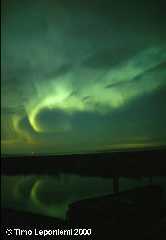
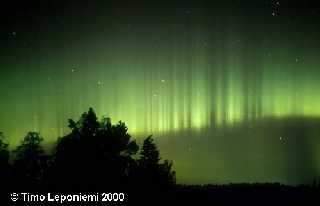
Gail Shaw wrote:
> For those who live far enough north to see the real thing, does
> it look right?

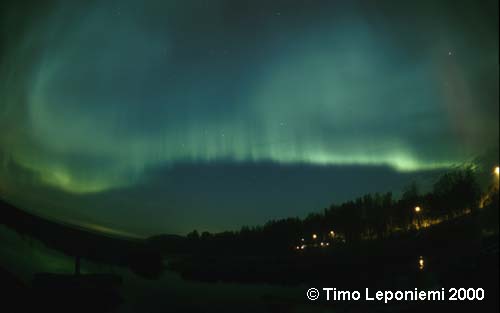
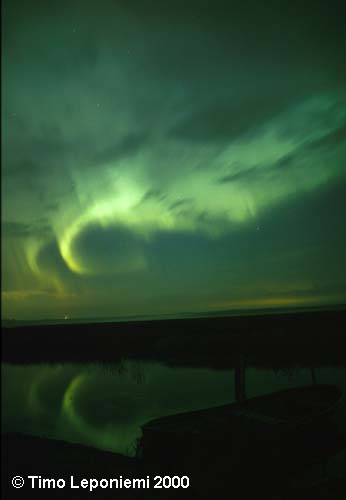
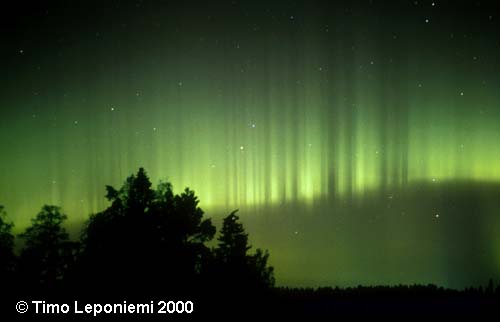
I personally live in city area, where those can't be seen, and a bit too
south, but I found some nice finnish photos about northern lights:
<http://www.sci.fi/~fmbb/astro/revontulet.htm#kuvat>. Page itself is in
finnish, but I think the pics itself talk some language you understand.
Almost all links in that section point to picture pages.

You have taken a challenging but wonderful task, I wish you luck.

--
          /"\                           |    iki.
          \ /     ASCII Ribbon Campaign |    fi/
           X      Against HTML Mail     |    zds
          / \
Post a reply to this message
Attachments:
Download 'aur32435.jpg' (11 KB)
Download 'aur32432.jpg' (12 KB)
Download 'aur29934.jpg' (15 KB)
Preview of image 'aur32435.jpg'
Preview of image 'aur32432.jpg'
Preview of image 'aur29934.jpg'
|
|
| |
| |
|
|
|
|
| |
| |
|
|
"Gail Shaw" <gsh### [at] monotixcoza> wrote in message
news:3ac0a200@news.povray.org...
> Now using multiple sine waves with different frequencies,
> amplitudes and phase. (Thanks Christoph)
>
> The color is also varied slightly.
>
D'oh! I've been blind. You just gave me what I was looking for. A sine wae
isosurface would make a great corrogated iron roofing sheet.
The Aurora looks cool, too
Post a reply to this message
|
|
| |
| |
|
|
|
|
| |
| |
|
|
On Tue, 27 Mar 2001 12:52:13 +0200, Gail Shaw wrote:

>Comments? suggestions?

I love Aurora, but have only ever seen it on TV or in
photos.  The stars had quite an impact, I put my hand
up and rubbed the screen thinking it was dusty:-)

--
Cheers
Steve              email mailto:ste### [at] zeroppsuklinuxnet

%HAV-A-NICEDAY Error not enough coffee  0 pps.

web http://www.zeropps.uklinux.net/

or  http://start.at/zero-pps

 10:45pm  up 53 days, 23:28,  2 users,  load average: 1.12, 1.18, 1.09
Post a reply to this message
|
|
| |
| |
|
|
|
|
| |
| |
|
|
Gail Shaw wrote:
>
> I decided I needed some atmospheric effects for my
> irtc entry (which I will post once it's more than a few cylinders
> and cones)
>
> This is supposed to be the aurora borealis.  It's an isosurface
> containing media with a function used in the density.
>
> For those who live far enough north to see the real thing, does
> it look right?

Here's a Norwegian "Northern-light picture of the month" page:

http://www.northern-lights.no/zope//Contest/Gallery/

The above link takes you to the photos of the current month, but
you can choose to view a lot of photos from prior months as well.

You'll probably notice that northern-lights comes in a great
variety of "shapes" and colours.


--
Best regards,

Tor Olav

mailto:tor### [at] hotmailcom
http://hjem.sol.no/t-o-k/tokpicts.html
http://www.crosswinds.net/~tok
Post a reply to this message
|
|
| |
| |
|
|
|
|
| |
| |
|
|
>

Impressive.  Knowing what you're attempting, the effect is impressively
close.  But I wonder if, in a scene, I would interpret it correctly.  From
the photos others have posted, your result looks perfectly plausible, but too
regular perhaps to fit our idea of how the borealis looks.  My memories of my
personal experience of them is the spooky speed and the awesome scale.  It's
as if they make you realize how big the sky really is.
Post a reply to this message
|
|
| |
| |
|
|
|
|
| |
| |
|
|
In article <3ac07177@news.povray.org>, "Gail Shaw"
<gsh### [at] monotixcoza> wrote:

> For the iso experts, is there any way I can randomly vary the
> distance between the peaks of a sine wave?

It might be better to just drop the sine wave, and use a 1D or 2D noise
pattern. Like noise3d(x, 1, 1), noise3d(x, 1, z*3), or something.

--
Christopher James Huff
Personal: chr### [at] maccom, http://homepage.mac.com/chrishuff/
TAG: chr### [at] tagpovrayorg, http://tag.povray.org/

<><
Post a reply to this message
|
|
| |
| |
|
|
|
|
| |
| |
|
|
Hello.  This is your friendly neighborhood Canadian here...
    We see the northern lights all the time at home.  First of all, what are
you wanting to use the northern light effect for?  If you are going for
visual impact, it is alright to use the photos that have been linked to as
examples, but the extreme colors and brightness is not typical (at least
where I live) so you may want to tone it down and make it just a little bit
whiter and more transparent (although the coloring in the second image you
posted is a lot better).
    I think the biggest problem with your image is the straight line on the
bottom.  It should really be more of a flowing line (always reminded me of a
brush stroke with watercolors bleeding up into the sky).  The other thing
that needs a bit of work is the bands of color that are very close together.
They don't really flow into each other the way they should, but if you
scaled the whole aurora borealis in the x direction by about 2, the effect
would be a lot more graceful.  The other thing that I was going to mention
is that if you are looking for more pictures of this effect, you may note
that they have similar effects in the southern hemisphere (aurora
australialis, I believe) that may have links and photos on the internet.
Great job though.  I still don't understand isosurfaces and media very well,
but it looks like quite the difficult project you've started.  Good luck.

Stephen Bell
http://students.oc.edu/stephen.bell


"Gail Shaw" <gsh### [at] monotixcoza> wrote in message
news:3ac0a200@news.povray.org...
> Now using multiple sine waves with different frequencies,
> amplitudes and phase. (Thanks Christoph)
>
> The color is also varied slightly.
>
> Gail
> *************************************************************************
> * gsh### [at] monotixcoza                *   Step into the abyss,           *
> * http://www.rucus.ru.ac.za/~gail/   *   and let go.        Babylon 5   *
> *************************************************************************
> * The difficult we do immediately, the impossible takes a little longer *
> *************************************************************************
>
>
>
Post a reply to this message
|
|
| |
| |
|
|
|
|
| |
| |
|
|
Look at http://www.spaceweather.com/aurora/gallery_20mar01.html

--
Mark
Post a reply to this message
|
|
| |
| |
|
|
|
|
| |
| |
|
|
Geoff Wedig <wed### [at] darwinepbicwruedu> wrote in message
news:3ac0d7b3@news.povray.org...
>
> Reminds me of the opening credits to Superman: The Movie. ;)

Is that good? (Never seen the movie)

> It looks too straight to me.  The pictures I've seen are more like swirls
of
> lit up mist with tendrils all throughout.  This looks more like a paint
line
> streaked upwards.

See below for the picture I'm using as a model

Gail
*************************************************************************
* gsh### [at] monotixcoza                *   Step into the abyss,           *
* http://www.rucus.ru.ac.za/~gail/   *   and let go.        Babylon 5   *
*************************************************************************
* The difficult we do immediately, the impossible takes a little longer *
*************************************************************************
Post a reply to this message
Attachments:
Download 'AuroraModel.jpg' (7 KB)
Preview of image 'AuroraModel.jpg'

|
|
| |
| |
|
|
|
|
| |
| |
|
|
And version 3. It's amazing what a little
turbulence does.


I'm also working on a red and yellow aurora, but it doesn't
look so good.

Comments?

Gail
*************************************************************************
* gsh### [at] monotixcoza                *   Step into the abyss,           *
* http://www.rucus.ru.ac.za/~gail/   *   and let go.        Babylon 5   *
*************************************************************************
* The difficult we do immediately, the impossible takes a little longer *
*************************************************************************
Post a reply to this message
Attachments:
Download 'aurora.jpg' (8 KB)
Download 'aurora2.jpg' (13 KB)
Preview of image 'aurora.jpg'

Preview of image 'aurora2.jpg'

|
|
| |
| |
|
|
|
|
| |
| |
|
|
Gail Shaw wrote:
>
> And version 3. It's amazing what a little
> turbulence does.
>
> I'm also working on a red and yellow aurora, but it doesn't
> look so good.
>
> Comments?
>

AWSOME ROLLEX!!!!111!!1!


--
Francois Labreque | The surest sign of the existence of extra-
    flabreque     | terrestrial intelligence is that they never
        @         | bothered to come down here and visit us!
  videotron.ca    |                             - Calvin
Post a reply to this message
|
|
| |
| |
|
|
|
|
| |
| |
|
|
I think the green one look very good (according to pictures I've seen - that
is. Never seen it in real life)

Nekar

"Gail Shaw" <gsh### [at] monotixcoza> wrote in message
news:3ac1ea75@news.povray.org...
> And version 3. It's amazing what a little
> turbulence does.
>
>
> I'm also working on a red and yellow aurora, but it doesn't
> look so good.
>
> Comments?
>
> Gail
> *************************************************************************
> * gsh### [at] monotixcoza                *   Step into the abyss,           *
> * http://www.rucus.ru.ac.za/~gail/   *   and let go.        Babylon 5   *
> *************************************************************************
> * The difficult we do immediately, the impossible takes a little longer *
> *************************************************************************
>
>
>
Post a reply to this message
|
|
| |
| |
|
|
|
|
| |
| |
|
|
Gail Shaw <gsh### [at] monotixcoza> wrote:

> And version 3. It's amazing what a little
> turbulence does.


> I'm also working on a red and yellow aurora, but it doesn't
> look so good.

> Comments?

Much nicer.  Shouldn't it be denser near the bottom, though?  I could be
wrong.  I'm not an expert or anything.

Geoff
Post a reply to this message
|
|
| |
| |
|
|
|
|
| |
| |
|
|
Francois Labreque <fla### [at] videotronca> wrote in message
news:3AC1EB03.8537ADB6@videotron.ca...
>
> AWSOME ROLLEX!!!!111!!1!

Is Not!!

Seriously, I'm glad you like it.

If anyone's interested, I'll post the source once I'm satisfied
with the second aurora.

Gail
*************************************************************************
* gsh### [at] monotixcoza                *   Step into the abyss,           *
* http://www.rucus.ru.ac.za/~gail/   *   and let go.        Babylon 5   *
*************************************************************************
* The difficult we do immediately, the impossible takes a little longer *
*************************************************************************
Post a reply to this message
|
|
| |
| |
|
|
|
|
| |
| |
|
|
Geoff Wedig <wed### [at] darwinepbicwruedu> wrote in message
news:3ac1ee73@news.povray.org...
>
> Much nicer.  Shouldn't it be denser near the bottom, though?  I could be
> wrong.  I'm not an expert or anything.

According the pics I've looked at, you're right. I'm also no expert on
aurora, never seen one except in pics.

Gail
--
*************************************************************************
* gsh### [at] monotixcoza                *   Step into the abyss,           *
* http://www.rucus.ru.ac.za/~gail/   *   and let go.        Babylon 5   *
*************************************************************************
* The difficult we do immediately, the impossible takes a little longer *
*************************************************************************
Post a reply to this message
|
|
| |
| |
|
|
|
|
| |
| |
|
|
The green one looks very real, according to the ones I -have- seen
in real life. The night I left Alaska, the skies were full of lights.

Gail Shaw wrote:
>
> Geoff Wedig <wed### [at] darwinepbicwruedu> wrote in message
> news:3ac1ee73@news.povray.org...
> >
> > Much nicer.  Shouldn't it be denser near the bottom, though?  I could be
> > wrong.  I'm not an expert or anything.
>
> According the pics I've looked at, you're right. I'm also no expert on
> aurora, never seen one except in pics.
>
> Gail
> --
> *************************************************************************
> * gsh### [at] monotixcoza                *   Step into the abyss,           *
> * http://www.rucus.ru.ac.za/~gail/   *   and let go.        Babylon 5   *
> *************************************************************************
> * The difficult we do immediately, the impossible takes a little longer *
> *************************************************************************
Post a reply to this message
|
|
| |
| |
|
|
|
|
| |
| |
|
|
"Gail Shaw" <gsh### [at] monotixcoza> wrote in message
news:3ac1ea75@news.povray.org...

Beautiful (I prefer the green one) - anyone read "Northern Lights"?
Post a reply to this message
|
|
| |
| |
|
|
|
|
| |
| |
|
|
Much nicer (*applause*).  The effect is much more subtle, so I think it is a
lot more realistic this time around.  Would it be possible to have a few
more, and give it kind of a layered look (although with the techniques
you're using, that may put the rendering time through the roof)?  It looks a
lot better not to have the color quite as concentrated around the bottom
edge.  Good show.  Is this going to be part of some bigger scene, or was
your goal just to make northern lights?

Stephen Bell

"Gail Shaw" <gsh### [at] monotixcoza> wrote in message
news:3ac1ea75@news.povray.org...
> And version 3. It's amazing what a little
> turbulence does.
>
>
> I'm also working on a red and yellow aurora, but it doesn't
> look so good.
>
> Comments?
>
> Gail
> *************************************************************************
> * gsh### [at] monotixcoza                *   Step into the abyss,           *
> * http://www.rucus.ru.ac.za/~gail/   *   and let go.        Babylon 5   *
> *************************************************************************
> * The difficult we do immediately, the impossible takes a little longer *
> *************************************************************************
>
>
>
Post a reply to this message
|
|
| |
| |
|
|
|
|
| |
| |
|
|
> // ===== 1 ======= 3 ======= 3 ======= 4 ======= 5 ======= 6 =======
7 =
                     ^ How/What do you count ? ;-)

or do you simply avoid to write the "23" ...
(We're all afraid of the Illuminates *g)

--
background{rgb 1}camera{location<1,5,-2>look_at 0}#macro
m(a,b,i)#local d=(b-a)
/8;#local
e=vcross(d,y);#if(i)m(a-e,a+e+2*d,i-1)m(a+e,a+2*d-e,i-1)m(a+3*d-e,a+e
+3*d,i-1)m(a+3*d-e,a+5*d-e,i-1)m(a+6*d-e,a+e+6*d,i-1)m(a+8*d-e,a+e+8*d
,i-1)#else
cylinder{a,b,vlength(d)/3 pigment{rgb 0}}#end#end m(-4*x,2*x,4) // Jan
Walzer
Post a reply to this message
|
|
| |
| |
|
|
|
|
| |
| |
|
|
This looks very realistic.

I've seen Northern Lights about 4-5 times now; once on the ground in
Anchorage AK, once in the air, and twice in Upstate NY (dark skies).

Generally speaking, they are pale bands of color.  They don't show quite the
same way pictures do - I've often thought it's because the exposure has to
be timed to get it all, and as a result the pictures look more 'wavy' and
brighter in certain areas as the colors overlap.

So if I made any change, I'd make them fatter and don't overlap them too
much.

If you animate them however, you should know that they can 'rope' all over
the sky.  I never saw them fold over themselves much.

Interested in other's impressions though, it's been probably 25 years since
I saw the ones in Anchorage; the ones in Upstate NY were just 3 years ago
but were far less bright.  (which is odd, you're closer to the magnetic pole
in NY than in AK).

        == John ==

"Gail Shaw" <gsh### [at] monotixcoza> wrote in message
news:3ac1ea75@news.povray.org...
> And version 3. It's amazing what a little
> turbulence does.
>
>
> I'm also working on a red and yellow aurora, but it doesn't
> look so good.
>
> Comments?
>
> Gail
> *************************************************************************
> * gsh### [at] monotixcoza                *   Step into the abyss,           *
> * http://www.rucus.ru.ac.za/~gail/   *   and let go.        Babylon 5   *
> *************************************************************************
> * The difficult we do immediately, the impossible takes a little longer *
> *************************************************************************
>
>
>
Post a reply to this message
|
|
| |
| |
|
|
|
|
| |
| |
|
|
The green one looks pretty good now. =)

--
David Fontaine  <dav### [at] faricynet>  ICQ 55354965
My raytracing gallery:  http://davidf.faricy.net/
Post a reply to this message
|
|
| |
| |
|
|
|
|
| |
| |
|
|
That looks like a julia fractal....
Post a reply to this message
|
|
| |
| |
|
|
|
|
| |
| |
|
|
Stephen Bell wrote:
>
> Is this going to be part of some bigger scene, or was
> your goal just to make northern lights?
>

Me smells an IRTC wip.

--
Francois Labreque | The surest sign of the existence of extra-
    flabreque     | terrestrial intelligence is that they never
        @         | bothered to come down here and visit us!
  videotron.ca    |                             - Calvin
Post a reply to this message
|
|
| |
| |
|
|
|
|
| |
| |
|
|
Francois Labreque <fla### [at] videotronca> wrote in message
news:3AC278FD.9752A47D@videotron.ca...
>
>
> Stephen Bell wrote:
> >
> > Is this going to be part of some bigger scene, or was
> > your goal just to make northern lights?
> >
>
> Me smells an IRTC wip.
>

You have a good nose (Although I said as much
in my first post)

Hopefully I'll be able to post a the whole scene
on monday.

Gail
*************************************************************************
* gsh### [at] monotixcoza                *   Step into the abyss,           *
* http://www.rucus.ru.ac.za/~gail/   *   and let go.        Babylon 5   *
*************************************************************************
* The difficult we do immediately, the impossible takes a little longer *
*************************************************************************
Post a reply to this message
|
|
| |
| |
|
|
|
|
| |
| |
|
|
Stephen Bell <ste### [at] yahoocom> wrote in message
news:3ac22b03$1@news.povray.org...
> Much nicer (*applause*).  The effect is much more subtle, so I think it is
a
> lot more realistic this time around.  Would it be possible to have a few
> more, and give it kind of a layered look (although with the techniques
> you're using, that may put the rendering time through the roof)?

Render time is currently about 15 min. That's on a PII 300 render priority
lower and lots of other stuff runing

> It looks a
> lot better not to have the color quite as concentrated around the bottom
> edge.  Good show.  Is this going to be part of some bigger scene, or was
> your goal just to make northern lights?
>

Going to be part of irtc entry (I hope)

Gail
*************************************************************************
* gsh### [at] monotixcoza                *   Step into the abyss,           *
* http://www.rucus.ru.ac.za/~gail/   *   and let go.        Babylon 5   *
*************************************************************************
* The difficult we do immediately, the impossible takes a little longer *
*************************************************************************
Post a reply to this message
|
|
| |
| |
|
|
|
|
| |
| |
|
|
Today's Astronomy Picture of the Day is some awesome aurora.

http://antwrp.gsfc.nasa.gov/apod/astropix.html


--
Derek Stark
Linux Admin - eSN
dms### [at] esupportnowcom
xt 8952
Post a reply to this message
|
|
| |
| |
|
|
|
|
| |
| |
|
|
"D. Stark - eSN" <dms### [at] esupportnowcom> wrote in message
news:3AC32A66.14D83985@esupportnow.com...
> Today's Astronomy Picture of the Day is some awesome aurora.
>

... with a fractal like shape at the bottom of the pic.
Post a reply to this message
|
|
| |
| |
|
|
|
|
| |
| |
|
|
On Thu, 29 Mar 2001 14:09:54 +0100, Tom Melly wrote:
>"D. Stark - eSN" <dms### [at] esupportnowcom> wrote in message
>news:3AC32A66.14D83985@esupportnow.com...
>> Today's Astronomy Picture of the Day is some awesome aurora.
>>
>
>... with a fractal like shape at the bottom of the pic.

Those'd be trees.  Methinks you need to get out more. :)

--
Ron Parker   http://www2.fwi.com/~parkerr/traces.html
My opinions.  Mine.  Not anyone else's.
Post a reply to this message
|
|
| |
| |
|
|
|
|
| |
| |
|
|
"Ron Parker" <ron### [at] povrayorg> wrote in message
news:slr### [at] fwicom...
> >
> >... with a fractal like shape at the bottom of the pic.
>
> Those'd be trees.  Methinks you need to get out more. :)
>

LOL

Um, ah, I knew that, really, honest. What? Trees aren't fractal?
Post a reply to this message
|
|
| |
| |
|
|
|
|
| |
| |
|
|
I saw this picture on the CNN site, thought it might help.

Kirk

"Gail Shaw" <gsh### [at] monotixcoza> wrote in message
news:3ac07177@news.povray.org...
> I decided I needed some atmospheric effects for my
> irtc entry (which I will post once it's more than a few cylinders
> and cones)
>
> This is supposed to be the aurora borealis.  It's an isosurface
> containing media with a function used in the density.
>
> For those who live far enough north to see the real thing, does
> it look right?
>
> For the iso experts, is there any way I can randomly vary the
> distance between the peaks of a sine wave?
>
> Comments? suggestions?
>
> Gail
> *************************************************************************
> * gsh### [at] monotixcoza                *   Step into the abyss,           *
> * http://www.rucus.ru.ac.za/~gail/   *   and let go.        Babylon 5   *
> *************************************************************************
> * The difficult we do immediately, the impossible takes a little longer *
> *************************************************************************
>
>
>
Post a reply to this message
Attachments:
Download 'aurora.jpg' (20 KB)
Preview of image 'aurora.jpg'

|
|
| |
| |
|
|
|
|
| |
| |
|
|
Gail Shaw wrote:
>
> And version 3. It's amazing what a little
> turbulence does.
>
> I'm also working on a red and yellow aurora, but it doesn't
> look so good.
>
> Comments?

Now you're getting somewhere. I've been working with norhtern lights
infotainment for about 6 years, and I also grew up in an area where
northern lights where more the rule than the exception during cold
winter nights.

One thing to remember about aurora is that it is almost always curling
across the sky, not in one sheet, but in curls as seen in many of the
pictures of actual auroras in this thread.

If you want to add yellow or red, it should be very subtle and at the
higher reaches of the aurora. It is very rarely seen, and it's almost
always overpowered by the green in the aurora.

The green in the aurora is also very light green, not as saturated green
as you have it. If you notice the images posted by Jari Juslin you can
see that the aurora is curling across the sky, and that the color is
dense at the bottom of the aurora almost greenish white, and it fades to
almost translucent towards the top. You will also notice that the aurora
is almost whiteish green at the bottom and the green is getting more
saturated at the top.

I've seen auroras with orange, blue and yellow colors, but always
intermixed with the ever present green.

Oh, well, I am rambling here. What I am saying is that it's close, but
no cigar yet. ;-) Keep working on it though!

--
Børge Berg-Olsen
------------------------------------------------------------------------
  +47 90 62 71 78          DoD#2101, DoDRT#017, NIC#015, PJ#006, OGM#007
  azo### [at] dodno, Ducati M600, Clementine  Ubesudlet: Aldri eid en J&%#PS.
Post a reply to this message
|
|
| |
| |
|
|
|
|
| |
| |
|
|
Trees -are- fractal.

Tom Melly wrote:
>
> "Ron Parker" <ron### [at] povrayorg> wrote in message
> news:slr### [at] fwicom...
> > >
> > >... with a fractal like shape at the bottom of the pic.
> >
> > Those'd be trees.  Methinks you need to get out more. :)
> >
>
> LOL
>
> Um, ah, I knew that, really, honest. What? Trees aren't fractal?
Post a reply to this message
|
|
| |
| |
|
|
|
|
| |
| |
|
|
These auroras are great to see, whether real or not.
I'm chiming in a bit late but I tried to create one using just media with
multiple density maps inside a box, not Gail's isosurface way.
I have only seen one in my whole life (long time) but it was everything from
a large diffuse red glow overhead to start with then changing to curtains
and finally rays.  Something everyone should be witness to at least once,
like me.
Attached is my trial and error and giving up on it now. Might make a nice
nebulosity anyhow, but there's already an include for that.
Post a reply to this message
Attachments:
Download 'abmedia5.jpg' (14 KB)
Preview of image 'abmedia5.jpg'

|
|
| |
| |
|
|
|
|
| |
| |
|
|
In article <3ac48209@news.povray.org>, Bob H. says...
> These auroras are great to see, whether real or not.
> I'm chiming in a bit late but I tried to create one using just media with
> multiple density maps inside a box, not Gail's isosurface way.
> I have only seen one in my whole life (long time)
long?? 52 = long???

> but it was everything from
> a large diffuse red glow overhead to start with then changing to curtains
> and finally rays.  Something everyone should be witness to at least once,
> like me.
> Attached is my trial and error and giving up on it now. Might make a nice
> nebulosity anyhow, but there's already an include for that.
>

ha, ha,
--
Regards,  Sander
Post a reply to this message
|
|
| |
| |
|
|
|
|
| |
| |
|
|
Today it's at:
http://antwrp.gsfc.nasa.gov/apod/ap010329.html

Kind of serendipitous ....

        == John ==

"D. Stark - eSN" <dms### [at] esupportnowcom> wrote in message
news:3AC32A66.14D83985@esupportnow.com...
> Today's Astronomy Picture of the Day is some awesome aurora.
>
> http://antwrp.gsfc.nasa.gov/apod/astropix.html
>
>
>
> --
> Derek Stark
> Linux Admin - eSN
> dms### [at] esupportnowcom
> xt 8952
Post a reply to this message
|
|
| |
| |
|
|
|
|
| |
| |
|
|
Hope this isn't a repeated web address:

http://www.pfrr.alaska.edu/~pfrr/AURORA/INDEX.HTM

Has a great prediction map you can select your own region from for northern
latitudes:

http://www.gi.alaska.edu/aurora_predict/worldmap8.html

There's a current maximum going on because of a recent solar flare.

A "raytraced" aurora at the originating web page (don't know what it was
raytraced with but looks POVish to me):

http://www.geo.mtu.edu/weather/aurora/

Click on the jpg link to enlarge it.

Bob H.
Post a reply to this message
|
|
| |
| |
|
|
|
|
| |
| |
|
|
"Bob H." <omn### [at] msncom> wrote in message
news:3ac532c8$1@news.povray.org...
> Hope this isn't a repeated web address:
>
> http://www.pfrr.alaska.edu/~pfrr/AURORA/INDEX.HTM
>
> Has a great prediction map you can select your own region from for northern
> latitudes:
>
> http://www.gi.alaska.edu/aurora_predict/worldmap8.html
>
> There's a current maximum going on because of a recent solar flare.
>
> A "raytraced" aurora at the originating web page (don't know what it was
> raytraced with but looks POVish to me):
>
> http://www.geo.mtu.edu/weather/aurora/
>
> Click on the jpg link to enlarge it.
>

Add this one:

 http://www.spaceweather.com/aurora/gallery_20mar01.html
Post a reply to this message
|
|
| |
| |
|
|
|
|
| |