|
|
|
|
|
|
| |
| |
|
|
|
|
| |
| |
|
|
Thanks to the recent posting by Paul Bourke regarding super shapes
extended to 3D via spherical products,
http://news.povray.org/povray.general/32398/, and also to Ingo Janssen’s
“mesmerizing mesh maker macros” (including param.inc),
http://members.home.nl/seedseven/, I put together something for my (fall
semester) multi-variable calculus students, generalizing from super
shapes to other polar curves.  I thought some POVRay users might be
interested,  at least in the results.  A fun evening can be had by
digging out an old analytic geometry book, or other source of polar
curves, and crossing different famous curves in different orders (at
least I found it to be fun.)  (This description’s a bit of overkill for
POVRay users, but my students will be learning POVRay as we go, and thus
be pretty much as ignorant as I am, regarding POVRay.  I did, at least,
clip out the reminders about how to use .inc files and such.)

Spherical Products and Polar Functions:

The spherical product of two parametrically-defined planar curves,
H(h_x(u), h_y(u)) and M(m_x(v), m_y(v)), is defined by (H * M)(u, v) via:
	x(u, v) = h_x(u)m_x(v)
	y(u, v) = h_y(u)m_x(v)
	z(u, v) = m_y(v)

(I use underscores, when I can't subscript.)

Note that about half the sources I looked up defined the product in the
opposite order, and, since this product is not commutative, it’s
important to know which order a particular source is using!

Since every planar polar function can also be described via the
canonical parameterization :  x = r(t)cos(t), 	y = r(t)sin(t), one can
form the spherical product of any two polar functions, r_1(u) and r_2(v):

r_1 * r_2 (or r_2 * r_1 for the alternate definition) via:

x(u, v) = r_1(u)cos(u)r_2(v)cos(v)
y(u, v) = r_1(u)sin(u)r_2(v)cos(v)
z(u, v) = r_2(v)sin(v)

To render these objects in a left-hand coordinate system (such as
POVRay) and achieve the same pictures as with Mathematica or Maple,
interchange the roles of y and z (as below, where F3 applies to the y
component.)

Here’s a sample of the call to Ingo Janssen’s Parametric macro, where

r_1(u) = cos(3u) and r_2(v) = sin(2v):

#declare F1= function(u,v){cos(3*u)*cos(u)*sin(2*v)*cos(v)}
#declare F2= function(u,v){cos(3*u)*sin(u)*sin (2*v)*cos(v)}
#declare F3= function(u,v){sin(2*v)*sin(v)}

object{
    Parametric(
       F1, F3, F2,
       <FromU(0), FromV(0)>, <ToU(2*pi), ToV(2*pi)>,
       150,150,"C_3UxS_2V.inc"
    )
  [ object_modifiers ]
}

The parameters in "Parametric" are described in the #include files.

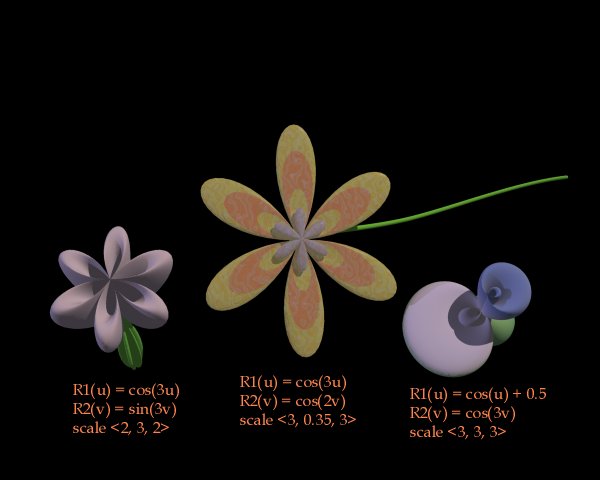
Here are 3 examples:

(Truth-In-Advertising Disclaimer:  The stem on the psychedelic flower is
a sphere_sweep, and not a part of the product.  The captions were added
in Photoshop.)
Post a reply to this message
Attachments:
Download 'polarspsjpg.jpg' (28 KB)
Preview of image 'polarspsjpg.jpg'
|
|
| |
| |
|
|
|
|
| |
| |
|
|
Wasn't it David Matthews who wrote:
>Thanks to the recent posting by Paul Bourke regarding super shapes
>extended to 3D via spherical products,
>http://news.povray.org/povray.general/32398/, and also to Ingo Janssen’s
>“mesmerizing mesh maker macros” (including param.inc),
>http://members.home.nl/seedseven/, I put together something for my (fall
>semester) multi-variable calculus students, generalizing from super
>shapes to other polar curves.  I thought some POVRay users might be
>interested,  at least in the results.  A fun evening can be had by
>digging out an old analytic geometry book, or other source of polar
>curves, and crossing different famous curves in different orders (at
>least I found it to be fun.)  (This description’s a bit of overkill for
>POVRay users, but my students will be learning POVRay as we go, and thus
>be pretty much as ignorant as I am, regarding POVRay.  I did, at least,
>clip out the reminders about how to use .inc files and such.)
>
>Spherical Products and Polar Functions:
>
>The spherical product of two parametrically-defined planar curves,
>H(h_x(u), h_y(u)) and M(m_x(v), m_y(v)), is defined by (H * M)(u, v) via:
>       x(u, v) = h_x(u)m_x(v)
>       y(u, v) = h_y(u)m_x(v)
>       z(u, v) = m_y(v)
>
>(I use underscores, when I can't subscript.)
>
>Note that about half the sources I looked up defined the product in the
>opposite order, and, since this product is not commutative, it’s
>important to know which order a particular source is using!
>
>Since every planar polar function can also be described via the
>canonical parameterization :  x = r(t)cos(t),  y = r(t)sin(t), one can
>form the spherical product of any two polar functions, r_1(u) and r_2(v):
>
>r_1 * r_2 (or r_2 * r_1 for the alternate definition) via:
>
>x(u, v) = r_1(u)cos(u)r_2(v)cos(v)
>y(u, v) = r_1(u)sin(u)r_2(v)cos(v)
>z(u, v) = r_2(v)sin(v)
>
>To render these objects in a left-hand coordinate system (such as
>POVRay) and achieve the same pictures as with Mathematica or Maple,
>interchange the roles of y and z (as below, where F3 applies to the y
>component.)
>
>Here’s a sample of the call to Ingo Janssen’s Parametric macro, where
>
>r_1(u) = cos(3u) and r_2(v) = sin(2v):
>
>#declare F1= function(u,v){cos(3*u)*cos(u)*sin(2*v)*cos(v)}
>#declare F2= function(u,v){cos(3*u)*sin(u)*sin (2*v)*cos(v)}
>#declare F3= function(u,v){sin(2*v)*sin(v)}
>
>object{
>    Parametric(
>       F1, F3, F2,
>       <FromU(0), FromV(0)>, <ToU(2*pi), ToV(2*pi)>,
>       150,150,"C_3UxS_2V.inc"
>    )
>  [ object_modifiers ]
>}
>
>The parameters in "Parametric" are described in the #include files.

Nice.

One tiny change to make life a little easier would be to #declare the
r_1 and r_2 functions, so that when you want to experiment with
different functions you only need to change them once.

// Change these lines to try different shapes
#declare r_1 = function(u,v){cos(3*u)}
#declare r_2 = function(u,v){sin(2*v)}

// Leave these lines alone
#declare F1= function(u,v){r_1(u,v)*cos(u) *r_2(u,v)*cos(v)}
#declare F2= function(u,v){r_1(u,v)*sin(u) *r_2(u,v)*cos(v)}
#declare F3= function(u,v){r_2(u,v)*sin(v)}

--
Mike Williams
Gentleman of Leisure
Post a reply to this message
|
|
| |
| |
|
|
|
|
| |
| |
|
|
Mike Williams wrote:

>Nice.
>
>One tiny change to make life a little easier would be to #declare the
>r_1 and r_2 functions, so that when you want to experiment with
>different functions you only need to change them once.
>
>// Change these lines to try different shapes
>#declare r_1 = function(u,v){cos(3*u)}
>#declare r_2 = function(u,v){sin(2*v)}
>
>// Leave these lines alone
>#declare F1= function(u,v){r_1(u,v)*cos(u) *r_2(u,v)*cos(v)}
>#declare F2= function(u,v){r_1(u,v)*sin(u) *r_2(u,v)*cos(v)}
>#declare F3= function(u,v){r_2(u,v)*sin(v)}
>
>Mike Williams
>Gentleman of Leisure
>

Thanks.

In fact, I tried to do that, but I had something goofed up on my syntax.  I
still have a mental block about declaring and using functions, and I don't
know why, since they're just like they are in math, and I use them there
every day.

A second thing I forgot to mention, is that if you are using uv_mapping, you
must make sure to only create the surface once.  In my example, for
example, u should only go from 0 to pi, while v goes from 0 to 2pi.

This determination is a bit more complicated than it first appears.

If r_1 and r_2 were non-negative, -pi/2 < v < pi/2 would always suffice.
But the above example shows this is not the case in general.

Since r_1(t) = cos ( 3t ) is created from 0 to pi, then repeated (on the
plane) and r_2(t) = sin ( 2t ) is created from 0 to 2pi, you might guess
that you simply limit your domain to what would create one copy of each, in
the plane.  This works, in the above example, and in the example:

r_1(u) = cos(u) + 0.5 and r_2(v) = sin (v) + 0.5.  Here each (u and v) must
go from 0 to 2pi.

It also works with:

r_1= r_2=cos(3t), which is created by letting u and v each go from 0 to pi.

However, due to symmetry, if you let

r_1 = r_2 = cos(2t),

the correct domain is 0 < u < pi, 0 < v < 2pi.

It is true that you need never increase the domains of u and v beyond what
would create one copy of the plane curve (since you can think of the surface
as being created by applying r_2 to the generator r_1(u) and vice-versa.)

I had to make animations to figure out how the complications arose (it also
showed me where the "extra" 3 petals come from in what is, on the plane, a
3 - petal rose, r = cos (3t), when r_1 =cos(3u) and r_2=cos (2v), and why
they disappear when the product is reversed. . . .)

Dave Matthews
Post a reply to this message
|
|
| |
| |
|
|
|
|
| |
|
|