|
|
|
|
|
|
| |
| |
|
|
|
|
| |
| |
|
|
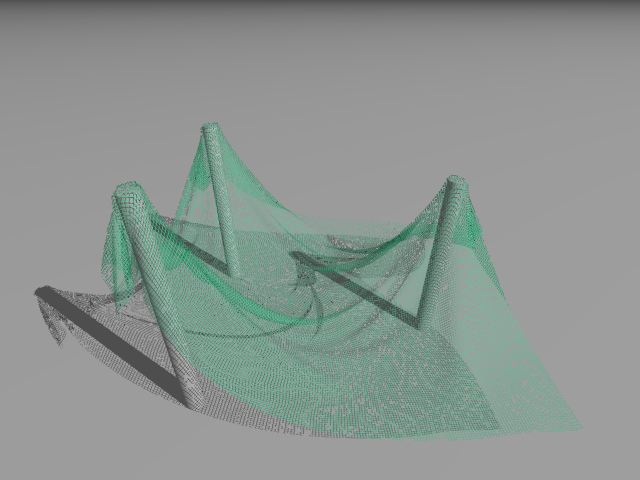
Another example of my cloth simulator...
Two notes:
* it's probably still a bit stiff but to get something better, I'd have
to increase the resolution with the corresponding increase in time :-(
* the simulator doesn't stop when nothing moves, but rather after a
certain number of simulation steps. I think in this case it hadn't
finished which is why the net seems to hang in mid-air on the right...
Jérôme
--
********************************* Jérôme M. BERGER
* Abandon the search for truth, * mailto:ber### [at] iname com
* Settle for a good fantasy. * http://www.enst.fr/~jberger
*********************************
Post a reply to this message
Attachments:
Download 'net.jpg' (28 KB)
Preview of image 'net.jpg'
|
|
| |
| |
|
|
|
|
| |
| |
|
|
That is very impressive, what are you doing the simulating with??
--
Rick
Kitty5 WebDesign - http://www.kitty5.com
TEL - +44 (01625) 266358 : FAX +44 (01625) 611913

PGP Public Key
http://pgpkeys.mit.edu:11371/pks/lookup?op=get&search=0x231E1CEA
Post a reply to this message
|
|
| |
| |
|
|
|
|
| |
| |
|
|
"Jérôme M. Berger" wrote:
>
>         Another example of my cloth simulator...
>
>         Two notes:
> * it's probably still a bit stiff but to get something better, I'd have
> to increase the resolution with the corresponding increase in time :-(
> * the simulator doesn't stop when nothing moves, but rather after a
> certain number of simulation steps. I think in this case it hadn't
> finished which is why the net seems to hang in mid-air on the right...
>

That looks neat, still a mesh ?

You seem to be right about the unfinished calculation on the right side,
although it's also a difficult case in real world.  If i understand things
right it's probably not that problematic to add some kind of 'unfinished
warning' to the program.

If it's an external program, i wonder what kind of shapes it can handle
for draping the cloth onto.

Christoph

--
Christoph Hormann <chr### [at] gmxde>
Homepage: http://www.schunter.etc.tu-bs.de/~chris/
Post a reply to this message
|
|
| |
| |
|
|
|
|
| |
| |
|
|
"Rick [Kitty5]" wrote:
>
> That is very impressive, what are you doing the simulating with??
	I wrote a C++ program to do the simulation

		Jérôme
--
********************************* Jérôme M. BERGER
* Abandon the search for truth, * mailto:ber### [at] inamecom
* Settle for a good fantasy.    * http://www.enst.fr/~jberger
*********************************
Post a reply to this message
|
|
| |
| |
|
|
|
|
| |
| |
|
|
Christoph Hormann wrote:
>
> That looks neat, still a mesh ?
>
	Still a mesh, with a combination of two gradients as a pigment to give
the illusion of a net

> You seem to be right about the unfinished calculation on the right side,
> although it's also a difficult case in real world.  If i understand things
> right it's probably not that problematic to add some kind of 'unfinished
> warning' to the program.
>
	Right, I'll probably do this

> If it's an external program, i wonder what kind of shapes it can handle
> for draping the cloth onto.
>
	Right now, it can handle any number of cylinders in any position, any
number of boxes whose sides are parallel to the axis and an horizontal
plane at any given altitude. It's not very difficult to add new shapes,
but those are all I need for the moment...

		Jérôme
--
********************************* Jérôme M. BERGER
* Abandon the search for truth, * mailto:ber### [at] inamecom
* Settle for a good fantasy.    * http://www.enst.fr/~jberger
*********************************
Post a reply to this message
|
|
| |
| |
|
|
|
|
| |
| |
|
|
"Jérôme M. Berger" wrote:
>
>         Right now, it can handle any number of cylinders in any position, any
> number of boxes whose sides are parallel to the axis and an horizontal
> plane at any given altitude. It's not very difficult to add new shapes,
> but those are all I need for the moment...
>
>                 Jérôme

A 'heightfield' would probably be useful, one could generate it from any
complicated shape with povray and it would work in nearly all cases.

Christoph

--
Christoph Hormann <chr### [at] gmxde>
Homepage: http://www.schunter.etc.tu-bs.de/~chris/
Post a reply to this message
|
|
| |
| |
|
|
|
|
| |
| |
|
|
"Jérôme M. Berger" wrote:

>         Right now, it can handle any number of cylinders in any position, any
> number of boxes whose sides are parallel to the axis and an horizontal
> plane at any given altitude. It's not very difficult to add new shapes,
> but those are all I need for the moment...

An idea : using the "trace" function to "scan" the geometry below the
cloth piece, and use the resulting height data into your utility...

Fabien.
Post a reply to this message
|
|
| |
| |
|
|
|
|
| |
| |
|
|
In article <3A112510.9DB97405@skynet.be>, Fabien Mosen
<fab### [at] skynetbe> wrote:

> An idea : using the "trace" function to "scan" the geometry below the
> cloth piece, and use the resulting height data into your utility...

Or just render an image from above the scene and use the depth
post_process...

--
Christopher James Huff
Personal: chr### [at] maccom, http://homepage.mac.com/chrishuff/
TAG: chr### [at] tagpovrayorg, http://tag.povray.org/

<><
Post a reply to this message
|
|
| |
| |
|
|
|
|
| |
| |
|
|
Chris Huff wrote:
>
> Or just render an image from above the scene and use the depth
> post_process...
>

Or a gradient pigment with black/white color_map and
finish { ambient 1 diffuse 0 ) combined with an orthographic camera.

Christoph

--
Christoph Hormann <chr### [at] gmxde>
Homepage: http://www.schunter.etc.tu-bs.de/~chris/
Post a reply to this message
|
|
| |
| |
|
|
|
|
| |
| |
|
|
Pretty. From what you're saying about increasing resolution, it sounds like
you're not using the Provot method, but rather the Elias method... The
latter is slower and the first doesn't need increases in resolution to lower
stiffness. You merely change a variable or two.
Post a reply to this message
|
|
| |
| |
|
|
|
|
| |
| |
|
|
Christoph Hormann wrote:
>
> Chris Huff wrote:
> >
> > Or just render an image from above the scene and use the depth
> > post_process...
> >
>
> Or a gradient pigment with black/white color_map and
> finish { ambient 1 diffuse 0 ) combined with an orthographic camera.
>
	Well, obviously there's no lack of solutions to generate the height
field, now if implementing it in a fast and efficient way was as easy
:))

	Just a note though: the problem with this hf approach is that the cloth
cannot fold under the objects (as it does in both examples I've
posted...)

		Jérôme
--
********************************* Jérôme M. BERGER
* Abandon the search for truth, * mailto:ber### [at] inamecom
* Settle for a good fantasy.    * http://www.enst.fr/~jberger
*********************************
Post a reply to this message
|
|
| |
| |
|
|
|
|
| |
| |
|
|
"Tony[B]" wrote:
>
> Pretty. From what you're saying about increasing resolution, it sounds like
> you're not using the Provot method, but rather the Elias method... The
> latter is slower and the first doesn't need increases in resolution to lower
> stiffness. You merely change a variable or two.
	AFAIK, neither. I developped the method from scratch along with the
program... There *is* a parameter that control stiffness, but no matter
how small you set it, the cloth can only fold at intersections so if the
intersections are too far appart (eg low resolution), the result will
appear stiff.

		Jérôme
--
********************************* Jérôme M. BERGER
* Abandon the search for truth, * mailto:ber### [at] inamecom
* Settle for a good fantasy.    * http://www.enst.fr/~jberger
*********************************
Post a reply to this message
|
|
| |
| |
|
|
|
|
| |
| |
|
|
"Jérôme M. Berger" wrote:

>         Just a note though: the problem with this hf approach is that the cloth
> cannot fold under the objects (as it does in both examples I've
> posted...)

Or use the "object" pattern to do a 3D scan of objects, in some kind
of voxels approach.

Fabien.
Post a reply to this message
|
|
| |
| |
|
|
|
|
| |
| |
|
|
In article <3A113F96.5C5D5B96@schunter.etc.tu-bs.de>,
chr### [at] gmxde wrote:

> Or a gradient pigment with black/white color_map and
> finish { ambient 1 diffuse 0 ) combined with an orthographic camera.

Or give everything a plain white pigment with ambient 1 diffuse 0, and
use a black fog...or make everything black and use a white fog...

--
Christopher James Huff
Personal: chr### [at] maccom, http://homepage.mac.com/chrishuff/
TAG: chr### [at] tagpovrayorg, http://tag.povray.org/

<><
Post a reply to this message
|
|
| |
| |
|
|
|
|
| |
| |
|
|
I s'pose U know about
http://developer.intel.com/software/idap/games/clothsample/index.htm
--
Bye
Pabs
Post a reply to this message
|
|
| |
| |
|
|
|
|
| |
| |
|
|
Pabs wrote:
>
>  I s'pose U know about
> http://developer.intel.com/software/idap/games/clothsample/index.htm
	Yes, I saw it after I already had something working. Actually the basic
idea is the same, but my physical model has evolved quite a bit from
there...

		Jérôme
--
********************************* Jérôme M. BERGER
* Abandon the search for truth, * mailto:ber### [at] inamecom
* Settle for a good fantasy.    * http://www.enst.fr/~jberger
*********************************
Post a reply to this message
|
|
| |
| |
|
|
|
|
| |
| |
|
|
Wow, thats so awesome.  Pity it wasn't ready for the Sea round
of the IRTC.

--
Cheers
Steve              email mailto:ste### [at] zeroppsuklinuxnet

%HAV-A-NICEDAY Error not enough coffee  0 pps.

web http://www.zeropps.uklinux.net/

or  http://start.at/zero-pps

  2:12pm  up 35 days, 16:35,  2 users,  load average: 2.01, 2.08, 2.05
Post a reply to this message
|
|
| |
| |
|
|
|
|
| |
| |
|
|
Steve wrote:
>
> Wow, thats so awesome.  Pity it wasn't ready for the Sea round
> of the IRTC.
>
	Eh! It wasn't even started by the end of the sea round! ;))

		Jérôme
--
********************************* Jérôme M. BERGER
* Abandon the search for truth, * mailto:ber### [at] inamecom
* Settle for a good fantasy.    * http://www.enst.fr/~jberger
*********************************
Post a reply to this message
|
|
| |
| |
|
|
|
|
| |