|
|
|
|
|
|
| |
| |
|
|
|
|
| |
| |
|
|
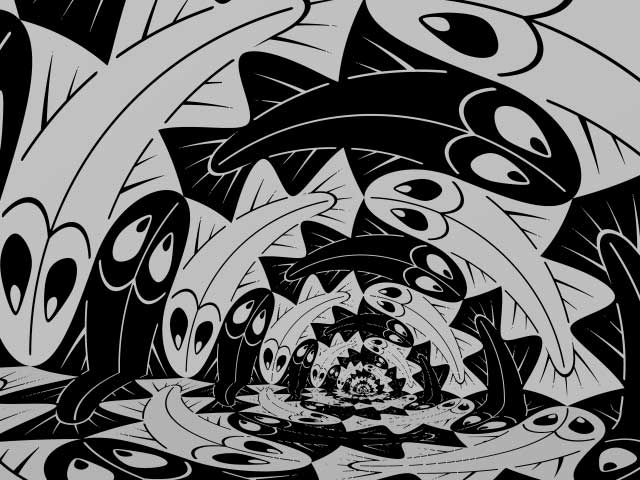
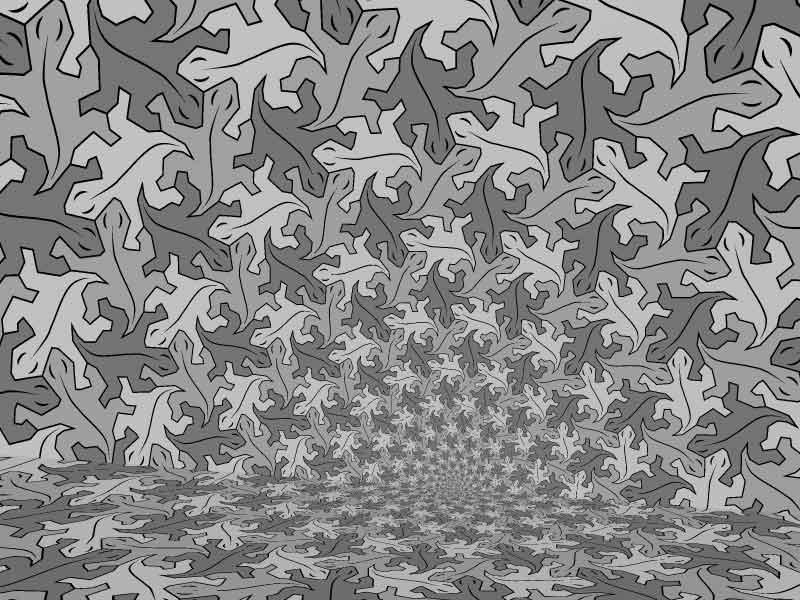
here it is!
my third procedural pattern based on eschers idea
it is again infinite, also towards to <0,0,0>
but what's more interesting
it is scaleable only in small range becouse
pigment{EscherPigment3}==pigment{EscherPigment3 scale 2}

ABX
Post a reply to this message
Attachments:
Download 'escher3.jpg' (57 KB)
Preview of image 'escher3.jpg'
|
|
| |
| |
|
|
|
|
| |
| |
|
|
On Wed, 11 Oct 2000 18:59:22 +0200, Wlodzimierz ABX Skiba wrote...
> here it is!
> my third procedural pattern based on eschers idea
> it is again infinite, also towards to <0,0,0>
> but what's more interesting
> it is scaleable only in small range becouse
> pigment{EscherPigment3}==pigment{EscherPigment3 scale 2}
>
> ABX

Unfair!  You're too good at this :)

Does anybody know of any good (and easy to understand) tutorials on
exactly what you're doing here?

Bye for now,
     Jamie.
Post a reply to this message
|
|
| |
| |
|
|
|
|
| |
| |
|
|
Jamie Davison wrote in message ...
>Does anybody know of any good (and easy to understand) tutorials on
>exactly what you're doing here?

I want public my stuff with tutorial
but if you want be faster look at
chapter 8.3.5 & 8.3.8 in MegaPOV 0.6 Documentation
I have only small csg of primitives
(sometimes with swere sweep, lathe or mesh
not with prism becouse prism has bug)
and always smart function to convert
infinite area to square <0,0><1,1>

ABX
Post a reply to this message
|
|
| |
| |
|
|
|
|
| |
| |
|
|
On Wed, 11 Oct 2000 18:59:22 +0200, Wlodzimierz ABX Skiba wrote:
>here it is!
>my third procedural pattern based on eschers idea
>it is again infinite, also towards to <0,0,0>
>but what's more interesting
>it is scaleable only in small range becouse
>pigment{EscherPigment3}==pigment{EscherPigment3 scale 2}
>
That is amazing.
--
Cheers
Steve email mailto:ste### [at] zeropps uklinuxnet
%HAV-A-NICEDAY Error not enough coffee 0 pps.
web http://www.zeropps.uklinux.net/
or http://start.at/zero-pps
10:21pm up 23:47, 2 users, load average: 1.00, 1.00, 1.00 uklinuxnet
%HAV-A-NICEDAY Error not enough coffee 0 pps.
web http://www.zeropps.uklinux.net/
or http://start.at/zero-pps
10:21pm up 23:47, 2 users, load average: 1.00, 1.00, 1.00
Post a reply to this message
|
|
| |
| |
|
|
|
|
| |
| |
|
|
Incredible!

ZK
http://www.povplace.be.tf

Wlodzimierz ABX Skiba <abx### [at] abxartpl> schreef in berichtnieuws
39e49cb3@news.povray.org...
> here it is!
> my third procedural pattern based on eschers idea
> it is again infinite, also towards to <0,0,0>
> but what's more interesting
> it is scaleable only in small range becouse
> pigment{EscherPigment3}==pigment{EscherPigment3 scale 2}
>
> ABX
>
>
>
Post a reply to this message
|
|
| |
| |
|
|
|
|
| |
| |
|
|
How the L do you do that?!
Post a reply to this message
|
|
| |
| |
|
|
|
|
| |
| |
|
|
Having looked at the site which was told of before:
http://www.domaindlx.com/Escher/default.asp
in the Tessellation link there exists such patterns but I have to say "I see
it and still don't believe it!"  But then I've seen no POV script.
If these (this one and the other one posted earlier here) are truly pigment
patterns I'll be stunned.  No less than a genius at work.

Bob

"Tony[B]" <ben### [at] panamac-comnet> wrote in message
news:39e5094b@news.povray.org...
| How the L do you do that?!
Post a reply to this message
|
|
| |
| |
|
|
|
|
| |
| |
|
|
Well, uh, actually....

If you look at the images carefully you can easily see how these are tiled.

Grim
Post a reply to this message
|
|
| |
| |
|
|
|
|
| |
| |
|
|
On Wed, 11 Oct 2000 18:59:22 +0200, "Wlodzimierz ABX Skiba"
<abx### [at] abxartpl> wrote:

>here it is!

You guys are just too good. That's it. I retire. Nice knowing y'all.

*sniff*


Peter Popov ICQ : 15002700
Personal e-mail : pet### [at] usanet
TAG      e-mail : pet### [at] tagpovrayorg
Post a reply to this message
|
|
| |
| |
|
|
|
|
| |
| |
|
|
"Peter Popov" <pet### [at] usanet> wrote in message
news:keqaus472cfvakio5q0tieshpec7i3m5dj@4ax.com...
|
| You guys are just too good. That's it. I retire. Nice knowing y'all.
|
| *sniff*

You can check my stuff out and see all the mistakes I make if it'll make you
feel any better.

( I still refuse to believe a human being was able to do this type of
pattern magic until I see proof in the way of scripting) :-D

Bob
Post a reply to this message
|
|
| |
| |
|
|
|
|
| |
| |
|
|
"Bob H." wrote:
>
> ( I still refuse to believe a human being was able to do this type of
> pattern magic until I see proof in the way of scripting) :-D
>

I think I'm on to his methods, although I probably lack the 3D perception to
imitate his work.
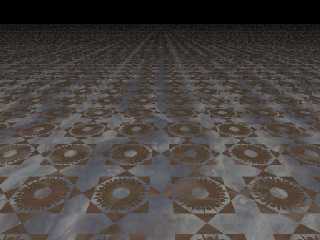
Here's a little "function pattern" for ya (no image maps!). It's a 2D pattern,
but that's just because I lacked inspiration for a 3D one. The basic principle
is very simple... Perhaps you can guess how it was made? :)

--
Margus Ramst

Personal e-mail: mar### [at] peakeduee
TAG (Team Assistance Group) e-mail: mar### [at] tagpovrayorg
Post a reply to this message
Attachments:
Download 'f_pat.jpg' (47 KB)
Preview of image 'f_pat.jpg'
|
|
| |
| |
|
|
|
|
| |
| |
|
|
"Margus Ramst" <mar### [at] peakeduee> wrote in message
news:39E65BBD.81BBC314@peak.edu.ee...
| "Bob H." wrote:
| >
| > ( I still refuse to believe a human being was able to do this type of
| > pattern magic until I see proof in the way of scripting) :-D
| >
|
| I think I'm on to his methods, although I probably lack the 3D perception
to
| imitate his work.
| Here's a little "function pattern" for ya (no image maps!). It's a 2D
pattern,
| but that's just because I lacked inspiration for a 3D one. The basic
principle
| is very simple... Perhaps you can guess how it was made? :)

I'll guess a overall spherical patterned pigment (or texture) map using
triangle pattern for outermost part and just clear to opaque central part,
with radial pattern for the spokes and dots.  But then I have no idea how
you actually got the spokes and dots made.
It's a bit much for my feeble mind.
It's good I assure you but nothing like those supposedly mathematically made
(?!) curves and shapes in such a rendition of a Escher drawing as what
Wlodzimierz has shown.

Bob
Post a reply to this message
|
|
| |
| |
|
|
From: Wlodzimierz ABX Skiba
Subject: Re: fished onion - how do this (2 img - 223KB bu)
Date: 13 Oct 2000 03:56:09
Message: <39e6c019@news.povray.org>
|
|
|
| |
| |
|
|
Bob H. wrote in message <39e6364c@news.povray.org>...
>( I still refuse to believe a human being was able to do this type of
>pattern magic until I see proof in the way of scripting) :-D


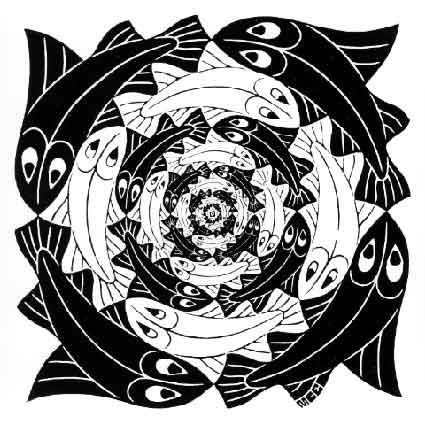
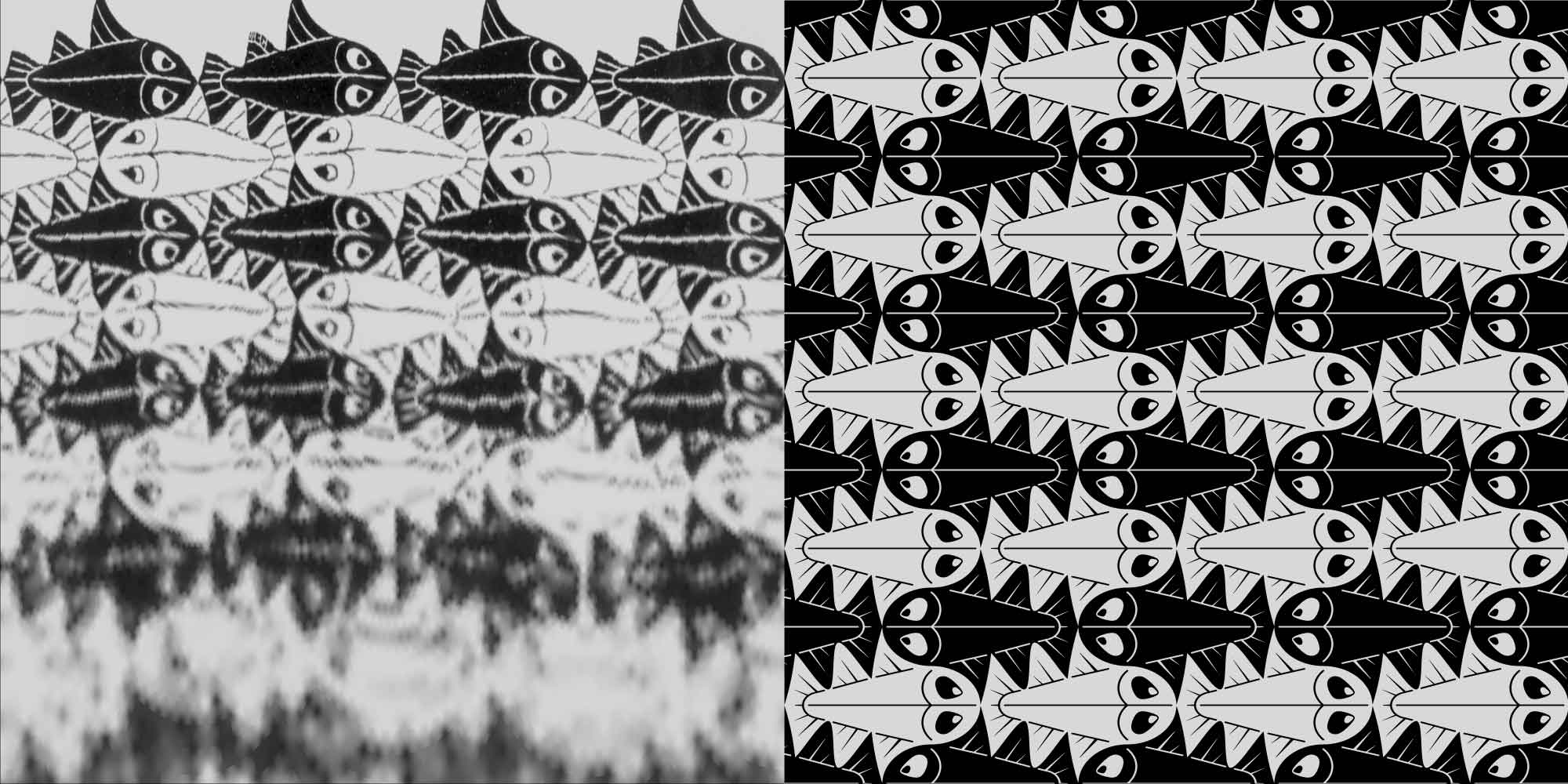
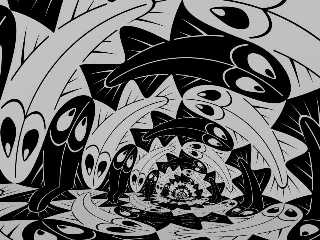
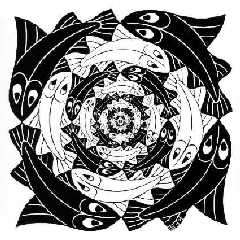
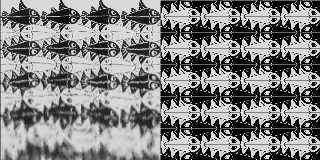
1. take original (first attached image)
2. flat this (left side of second attached image)
3. hand code best imitation from primitives (right side of second
attached image)
4. round this back to onion (attachment in 39e49cb3@news.povray.org)

:-D

ABX
Post a reply to this message
Attachments:
Download 'round.jpg' (33 KB)
Download 'flat.jpg' (192 KB)
Preview of image 'round.jpg'
Preview of image 'flat.jpg'
|
|
| |
| |
|
|
From: Bob H
Subject: Re: fished onion - how do this (2 img - 223KB bu)
Date: 13 Oct 2000 04:18:15
Message: <39e6c547@news.povray.org>
|
|
|
| |
| |
|
|
"Wlodzimierz ABX Skiba" <abx### [at] abxartpl> wrote in message
news:39e6c019@news.povray.org...
| Bob H. wrote in message <39e6364c@news.povray.org>...
| >( I still refuse to believe a human being was able to do this type of
| >pattern magic until I see proof in the way of scripting) :-D
|
| 1. take original (first attached image)
| 2. flat this (left side of second attached image)
| 3. hand code best imitation from primitives (right side of second
| attached image)
| 4. round this back to onion (attachment in 39e49cb3@news.povray.org)
|
| :-D

Okay, thankyou for explaining.  I still don't understand it completely but
the CSG of shapes makes more sense than the wild imaginings I was thinking
of.  I just can't follow step by step either, it's amazing regardless of
whether I know how it was done or not.

Bob
Post a reply to this message
|
|
| |
| |
|
|
|
|
| |
| |
|
|
"Bob H." wrote:
>
> I'll guess a overall spherical patterned pigment (or texture) map using
> triangle pattern for outermost part and just clear to opaque central part,
> with radial pattern for the spokes and dots.  But then I have no idea how
> you actually got the spokes and dots made.

Nope. Similar to what Wlodzimierz did, but this is just a quickie. CSG of a few
boxes, torus, spheres & cones; turned into an object pattern and tiled.
Besides, apparently his patterns are 2D too - I was truly stumped as to how he
managed a 3D-tilable Escher pattern ;) I'm not sure how he got more than 2
possible pattern values in his previous works, though...

--
Margus Ramst

Personal e-mail: mar### [at] peakeduee
TAG (Team Assistance Group) e-mail: mar### [at] tagpovrayorg
Post a reply to this message
|
|
| |
| |
|
|
|
|
| |
| |
|
|
Margus Ramst wrote in message <39E6FBC3.74782879@peak.edu.ee>...
> I'm not sure how he got more than 2
> possible pattern values in his previous works, though...


You mean this ?

    #local FunPig1=function{pigment{object{Obj1 color 0 color 1/3}}}
    #local FunPig2=function{pigment{object{Obj2 color 0 color 2/3}}}
    #local FunPig3=function{pigment{object{Obj3 color 0 color 1}}}
    #local EscherFunction=function{FunPig1+FunPig2+FunPig3}

ABX
Post a reply to this message
|
|
| |
| |
|
|
From: Wlodzimierz ABX Skiba
Subject: Re: fished onion - how do this
Date: 13 Oct 2000 10:39:19
Message: <39e71e97@news.povray.org>
|
|
|
| |
| |
|
|
Wlodzimierz ABX Skiba wrote in message <39e6c019@news.povray.org>...
>1. take original (first attached image)
>2. flat this (left side of second attached image)
>3. hand code best imitation from primitives (right side of second
>attached image)
>4. round this back to onion (attachment in 39e49cb3@news.povray.org)


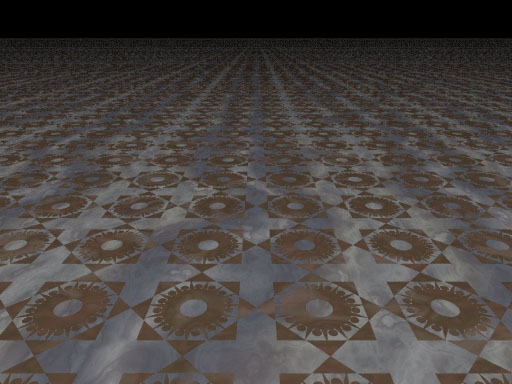
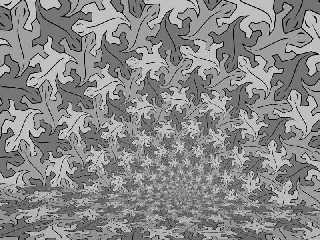
as you see at point 3 - to put something in onion
I need this pattern in square
this way I can take any pattern available in square
and put it as such onioned one
it coul be favorite checkered pattern
but also it could be my second eschered lizards

ABX

(sorry for jpg compression)
Post a reply to this message
Attachments:
Download 'escher4.jpg' (70 KB)
Preview of image 'escher4.jpg'
|
|
| |
| |
|
|
|
|
| |
| |
|
|
that hurts, makes my eyes go funny

Rick
Post a reply to this message
|
|
| |
| |
|
|
|
|
| |
| |
|
|
Margus,

I made an attempt at this last night (and failed)...  I could figure out how
to make the shape I wanted using an object pigment, but I couldn't figure
out how to tile it without just writing a loop that csg's the objects
together.  How did you do the tiling?

-autowitch

p.s. (if this posts twice, I apologize - my newsreader is really losing it
today)
--
duncan gold [TurboPower Software]
Post a reply to this message
|
|
| |
| |
|
|
|
|
| |
| |
|
|
Wlodzimierz ABX Skiba wrote:
>
> You mean this ?
>
>     #local FunPig1=function{pigment{object{Obj1 color 0 color 1/3}}}
>     #local FunPig2=function{pigment{object{Obj2 color 0 color 2/3}}}
>     #local FunPig3=function{pigment{object{Obj3 color 0 color 1}}}
>     #local EscherFunction=function{FunPig1+FunPig2+FunPig3}
>
> ABX

Ah, yes. I suspected something like this, but couldn't quite figure it out.
Thanks!

--
Margus Ramst

Personal e-mail: mar### [at] peakeduee
TAG (Team Assistance Group) e-mail: mar### [at] tagpovrayorg
Post a reply to this message
|
|
| |
| |
|
|
|
|
| |
| |
|
|
autowitch wrote:
>
> How did you do the tiling?
>

You have two options (that I can think of).

1) Use the repeat warp. For example, to get a <0,0,0>-<1,1,1> slice of your
texture to tile in 3D, you need 3 consecutive repeat warps:
warp{repeat x}
warp{repeat y}
warp{repeat z}

2) The way I did it was to modify the (x,y,z) parameters in the function call,
like this:
function{
    My_pigment_function(
        abs(x)-floor(abs(x)),
        abs(y)-floor(abs(y)),
        abs(z)-floor(abs(z))
    )
}
This also tiles a <0,0,0>-<1,1,1> slice of the pattern in 3D - but if I'm not
mistaken, the pattern is mirrored at the origin.

--
Margus Ramst

Personal e-mail: mar### [at] peakeduee
TAG (Team Assistance Group) e-mail: mar### [at] tagpovrayorg
Post a reply to this message
|
|
| |
| |
|
|
|
|
| |
| |
|
|
Well it's incredible.  I think I'm understanding it more as time goes on.

Bob
Post a reply to this message
|
|
| |
| |
|
|
|
|
| |
| |
|
|
Obviously guessing how something is done without knowing all the possible
tools and/or techniques available can get a person nowhere.  I was trying to
think of how the old-fashioned texturing methods would create it.

Bob
Post a reply to this message
|
|
| |
| |
|
|
|
|
| |
| |
|
|
"Bob H." wrote:

> Obviously guessing how something is done without knowing all the possible
> tools and/or techniques available can get a person nowhere.  I was trying to
> think of how the old-fashioned texturing methods would create it.

Me too. I think a lot of people try to do that.

...and people with pirated versions of Max realize that and use it to their
advantage...

--
David Fontaine  <dav### [at] faricynet>  ICQ 55354965
My raytracing gallery:  http://davidf.faricy.net/
Post a reply to this message
|
|
| |
| |
|
|
|
|
| |
| |
|
|
> 2) The way I did it was to modify the (x,y,z) parameters in the
function call,
> like this:
> function{
>     My_pigment_function(
>        abs(x)-floor(abs(x)),
>        abs(y)-floor(abs(y)),
>        abs(z)-floor(abs(z))
>    )
> }
> This also tiles a <0,0,0>-<1,1,1> slice of the pattern in 3D - but if
I'm not
> mistaken, the pattern is mirrored at the origin.


why you absolute coordinates ?

My_pigment_function(x-floor(x),y-floor(y),z-floor(z))

ABX
Post a reply to this message
|
|
| |
| |
|
|
|
|
| |
| |
|
|
Wlodzimierz ABX Skiba wrote:
>
> why you absolute coordinates ?
>

Because, if I'm not mistaken, that mirrors the pattern at the origin :)
In my case, that was the desired effect. Otherwise, repeat warps can do the job
and are probably easier to understand.

--
Margus Ramst

Personal e-mail: mar### [at] peakeduee
TAG (Team Assistance Group) e-mail: mar### [at] tagpovrayorg
Post a reply to this message
|
|
| |
| |
|
|
From: Anton Sherwood
Subject: Re: fished onion - how do this (2 img - 223KB bu)
Date: 13 May 2001 03:28:32
Message: <3AFE37D6.B037BBB1@pobox.com>
|
|
|
| |
| |
|
|
would it be cheating to print the fish onto a cylinder?

--
Anton Sherwood  --  br0### [at] p0b0xcom  --  http://ogre.nu/
Post a reply to this message
|
|
| |
| |
|
|
|
|
| |