|
|
|
|
|
|
| |
| |
|
|
|
|
| |
| |
|
|
Yesterday I took some time off from my old CSG-macros to
explore the bozo pattern.
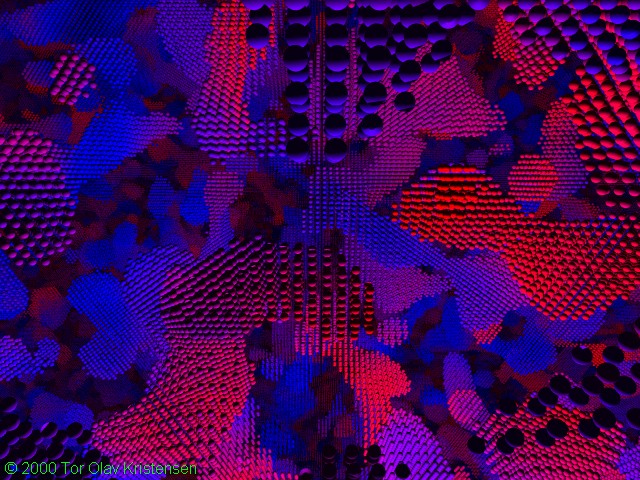
Here's an image from this journey.
(The camera was placed inside the pattern.)
In this scene there are several hundred million spheres generated
by only one iso-surface.
Parsing time was a fraction of a second and rendering time was
about 2.6 hours on an AMD K6@200MHz
The image is best viewed with the lights in the room switched off.
Any comments ?
Tor Olav
--
mailto:tor### [at] hotmail com
http://www.crosswinds.net/~tok/tokrays.html
Post a reply to this message
Attachments:
Download 'bozo04.jpg' (145 KB)
Preview of image 'bozo04.jpg'
|
|
| |
| |
|
|
|
|
| |
| |
|
|
Tor Olav Kristensen wrote:
>
> Yesterday I took some time off from my old CSG-macros to
> explore the bozo pattern.
>
> Here's an image from this journey.
> (The camera was placed inside the pattern.)
>
> In this scene there are several hundred million spheres generated
> by only one iso-surface.

Don't tell me you counted them ;-)

>
> Parsing time was a fraction of a second and rendering time was
> about 2.6 hours on an AMD K6@200MHz
>
> The image is best viewed with the lights in the room switched off.
>
> Any comments ?
>

It looks good, i suspect it's made with no_shadow modifier.

A flythrough animation would be great, but 2.6 hours/frame would be quite a
lot.

BTW, you said it's a bozo pattern so you probably use a pigment function which
is slower than the plain noise3d although it should lead to identical results.

Christoph

--
Christoph Hormann <chr### [at] gmxde>
Homepage: http://www.schunter.etc.tu-bs.de/~chris/
Post a reply to this message
|
|
| |
| |
|
|
From: ian mcdonald
Subject: Re: Delving into the bozo world (144KB)
Date: 17 Oct 2000 11:30:24
Message: <39ec7090@news.povray.org>
|
|
|
| |
| |
|
|
Interesting. :)
I would have used shades of grey, as red and blue 'hurt' to look at.

How did you position the spheres according to the isosurface?

ian

Tor Olav Kristensen <tor### [at] hotmailcom> wrote in message
news:39EC223E.51300FC7@hotmail.com...
Post a reply to this message
|
|
| |
| |
|
|
|
|
| |
| |
|
|
The beauty of mathmatics? Maybe...

Neat idea.

--
David Fontaine  <dav### [at] faricynet>  ICQ 55354965
My raytracing gallery:  http://davidf.faricy.net/
Post a reply to this message
|
|
| |
| |
|
|
|
|
| |
| |
|
|
Christoph Hormann wrote:

> Tor Olav Kristensen wrote:
> >
> > Yesterday I took some time off from my old CSG-macros to
> > explore the bozo pattern.
> >
> > Here's an image from this journey.
> > (The camera was placed inside the pattern.)
> >
> > In this scene there are several hundred million spheres generated
> > by only one iso-surface.
>
> Don't tell me you counted them ;-)

Actually I tried to calculate how many there are.
I estimated the number of spheres in this scene to be about 10^10.


> ...
> It looks good, i suspect it's made with no_shadow modifier.

Yes you're right -My iso has a no_shadow modifier. But I believe now that
the sense of depth suffers from this.


> A flythrough animation would be great, but 2.6 hours/frame would be quite a
> lot.

It certainly crossed my mind too. But I would need a much faster PC in order
to plan a good path for the flight. It was a lot of work just finding a good spot
to place the camera in this scene.

I even thought of a new application for my Nelder-Mead simplex macros:

Maybe I could make them determine the best "forward direction" in which
to move, in order to reach a new spot with low field strength. If this were
repeated, one could determine a flight path through the areas with low field
strength and therefore few spheres.

I.e.: An autopilot for "flying" through the "opens" in pattern-worlds.

But this would be a lot of work :(   -so I guess I wont try it.


> BTW, you said it's a bozo pattern so you probably use a pigment function which
> is slower than the plain noise3d although it should lead to identical results.

Do you mean that the noise3d function also uses a kind of bozo pattern ?


Tor Olav
--
mailto:tor### [at] hotmailcom
http://www.crosswinds.net/~tok/tokrays.html
Post a reply to this message
|
|
| |
| |
|
|
|
|
| |
| |
|
|
ian mcdonald wrote:

> Interesting. :)
> I would have used shades of grey, as red and blue 'hurt' to look at.

I agree that the colours are not nice. I'm doing a new rendering now,
with the crackle pattern, where I have given all the spheres a light
blue
pigment.

And with a light source that fades with distances, this makes the
colours of the spheres to vary from deep blue to almost white.

> How did you position the spheres according to the isosurface?

I let the iso-surface do the work itself.
(-By using a pigment function inside an if statement. If the pigment
value in the middle of a "subcube" in 3D-space is above a certain
limit/threshold, a function is called to make a sphere in this
"subcube".
Else a constant outside the limit is returned.)

Unfortunately I have lost the source code for the image I posted,
but I'll soon post the code for the new image I'm rendering.


Tor Olav
--
mailto:tor### [at] hotmailcom
http://www.crosswinds.net/~tok/tokrays.html
Post a reply to this message
|
|
| |
| |
|
|
|
|
| |
| |
|
|
David Fontaine wrote:

> The beauty of mathmatics? Maybe...
>
> Neat idea.

Thank you.

I have been curious, for some time now, about how it will
look like if one could stand inside the different types of
3D-patterns that come with POV-Ray.

I think that the image I posted does not give a good sense
of depth. - It looks kind of flat.

So now I'm trying to figure out ways to increase the "3D-
feeling" for such scenes.

Do you have any ideas ?


Tor Olav
--
mailto:tor### [at] hotmailcom
http://www.crosswinds.net/~tok/tokrays.html
Post a reply to this message
|
|
| |
| |
|
|
|
|
| |
| |
|
|
In article <39ECE0E9.305975BC@hotmail.com>, Tor Olav Kristensen
<tor### [at] hotmailcom> wrote:

> Do you mean that the noise3d function also uses a kind of bozo pattern ?

The bozo pattern *is* noise3d, or actually, Noise(). So are bumps(when
used outside of normals) and spotted.

--
Christopher James Huff
Personal: chr### [at] maccom, http://homepage.mac.com/chrishuff/
TAG: chr### [at] tagpovrayorg, http://tag.povray.org/

<><
Post a reply to this message
|
|
| |
| |
|
|
|
|
| |
| |
|
|
Chris Huff wrote:

> In article <39ECE0E9.305975BC@hotmail.com>, Tor Olav Kristensen
> <tor### [at] hotmailcom> wrote:
>
> > Do you mean that the noise3d function also uses a kind of bozo pattern ?
>
> The bozo pattern *is* noise3d, or actually, Noise(). So are bumps(when
> used outside of normals) and spotted.

OK. Thank you.

But are there any differences in the possible applications (within
iso-surfaces)
for the bozo pattern and the noise3d function ?


And another question:

I tried to make the radius of all my iso spheres dependent of the field
strength
at certain points in space, but MegaPOV complained about not finding a
float inside the <> part of the "sphere" statement.

I think this is what I tried:

#declare BozoFunction =
function { pigment { bozo color_map { [ 0 rgb 0 ] [ 1 rgb 1 ] } scale 30 } }

#declare SphereFunction =
function { "sphere" <BozoFunction(x, y, z)> }

#declare ManySpheres =
function {
  SphereFunction(
    x - floor(x) - 0.5,
    y - floor(y) - 0.5,
    z - floor(z) - 0.5
  )
}

Can you please explain ?    Is there any other way to do this ?


Tor Olav
--
mailto:tor### [at] hotmailcom
http://www.crosswinds.net/~tok/tokrays.html
Post a reply to this message
|
|
| |
| |
|
|
|
|
| |
| |
|
|
Well, I would search for other nooks and crannies similar to how you placed
the camera, and place a few point light sources  here and there... and allow
the isosurface to cast shadows... you'd get little 'caves' of light. Mainly
just avoid using a main 'fill' light near the camera.

Andy Cocker

--
---------------------------------------------------------------
www.mariner9.net

..... for my music and graphics.
---------------------------------------------------------------
'I spilled spot remover on my dog. He's gone now. '
'I went to a restaurant that serves "breakfast at any time."
So I ordered french toast during the Renaissance. '

 - Steven Wright.
"Tor Olav Kristensen" <tor### [at] hotmailcom> wrote in message
news:39ECE583.3C581FC9@hotmail.com...
>
> David Fontaine wrote:
>
> > The beauty of mathmatics? Maybe...
> >
> > Neat idea.
>
> Thank you.
>
> I have been curious, for some time now, about how it will
> look like if one could stand inside the different types of
> 3D-patterns that come with POV-Ray.
>
> I think that the image I posted does not give a good sense
> of depth. - It looks kind of flat.
>
> So now I'm trying to figure out ways to increase the "3D-
> feeling" for such scenes.
>
> Do you have any ideas ?
>
>
> Tor Olav
> --
> mailto:tor### [at] hotmailcom
> http://www.crosswinds.net/~tok/tokrays.html
>
>
Post a reply to this message
|
|
| |
| |
|
|
|
|
| |
| |
|
|
In article <39ECEEA7.AD8656E5@hotmail.com>, Tor Olav Kristensen
<tor### [at] hotmailcom> wrote:

> But are there any differences in the possible applications (within
> iso-surfaces) for the bozo pattern and the noise3d function ?

Well, you can use the color_map of the bozo pigment function to get a
different range of values...and using noise3d() directly is faster.


> I tried to make the radius of all my iso spheres dependent of the
> field strength at certain points in space, but MegaPOV complained
> about not finding a float inside the <> part of the "sphere"
> statement.
...
> Can you please explain ?

That portion of the function is parsed once and then the result is
evaluated multiple times...you can't use isofunctions to control it. The
same goes for pigment functions...you can't do something like this:
function {pigment {bozo scale Func(x, y, z)}}
One of the more obvious reasons for this is that the syntax for
functions and the syntax for the rest of the POV-Script can't be used in
the same place...for example, x, y, and z mean different things, vectors
don't exist in functions, etc.


> Is there any other way to do this ?

No. Well, yes...you could modify the isosurface code to add a function
to do what you want, or you could use the eval_pattern() or
eval_pigment() functions to control millions of separate objects, but
that is probably not what you wanted to hear.
There may be some other way to get the same or a similar effect with
isosurfaces, though. There is very little that is impossible to do with
an isosurface...

--
Christopher James Huff
Personal: chr### [at] maccom, http://homepage.mac.com/chrishuff/
TAG: chr### [at] tagpovrayorg, http://tag.povray.org/

<><
Post a reply to this message
|
|
| |
| |
|
|
|
|
| |
| |
|
|
Tor Olav Kristensen wrote:

> I have been curious, for some time now, about how it will
> look like if one could stand inside the different types of
> 3D-patterns that come with POV-Ray.

Not quite related but similar, I had this idea to show the perspective
of being inside a menger sponge. Assuming the sponge is only a 2d
surface. I think by the nature of the sponge though it would be hard to
get a view that has a good onobstructed field.

--
David Fontaine  <dav### [at] faricynet>  ICQ 55354965
My raytracing gallery:  http://davidf.faricy.net/
Post a reply to this message
|
|
| |
| |
|
|
|
|
| |
| |
|
|
Isometrics is a cool tool...=)

Tor Olav Kristensen wrote:

> Yesterday I took some time off from my old CSG-macros to
> explore the bozo pattern.
>
> Here's an image from this journey.
> (The camera was placed inside the pattern.)
>
> In this scene there are several hundred million spheres generated
> by only one iso-surface.
>
> Parsing time was a fraction of a second and rendering time was
> about 2.6 hours on an AMD K6@200MHz
>
> The image is best viewed with the lights in the room switched off.
>
> Any comments ?
>
> Tor Olav
> --
> mailto:tor### [at] hotmailcom
> http://www.crosswinds.net/~tok/tokrays.html
>
>   ------------------------------------------------------------------------
>  [Image]
Post a reply to this message
|
|
| |
| |
|
|
|
|
| |
| |
|
|
Tor Olav Kristensen wrote:
>
> Can you please explain ?    Is there any other way to do this ?

	Something like that should work:

#declare ManySpheres = function {
  sqrt (sqr (x-floor(x)-0.5) + sqr (y-floor(y)-0.5) + sqr
(z-floor(z)-0.5)) -
  noise3d (x/30, y/30, z/30)
}

	But I haven't tested it...

		Jérôme
--
********************************* Jérôme M. BERGER
* Abandon the search for truth, * mailto:ber### [at] inamecom
* Settle for a good fantasy.    * http://www.enst.fr/~jberger
*********************************
Post a reply to this message
|
|
| |
| |
|
|
|
|
| |
| |
|
|
BigCeef wrote:

> Well, I would search for other nooks and crannies similar to how you placed
> the camera, and place a few point light sources  here and there... and allow
> the isosurface to cast shadows... you'd get little 'caves' of light. Mainly
> just avoid using a main 'fill' light near the camera.

Yes. I think several point light sources is a good idea.

I now remember that I have seen pictures from real caves, where
there has been several light sources scattered around in the cave.
The effect from this was nice.

Thank you very much for this suggestion !


I have tried to let the isosurface cast shadows, but there seems to be
some problems with this. (See my "Inside the Crackle pattern" thread.)


Tor Olav
--
mailto:tor### [at] hotmailcom
http://www.crosswinds.net/~tok/tokrays.html
Post a reply to this message
|
|
| |
| |
|
|
|
|
| |
| |
|
|
On Wed, 18 Oct 2000 01:49:24 +0200, Tor Olav Kristensen wrote:

>So now I'm trying to figure out ways to increase the "3D-
>feeling" for such scenes.
>
>Do you have any ideas ?

Have a cylinder or two at the bottom of the scene running from
front to back, they could be neon pink or something.

--
Cheers
Steve              email mailto:ste### [at] zeroppsuklinuxnet

%HAV-A-NICEDAY Error not enough coffee  0 pps.

web http://www.zeropps.uklinux.net/

or  http://start.at/zero-pps

 10:19pm  up 7 days, 23:39,  2 users,  load average: 1.07, 1.02, 1.00
Post a reply to this message
|
|
| |
| |
|
|
|
|
| |
| |
|
|
David Fontaine wrote:

> ...
> Not quite related but similar, I had this idea to show the perspective
> of being inside a menger sponge. Assuming the sponge is only a 2d
> surface. I think by the nature of the sponge though it would be hard to
> get a view that has a good onobstructed field.

Earlier today I didn't know what kind of sponge you were talking
about here. My dictionary didn't give me any clues either.

But then I did a search for "menger sponge" on www.google.com.

I found that this sponge is indeed interesting !

Have you or (anyone else in here) rendered this shape ?
With a recursive macro ? (Or with an isosurface ? =)


Tor Olav
--
mailto:tor### [at] hotmailcom
http://www.crosswinds.net/~tok/tokrays.html
Post a reply to this message
|
|
| |
| |
|
|
|
|
| |
| |
|
|
Steve wrote:

> On Wed, 18 Oct 2000 01:49:24 +0200, Tor Olav Kristensen wrote:
>
> >So now I'm trying to figure out ways to increase the "3D-
> >feeling" for such scenes.
> >
> >Do you have any ideas ?
>
> Have a cylinder or two at the bottom of the scene running from
> front to back, they could be neon pink or something.

Thanks for the suggestion.

I'll try something like this when I have found a solution to the problems

that I mentioned in "Inside the Crackle pattern" thread.


Tor Olav
--
mailto:tor### [at] hotmailcom
http://www.crosswinds.net/~tok/tokrays.html
Post a reply to this message
|
|
| |
| |
|
|
|
|
| |
| |
|
|
"Jérôme M. Berger" wrote:

> Tor Olav Kristensen wrote:
> >
> > Can you please explain ?    Is there any other way to do this ?
>
>         Something like that should work:
>
> #declare ManySpheres = function {
>   sqrt (sqr (x-floor(x)-0.5) + sqr (y-floor(y)-0.5) + sqr
> (z-floor(z)-0.5)) -
>   noise3d (x/30, y/30, z/30)
> }
> ...

Hmmm...

I used this sqrt equation for the spheres, but then I discovered
the built in "spheres" function and started using that instead.

It didn't cross my mind to use the sqrt function when trying
to adjust the different radii according to the field strength.

But I think that I would have to change your noise3d part to
something like this:

noise3d (floor(x/30) + 0.5, floor(y/30) + 0.5, floor(z/30) + 0.5)

I have not tested this yet either :)

Thank you.for this tip.


Tor Olav
--
mailto:tor### [at] hotmailcom
http://www.crosswinds.net/~tok/tokrays.html
Post a reply to this message
|
|
| |
| |
|
|
|
|
| |
| |
|
|
Chris Huff wrote:

> In article <39ECEEA7.AD8656E5@hotmail.com>, Tor Olav Kristensen
> <tor### [at] hotmailcom> wrote:
> ...
> > Is there any other way to do this ?
>
> No. Well, yes...you could modify the isosurface code to add a function
> to do what you want, or you could use the eval_pattern() or
> eval_pigment() functions to control millions of separate objects, but
> that is probably not what you wanted to hear.

I'm not very much into this kind of C-programming, so I think I'll seek for
other solutions.


> There may be some other way to get the same or a similar effect with
> isosurfaces, though. There is very little that is impossible to do with
> an isosurface...

I hope you are right. I'll try out a suggestion provided by  Jérôme M.
Berger.


Again: Thank you for explaining. I appreciate very much your efforts to
help.


Regards,

Tor Olav
--
mailto:tor### [at] hotmailcom
http://www.crosswinds.net/~tok/tokrays.html
Post a reply to this message
|
|
| |
| |
|
|
|
|
| |
| |
|
|
In article <39EE2C8F.B5103C2B@hotmail.com>, Tor Olav Kristensen
<tor### [at] hotmailcom> wrote:

> Have you or (anyone else in here) rendered this shape ?
> With a recursive macro ? (Or with an isosurface ? =)

A while ago there was a craze of Menger sponges, Serpinski pyramids, and
other fractal shapes...I think there were at least a dozen different
methods being tried for Menger sponges alone. Some of them reached quite
high recursion levels...

--
Christopher James Huff
Personal: chr### [at] maccom, http://homepage.mac.com/chrishuff/
TAG: chr### [at] tagpovrayorg, http://tag.povray.org/

<><
Post a reply to this message
|
|
| |
| |
|
|
|
|
| |
| |
|
|
Tor Olav Kristensen wrote:
>
> But I think that I would have to change your noise3d part to
> something like this:
>
> noise3d (floor(x/30) + 0.5, floor(y/30) + 0.5, floor(z/30) + 0.5)
>
	You're right, I thought about this too late. OTOH, since the value of
the noise3d won't change much over the size of one sphere, you might
find that the other equation gives adequate results and renders faster
(again completely untried...)

		Jérôme
--
********************************* Jérôme M. BERGER
* Abandon the search for truth, * mailto:ber### [at] inamecom
* Settle for a good fantasy.    * http://www.enst.fr/~jberger
*********************************
Post a reply to this message
|
|
| |
| |
|
|
|
|
| |
| |
|
|
Wow!  This is neat!
Brendan

Tor Olav Kristensen wrote:

> Yesterday I took some time off from my old CSG-macros to
> explore the bozo pattern.
>
> Here's an image from this journey.
> (The camera was placed inside the pattern.)
>
> In this scene there are several hundred million spheres generated
> by only one iso-surface.
>
> Parsing time was a fraction of a second and rendering time was
> about 2.6 hours on an AMD K6@200MHz
>
> The image is best viewed with the lights in the room switched off.
>
> Any comments ?
>
> Tor Olav
> --
> mailto:tor### [at] hotmailcom
> http://www.crosswinds.net/~tok/tokrays.html
>
>   ------------------------------------------------------------------------
>  [Image]
Post a reply to this message
|
|
| |
| |
|
|
|
|
| |