|
|
|
|
|
|
| |
| |
|
|
|
|
| |
| |
|
|
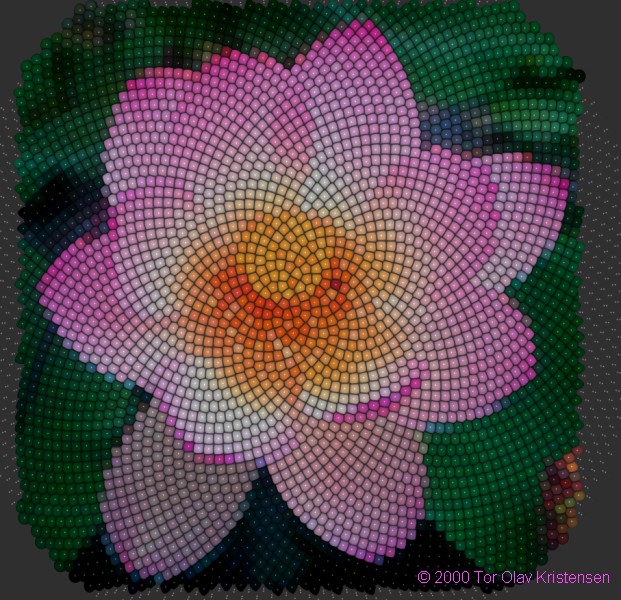
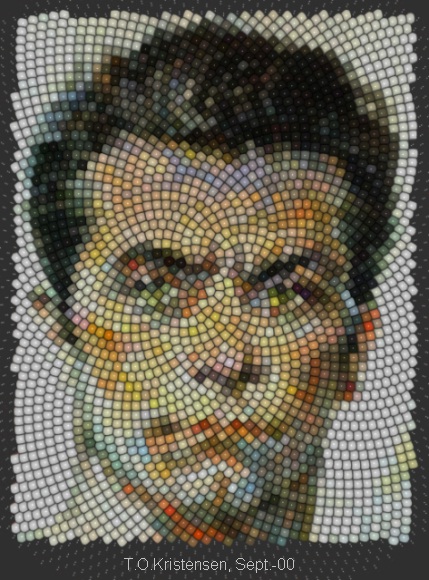
Here are two images made with "antiblobs" placed in a
Fibonacci pattern and coloured with an image_map
in standard POV.
Thank you to;
Alf Peake for providing the Fibonacci code.
Xplo Eristotle for suggestion to make mosaic with my "anti blobs".
Chris Huff for suggestion of method for pigmenting in standard POV.
Any suggestions for improvements ?
Tor Olav
--
mailto:tor### [at] hotmail com
http://www.crosswinds.net/~tok/tokrays.html
Post a reply to this message
Attachments:
Download 'imagemosaic04.jpg' (151 KB)
Download 'imagemosaic03.jpg' (145 KB)
Preview of image 'imagemosaic04.jpg'
Preview of image 'imagemosaic03.jpg'
|
|
| |
| |
|
|
|
|
| |
| |
|
|
In article <39B65D7C.9BE96D79@online.no>, Tor Olav Kristensen
<tto### [at] onlineno> wrote:

> Here are two images made with "antiblobs" placed in a
> Fibonacci pattern and coloured with an image_map
> in standard POV.

I wonder how difficult it would be to make a crackle-like fibonacci
built-in pattern...or to allow the centers of each "cell" in a crackle
pattern to be specified manually. Maybe as an extension of the blob
pattern...

--
Christopher James Huff
Personal: chr### [at] maccom, http://homepage.mac.com/chrishuff/
TAG: chr### [at] tagpovrayorg, http://tag.povray.org/

<><
Post a reply to this message
|
|
| |
| |
|
|
|
|
| |
| |
|
|
Saddam Hussein, right?

Tor Olav Kristensen wrote:
Post a reply to this message
|
|
| |
| |
|
|
|
|
| |
| |
|
|
On Wed, 06 Sep 2000 17:06:36 +0200, Tor Olav Kristensen wrote:
>
>
>Here are two images made with "antiblobs" placed in a
>Fibonacci pattern and coloured with an image_map
>in standard POV.

I can only say impressive.

--
Cheers
Steve              email mailto:ste### [at] zeroppsuklinuxnet

%HAV-A-NICEDAY Error not enough coffee  0 pps.

web http://www.zeropps.uklinux.net/

or  http://start.at/zero-pps

 10:29pm  up 16 days,  2:41,  3 users,  load average: 1.18, 1.17, 1.11
Post a reply to this message
|
|
| |
| |
|
|
|
|
| |
| |
|
|
These are good! The first is a better subject for the process IMHO, int the
second the pattern is very distracting...

--
David Fontaine   <dav### [at] faricynet>   ICQ 55354965
Please visit my website:  http://davidf.faricy.net/
Post a reply to this message
|
|
| |
| |
|
|
|
|
| |
| |
|
|
no no no!

Isn't it Frank Frazetta?

"Greg M. Johnson" wrote:

> Saddam Hussein, right?
>
> Tor Olav Kristensen wrote:
Post a reply to this message
|
|
| |
| |
|
|
|
|
| |
| |
|
|
> Tor Olav Kristensen <tto### [at] onlineno> wrote:
> > Here are two images made with "antiblobs" placed in a
> > Fibonacci pattern and coloured with an image_map
> > in standard POV.

That's marvelous.  Now I have an idea for the rose-window of my gothic
fullerene.


Chris Huff wrote:
> I wonder how difficult it would be to make a crackle-like fibonacci
> built-in pattern...

Oddly enough, the math I did for the newest (top) scenes in
http://ogre.nu/doodle.html just might be useful for that!
(source in http://ogre.nu/text/pov/flatbasket.pov)


--
Anton Sherwood  --  br0### [at] p0b0xcom  --  http://ogre.nu/
Post a reply to this message
|
|
| |
| |
|
|
|
|
| |
| |
|
|
Chris Huff wrote:

> In article <39B65D7C.9BE96D79@online.no>, Tor Olav Kristensen
> <tto### [at] onlineno> wrote:
>
> > Here are two images made with "antiblobs" placed in a
> > Fibonacci pattern and coloured with an image_map
> > in standard POV.
>
> I wonder how difficult it would be to make a crackle-like fibonacci
> built-in pattern...or to allow the centers of each "cell" in a crackle
> pattern to be specified manually. Maybe as an extension of the blob
> pattern...

This sounds interesting.

Can you please try to explain more about what
you have in mind ?

(I don't understand what you mean by "cell" and
I don't know any crackle patterns yet.)

Are you thinking of a Fibonacci pattern in 3
dimensions ?


Tor Olav
--
mailto:tor### [at] hotmailcom
http://www.crosswinds.net/~tok/tokrays.html
Post a reply to this message
|
|
| |
| |
|
|
|
|
| |
| |
|
|
David Fontaine wrote:

> These are good!

Thanks !


> The first is a better subject for the process IMHO, int the
> second the pattern is very distracting...

I agree.

I have to admit that I didn't plan the Fibonacci
centre to be in the centre of the flower.

And I find this a little bit funny because the centre
of the flower is where I would expect to find a
Fibonacci pattern in "the real nature".

It's also interesting to see how well the curves
in the Fibonacci pattern follows the edges of the
flower's leafs.


Tor Olav
--
mailto:tor### [at] hotmailcom
http://www.crosswinds.net/~tok/tokrays.html
Post a reply to this message
|
|
| |
| |
|
|
|
|
| |
| |
|
|
Steve wrote:

> I can only say impressive.

Then I'll only smile and say thanks.


Tor Olav
Post a reply to this message
|
|
| |
| |
|
|
|
|
| |
| |
|
|
In article <39B82B9C.36DAF298@online.no>, Tor Olav Kristensen
<tto### [at] onlineno> wrote:

> This sounds interesting.
> Can you please try to explain more about what
> you have in mind ?
> (I don't understand what you mean by "cell" and
> I don't know any crackle patterns yet.)

I have attached an image of a sphere with a crackle pigment. As you see,
it has separate "cells". In the official version and MegaPOV, these are
located randomly, I was wondering if it would be possible to specify
their locations and strengths manually, maybe as an extension to the
blob pattern.


> Are you thinking of a Fibonacci pattern in 3
> dimensions ?

No, though it could be used to do that if you wanted(and if you figure
out what a 3D Fibonacci pattern is).

--
Christopher James Huff
Personal: chr### [at] maccom, http://homepage.mac.com/chrishuff/
TAG: chr### [at] tagpovrayorg, http://tag.povray.org/

<><
Post a reply to this message
Attachments:
Download 'crackle.jpg' (4 KB)
Preview of image 'crackle.jpg'

|
|
| |
| |
|
|
|
|
| |
| |
|
|
Ben Paschke wrote:

> no no no!
>
> Isn't it Frank Frazetta?
>
> "Greg M. Johnson" wrote:
>
> > Saddam Hussein, right?

It's from the lower left image on this page:
http://www.wadhome.org/frazetta/overview0002.html

I don't know how Frank Frazetta look(ed ?), but
if it is showing him, then it must be a self-portrait.

Does anyone know more about this ?


Tor Olav
--
mailto:tor### [at] hotmailcom
http://www.crosswinds.net/~tok/tokrays.html
Post a reply to this message
|
|
| |
| |
|
|
From: Tor Olav Kristensen
Subject: Re: Fibonacci Mosaics (151KB & 145KB) - crackle.jpg (1/1)
Date: 7 Sep 2000 20:46:35
Message: <39B835A1.EEB8B211@online.no>
|
|
|
| |
| |
|
|
Chris Huff wrote:

> ...
> I have attached an image of a sphere with a crackle pigment. As you see,
> it has separate "cells". In the official version and MegaPOV, these are
> located randomly, I was wondering if it would be possible to specify
> their locations and strengths manually, maybe as an extension to the
> blob pattern.

Now I see. Thank you for explaining.


> > Are you thinking of a Fibonacci pattern in 3
> > dimensions ?
>
> No, though it could be used to do that if you wanted(and if you figure
> out what a 3D Fibonacci pattern is).

I'll have to brood on this for a while.


Tor Olav
--
mailto:tor### [at] hotmailcom
http://www.crosswinds.net/~tok/tokrays.html
Post a reply to this message
|
|
| |
| |
|
|
|
|
| |
| |
|
|
Tor Olav Kristensen wrote:

> It's also interesting to see how well the curves
> in the Fibonacci pattern follows the edges of the
> flower's leafs.

Yeah, there's probably 1000 different places you could find the golden
ratio or a Fibannochi number on a single plant...

--
David Fontaine   <dav### [at] faricynet>   ICQ 55354965
Please visit my website:  http://davidf.faricy.net/
Post a reply to this message
|
|
| |
| |
|
|
|
|
| |
| |
|
|
On Thu, 07 Sep 2000 19:39:16 -0500, Chris Huff wrote:
>I have attached an image of a sphere with a crackle pigment. As you see,
>it has separate "cells". In the official version and MegaPOV, these are
>located randomly, I was wondering if it would be possible to specify
>their locations and strengths manually, maybe as an extension to the
>blob pattern.

Yes, but you'd need an efficient data structure to find the closest center
to a given sample point quickly.  Fortunately, I've done some work in that
field (though in 2D) so I have some ideas on how it might be done.

Such a pattern would solve Gilles' lizard-skin problem, too.

--
Ron Parker   http://www2.fwi.com/~parkerr/traces.html
My opinions.  Mine.  Not anyone else's.
Post a reply to this message
|
|
| |
| |
|
|
|
|
| |
| |
|
|
On Thu, 07 Sep 2000 22:12:32 -0500, David Fontaine wrote:
>Tor Olav Kristensen wrote:
>
>> It's also interesting to see how well the curves
>> in the Fibonacci pattern follows the edges of the
>> flower's leafs.
>
>Yeah, there's probably 1000 different places you could find the golden
>ratio or a Fibannochi number on a single plant...

You realize, of course, that there's a relationship between the two.

If F(n) is the n'th Fibonacci number, then

  lim    F(n)/F(n-1) = phi
n -> oo

(where "oo" should be taken as a low-resolution version of the symbol for
infinity.)

--
Ron Parker   http://www2.fwi.com/~parkerr/traces.html
My opinions.  Mine.  Not anyone else's.
Post a reply to this message
|
|
| |
| |
|
|
|
|
| |
| |
|
|
Tor Olav Kristensen <tto### [at] onlineno> wrote in message
news:39B65D7C.9BE96D79@online.no...
>
> Any suggestions for improvements ?
>
You've got to be joking?
:)

Alf
Post a reply to this message
|
|
| |
| |
|
|
|
|
| |
| |
|
|
I think the pattern adds to these images. A regular 50*50 grid might
look good, but these 2 images say "Hey! Look at this!"

Alf


David Fontaine <dav### [at] faricynet> wrote in message
news:39B6C977.BCA27C4F@faricy.net...
> These are good! The first is a better subject for the process IMHO,
int the
> second the pattern is very distracting...
>
> --
> David Fontaine   <dav### [at] faricynet>   ICQ 55354965
> Please visit my website:  http://davidf.faricy.net/
>
>
Post a reply to this message
|
|
| |
| |
|
|
|
|
| |
| |
|
|
Ron Parker wrote:

> You realize, of course, that there's a relationship between the two.

Well Duh

> If F(n) is the n'th Fibonacci number, then
>
>   lim    F(n)/F(n-1) = phi
> n -> oo

Well Duh

> (where "oo" should be taken as a low-resolution version of the symbol for
> infinity.)

Well Duh

:-)


teehee

--
David Fontaine   <dav### [at] faricynet>   ICQ 55354965
Please visit my website:  http://davidf.faricy.net/
Post a reply to this message
|
|
| |
| |
|
|
|
|
| |
| |
|
|
Tor Olav Kristensen <tto### [at] onlineno> wrote in message
news:39B8344B.27A063A3@online.no...
> I don't know how Frank Frazetta look(ed ?), but
> if it is showing him, then it must be a self-portrait.
>
> Does anyone know more about this ?

Yeah, if you take a look at the official Frazetta website
http://www.frazettaartgallery.com/ they mention this self-portrait briefly
in his bio.

-Chris-
Post a reply to this message
|
|
| |
| |
|
|
|
|
| |
| |
|
|
> Any suggestions for improvements ?

I've made some code which only parses the fibonacci antiblobs needed to make
any given rectangle rather than a circle....  It would have save a *lot* of
parsing time for these images and it would have looked better.  I can post
it if you"re interested ;-)
Post a reply to this message
|
|
| |
| |
|
|
|
|
| |
| |
|
|
Ian Witham wrote:

> > Any suggestions for improvements ?
>
> I've made some code which only parses the fibonacci antiblobs needed to make
> any given rectangle rather than a circle....  It would have save a *lot* of
> parsing time for these images and it would have looked better.  I can post
> it if you"re interested ;-)

Yes, please.


Tor Olav
--
mailto:tor### [at] hotmailcom
http://www.crosswinds.net/~tok/tokrays.html
Post a reply to this message
|
|
| |
| |
|
|
|
|
| |
| |
|
|
Post a reply to this message
|
|
| |
| |
|
|
|
|
| |
| |
|
|
On Thu, 14 Sep 2000 07:09:50 -0500, Chris Huff wrote:
>In article <slr### [at] fwicom>, ron### [at] povrayorg
>wrote:
>
>> Yes, but you'd need an efficient data structure to find the closest
>> center to a given sample point quickly.  Fortunately, I've done some
>> work in that field (though in 2D) so I have some ideas on how it
>> might be done.
>
>Any suggestions? I am thinking of it as an addition to the blob pattern,
>which has several more component types than the blob object. Could this
>data structure also handle line(cylinder) components? Of course, just
>having it available for the spherical components(and components that can
>be approximated by spheres) would help...

The code I had (in 2d) used a quadtree to store the points, and another to
store the lines.  Points are simple: find the quadtree node that contains
the sample point, and search it for closer points.  If any edges are closer
than the closest point, search the quadtree node on that side for closer
points as well.  If any corners are closer, search the node diagonally
adjacent to the current node as well.  Continue for all edges and corners
of all tested nodes, until none are closer than the closest point found.
(This is easier than it looks, due to the structure of a quadtree.)  For 3d,
of course, you'd use an octree, and you'd generalize the above description
to faces, edges, and corners of an octree node.

To store lines, you have to corrupt the quadtree structure a bit by storing
lines that are too long to fit entirely in a leaf node in the interior nodes
of the tree.  The procedure is the same, though, with the caveat that you must
also search all ancestor nodes of any leaf node you search.  This structure
is not as efficient as the one for points unless your line segments are all
very small, with the possible exception of a few large ones.  In my case,
working with digital cartography, this was true.  In the case of a blob, it
may not be.  You may need to modify the criteria you use to split (for example,
it may make more sense to break the nodes on one axis at a time rather than
all at once.)

If you generalize to 3d, it should become obvious that the same strategy
that works for line segments will work for polygons.

--
Ron Parker   http://www2.fwi.com/~parkerr/traces.html
My opinions.  Mine.  Not anyone else's.
Post a reply to this message
|
|
| |
| |
|
|
|
|
| |