|
|
|
|
|
|
| |
| |
|
|
|
|
| |
| |
|
|
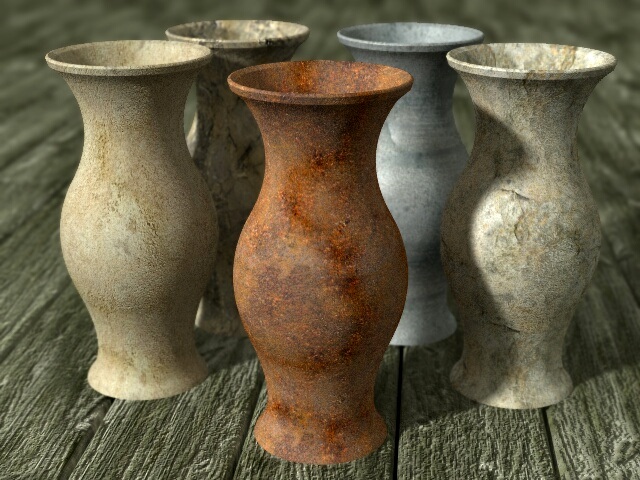
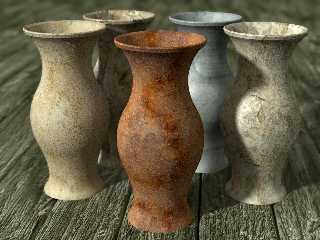
I have improve a bit the bootom part of the pic. There are still
room for improvment but as this is only tests :).

Comment are welcome (this help a lot) :).

Fabian.
Post a reply to this message
Attachments:
Download 'vase_all2.jpg' (131 KB)
Preview of image 'vase_all2.jpg'
|
|
| |
| |
|
|
|
|
| |
| |
|
|
Fabian BRAU wrote:
>
> I have improve a bit the bootom part of the pic. There are still
> room for improvment but as this is only tests :).
>
> Comment are welcome (this help a lot) :).
>
looks much better now, maybe you could round the bottom rim of the vases a bit
more.
If i see it right, you are using a normal statement for the wood structure. If
you would use a heightfield/isosurface, it would improve things even more,
because you could see the shadows of the vases interfering with the wood's
surface. Right now, it looks like the red one is to much sticking to the
plank.
Christoph
--
Christoph Hormann <chr### [at] gmx de>
Homepage: http://www.schunter.etc.tu-bs.de/~chris/
Post a reply to this message
|
|
| |
| |
|
|
|
|
| |
| |
|
|
How did you make the wood? I think the reason why the vases look like they
were photoshopped in is because the surfaceof the wood meets the vase in a
simple curve, so the wood suddenly has to be flat. I really really love these
textures.

Josh

Fabian BRAU wrote:

> I have improve a bit the bootom part of the pic. There are still
> room for improvment but as this is only tests :).
>
> Comment are welcome (this help a lot) :).
>
> Fabian.
>
>   ------------------------------------------------------------------------
>  [Image]

--
Josh English -- Lexiphanic Lethomaniac
eng### [at] spiritonecom
The POV-Ray Cyclopedia http://www.spiritone.com/~english/cyclopedia/
Post a reply to this message
|
|
| |
| |
|
|
|
|
| |
| |
|
|
The wood looks a little better, but I still think procedural wood would look
somewhat better. I like the rust colored vase the best. These would look
nice in an outdoor garden scene; they look nice and weathered.
HH

"Fabian BRAU" <Fab### [at] umhacbe> wrote in message
news:3992E108.D6CDEE46@umh.ac.be...
> I have improve a bit the bootom part of the pic. There are still
> room for improvment but as this is only tests :).
>
> Comment are welcome (this help a lot) :).
>
> Fabian.


----------------------------------------------------------------------------
----
Post a reply to this message
|
|
| |
| |
|
|
|
|
| |
| |
|
|
In article <3992E108.D6CDEE46@umh.ac.be>, Fabian BRAU
<Fab### [at] umhacbe> wrote:

> I have improve a bit the bootom part of the pic. There are still
> room for improvment but as this is only tests :).

I think the problem is that the lighting on the image you are using in
your image_map is different from the lighting on the vases...it really
doesn't look right. Try a procedural wood texture, that way the lighting
and shadows are always correct, and you don't end up with as much as a
"faked" look.

--
Christopher James Huff - Personal e-mail: chr### [at] maccom
TAG(Technical Assistance Group) e-mail: chr### [at] tagpovrayorg
Personal Web page: http://homepage.mac.com/chrishuff/
TAG Web page: http://tag.povray.org/
Post a reply to this message
|
|
| |
| |
|
|
|
|
| |
| |
|
|
> The wood looks a little better, but I still think procedural wood would look
> somewhat better.

Show me good procedurial wood! I never see good one. Even from
Gilles Tran, Jaime Vives Piqueres etc.... :).

Fabian.
Post a reply to this message
|
|
| |
| |
|
|
|
|
| |
| |
|
|
Christoph Hormann a écrit :
>
> Fabian BRAU wrote:
> >
> > I have improve a bit the bootom part of the pic. There are still
> > room for improvment but as this is only tests :).
> >
> > Comment are welcome (this help a lot) :).
> >
>
> looks much better now, maybe you could round the bottom rim of the vases a bit
> more.
>

As this is test rendering and not scene I will not do it :).
Actually the purpose of these pictures was to put texture on non so
trivial
object (need uv mapping here etc...) and see if there were good, it's
all.

Fabian.
Post a reply to this message
|
|
| |
| |
|
|
|
|
| |
| |
|
|
Chris Huff a écrit :
>
> In article <3992E108.D6CDEE46@umh.ac.be>, Fabian BRAU
> <Fab### [at] umhacbe> wrote:
>
> > I have improve a bit the bootom part of the pic. There are still
> > room for improvment but as this is only tests :).
>
> I think the problem is that the lighting on the image you are using in
> your image_map is different from the lighting on the vases...it really
> doesn't look right.

There is only image map in this scene :).

> Try a procedural wood texture, that way the lighting
> and shadows are always correct, and you don't end up with as much as a
> "faked" look.

Procedurial wood look always fake :).

Fabian.

>
> --
> Christopher James Huff - Personal e-mail: chr### [at] maccom
> TAG(Technical Assistance Group) e-mail: chr### [at] tagpovrayorg
> Personal Web page: http://homepage.mac.com/chrishuff/
> TAG Web page: http://tag.povray.org/
Post a reply to this message
|
|
| |
| |
|
|
|
|
| |
| |
|
|
Josh English a écrit :
>
> How did you make the wood?

Image map + bump map. And rework with photoshop.

> I think the reason why the vases look like they
> were photoshopped in is because the surfaceof the wood meets the vase in a
> simple curve, so the wood suddenly has to be flat.

This is a well known problem with povray : normals!

In other soft you can use displacement map and you have real
elevation, just by using the bump map. With povray, this is
more tricky because you need isosurface or heightfield. Which
is more difficult. I already saw some attempt to create wood
with hieghtfield, the result was more or less good but it took
several weeks for the guy to get a "good" result so...
With a displacement map it take you no more time that with the
present bump map.

Fabian.

> I really really love these
> textures.

Thanks a lot. This was just the purpose of these images :
test texture :).

Fabian.

>
> Josh
>
> Fabian BRAU wrote:
>
> > I have improve a bit the bootom part of the pic. There are still
> > room for improvment but as this is only tests :).
> >
> > Comment are welcome (this help a lot) :).
> >
> > Fabian.
> >
> >   ------------------------------------------------------------------------
> >  [Image]
>
> --
> Josh English -- Lexiphanic Lethomaniac
> eng### [at] spiritonecom
> The POV-Ray Cyclopedia http://www.spiritone.com/~english/cyclopedia/
Post a reply to this message
|
|
| |
| |
|
|
From: Rick [Kitty5]
Subject: Re: Test Rendering : The Vases Improved
Date: 11 Aug 2000 06:42:34
Message: <3993d89a@news.povray.org>
|
|
|
| |
| |
|
|
> I have improve a bit the bootom part of the pic. There are still
> room for improvment but as this is only tests :).

this looks a lot better (if fact the wood floor tex is damn nice!), but it
still seems disjointed, however that maybe because we are all now looking
for problems at the base of the vase's (and are unlikely to ever be happy!)

Rick
Post a reply to this message
|
|
| |
| |
|
|
|
|
| |
| |
|
|
Fabian BRAU wrote:

> I already saw some attempt to create wood
> with hieghtfield, the result was more or less good but it took
> several weeks for the guy to get a "good" result so...

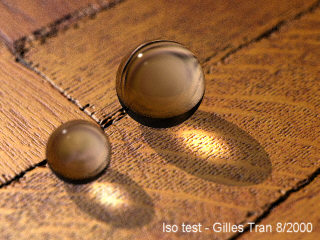
But does displacement mapping solves the problem of having a good displacement map
in the first place ?
For me the main problem in using isosurfaces for displacement mapping in Megapov
is that it is restricted to what isosurfaces can do. For instance, using it on CSG
is not straigthforward, if not impossible. The second problem is that it's not
fast. Otherwise it's not that complicated.

Below is a setup for a floor with displacement mapping in Megapov (equivalent to a
height field).
#declare hf=function{pigment{image_map{png "floorbump" interpolate 2} rotate
x*90}}
#declare rs=0.005;
isosurface{function{y - hf(x,y,z)*rs } contained_by{box{<-2,-1,-1>,<2,1,2>}}
threshold 0    rotate x*-90
        texture{pigment{image_map{png "floormap"}} finish{ambient 0 diffuse 0.8
specular 0.2 roughness 0.1} rotate x*90 }
}

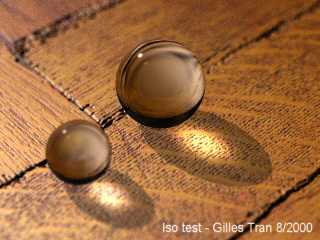
And a picture here (uses official focal blur, official caustics, a big image map
for the texture and another big one for the displacement).
Post a reply to this message
Attachments:
Download 'parquet.jpg' (30 KB)
Preview of image 'parquet.jpg'
|
|
| |
| |
|
|
|
|
| |
| |
|
|
Gilles Tran wrote:
>
> But does displacement mapping solves the problem of having a good displacement map
> in the first place ?

If i see it right your sample is similar to the heightfield solution.  The
obvious starting point would be to take the image map used for the texture and
try to get a reasonable corresponding heightfield/isosurface map using filter
functions.

[...]
> The second problem is that it's not
> fast. Otherwise it's not that complicated.
>

heightfields should be a lot faster than isosurfaces in many cases, but of
course they are not that flexible.

Christoph

--
Christoph Hormann <chr### [at] gmxde>
Homepage: http://www.schunter.etc.tu-bs.de/~chris/
Post a reply to this message
|
|
| |
| |
|
|
|
|
| |
| |
|
|
Exactly!! I forgot that we can use image map in iso surface :).
But yes this slow but feasible!
I will have a look!

Fabian.

Gilles Tran a écrit :
>
> Fabian BRAU wrote:
>
> > I already saw some attempt to create wood
> > with hieghtfield, the result was more or less good but it took
> > several weeks for the guy to get a "good" result so...
>
> But does displacement mapping solves the problem of having a good displacement map
> in the first place ?
> For me the main problem in using isosurfaces for displacement mapping in Megapov
> is that it is restricted to what isosurfaces can do. For instance, using it on CSG
> is not straigthforward, if not impossible. The second problem is that it's not
> fast. Otherwise it's not that complicated.
>
> Below is a setup for a floor with displacement mapping in Megapov (equivalent to a
> height field).
> #declare hf=function{pigment{image_map{png "floorbump" interpolate 2} rotate
> x*90}}
> #declare rs=0.005;
> isosurface{function{y - hf(x,y,z)*rs } contained_by{box{<-2,-1,-1>,<2,1,2>}}
> threshold 0    rotate x*-90
>         texture{pigment{image_map{png "floormap"}} finish{ambient 0 diffuse 0.8
> specular 0.2 roughness 0.1} rotate x*90 }
> }
>
> And a picture here (uses official focal blur, official caustics, a big image map
> for the texture and another big one for the displacement).
>
>   ------------------------------------------------------------------------
>  [Image]
Post a reply to this message
|
|
| |
| |
|
|
|
|
| |
| |
|
|
Christoph Hormann wrote:

> If i see it right your sample is similar to the heightfield solution.  The
> obvious starting point would be to take the image map used for the texture and
> try to get a reasonable corresponding heightfield/isosurface map using filter
> functions.

Which exactly what I did here. The map was desaturated, and then I made a copy of it.
On
this one I painted the planks white, leaving only the gaps black. I gaussian-blurred
it
and then added this map to the previous map.

> heightfields should be a lot faster than isosurfaces in many cases, but of
> course they are not that flexible.

Heightfields are surely faster in the case of  flat objects. I rendered the previous
picture with a height field instead of an isosurface and it rendered 5 times faster
for
an identical output (no need to post it !).
Their main problem is that they are not tileable (unless you make copies of them and
stitch them together) while an isosurface can be of any size.

G.
Post a reply to this message
|
|
| |
| |
|
|
|
|
| |
| |
|
|
Gilles Tran wrote:

> Heightfields are surely faster in the case of  flat objects. I rendered the previous
> picture with a height field instead of an isosurface and it rendered 5 times faster
for
> an identical output (no need to post it !).
> Their main problem is that they are not tileable (unless you make copies of them and
> stitch them together) while an isosurface can be of any size.

 And they consume much more memory, and have a finite resolution, while
isosurfaces can have infinite resolution (with precedural displacement).
 Happily, both exists !  Twice the fun !

Fabien.
Post a reply to this message
|
|
| |
| |
|
|
|
|
| |
| |
|
|
What's going on here?  The pots seem to come out of the picture like
one of them 3D glasses things.  Has a chillingly realistic feel to it
but something in there lookks very flat at the same time, gives me a
slight feeling of vertigo.

--
Cheers
Steve              email mailto:ste### [at] zeroppsuklinuxnet

%HAV-A-NICEDAY Error not enough coffee  0 pps.

web http://www.zeropps.uklinux.net/

or  http://start.at/zero-pps

  6:14pm  up 27 days, 16:41,  2 users,  load average: 1.08, 1.02, 1.02
Post a reply to this message
|
|
| |
| |
|
|
|
|
| |
| |
|
|
In article <3993ADDC.EA0B3F81@umh.ac.be>, Fabian BRAU
<Fab### [at] umhacbe> wrote:

> There is only image map in this scene :).

Yes, but the map is tiled over the vases, right? It isn't a single image
wrapped over the vase. So lighting can affect it as it normally would.
However, it looks like much of the "lighting" effect on the wood is part
of the image_map.


> Procedurial wood look always fake :).

Not always...I have seen some very convincing wood textures, some which
you really couldn't tell from real wood. And no offense, but even many
of the less convincing ones looked better than this. There is a very
noticeable discontinuity between the bases of the vases and the wood
texture.

--
Christopher James Huff - Personal e-mail: chr### [at] maccom
TAG(Technical Assistance Group) e-mail: chr### [at] tagpovrayorg
Personal Web page: http://homepage.mac.com/chrishuff/
TAG Web page: http://tag.povray.org/
Post a reply to this message
|
|
| |
| |
|
|
|
|
| |
| |
|
|
> Not always...I have seen some very convincing wood textures, some which
> you really couldn't tell from real wood. And no offense, but even many
> of the less convincing ones looked better than this.

No problem, I wait your art ...
Post a reply to this message
|
|
| |
| |
|
|
|
|
| |