|
|
|
|
|
|
| |
| |
|
|
|
|
| |
| |
|
|
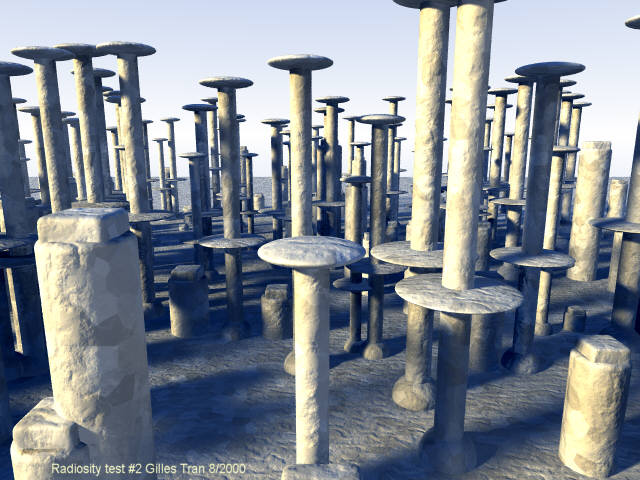
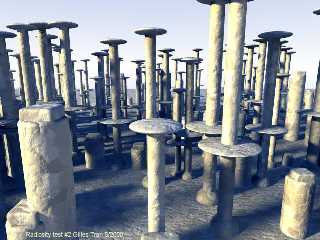
Same radiosity, lighting and textures as in the previous image (with
"normal on", this time, thanks Jérôme for the reminder), different
objects for a more "outdoor" feeling. What's wrong and what's right in
this picture (radiosity-wise) is quite easy to spot I guess.
The normals are now apparent due to "normal on", but the render time was
multiplied by 3 (1h30 with normals, 30 min without).
Code is in povray.text.scene-files this time, as it is quite short.
G.
Post a reply to this message
Attachments:
Download 'testrad2.jpg' (69 KB)
Preview of image 'testrad2.jpg'
|
|
| |
| |
|
|
|
|
| |
| |
|
|
No easy for me to spot whats wrong or right. The radiosity looks good.
"Gilles Tran" <tra### [at] inapg inrafr> wrote in message
news:398EE60E.DCFE0C7E@inapg.inra.fr...
> Same radiosity, lighting and textures as in the previous image (with
> "normal on", this time, thanks Jérôme for the reminder), different
> objects for a more "outdoor" feeling. What's wrong and what's right in
> this picture (radiosity-wise) is quite easy to spot I guess.
> The normals are now apparent due to "normal on", but the render time was
> multiplied by 3 (1h30 with normals, 30 min without).
> Code is in povray.text.scene-files this time, as it is quite short.
> G.
>
----------------------------------------------------------------------------
----
Post a reply to this message
|
|
| |
| |
|
|
|
|
| |
| |
|
|
Both are amazing.  Are they perfectly smooth, hard-edged objects and the 3d
weathered look is entirely in the texture??  All the more impressive if so...

Gilles Tran wrote:

> Same radiosity, lighting and textures as in the previous image (with
> "normal on", this time, thanks Jérôme for the reminder), different
> objects for a more "outdoor" feeling. What's wrong and what's right in
> this picture (radiosity-wise) is quite easy to spot I guess.
> The normals are now apparent due to "normal on", but the render time was
> multiplied by 3 (1h30 with normals, 30 min without).
> Code is in povray.text.scene-files this time, as it is quite short.
> G.
>
>   ------------------------------------------------------------------------
>  [Image]
Post a reply to this message
|
|
| |
| |
|
|
|
|
| |
| |
|
|
Gilles Tran wrote:
>
>  [Image]

How many times must we ask you to stop posting photos?


;)
--
Francois Labreque | Unfortunately, there's no such thing as a snooze
     flabreq      | button on a cat who wants breakfast.
        @         |      - Unattributed quote from rec.humor.funny
  attglobal.net
Post a reply to this message
|
|
| |
| |
|
|
|
|
| |
| |
|
|
All you need is a puddle of water here and there and it's real.

Looks like the sun in the late afternoon in autumn.

--
Cheers
Steve              email mailto:ste### [at] zeroppsuklinuxnet

%HAV-A-NICEDAY Error not enough coffee  0 pps.

web http://www.zeropps.uklinux.net/

or  http://start.at/zero-pps

  9:02pm  up 23 days, 19:28,  2 users,  load average: 1.86, 1.91, 1.92
Post a reply to this message
|
|
| |
| |
|
|
|
|
| |
| |
|
|
Hate to beg for the credits, but it was me who posted the remark about the
normals...
Anyway.  Very nice picture.
You make me feel jalous, although I don't know how to spell that word :-)

ZK
http://www.povplace.be.tf
Post a reply to this message
|
|
| |
| |
|
|
|
|
| |
| |
|
|
When you look at the nearby shaded surfaces (bot in this and previous), the
shading looks strange. Perhaps it's just because of the faceted texture, but
somehow it doesn't seem quite right...

--
Margus Ramst

Personal e-mail: mar### [at] peakeduee
TAG (Team Assistance Group) e-mail: mar### [at] tagpovrayorg
Post a reply to this message
|
|
| |
| |
|
|
|
|
| |
| |
|
|
Damnit, stop, I can't compete! It's just not fair! (breaks down sobbing)

--
David Fontaine     <dav### [at] faricynet>     ICQ 55354965
Please visit my website: http://www.faricy.net/~davidf/
Post a reply to this message
|
|
| |
| |
|
|
|
|
| |
| |
|
|
Zeger Knaepen wrote:

> You make me feel jalous, although I don't know how to spell that word :-)

I spell it "envy".

--
Ken Tyler - 1400+ POV-Ray, Graphics, 3D Rendering, and Raytracing Links:
http://home.pacbell.net/tylereng/index.html http://www.povray.org/links/
Post a reply to this message
|
|
| |
| |
|
|
|
|
| |
| |
|
|
seems your ahead of me on this rad lighting game (no surprise there then!),
will have to pinch your code and see how it works for me :)

i like the textures btw

Rick
Post a reply to this message
|
|
| |
| |
|
|
|
|
| |
| |
|
|
Impressive work, esp. on the textures / lighting.

IMO, the shadows the objects are casting on the ground look a bit to soft for
shadows made by direct sunlight. (maybe i'm wrong)

I wonder how it would change lighting/radiosity effects, if you use *real*
surface turbulence (isosurfaces) instead of normal statements.

Christoph

--
Christoph Hormann <chr### [at] gmxde>
Homepage: http://www.schunter.etc.tu-bs.de/~chris/
Post a reply to this message
|
|
| |
| |
|
|
|
|
| |
| |
|
|
If you people don't stop kissing Gilles' ass, he's gonna get a rash.

Don't get me wrong.. he's a badass mutha and I know it as well as the
rest of you. That city pic he did for the IRTC made me weep like a
little girl. But this is NOT an awesome pic, nor does it look even
remotely photographic. It's just a radiosity test with a bunch of simple
primitives scattered around. I'll grant that it's interesting, but most
of us could probably have made it ourselves. All I'm saying is, show
some sense of perspective.

Now, Gilles, you can't keep doing this sort of thing. It's a letdown
when you create scenes that merely require human ingenuity. ;)
Post a reply to this message
|
|
| |
| |
|
|
|
|
| |
| |
|
|
Xplo Eristotle wrote:
>
> If you people don't stop kissing Gilles' ass, he's gonna get a rash.

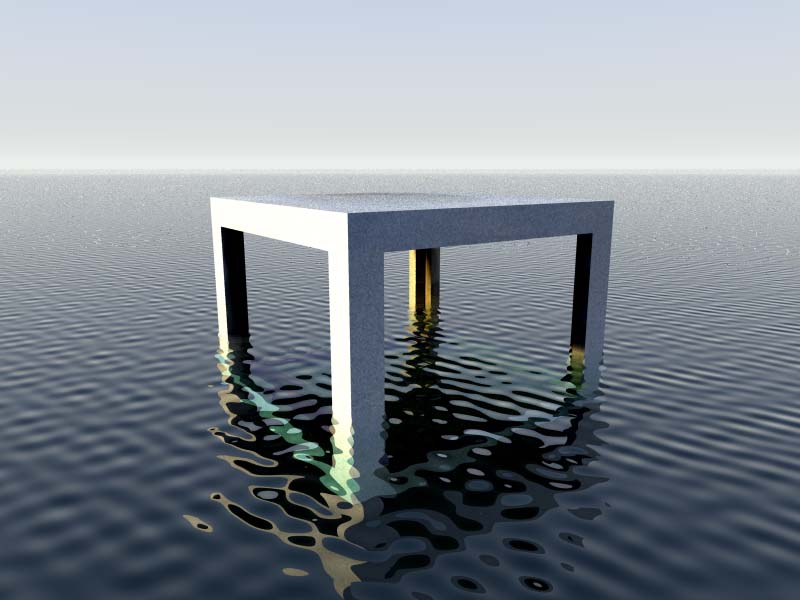
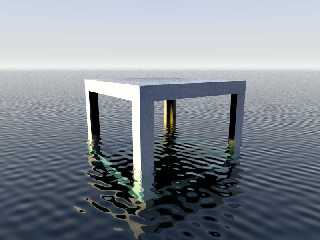
Yeah, as he said... ;-O Anyhow, here is my radiosity test. Of course
this one use caustics and photons as well. I just wonder why it doesn't
show up. *grumble*

It's just a simple test to see if I got some caustics and reflections
showing up, but albeit no such thing.

As usual it's a total ripoff of other peoples code, except for the
simple object.

--
Børge Berg-Olsen
------------------------------------------------------------------------
  +47 90 62 71 78          DoD#2101, DoDRT#017, NIC#015, PJ#006, OGM#007
  azo### [at] dodno, Ducati M600, Clementine  Ubesudlet: Aldri eid en J&%#PS.
Post a reply to this message
Attachments:
Download 'radtest.jpg' (53 KB)
Preview of image 'radtest.jpg'
|
|
| |
| |
|
|
|
|
| |
| |
|
|
Christoph Hormann wrote:
> IMO, the shadows the objects are casting on the ground look a bit to soft for
> shadows made by direct sunlight. (maybe i'm wrong)

Sun light_source diameter should be 1 at a distance of 100.

K.K.
Post a reply to this message
|
|
| |
| |
|
|
|
|
| |
| |
|
|
"Børge Berg-Olsen" <azo### [at] dodno> wrote in message
news:3990A64C.E3CBB127@dod.no...
|
| Yeah, as he said... ;-O Anyhow, here is my radiosity test. Of course
| this one use caustics and photons as well. I just wonder why it doesn't
| show up. *grumble*
|
| It's just a simple test to see if I got some caustics and reflections
| showing up, but albeit no such thing.

Well I like the way the water is aligning with the box anyhow, like it's the
only thing causing the surface waves.

Bob
Post a reply to this message
|
|
| |
| |
|
|
|
|
| |
| |
|
|
Børge Berg-Olsen wrote:
>
[...]
>
> It's just a simple test to see if I got some caustics and reflections
> showing up, but albeit no such thing.
>
> As usual it's a total ripoff of other peoples code, except for the
> simple object.
>

Well, not bad for throwing together different things :-) The water suffers much
from the regular structure, you could try RMF for that.

I wonder about the different material for the outside/inside of the table.

Christoph

--
Christoph Hormann <chr### [at] gmxde>
Homepage: http://www.schunter.etc.tu-bs.de/~chris/
Post a reply to this message
|
|
| |
| |
|
|
|
|
| |
| |
|
|
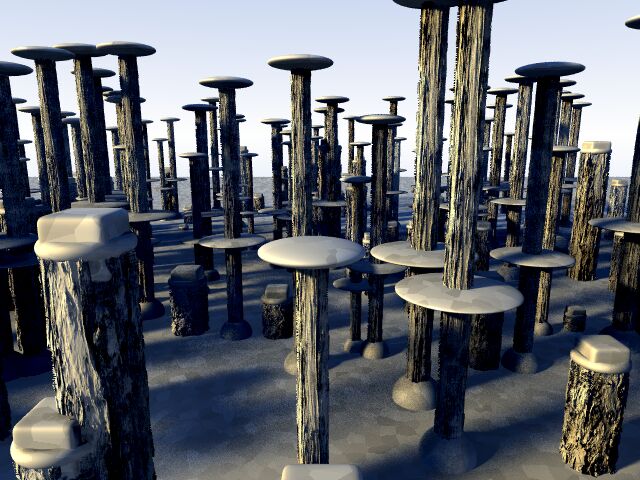
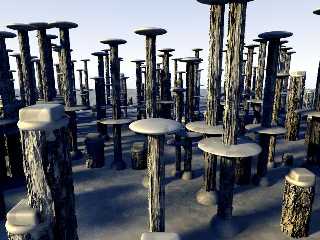
> I wonder how it would change lighting/radiosity effects, if you use *real*
> surface turbulence (isosurfaces) instead of normal statements.

The answer to your question...

I backed off on the brightness(1.095) and of course the pigment function
is different from what Gilles had as the normal. Also I only did the
cylinders(laziness).

function{
  pigment{
          agate
          turbulence 0.24
          color_map{[0 rgb 1][.75 rgb 0][1 rgb<.3,.95,.3>]}
          scale 0.3
          }
  }

The pigment is later multiplied by 0.15 which cuts into the surface too
much
but it looks neat anyhow.

Total Time:    4 hours 29 minutes  43.0 seconds
Peak memory used:         10044266 bytes
PII 233 , 96 mb

--
Phil
...coffee?...yes please! extra sugar,extra cream...Thank you.
Post a reply to this message
Attachments:
Download 'radiosity_test_file.jpg' (81 KB)
Preview of image 'radiosity_test_file.jpg'
|
|
| |
| |
|
|
|
|
| |
| |
|
|
Kari Kivisalo wrote:
>
> Christoph Hormann wrote:
> > IMO, the shadows the objects are casting on the ground look a bit to soft for
> > shadows made by direct sunlight. (maybe i'm wrong)
>
> Sun light_source diameter should be 1 at a distance of 100.
>
> K.K.

<taking out calculator> arctan(1/100) => 0.57 deg.

Yes, that seems ok. ( sun usually is about 30 arcminutes )

I think Gilles's sun is much larger, but i'm not very experienced with area
lights.

Christoph

--
Christoph Hormann <chr### [at] gmxde>
Homepage: http://www.schunter.etc.tu-bs.de/~chris/
Post a reply to this message
|
|
| |
| |
|
|
|
|
| |
| |
|
|
Xplo Eristotle wrote:

> If you people don't stop kissing Gilles' ass, he's gonna get a rash.

It really hurts now. Hard to code standing up ;-)

> But this is NOT an awesome pic, nor does it look even
> remotely photographic. It's just a radiosity test with a bunch of simple
> primitives scattered around. I'll grant that it's interesting, but most
> of us could probably have made it ourselves.

My point exactly. With the current Megapov implementation of radiosity, it's
become very easy to use. Now the effect obtained in these tests, while
highly satisfying, are far from the "real" thing. There's a LOT of room for
improvement. Of course, it's still hard to tell if the shortcomings of the
pics come from the scene code (a quick hack, with mostly standard settings)
or from the radiosity algorithm   itself. For instance, I've been totally
unable to reproduce the simple (?) effect seen here :
http://www.3dluvr.com/marcosss/sky6s.jpg

G.
Post a reply to this message
|
|
| |
| |
|
|
|
|
| |
| |
|
|
> Don't get me wrong.. he's a badass mutha and I know it as well as the
> rest of you. That city pic he did for the IRTC made me weep like a
> little girl. But this is NOT an awesome pic, nor does it look even
> remotely photographic. It's just a radiosity test with a bunch of simple
> primitives scattered around. I'll grant that it's interesting, but most
> of us could probably have made it ourselves. All I'm saying is, show
> some sense of perspective.

you may feel that whenever Gilles posts, we all go crazy, and usually with
good reason.

as for the recent rad test images, we got so excited about those, because
quite a few of us have been playing with rad lighting, and Gilles happens to
have done a better job than most of us had managed (not for lack of trying)

if those images had been posted by anyone else (source included!), we would
have been equally happy :))

you try suffering with long render times for a few days, desperately trying
to accomplish a particular technique with only some success, then someone
gives you the moon on a stick. and tells you exactly how he did it.

Rick
Post a reply to this message
|
|
| |
| |
|
|
|
|
| |
| |
|
|
Christoph Hormann wrote:
>
> Kari Kivisalo wrote:
>
> > Sun light_source diameter should be 1 at a distance of 100.
>
> Yes, that seems ok. ( sun usually is about 30 arcminutes )

Sun radius 696 000km, distance 150 000 000km.

2*696000/150000000=1/108

K.K.
Post a reply to this message
|
|
| |
| |
|
|
|
|
| |
| |
|
|
Kari Kivisalo wrote:
>
> Sun radius 696 000km, distance 150 000 000km.
>
> 2*696000/150000000=1/108

 Reminds me : in my "nature" IRTC entry (fmnat.jpg), the scene was
modelled in centimeters, and I've put an area light at the REAL
earth-sun distance :-)))
 15 000 000 000 000 cm !
 (won 2nd price)

Fabien.
Post a reply to this message
|
|
| |
| |
|
|
|
|
| |
| |
|
|
Christoph Hormann wrote:
>
> Børge Berg-Olsen wrote:
> >
> [...]
> >
> > It's just a simple test to see if I got some caustics and reflections
> > showing up, but albeit no such thing.
> >
> > As usual it's a total ripoff of other peoples code, except for the
> > simple object.
> >
>
> Well, not bad for throwing together different things :-) The water suffers much
> from the regular structure, you could try RMF for that.

Yeah, well ... I am not too good with RMFs :-)

> I wonder about the different material for the outside/inside of the table.

There are no different material for the outside/inside of the table,
which by the way is no table but a box that is a difference of 3 boxes.
Like this:

difference {
   box { <-5, -5, -5>, <5, 5, 5> }
   box { <-4.5, -4.5, -4.5>, <4.5, 4.5, 4.5> }
   box { <-6, -4, -4>, <6, 4, 4> }
   box { <-6, -4, -4>, <6, 4, 4> rotate 90*y}
}

The reason it is different colors on the "inside" than the "outside"
must be because of reflections of the sun from the water plane, which by
the way is media water...

--
Børge Berg-Olsen
------------------------------------------------------------------------
  +47 90 62 71 78          DoD#2101, DoDRT#017, NIC#015, PJ#006, OGM#007
  azo### [at] dodno, Ducati M600, Clementine  Ubesudlet: Aldri eid en J&%#PS.
Post a reply to this message
|
|
| |
| |
|
|
|
|
| |
| |
|
|
Kari Kivisalo wrote:
>
[...]
>
> Sun radius 696 000km, distance 150 000 000km.
>
> 2*696000/150000000=1/108
>
> K.K.

If you want to be excact, you should also include, that sun-earth distance
varies quite a lot during the year (it's nearer in winter IIRC) :-)

Furthermore, i'm not sure, whether the atmosphere influences things (both sun
and moon seem larger when near the horizon)

Christoph

--
Christoph Hormann <chr### [at] gmxde>
Homepage: http://www.schunter.etc.tu-bs.de/~chris/
Post a reply to this message
|
|
| |
| |
|
|
|
|
| |
| |
|
|
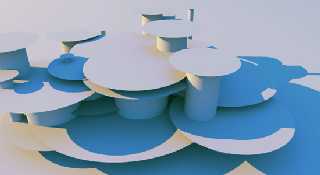
Gilles Tran wrote:
> For instance, I've been totally
> unable to reproduce the simple (?) effect seen here :
> http://www.3dluvr.com/marcosss/sky6s.jpg

Bigger picture.
http://www.3dluvr.com/marcosss/sky6.jpg

I tried but there seems to a problem that
may require patching the source. Full details
later if I succeed.

K.K.
Post a reply to this message
Attachments:
Download 'discs_1.jpg' (31 KB)
Preview of image 'discs_1.jpg'
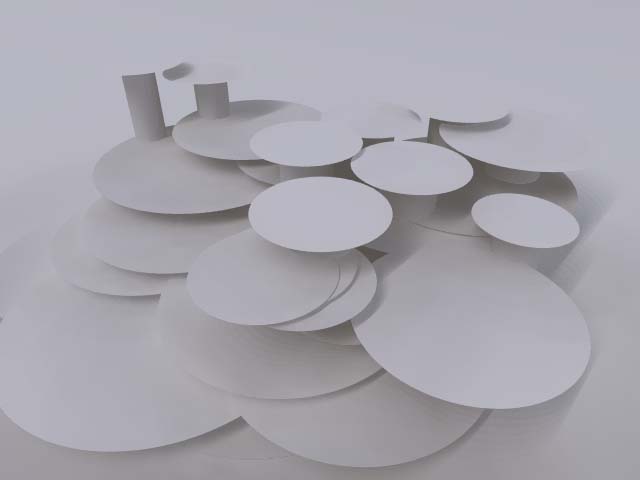
|
|
| |
| |
|
|
|
|
| |
| |
|
|
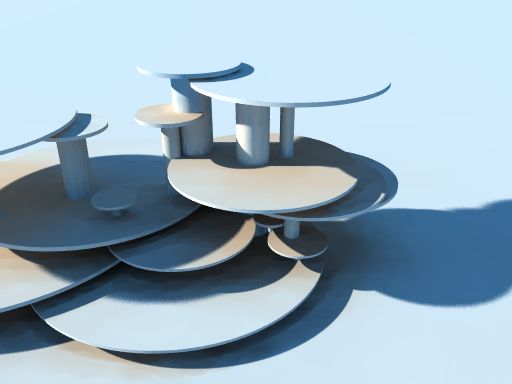
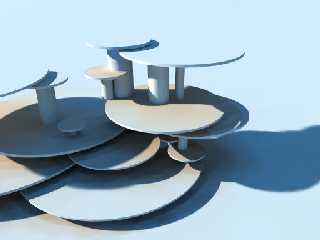
I tried recreating the general look of this scene, but I can't get
radiosity to work like that.  The main problem is getting the shadow
bright enough without washing out everything else.  Perhaps a cheat to
increase the brightness of radiosity when testing a shadow ray  could
overcome this...

Source is going to text.scene-files.
Post a reply to this message
Attachments:
Download 'radiocity.jpg' (18 KB)
Preview of image 'radiocity.jpg'
|
|
| |
| |
|
|
|
|
| |
| |
|
|
Gilles Tran wrote:
>
> With the current Megapov implementation of radiosity, it's
> become very easy to use. Now the effect obtained in these tests, while
> highly satisfying, are far from the "real" thing. There's a LOT of room for
> improvement. Of course, it's still hard to tell if the shortcomings of the
> pics come from the scene code (a quick hack, with mostly standard settings)
> or from the radiosity algorithm   itself. For instance, I've been totally
> unable to reproduce the simple (?) effect seen here :
> http://www.3dluvr.com/marcosss/sky6s.jpg

I'm not sure that pic is very accurate, actually. It LOOKS good.. but
you'll note that the brownish light that "bleeds" from the cylinders
onto the discs actually appears to darken, not lighten them. I might be
missing something here but that doesn't seem right to me.

If you look at the gradient along the top edge, it seems to me that the
light source is fairly close to the scene, and fairly low. Dunno if
that's any help.

-Xplo
Post a reply to this message
|
|
| |
| |
|
|
|
|
| |
| |
|
|
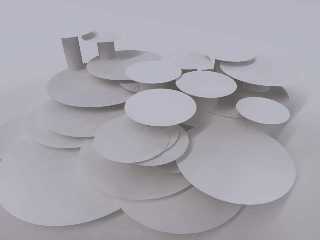
Mike <Ama### [at] aolcom> wrote in message news:3991B0AB.ACDC6F8B@aol.com...
> I tried recreating the general look of this scene, but I can't get
> radiosity to work like that.  The main problem is getting the shadow
> bright enough without washing out everything else.  Perhaps a cheat to
> increase the brightness of radiosity when testing a shadow ray  could
> overcome this...

At least you're looks better than mine. I've given up for now. Got
frustrated...

David
Post a reply to this message
Attachments:
Download 'rad_test_Aug.jpg' (18 KB)
Preview of image 'rad_test_Aug.jpg'
|
|
| |
| |
|
|
|
|
| |
| |
|
|
Can't really tell with this one so much, maybe because there's so few
objects in there, and I think that jpeg's playing havock with the top
of the box.

--
Cheers
Steve              email mailto:ste### [at] zeroppsuklinuxnet

%HAV-A-NICEDAY Error not enough coffee  0 pps.

web http://www.zeropps.uklinux.net/

or  http://start.at/zero-pps

  6:24pm  up 25 days, 16:50,  2 users,  load average: 2.22, 1.94, 1.52
Post a reply to this message
|
|
| |
| |
|
|
|
|
| |
| |
|
|
actually, great images aside, the best thing about gilles, is his
willingness to share.  there are other great povers that seem to be more
reluctant to give out their "secrets", while the rest of us regular
povers will usually bend over backwards to share a technique or a
texture or an object.  so thanks gilles.

Gilles Tran wrote:
>
> Xplo Eristotle wrote:
>
> > If you people don't stop kissing Gilles' ass, he's gonna get a rash.
>
> It really hurts now. Hard to code standing up ;-)
>
> > But this is NOT an awesome pic, nor does it look even
> > remotely photographic. It's just a radiosity test with a bunch of simple
> > primitives scattered around. I'll grant that it's interesting, but most
> > of us could probably have made it ourselves.
>
> My point exactly. With the current Megapov implementation of radiosity, it's
> become very easy to use. Now the effect obtained in these tests, while
> highly satisfying, are far from the "real" thing. There's a LOT of room for
> improvement. Of course, it's still hard to tell if the shortcomings of the
> pics come from the scene code (a quick hack, with mostly standard settings)
> or from the radiosity algorithm   itself. For instance, I've been totally
> unable to reproduce the simple (?) effect seen here :
> http://www.3dluvr.com/marcosss/sky6s.jpg
>
> G.
Post a reply to this message
|
|
| |
| |
|
|
|
|
| |
| |
|
|
the one at 3dluvr seems to have a small normal over all the objects.
also it looks like there is a blue sky sphere (your's may too already).
what color do you think the original objects are?  white?  how about the
light source?  it looks like the direct light is yellow on the
cylinders.  or maybe yellow due to interaction with the color of the
cylinders?  and how about the edges of the disks.  they seem to be
rounded or soft or something.  i don't see hard edges.  hope these
observations help you guys out.  good luck.

Kari Kivisalo wrote:
>
> Gilles Tran wrote:
> > For instance, I've been totally
> > unable to reproduce the simple (?) effect seen here :
> > http://www.3dluvr.com/marcosss/sky6s.jpg
>
> Bigger picture.
> http://www.3dluvr.com/marcosss/sky6.jpg
>
> I tried but there seems to a problem that
> may require patching the source. Full details
> later if I succeed.
>
> K.K.
>
>   ------------------------------------------------------------------------
>  [Image]
Post a reply to this message
|
|
| |
| |
|
|
|
|
| |
| |
|
|
Kari Kivisalo wrote:

> I tried but there seems to a problem that
> may require patching the source. Full details
> later if I succeed.

That's already much better that anything I've obtained so far...

G.
Post a reply to this message
|
|
| |
| |
|
|
|
|
| |
| |
|
|
ryan constantine wrote:

> actually, great images aside, the best thing about gilles, is his
> willingness to share.  there are other great povers that seem to be more
> reluctant to give out their "secrets", while the rest of us regular
> povers will usually bend over backwards to share a technique or a
> texture or an object.  so thanks gilles.

Then there are those of us with massive unorganized source files requiring several
includes (like me!). Sometimes it is simply to massive of a project to organize
source. I post small scenes if people ask for them, but my LEGOs...

--
David Fontaine     <dav### [at] faricynet>     ICQ 55354965
Please visit my website: http://www.faricy.net/~davidf/
Post a reply to this message
|
|
| |
| |
|
|
|
|
| |