|
|
|
|
|
|
| |
| |
|
|
|
|
| |
| |
|
|
Hi all...
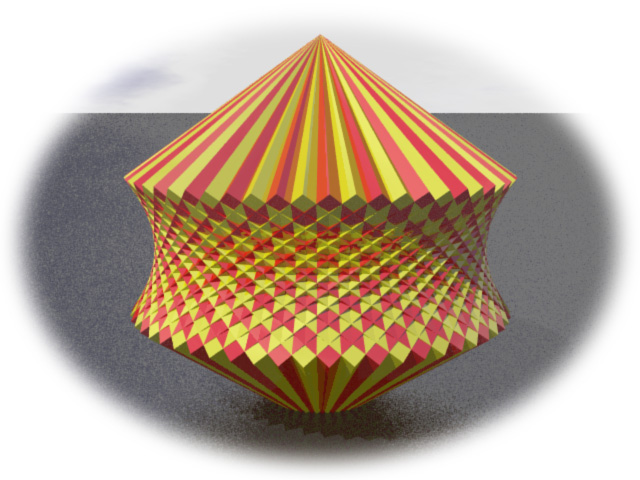
recently I was confronted with a bit of a brain teaser:  When a cube is spun
about the axis of it's two opposite corners what is the shape of the space
it passes through?
I had a few bright idea's.. some of them pretty accurate.. but before long I
decided to test the result.
The resulting shape is fairly intriguing so I thought it may be worth
sharing.
BTW.. just try placing a POV cube so that two opposite corners lie on the y
axis. It's trickier than it sounds.

--

Ian

Inkwell: Ian's Homepage
http://www.topcities.com/cartoon/inkwell/index.htm
Post a reply to this message
Attachments:
Download 'rypic.jpg' (110 KB)
Preview of image 'rypic.jpg'
|
|
| |
| |
|
|
|
|
| |
| |
|
|
A kind of amusement park carousel ride object.  If you make that with filtered
color and give it a ior I'd bet it would take 100 times longer to render, if
not more  :-)

Bob
Post a reply to this message
|
|
| |
| |
|
|
|
|
| |
| |
|
|
Looks like a circus tent...
And is that one of my post_process filters you used to make the circular
image? Maybe multiply and add with a spherical/wood/onion/cylinderical
pigment?
--
Christopher James Huff - Personal e-mail: chr### [at] mac com
TAG(Technical Assistance Group) e-mail: chr### [at] tagpovrayorg
Personal Web page: http://homepage.mac.com/chrishuff/
TAG Web page: http://tag.povray.org/
Post a reply to this message
|
|
| |
| |
|
|
|
|
| |
| |
|
|
Chris Huff <chr### [at] maccom> wrote in message
news:chrishuff-EF9A5B.12173503072000@news.povray.org...
> Looks like a circus tent...
> And is that one of my post_process filters you used to make the circular
> image? Maybe multiply and add with a spherical/wood/onion/cylinderical
> pigment?

No, I used Adobe Photodeluxe... I guess I can't enter this in the irtc :-)

--

Ian

Inkwell: Ian's Homepage
http://www.topcities.com/cartoon/inkwell/index.htm
Post a reply to this message
|
|
| |
| |
|
|
|
|
| |
| |
|
|
Ian Witham <ian### [at] hotmailcom> wrote:
: BTW.. just try placing a POV cube so that two opposite corners lie on the y
: axis. It's trickier than it sounds.

  It requires some math.

  One may think that just rotate 45 degrees around x axis and then 45 degrees
around z axis, but one will soon discover that it's not so easy (when trying
to render it).

  The first step was right: rotating 45 degrees around the x axis makes the
diagonal to lay on the x-y plane. Now we only need to rotate it around the
z axis so that the diagonal is parallel to the y axis.
  The reason why 45 degrees is not correct is because the diagonal
is not 45 degrees from the y axis anymore. This is because now the diagonal
is higher than it's wide.
  More precisely the diagonal is 2*1 units wide while it's 2*vlength(<1,1,0>)
units high (supposing we have a -1,1 cube).
  The degree is precisely asin(width/length), ie. asin(1/vlength(1,1,1)).

  Now we only have to translate the box up so that the corner will be located
at the origin. Since we have the length of the diagonal (2*vlength(<1,1,1>)),
that's easy.
  In povray code it will be:

camera { location <-2,4,-10> look_at y angle 35 }
light_source { <100,200,-300> 1 }
plane { y,0 pigment { checker rgb 1, rgb .5 } }

box
{ -1,1 pigment { rgb <1,1,0> }
  rotate x*45
  #declare len = vlength(<1,1,1>);
  rotate z*degrees(asin(1/len))
  translate y*len
}

--
main(i,_){for(_?--i,main(i+2,"FhhQHFIJD|FQTITFN]zRFHhhTBFHhhTBFysdB"[i]
):5;i&&_>1;printf("%s",_-70?_&1?"[]":" ":(_=0,"\n")),_/=2);} /*- Warp -*/
Post a reply to this message
|
|
| |
| |
|
|
|
|
| |
| |
|
|
Ian Witham wrote:

> Hi all...
> recently I was confronted with a bit of a brain teaser:  When a cube is spun
> about the axis of it's two opposite corners what is the shape of the space
> it passes through?

Ooh, sounds easy...

> BTW.. just try placing a POV cube so that two opposite corners lie on the y
> axis. It's trickier than it sounds.

Bah, rotate <0,45,degrees(asin(1/sqrt(3)))-90> should do it.

Okay, i'll stop ;)

--
David Fontaine     <dav### [at] faricynet>     ICQ 55354965
Please visit my website: http://www.faricy.net/~davidf/
Post a reply to this message
|
|
| |
| |
|
|
|
|
| |
| |
|
|
On Tue, 4 Jul 2000 04:36:38 +1200, Ian Witham wrote...
> Hi all...
> recently I was confronted with a bit of a brain teaser:  When a cube is spun
> about the axis of it's two opposite corners what is the shape of the space
> it passes through?
> I had a few bright idea's.. some of them pretty accurate.. but before long I
> decided to test the result.
> The resulting shape is fairly intriguing so I thought it may be worth
> sharing.
> BTW.. just try placing a POV cube so that two opposite corners lie on the y
> axis. It's trickier than it sounds.

You could have just asked what a spun cube looked like.  Anyone who's
ever played roleplaying games (AD&D (Yech!), Call Of Cthulhu, Runequest,
etc.) and gotten bored would have been able to tell you that the answer
is a SOR with a profile of a sort of waisted equilateral diamond.

Well, that made no sense.  Go find a six sided dice, and spin in on a
flat surface.  It'll probably take a hell of a lot longer than it took
you to do the maths, write the scene file and render it...

<grin>

Oh, and I figured it out using a pencil, paper and calculator, and the
rotations I came out with were <45.0,0.0,35.26439>.  This was using
nothing more complicated than basic trigonometry and Pythagoras' theorem.

Bye for now.
     Jamie.
Post a reply to this message
|
|
| |
| |
|
|
|
|
| |
| |
|
|
Jamie Davison wrote:

> <grin>
>
> Oh, and I figured it out using a pencil, paper and calculator, and the
> rotations I came out with were <45.0,0.0,35.26439>.  This was using
> nothing more complicated than basic trigonometry and Pythagoras' theorem.

<grin>
*cough cough*
I will not tolerate imperfection! Rotate <45,0,asin(1/sqrt(3))> ;-)

--
David Fontaine     <dav### [at] faricynet>     ICQ 55354965
Please visit my website: http://www.faricy.net/~davidf/
Post a reply to this message
|
|
| |
| |
|
|
|
|
| |
| |
|
|
> Oh, and I figured it out using a pencil, paper and calculator, and the
> rotations I came out with were <45.0,0.0,35.26439>.  This was using
> nothing more complicated than basic trigonometry and Pythagoras' theorem.


okay okay.. as so many of you have pointed out it isn't all that tricky
after all <hangs his head in shame> :-(
Post a reply to this message
|
|
| |
| |
|
|
|
|
| |
| |
|
|
Ian Witham wrote:

> okay okay.. as so many of you have pointed out it isn't all that tricky
> after all <hangs his head in shame> :-(

Wait, wait, I have a *really* hard one! What would it look like if you took a
regular octahedron, aligned opposite points on the y-axis, and spun it? Only
kidding, of course... (not to self--shut up)

--
David Fontaine     <dav### [at] faricynet>     ICQ 55354965
Please visit my website: http://www.faricy.net/~davidf/
Post a reply to this message
|
|
| |
| |
|
|
|
|
| |
| |
|
|
On Wed, 05 Jul 2000 21:20:20 -0500, David Fontaine wrote...
> Jamie Davison wrote:
>
> > <grin>
> >
> > Oh, and I figured it out using a pencil, paper and calculator, and the
> > rotations I came out with were <45.0,0.0,35.26439>.  This was using
> > nothing more complicated than basic trigonometry and Pythagoras' theorem.
>
> <grin>
> *cough cough*
> I will not tolerate imperfection! Rotate <45,0,asin(1/sqrt(3))> ;-)

Nope, I came to it through Rotate <45.0, 0.0, atan(1/sqrt(2))>  :)

Or you could have used Rotate <45.0, 0.0, acos(sqrt(2)/sqrt(3))  But
that's just silly.

They all give you the same result, so who cares <grin>

Using the (admittedly crap) windows calculator, the following came out of
the two simpler methods:

asin(1/sqrt(3)) = 35.2643896827546543153770003300188
atan(1/sqrt(2)) = 35.2643896827546543153770003300188

Is that perfect enough?  Or do you require anally retentive levels of
precision?  ;)

Bye for now,
     Jamie.
Post a reply to this message
|
|
| |
| |
|
|
|
|
| |
| |
|
|
On Thu, 6 Jul 2000 21:32:47 +1200, Ian Witham wrote...
> > Oh, and I figured it out using a pencil, paper and calculator, and the
> > rotations I came out with were <45.0,0.0,35.26439>.  This was using
> > nothing more complicated than basic trigonometry and Pythagoras' theorem.
>
>
> okay okay.. as so many of you have pointed out it isn't all that tricky
> after all <hangs his head in shame> :-(

It wasn't too easy either...  I took me a sheet of paper and a fair
amount of cursing before I remembered enough of my maths to figure it
out.  It's just too easy to sound glib and self satisfied when you've got
the answer sitting in front of you while you compose the posting to the
NG :)

Having a copy of Moray to display and verify the transformations didn't
hurt either <grin>

Oh, and I did a quick scene with 3200 cubes rotated at .1 degree
intervals, but got bored waiting for it to render :)

Bye for now,
     Jamie.
Post a reply to this message
|
|
| |
| |
|
|
|
|
| |
| |
|
|
David Fontaine wrote in message <3964C951.BCF19E94@faricy.net>...
>Wait, wait, I have a *really* hard one! What would it look like if you took
a
>regular octahedron, aligned opposite points on the y-axis, and spun it?
Only
>kidding, of course... (not to self--shut up)


Or how about a regular hexahedron?  :-)

Mark
Post a reply to this message
|
|
| |
| |
|
|
|
|
| |
| |
|
|
Of course, it really should be written as asin(sqrt(3)/3)...

Jamie Davison wrote:

> Nope, I came to it through Rotate <45.0, 0.0, atan(1/sqrt(2))>  :)
>
> Or you could have used Rotate <45.0, 0.0, acos(sqrt(2)/sqrt(3))  But
> that's just silly.
>
> They all give you the same result, so who cares <grin>
>
> Using the (admittedly crap) windows calculator, the following came out of
> the two simpler methods:
>
> asin(1/sqrt(3)) = 35.2643896827546543153770003300188
> atan(1/sqrt(2)) = 35.2643896827546543153770003300188
>
> Is that perfect enough?  Or do you require anally retentive levels of
> precision?  ;)

--
David Fontaine     <dav### [at] faricynet>     ICQ 55354965
Please visit my website: http://www.faricy.net/~davidf/
Post a reply to this message
|
|
| |
| |
|
|
|
|
| |
| |
|
|
Mark Wagner wrote:

> David Fontaine wrote in message <3964C951.BCF19E94@faricy.net>...
> >Wait, wait, I have a *really* hard one! What would it look like if you took
> a
> >regular octahedron, aligned opposite points on the y-axis, and spun it?
> Only
> >kidding, of course... (not to self--shut up)
>
> Or how about a regular hexahedron?  :-)
>
> Mark

Oops, should be NOTE to self (missed the 'e')
Did you know that any four non-consecutive points on a cube define a regular
tetrahedron? :) Of course, there's only two ways to do that on a cube.

--
David Fontaine     <dav### [at] faricynet>     ICQ 55354965
Please visit my website: http://www.faricy.net/~davidf/
Post a reply to this message
|
|
| |
| |
|
|
|
|
| |
| |
|
|
On Fri, 07 Jul 2000 13:36:02 -0500, David Fontaine wrote...
> Of course, it really should be written as asin(sqrt(3)/3)...

Why?  It all comes out the same in the end, so use the syntax you like
and can understand.

Or am I missing something here?  Admittedly, my mathematics goes up to
about halfway through 'A' Level, when we hit the more complex end of
calculus and statisitcs, whereupon my brain fell over, so I could easily
be missing something.

Bye for now,
     Jamie.
Post a reply to this message
|
|
| |
| |
|
|
|
|
| |
| |
|
|
On Fri, 7 Jul 2000 22:51:16 +0100, jam### [at] dh70qdu-netcom (Jamie
Davison) wrote:

>On Fri, 07 Jul 2000 13:36:02 -0500, David Fontaine wrote...
>> Of course, it really should be written as asin(sqrt(3)/3)...
>
>Why?  It all comes out the same in the end, so use the syntax you like
>and can understand.

Well, 1/sqrt(3) = sqrt(3)/3
It's just that the latter is the rationalized, more acceptable form of
it.


Peter Popov ICQ : 15002700
Personal e-mail : pet### [at] usanet
TAG      e-mail : pet### [at] tagpovrayorg
Post a reply to this message
|
|
| |
| |
|
|
|
|
| |
| |
|
|
On Fri, 07 Jul 2000 07:14:47 +0300, Peter Popov wrote...
> >> Of course, it really should be written as asin(sqrt(3)/3)...
> >
> >Why?  It all comes out the same in the end, so use the syntax you like
> >and can understand.
>
> Well, 1/sqrt(3) = sqrt(3)/3
> It's just that the latter is the rationalized, more acceptable form of
> it.

OK, so I *was* missing something :)

I think I'll stick to the incorrect syntax myself, as if nothing else, it
helps me remember where in the calculations I got the value from. (if you
could see the average page of scribbling and trigonometry, you'd
understand why I need help remembering such things <grin>)

Bye for now,
     Jamie.
Post a reply to this message
|
|
| |
| |
|
|
|
|
| |
|
|