|
|
|
|
|
|
| |
| |
|
|
|
|
| |
| |
|
|
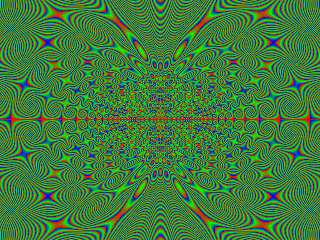
I think this an interesting effect.
Almost fractal isn't it ?
See code below.
Tor Olav
--
mailto:tor### [at] hotmail com
http://www.crosswinds.net/~tok/tokrays.html
// ===== 1 ======= 2 ======= 3 ======= 4 ======= 5 ======= 6 ======= 7
// Try rendering at different resolutions
// with no AA (Anti Aliasing)
#version 3.1;
light_source { <0, 0, 0>, 1.5 }
sphere {
<0, 0, 0>, 600 // Changing this radius gives different patterns
pigment {
gradient y
color_map {
[ 0.0 rgb <1, 0, 0> ]
[ 0.5 rgb <0, 1, 0> ]
[ 1.0 rgb <0, 0, 1> ]
}
}
}
camera {
location <1, 0, 0>
look_at <0, 0, 0>
angle 168 // Changing this angle also alters the patterns
}
// ===== 1 ======= 2 ======= 3 ======= 4 ======= 5 ======= 6 ======= 7
Post a reply to this message
Attachments:
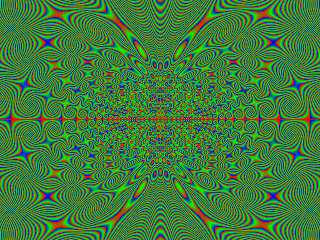
Download 'aliasing.gif' (78 KB)
Preview of image 'aliasing.gif'
|
|
| |
| |
|
|
|
|
| |
| |
|
|
On Fri, 02 Jun 2000 15:30:52 +0200, Tor Olav Kristensen
<tor### [at] hotmailcom> wrote:

>
>I think this an interesting effect.
>
>Almost fractal isn't it ?

Cool! Some time age (13 years? Man, does time fly by!) I made a BASIC
program for my Apple IIe which produced Moire patterns. Back then I
would have never thought of them as of something other than beautiful.
This image reminds me of the good ole days (though yours probably
didn't take as long to render, an hour and a half at 280*192 :) ).
Very, very soothing.

BTW I've found a great way of making tileable moire patterns in
PhotoShop so the good ole days are back <g>


Peter Popov ICQ : 15002700
Personal e-mail : pet### [at] usanet
TAG      e-mail : pet### [at] tagpovrayorg
Post a reply to this message
|
|
| |
| |
|
|
|
|
| |
| |
|
|
Peter Popov wrote:
>
> Cool! Some time age (13 years? Man, does time fly by!) I made a BASIC
> program for my Apple IIe which produced Moire patterns. Back then I
> would have never thought of them as of something other than beautiful.

But are there any useful applications for them ?


> This image reminds me of the good ole days (though yours probably
> didn't take as long to render, an hour and a half at 280*192 :) ).
> Very, very soothing.

17 years ago I ordered a Sinclair ZX Spectrum
from England.

Back then I did some experimenting with Lissajous
curves in 2D, and sometimes when plotting those,
nice Moire patterns appeared.


> BTW I've found a great way of making tileable moire patterns in
> PhotoShop so the good ole days are back <g>

How do you do this ?


Tor Olav
--
mailto:tor### [at] hotmailcom
http://www.crosswinds.net/~tok/tokrays.html
Post a reply to this message
|
|
| |
| |
|
|
|
|
| |
| |
|
|
If one continues to get interesting structures at many levels of
magnification, this meets one most basic definition of a fractal.

Tor Olav Kristensen wrote:

> I think this an interesting effect.
>
> Almost fractal isn't it ?
>
> See code below.
>
> Tor Olav
> --
> mailto:tor### [at] hotmailcom
> http://www.crosswinds.net/~tok/tokrays.html
>
> // ===== 1 ======= 2 ======= 3 ======= 4 ======= 5 ======= 6 ======= 7
> // Try rendering at different resolutions
> // with no AA (Anti Aliasing)
>
> #version 3.1;
>
> light_source { <0, 0, 0>, 1.5 }
>
> sphere {
>   <0, 0, 0>, 600 // Changing this radius gives different patterns
>   pigment {
>     gradient y
>     color_map {
>       [ 0.0 rgb <1, 0, 0> ]
>       [ 0.5 rgb <0, 1, 0> ]
>       [ 1.0 rgb <0, 0, 1> ]
>     }
>   }
> }
>
> camera {
>   location <1, 0, 0>
>   look_at <0, 0, 0>
>   angle 168 // Changing this angle also alters the patterns
> }
>
> // ===== 1 ======= 2 ======= 3 ======= 4 ======= 5 ======= 6 ======= 7
>
>   ------------------------------------------------------------------------
>  [Image]
Post a reply to this message
|
|
| |
| |
|
|
|
|
| |
| |
|
|
On Fri, 02 Jun 2000 18:26:56 +0200, Tor Olav Kristensen
<tor### [at] hotmailcom> wrote:

>
>Peter Popov wrote:
>>
>> Cool! Some time age (13 years? Man, does time fly by!) I made a BASIC
>> program for my Apple IIe which produced Moire patterns. Back then I
>> would have never thought of them as of something other than beautiful.
>
>But are there any useful applications for them ?

I have heard of moire pattern analysis being used in vibrational
dynamics but can't say anything for sure.

>> This image reminds me of the good ole days (though yours probably
>> didn't take as long to render, an hour and a half at 280*192 :) ).
>> Very, very soothing.
>
>17 years ago I ordered a Sinclair ZX Spectrum from England.

17 years ago I was probably spending most of my days sitting on my
bottom, building castles from wooden blocks.

>Back then I did some experimenting with Lissajous
>curves in 2D, and sometimes when plotting those,
>nice Moire patterns appeared.

Yes, Lissajous... these were the other major fun factor back then. Of
course I did not know what sine and cosine meant but at least I could
tweak and tweak and tweak :)

>> BTW I've found a great way of making tileable moire patterns in
>> PhotoShop so the good ole days are back <g>
>
>How do you do this ?

What is a moire pattern? The overlapping of two similar grids. Make a
grid (for example, create a pattern and fill the canvas with it),
distort it a little bit and mix it with the original. In order to make
the pattern cyclic, the distortion should be cyclic as well. The wave
distortion works well, just make sure that the wavelenghts are
divisible of the image dimensions and the edge pixels wrap around. The
mixing can be done as 'multiply', 'hard light' or virtually any other
mixing type. It gets even better if this is done for the r, g and b
channels separately.


Peter Popov ICQ : 15002700
Personal e-mail : pet### [at] usanet
TAG      e-mail : pet### [at] tagpovrayorg
Post a reply to this message
|
|
| |
| |
|
|
|
|
| |
| |
|
|
I was doing one of these couple years ago in POV-Ray, and I've seen some other
people did so too when the subject came up on AOL.  There were these "zonk"
posters you could buy back in the 70's which were the same thing except on
paper instead.  Much less vivid than this one here of course.
Must be a common side effect of dealing with AA, seems people will tend
exploit the weaknesses of something by turning it into a better thing.

Bob

"Tor Olav Kristensen" <tor### [at] hotmailcom> wrote in message
news:3937B70C.3FAA29D0@hotmail.com...
|
| I think this an interesting effect.
|
| Almost fractal isn't it ?
Post a reply to this message
|
|
| |
| |
|
|
|
|
| |
| |
|
|
"Greg M. Johnson" wrote:
>
> If one continues to get interesting structures at many levels of
> magnification, this meets one most basic definition of a fractal.

Hmmm ...

I believe the image itself is by your definition
a strange form for fractal.

But I think that this cannot be said to be
an image OF a fractal, because the fractal
patterns appear because of the limitations
in the presentation of the striped sphere.


> Tor Olav Kristensen wrote:
>
> > I think this an interesting effect.
> >
> > Almost fractal isn't it ?


Tor Olav
--
mailto:tor### [at] hotmailcom
http://www.crosswinds.net/~tok/tokrays.html
Post a reply to this message
|
|
| |
| |
|
|
|
|
| |
| |
|
|
Bob Hughes wrote:
>
> I was doing one of these couple years ago in POV-Ray,

Did you use the same technique ?


> and I've seen some other
> people did so too when the subject came up on AOL.  There were these "zonk"
> posters you could buy back in the 70's which were the same thing except on
> paper instead.  Much less vivid than this one here of course.

I don't think I've seen those posters.

Stupid question but what is "zonk" ?
(I was too young in the 70's :)


> Must be a common side effect of dealing with AA, seems people will tend
> exploit the weaknesses of something by turning it into a better thing.

This time I just stumbled into these patterns.
And then I tried to make them as strong as
possible.

I wonder if it's possible to make them even
stronger ?


Tor Olav
--
mailto:tor### [at] hotmailcom
http://www.crosswinds.net/~tok/tokrays.html
Post a reply to this message
|
|
| |
| |
|
|
|
|
| |
| |
|
|
Peter Popov wrote:
>
> I have heard of moire pattern analysis being used in vibrational
> dynamics but can't say anything for sure.

Strange. If so, I wonder how it is applied.


> 17 years ago I was probably spending most of my days sitting on my
> bottom, building castles from wooden blocks.

:-)


> >Back then I did some experimenting with Lissajous
> >curves in 2D, and sometimes when plotting those,
> >nice Moire patterns appeared.
>
> Yes, Lissajous... these were the other major fun factor back then. Of
> course I did not know what sine and cosine meant but at least I could
> tweak and tweak and tweak :)

My problem was that I didn't know back then that it
was called Lissajous curves.

I knew the meaning of cosine and sine.
But I too had to do a lot of tweaking
to get the nice patterns !


> What is a moire pattern? The overlapping of two similar grids. Make a
> grid (for example, create a pattern and fill the canvas with it),
> distort it a little bit and mix it with the original. In order to make
> the pattern cyclic, the distortion should be cyclic as well. The wave
> distortion works well, just make sure that the wavelenghts are
> divisible of the image dimensions and the edge pixels wrap around. The
> mixing can be done as 'multiply', 'hard light' or virtually any other
> mixing type. It gets even better if this is done for the r, g and b
> channels separately.

I see. Thank you for explaining !

I have access to Photoshop, but I haven't
worked much with it yet.


Tor Olav
--
mailto:tor### [at] hotmailcom
http://www.crosswinds.net/~tok/tokrays.html
Post a reply to this message
|
|
| |
| |
|
|
|
|
| |
| |
|
|
"Tor Olav Kristensen" <tor### [at] hotmailcom> wrote in message
news:393983D3.C3E17676@hotmail.com...
|
| Bob Hughes wrote:
| >
| > I was doing one of these couple years ago in POV-Ray,
|
| Did you use the same technique ?

Overlapping 'radial' patterns of black lines rotated a bit differently over a
background plane of 'bozo' or other patterns.  Of course variations were
tried, like bright lines, etc. later on when the subject came up again.
I'd say your technique makes for a more true moire pattern.

| > and I've seen some other
| > people did so too when the subject came up on AOL.  There were these
"zonk"
| > posters you could buy back in the 70's which were the same thing except on
| > paper instead.  Much less vivid than this one here of course.
|
| I don't think I've seen those posters.
|
| Stupid question but what is "zonk" ?
| (I was too young in the 70's :)

I would define it as what the sound might be if you heard one when first
seeing it, but I don't really know the origin.  Ever seen Star Trek (TV) where
they had a display near Spock's control panel which was a couple sets of
radial lines rotated one over the other.  Same thing.  Guess they had that
effect in the '60s too.

| > Must be a common side effect of dealing with AA, seems people will tend
| > exploit the weaknesses of something by turning it into a better thing.
|
| This time I just stumbled into these patterns.
| And then I tried to make them as strong as
| possible.
|
| I wonder if it's possible to make them even
| stronger ?

Not sure how that would be, yours was quite bold already.

Bob
Post a reply to this message
|
|
| |
| |
|
|
|
|
| |
| |
|
|
Bob Hughes wrote:
>
> "Tor Olav Kristensen" <tor### [at] hotmailcom> wrote in message
> news:393983D3.C3E17676@hotmail.com...
>
> | Did you use the same technique ?
>
> Overlapping 'radial' patterns of black lines rotated a bit differently over a
> background plane of 'bozo' or other patterns.  Of course variations were
> tried, like bright lines, etc. later on when the subject came up again.

Interesting. But I don't understand how
the "bozo" pattern comes in useful.

Isn't that a kind of random pattern ?


> I'd say your technique makes for a more true moire pattern.

I have never seen a definition Moire patterns.
Have you ?


> | Stupid question but what is "zonk" ?
> | (I was too young in the 70's :)
>
> I would define it as what the sound might be if you heard one when first
> seeing it, but I don't really know the origin.  Ever seen Star Trek (TV) where
> they had a display near Spock's control panel which was a couple sets of
> radial lines rotated one over the other.  Same thing.  Guess they had that
> effect in the '60s too.

Sorry. I haven't seen Star Trek either.
Just small fractions of different episodes.

But I can imagine that it was a cool film
"trick" back then.


Tor Olav
--
mailto:tor### [at] hotmailcom
http://www.crosswinds.net/~tok/tokrays.html
Post a reply to this message
|
|
| |
| |
|
|
|
|
| |
| |
|
|
| Interesting. But I don't understand how
| the "bozo" pattern comes in useful.
|
| Isn't that a kind of random pattern ?

Yes.  Only as backdrop behind the interference pattern created by the lines.
Anything could go behind them, even a whole scene :-)  Don't think too much
into it and you'll understand.

| > I'd say your technique makes for a more true moire pattern.
|
| I have never seen a definition Moire patterns.
| Have you ?

moiré (noun):
an independent usually shimmering pattern seen when two geometrically regular
patterns (as two sets of parallel lines or two halftone screens) are
superimposed esp. at an acute angle

How's that?  :-)

Bob
Post a reply to this message
|
|
| |
| |
|
|
|
|
| |
| |
|
|
Groovy.

Eric
--------------------
http://www.datasync.com/~ericfree
--------------------
"I don't like it, and I'm sorry I ever had anything to do with it."
- Erwin Schrodinger talking about Quantum Mechanics.
Post a reply to this message
|
|
| |
| |
|
|
|
|
| |
| |
|
|
On Sun, 04 Jun 2000 03:39:18 +0200, Tor Olav Kristensen
<tor### [at] hotmailcom> wrote:

>I have never seen a definition Moire patterns.
>Have you ?

A Moire pattern is an interference pattern resulting from
superimposing two or more grids with close parameters. To answer your
question about vibrational analysis, a French guy named Moire found
this phenomenon when introducing vibrations into fine sand-covered
glass plate by means of a violin bow.


Peter Popov ICQ : 15002700
Personal e-mail : pet### [at] usanet
TAG      e-mail : pet### [at] tagpovrayorg
Post a reply to this message
|
|
| |
| |
|
|
|
|
| |
| |
|
|
Tor Olav Kristensen wrote:
>
> Strange. If so, I wonder how it is applied.

You project a stripe pattern onto an object. You take
a CCD-Image of this pattern. Then you "stress" the object
(put pressure in/onto it or whatever), project the same
pattern on it and take another picture. You overlay
those picture and you get a moiree pattern that you can
analyse.

Also useful in Speckle interferometry.

(http://www.google.com) and search for speckle interferometry
and/or moiree analysis.

Markus
Post a reply to this message
|
|
| |
| |
|
|
|
|
| |
| |
|
|
Bob Hughes wrote:

> Don't think too much into it and you'll understand.

Hehe.

=)


> moiré (noun):
> an independent usually shimmering pattern seen when two geometrically regular
> patterns (as two sets of parallel lines or two halftone screens) are
> superimposed esp. at an acute angle
>
> How's that?  :-)

That's nice to know. Thank you !


Tor Olav
--
mailto:tor### [at] hotmailcom
http://www.crosswinds.net/~tok/tokrays.html
Post a reply to this message
|
|
| |
| |
|
|
|
|
| |
| |
|
|
Peter Popov wrote:

> A Moire pattern is an interference pattern resulting from
> superimposing two or more grids with close parameters.

So then there are many possible "types" of Moire patterns !
I wonder if there are any 3D Moire patterns


> To answer your question about vibrational analysis, a
> French guy named Moire found this phenomenon when
> introducing vibrations into fine sand-covered glass plate
> by means of a violin bow.

Doesn't this mean that this phenomenon also is related to
minima and maxima of standing waves ?

Wouldn't standing waves in a patterned "3D-medium(s)"
then generate 3D Moire patterns ?


Tor Olav
--
mailto:tor### [at] hotmailcom
http://www.crosswinds.net/~tok/tokrays.html
Post a reply to this message
|
|
| |
| |
|
|
|
|
| |
| |
|
|
Eric Freeman wrote:

> Groovy.

Thanks.

Btw: I found some nice moving grooves:

http://www.sandlotscience.com/Moire/moire_2.htm
http://www.sandlotscience.com/Moire/moire_1.htm
http://math.hws.edu/xJava/other/Moire1.html

Tor Olav
--
mailto:tor### [at] hotmailcom
http://www.crosswinds.net/~tok/tokrays.html
Post a reply to this message
|
|
| |
| |
|
|
|
|
| |
| |
|
|
Markus Becker wrote:

> Tor Olav Kristensen wrote:
> >
> > Strange. If so, I wonder how it is applied.
>
> You project a stripe pattern onto an object. You take
> a CCD-Image of this pattern. Then you "stress" the object
> (put pressure in/onto it or whatever), project the same
> pattern on it and take another picture. You overlay
> those picture and you get a moiree pattern that you can
> analyse.

So from the co-ordinates where the two sets of stripes cross,
one can deduct information about how the material has
moved/deformed in that region ?

This leads me to think about the nice coloured patterns
that appear when one shines polarized light through stressed
acrylic materials and then views this through a polarized filter.

I did a search for photoelasticy and got this hit:
http://www.britannica.com/bcom/eb/article/1/0,5716,61311+1,00.html

(I did not know that Britannica now is available on the net. :)


And of coarse then I had to look up Moire in Brittanica,
and then I found this:
http://www.britannica.com/bcom/eb/article/5/0,5716,54535+1+53206,00.html

(Here they also mention other useful applications for the Moire
patterns.)


Tor Olav
--
mailto:tor### [at] hotmailcom
http://www.crosswinds.net/~tok/tokrays.html
Post a reply to this message
|
|
| |
| |
|
|
|
|
| |
| |
|
|
Tor Olav Kristensen wrote:
>
> So from the co-ordinates where the two sets of stripes cross,
> one can deduct information about how the material has
> moved/deformed in that region ?

Right, but I think usually the reulsting image is processed
in such a way that is is smoothed (blurred) so that no
individual lines appear but only bright and dark stripes
(i.e. the moiree is the only information that remains).

> This leads me to think about the nice coloured patterns
> that appear when one shines polarized light through stressed
> acrylic materials and then views this through a polarized filter.

It's a similar effect, both have to do with interference.

Markus
Post a reply to this message
|
|
| |
| |
|
|
|
|
| |