|
|
|
|
|
|
| |
| |
|
|
|
|
| |
| |
|
|
Hi all,

I've recently been experimenting with the cloth simulation theory found at
http://freespace.virgin.net/hugo.elias/
I'm planning on writing a POV macro that let's you drape a cloth over any
object, using the trace function. So far I've implemented the code in Visual
Basic, and made a small prog that outputs a bunch of triangles when done
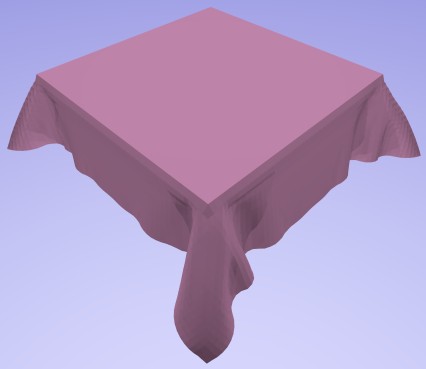
simulating. The attached pic is a sample of what it produces. I know it's
not too pretty, but I just felt like posting something :)


Sebastian Strand
  E-mail: thezeb -at- bigfoot -dot- com
  URL: http://www.zeb.f2s.com/
Post a reply to this message
|
|
| |
| |
|
|
|
|
| |
| |
|
|
Oh yeah, the pic...
Post a reply to this message
Attachments:
Download 'cloth.jpg' (13 KB)
Preview of image 'cloth.jpg'
|
|
| |
| |
|
|
|
|
| |
| |
|
|
You've obviously had better luck than I did.  I tried the same thing a couple of
months ago, but could never really get it right.  I hope you post the code when
you get it finished.

Mike Wilson

Sebastian Strand wrote:

> Hi all,
>
> I've recently been experimenting with the cloth simulation theory found at
> http://freespace.virgin.net/hugo.elias/
> I'm planning on writing a POV macro that let's you drape a cloth over any
> object, using the trace function. So far I've implemented the code in Visual
> Basic, and made a small prog that outputs a bunch of triangles when done
> simulating. The attached pic is a sample of what it produces. I know it's
> not too pretty, but I just felt like posting something :)
>
> Sebastian Strand
>   E-mail: thezeb -at- bigfoot -dot- com
>   URL: http://www.zeb.f2s.com/
Post a reply to this message
|
|
| |
| |
|
|
|
|
| |
| |
|
|
That's impressive. I'd like to see where this goes.
Sebastian Strand wrote:
> Oh yeah, the pic...
>
> [Image]
--
Samuel Benge
E-Mail: STB### [at] aol com
Visit my isosurface tutorial at http://members.aol.com/stbenge
Post a reply to this message
|
|
| |
| |
|
|
|
|
| |
| |
|
|
You're taking your cloth simulation theories from the wrong place. I
seriously recommend you check out the work done by some french guys that
really improves on the description you see at Hugo Elias' site. The address
is: http://www-syntim.inria.fr/syntim/recherche/provot/index-eng.html Read
it. You will like it. :)
Post a reply to this message
|
|
| |
| |
|
|
|
|
| |
| |
|
|
"Mike Wilson" <maw### [at] iastateedu> wrote in
news:392ACD34.F3159A33@iastate.edu...
> I hope you post the code when you get it finished.

I certainly plan to, but my rather ambitious feature ideas could slow down
the process :/


Sebastian Strand
  E-mail: thezeb -at- bigfoot -dot- com
  URL: http://www.zeb.f2s.com/
Post a reply to this message
|
|
| |
| |
|
|
|
|
| |
| |
|
|
Hey,

Cool, I can't wait to see how this project develops. I saw some cloth
simulations on TV about a year ago, and have always wondered how easy it
would be to do. I am interested in your picture that the image isn't totally
symetrical. What introduced the randomness in the way the cloth hangs? I
would have though that a computer simulation would have been too "perfect",
but I am pleased to see that it isn't.

Keep up the good work,

Equiprawn
Post a reply to this message
|
|
| |
| |
|
|
|
|
| |
| |
|
|
"Equiprawn" <equ### [at] tinetie> wrote in news:392acfbc@news.povray.org...
> What introduced the randomness in the way the cloth hangs?

I have to admit that I'm not sure, but it might be that the cloth isn't
perfectly cenetered on the box.


Sebastian Strand
  E-mail: the### [at] bigfootcom
  URL: http://www.zeb.f2s.com/
Post a reply to this message
|
|
| |
| |
|
|
|
|
| |
| |
|
|
"Tony[B]" <ben### [at] panamac-comnet> wrote in
news:392acf88@news.povray.org...
> seriously recommend you check out the work done by some french guys that
> really improves on the description you see at Hugo Elias' site. The
address
> is: http://www-syntim.inria.fr/syntim/recherche/provot/index-eng.html Read
> it. You will like it. :)

I would have liked it more if any of the images had loaded :(
Thanks for the link though, I will check out the document he'd put up.

Sebastian Strand
  E-mail: thezeb -at- bigfoot -dot- com
  URL: http://www.zeb.f2s.com/
Post a reply to this message
|
|
| |
| |
|
|
|
|
| |
| |
|
|
very nice

"Sebastian Strand" <the### [at] bigfootcom> wrote in message
news:392acb60@news.povray.org...
> Oh yeah, the pic...
>
>
>
>
Post a reply to this message
|
|
| |
| |
|
|
|
|
| |
| |
|
|
Very nice.  This could be interesting if it is incorporated into the Spray
macro so that water that falls onto something do a little more than just
puddle.

Just an idea :)

Lee
Post a reply to this message
|
|
| |
| |
|
|
|
|
| |
| |
|
|
Sebastian Strand wrote:
>
> Oh yeah, the pic...

Very cool. Every kid'll want one this Christmas. ;)

--
Xplo Eristotle
http://start.at/xplosion/

"And then one day you find ten years have got behind you
No one told you when to run, you missed the starting gun"
    -Pink Floyd
Post a reply to this message
|
|
| |
| |
|
|
|
|
| |
| |
|
|
This is amazing for the modeling aspect. I read through his pages, but I didn't
catch where to stop the iterations to say "this is where the damn thing lies."
How did you determine when the process was done?

Josh

Sebastian Strand wrote:

> Hi all,
>
> I've recently been experimenting with the cloth simulation theory found at
> http://freespace.virgin.net/hugo.elias/
> I'm planning on writing a POV macro that let's you drape a cloth over any
> object, using the trace function. So far I've implemented the code in Visual
> Basic, and made a small prog that outputs a bunch of triangles when done
> simulating. The attached pic is a sample of what it produces. I know it's
> not too pretty, but I just felt like posting something :)
>
> Sebastian Strand
>   E-mail: thezeb -at- bigfoot -dot- com
>   URL: http://www.zeb.f2s.com/

--
Josh English
eng### [at] spiritonecom
"May your hopes, dreams, and plans not be destroyed by a few zeros."
Post a reply to this message
|
|
| |
| |
|
|
|
|
| |
| |
|
|
Great! I'm impatient to see the result.
Have you seen the 3 animations of Magnussen based on the theory of
Hugo-Elias?

Objet: Falling cloth
Objet: Falling cloth #2
Objet: Falling cloth #3 (179 kB MPEG)
la date: Mon, 8 Mar 1999 09:34:43 +0100
De: "Martin Magnusson" <ama### [at] geocitiescom>
Forums: povray.binaries.animations

and the script:

Objet: Falling cloth
la date: Mon, 8 Mar 1999 09:33:50 +0100
De:  "Martin Magnusson" <ama### [at] geocitiescom>
Forums:  povray.text.scene-files

DEPerere

Sebastian Strand a écrit:
>
> Hi all,
>
> I've recently been experimenting with the cloth simulation theory found at
> http://freespace.virgin.net/hugo.elias/
> I'm planning on writing a POV macro that let's you drape a cloth over any
> object, using the trace function. So far I've implemented the code in Visual
Post a reply to this message
|
|
| |
| |
|
|
|
|
| |
| |
|
|
On Tue, 23 May 2000 21:44:16 +0300, "Sebastian Strand"
<the### [at] bigfootcom> wrote:

>
>"Equiprawn" <equ### [at] tinetie> wrote in news:392acfbc@news.povray.org...
>> What introduced the randomness in the way the cloth hangs?
>
>I have to admit that I'm not sure, but it might be that the cloth isn't
>perfectly cenetered on the box.

Well, Hugo suggests that some randomness is introduced in the
tangential forces of threads and in thread density as well. If you
followed his algorithms closely enough this should account for the
randomness. Cloth simulation is a chaotic problem so even the
slightest change somewhere can change output dramatically.


Peter Popov ICQ : 15002700
Personal e-mail : pet### [at] usanet
TAG      e-mail : pet### [at] tagpovrayorg
Post a reply to this message
|
|
| |
| |
|
|
|
|
| |
| |
|
|
"Josh English" <eng### [at] spiritonecom> wrote in
news:392AFB0C.134DE921@spiritone.com...
> This is amazing for the modeling aspect. I read through his pages, but I
didn't
> catch where to stop the iterations to say "this is where the damn thing
lies."
> How did you determine when the process was done?

The program I wrote shows a top-down view of the cloth, so when the cloth
didn't seem to move much anymore, I just stopped the simulation, and dumped
the triangle data. For the macro I will probably write some code that checks
when the total movement of all the nodes go below a certain(adjustable)
threshold, and then stop the simulation.


Sebastian Strand
  E-mail: thezeb -at- bigfoot -dot- com
  URL: http://www.zeb.f2s.com/
Post a reply to this message
|
|
| |
| |
|
|
|
|
| |
| |
|
|
Sebastian Strand wrote:
>
> Hi all,
>
> I've recently been experimenting with the cloth simulation theory found at
> http://freespace.virgin.net/hugo.elias/

Very nice. But for you and all others (since I thought I had
seen this before), have a look at:

http://www.realflow.com/gallery.html

and scroll down until you reach "Elastic Particles".
This does not mean, that the other animations aren't
interesting.... It just fits.

Markus
Post a reply to this message
|
|
| |
| |
|
|
|
|
| |