|
|
|
|
|
|
| |
| |
|
|
|
|
| |
| |
|
|
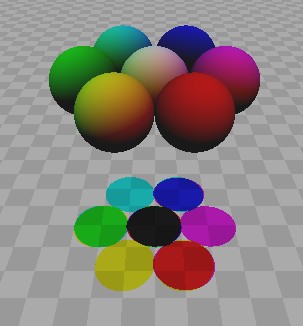
Note the colors of the spheres.
Note the colors on the ground.

How was this done?

Mark
Post a reply to this message
Attachments:
Download 'COLORS.JPG' (21 KB)
Preview of image 'COLORS.JPG'
|
|
| |
| |
|
|
|
|
| |
| |
|
|
On Thu, 3 Feb 2000 01:59:51 -0500, "Mark Wagner"
<mar### [at] gte net> wrote:
>Note the colors of the spheres.
>Note the colors on the ground.
>
>How was this done?
>
I suppose the spheres are using solid colors, and the "colored spots"
on the ground which might appear to be shadows to some, are actually
transparent discs. Is this close?
later,
Glen Berry
Post a reply to this message
|
|
| |
| |
|
|
|
|
| |
| |
|
|
This is one way of doing it very easyly:

sphere { 0,1 no_shadow pigment { rgb <1,0,0> } }
sphere { 0,.999 pigment { rgbf <1,0,0,.9> } }

and so on.

--
main(i,_){for(_?--i,main(i+2,"FhhQHFIJD|FQTITFN]zRFHhhTBFHhhTBFysdB"[i]
):5;i&&_>1;printf("%s",_-70?_&1?"[]":" ":(_=0,"\n")),_/=2);} /*- Warp -*/
Post a reply to this message
|
|
| |
| |
|
|
|
|
| |
| |
|
|
Mark Wagner wrote:
>
> Note the colors of the spheres.
> Note the colors on the ground.
>
> How was this done?

I know. With POV-Ray.

--
Ken Tyler -  1300+ Povray, Graphics, 3D Rendering, and Raytracing Links:
http://home.pacbell.net/tylereng/index.html http://www.povray.org/links/
Post a reply to this message
|
|
| |
| |
|
|
|
|
| |
| |
|
|
Parallel light source in Mega POVray? Even the black one.

Mark Wagner wrote:
>
> Note the colors of the spheres.
> Note the colors on the ground.
>
> How was this done?
>
> Mark
>
>  [Image]

--
Mr. Art

"Often the appearance of reality is more important
than the reality of the appearance."
Bill DeWitt 2000
Post a reply to this message
|
|
| |
| |
|
|
|
|
| |
| |
|
|
Nieminen Juha wrote:
>
>   This is one way of doing it very easyly:
>
> sphere { 0,1 no_shadow pigment { rgb <1,0,0> } }
> sphere { 0,.999 pigment { rgbf <1,0,0,.9> } }
If he used MegaPatch, he could have typed
sphere {0,1 no_shadow pigment {red 1}}
sphere {0,1 no_image pigment {red 1 filter 1}}
instead...

Anyway, I described this method some months ago in p.g (subject:
'colored shadows' or something like that).


> and so on.
If you say so...

sphere {0,1 pigment {rgb <1,0,0>}}
sphere {y,1 pigment {rgb <1,1,0>}}
sphere {y*2,1 pigment {rgb <0,1,0>}}
sphere {y*3,1 pigment {rgb <0,1,1>}}
sphere {y*4,1 pigment {rgb <0,0,1>}}
sphere {y*5,1 pigment {rgb <1,0,1>}}
sphere {y*6,1 pigment {rgb <1,0,0>}}

Or isn't that what you asked for?

ZK

> --
> main(i,_){for(_?--i,main(i+2,"FhhQHFIJD|FQTITFN]zRFHhhTBFHhhTBFysdB"[i]
> ):5;i&&_>1;printf("%s",_-70?_&1?"[]":" ":(_=0,"\n")),_/=2);} /*- Warp -*/
Post a reply to this message
|
|
| |
| |
|
|
|
|
| |
| |
|
|
Nieminen Juha wrote:

>   This is one way of doing it very easyly:
>
> sphere { 0,1 no_shadow pigment { rgb <1,0,0> } }
> sphere { 0,.999 pigment { rgbf <1,0,0,.9> } }

I figured it was some type of shadowless and filter stuff. It looks like it
has radiosity, either that or all seven spheres are textured together using a
radial angle hue and radial distance chroma.

--
Homepage: http://www.faricy.net/~davidf/
___     ______________________________
 | \     |_       <dav### [at] faricynet>
 |_/avid |ontaine      <ICQ 55354965>
Post a reply to this message
|
|
| |
| |
|
|
|
|
| |
| |
|
|
Glen Berry <7no### [at] ezwvcom> wrote in message ...
>I suppose the spheres are using solid colors, and the "colored spots"
>on the ground which might appear to be shadows to some, are actually
>transparent discs. Is this close?


"Scene contains 8 frame-level objects; 1 infinite"

Nope!

Mark
Post a reply to this message
|
|
| |
| |
|
|
|
|
| |
| |
|
|
Nieminen Juha wrote in message <38994435@news.povray.org>...
>  This is one way of doing it very easyly:
>
>sphere { 0,1 no_shadow pigment { rgb <1,0,0> } }
>sphere { 0,.999 pigment { rgbf <1,0,0,.9> } }
>
>and so on.


See the reply to Glen Berry.

Mark
Post a reply to this message
|
|
| |
| |
|
|
|
|
| |
| |
|
|
Zeger Knaepen wrote in message <3899CE0B.10A0C182@student.kuleuven.ac.be>...
>If he used MegaPatch, he could have typed
>sphere {0,1 no_shadow pigment {red 1}}
>sphere {0,1 no_image pigment {red 1 filter 1}}
>instead...


Rendered using the SuperPatch 3.1e.

>
>sphere {0,1 pigment {rgb <1,0,0>}}
>sphere {y,1 pigment {rgb <1,1,0>}}
>sphere {y*2,1 pigment {rgb <0,1,0>}}
>sphere {y*3,1 pigment {rgb <0,1,1>}}
>sphere {y*4,1 pigment {rgb <0,0,1>}}
>sphere {y*5,1 pigment {rgb <1,0,1>}}
>sphere {y*6,1 pigment {rgb <1,0,0>}}
>


This won't account for the shadows.

Mark
Post a reply to this message
|
|
| |
| |
|
|
|
|
| |
| |
|
|
David Fontaine wrote in message <3899FF36.B69C02E5@faricy.net>...
>I figured it was some type of shadowless and filter stuff. It looks like it
>has radiosity, either that or all seven spheres are textured together using
a
>radial angle hue and radial distance chroma.


No, no, and no.

Mark
Post a reply to this message
|
|
| |
| |
|
|
|
|
| |
| |
|
|
mr.art wrote in message <38997457.6AE2B531@gci.net>...
>Parallel light source in Mega POVray? Even the black one.


No.  The lights are, however, far enough away that they act like parallel
lights.

Mark
Post a reply to this message
|
|
| |
| |
|
|
|
|
| |
| |
|
|
Ken wrote in message <38994DA7.368BCAAE@pacbell.net>...
>
>Mark Wagner wrote:
>>
>> Note the colors of the spheres.
>> Note the colors on the ground.
>>
>> How was this done?
>
>I know. With POV-Ray.


Yes, as far as it goes.  :-)

Mark
Post a reply to this message
|
|
| |
| |
|
|
|
|
| |
| |
|
|
Mark Wagner wrote:

> Note the colors of the spheres.
> Note the colors on the ground.
>
> How was this done?

    Colored lights?


> --

The question is not, "Who will let me do it?"
The question is, "Who will stop me?"
Offering an apology is easier than getting permission.
Post a reply to this message
|
|
| |
| |
|
|
|
|
| |
| |
|
|
Mark Wagner wrote:

> Note the colors of the spheres.
> Note the colors on the ground.
>
> How was this done?

    Colored lights layed out with the color of the
light a mirror image of the colors of the spheres.

--
The question is not, "Who will let me do it?"
The question is, "Who will stop me?"
Offering an apology is easier than getting permission.
Post a reply to this message
|
|
| |
| |
|
|
|
|
| |
| |
|
|
On Thu, 3 Feb 2000 01:59:51 -0500, "Mark Wagner"
<mar### [at] gtenet> wrote:

>Note the colors of the spheres.
>Note the colors on the ground.
>
>How was this done?
>
>Mark

The spheres have no_shadow and there are 7 spotlights (one is
negative) of equal radius and falloff?


Peter Popov
pet### [at] usanet
ICQ: 15002700
Post a reply to this message
|
|
| |
| |
|
|
|
|
| |
| |
|
|
Matt Giwer wrote in message <389BD097.7720A07E@ij.net>...
>Mark Wagner wrote:
>
>> Note the colors of the spheres.
>> Note the colors on the ground.
>>
>> How was this done?
>
>    Colored lights layed out with the color of the
>light a mirror image of the colors of the spheres.


No.  The spheres are all white.

Mark
Post a reply to this message
|
|
| |
| |
|
|
|
|
| |
| |
|
|
Peter Popov wrote in message ...
>The spheres have no_shadow and there are 7 spotlights (one is
>negative) of equal radius and falloff?


No, only point lights were used.

Mark
Post a reply to this message
|
|
| |
| |
|
|
|
|
| |
| |
|
|
You used six lights whose colors add up to 1 and placed them above the
spheres, so that the spheres appear to be transparent when you look at the
shawows. Right?

Simen.

Mark Wagner skrev i meldingen <38992828@news.povray.org>...
>Note the colors of the spheres.
>Note the colors on the ground.
>
>How was this done?
>
>Mark
>
>
>
Post a reply to this message
|
|
| |
| |
|
|
|
|
| |
| |
|
|
Are the spheres reflecting the point light(s) to the ground...?
Is the checkered plane transparent...?

Mark Wagner wrote:

> Matt Giwer wrote in message <389BD097.7720A07E@ij.net>...
> >Mark Wagner wrote:
> >
> >> Note the colors of the spheres.
> >> Note the colors on the ground.
> >>
> >> How was this done?
> >
> >    Colored lights layed out with the color of the
> >light a mirror image of the colors of the spheres.
>
> No.  The spheres are all white.
>
> Mark
Post a reply to this message
|
|
| |
| |
|
|
|
|
| |
| |
|
|
On Sun, 6 Feb 2000 00:36:43 -0500, Mark Wagner wrote:
>
>Matt Giwer wrote in message <389BD097.7720A07E@ij.net>...
>>Mark Wagner wrote:
>>
>>> Note the colors of the spheres.
>>> Note the colors on the ground.
>>>
>>> How was this done?
>>
>>    Colored lights layed out with the color of the
>>light a mirror image of the colors of the spheres.
>
>
>No.  The spheres are all white.

I assume you used light groups.  The "red" sphere is set to interact with
the red light (and the yellow and magenta lights) and set to block light
from all but the red light.

--
These are my opinions.  I do NOT speak for the POV-Team.
The superpatch: http://www2.fwi.com/~parkerr/superpatch/
My other stuff: http://www2.fwi.com/~parkerr/traces.html
Post a reply to this message
|
|
| |
| |
|
|
|
|
| |
| |
|
|
On Sun, 6 Feb 2000 00:37:03 -0500, "Mark Wagner"
<mar### [at] gtenet> wrote:

>
>Peter Popov wrote in message ...
>>The spheres have no_shadow and there are 7 spotlights (one is
>>negative) of equal radius and falloff?
>
>
>No, only point lights were used.
>
>Mark

intersection
{
  union
  {
    sphere { 2*x, 1 pigment { Red } }
    sphere { 2*x, 1 rotate 60*y pigment { Yellow } }
    ...
  }
  plane { y, 0 }
  pigment { White }
}

?

This should report the CSG as a single infinite object (untested).


Peter Popov
pet### [at] usanet
ICQ: 15002700
Post a reply to this message
|
|
| |
| |
|
|
|
|
| |
| |
|
|
Ron Parker wrote in message ...
>I assume you used light groups.  The "red" sphere is set to interact with
>the red light (and the yellow and magenta lights) and set to block light
>from all but the red light.


Close, but no cigar.

Mark
Post a reply to this message
|
|
| |
| |
|
|
|
|
| |
| |
|
|
Simen Kvaal wrote in message <389eefc9@news.povray.org>...
>You used six lights whose colors add up to 1 and placed them above the
>spheres, so that the spheres appear to be transparent when you look at the
>shawows. Right?
>
Wrong.

Mark
Post a reply to this message
|
|
| |
| |
|
|
|
|
| |
| |
|
|
Peter Popov wrote in message ...
>intersection
>{
>  union
>  {
>    sphere { 2*x, 1 pigment { Red } }
>    sphere { 2*x, 1 rotate 60*y pigment { Yellow } }
>    ...
>  }
>  plane { y, 0 }
>  pigment { White }
>}
>
>?
>
>This should report the CSG as a single infinite object (untested).


Yes, it is reported as a single object.  No, it is not reported as infinite.
No, this is not how I did it.

Mark
Post a reply to this message
|
|
| |
| |
|
|
|
|
| |
| |
|
|
On Tue, 8 Feb 2000 01:16:26 -0500, "Mark Wagner"
<mar### [at] gtenet> wrote:

>>No, this is not how I did it.

I am sure someone with more math brains than myself can come up with
an isosurface function to colorise the floor plane in this way.


Peter Popov
pet### [at] usanet
ICQ: 15002700
Post a reply to this message
|
|
| |
| |
|
|
|
|
| |
| |
|
|
sphere { <1,0,0> 0.5 pigment { rgb 1 } light_group "one" }
light_source { <1,3000,0> rgb <1,0,0> groups "one"
                      projected_through { sphere { <1,0,0> 0.51 } light
group "one" }

This at least creates the same effect, but the colors get washed out.
Perhaps you fix this with radiosity?

Mark Wagner wrote:

> Note the colors of the spheres.
> Note the colors on the ground.
>
> How was this done?
>
> Mark
>
>  [Image]

--
Josh English
eng### [at] spiritonecom
"May your hopes, dreams, and plans not be destroyed by a few zeros."
Post a reply to this message
|
|
| |
| |
|
|
|
|
| |
| |
|
|
/*
Josh English wrote in message <38A### [at] spiritonecom>...
>sphere { <1,0,0> 0.5 pigment { rgb 1 } light_group "one" }
>light_source { <1,3000,0> rgb <1,0,0> groups "one"
>                      projected_through { sphere { <1,0,0> 0.51 } light
>group "one" }
>
>This at least creates the same effect, but the colors get washed out.
>Perhaps you fix this with radiosity?


Get rid of the projected_through and you've got it.

The source:
*/
sphere{<2,0,0>, 1 light_group "A" pigment{rgb 1} rotate y*60}
sphere{<2,0,0>, 1 light_group "B" pigment{rgb 1} rotate y*120}
sphere{<2,0,0>, 1 light_group "C" pigment{rgb 1} rotate y*180}
sphere{<2,0,0>, 1 light_group "D" pigment{rgb 1} rotate y*240}
sphere{<2,0,0>, 1 light_group "E" pigment{rgb 1} rotate y*300}
sphere{<2,0,0>, 1 light_group "F" pigment{rgb 1} rotate y*0}
sphere{<0,0,0>, 1 light_group "G" pigment{rgb 1} }

plane{y, -6 pigment{checker rgb 1, rgb .9 }}

light_source{ <100,300,0>*100, red 1   groups "C,D,E,G"  rotate y*240}
light_source{ <100,300,0>*100, green 1 groups "E,F,A,G"  rotate y*0}
light_source{ <100,300,0>*100, blue 1  groups "A,B,C,G"  rotate y*120}

camera{ location <0,5,10> look_at y*-2}
/* The colors come from color addition and color subtraction.*/

/* Mark */
Post a reply to this message
|
|
| |
| |
|
|
|
|
| |
| |
|
|
OOOOH.. I was so close. Projected_through was the only way I could get the
shadow to be colored properly, with out it the colors of the shadows seemed
to be rotated 180*y under their spheres....

I personally want to thank you for posting a challenge that forced me to
look into the newer features of MegaPov that I probably wouldn't have looked
at before. It was a learning experience.

Mark Wagner wrote:

> /*
> Josh English wrote in message <38A### [at] spiritonecom>...
> >sphere { <1,0,0> 0.5 pigment { rgb 1 } light_group "one" }
> >light_source { <1,3000,0> rgb <1,0,0> groups "one"
> >                      projected_through { sphere { <1,0,0> 0.51 } light
> >group "one" }
> >
> >This at least creates the same effect, but the colors get washed out.
> >Perhaps you fix this with radiosity?
>
> Get rid of the projected_through and you've got it.
>
> The source:
> */
> sphere{<2,0,0>, 1 light_group "A" pigment{rgb 1} rotate y*60}
> sphere{<2,0,0>, 1 light_group "B" pigment{rgb 1} rotate y*120}
> sphere{<2,0,0>, 1 light_group "C" pigment{rgb 1} rotate y*180}
> sphere{<2,0,0>, 1 light_group "D" pigment{rgb 1} rotate y*240}
> sphere{<2,0,0>, 1 light_group "E" pigment{rgb 1} rotate y*300}
> sphere{<2,0,0>, 1 light_group "F" pigment{rgb 1} rotate y*0}
> sphere{<0,0,0>, 1 light_group "G" pigment{rgb 1} }
>
> plane{y, -6 pigment{checker rgb 1, rgb .9 }}
>
> light_source{ <100,300,0>*100, red 1   groups "C,D,E,G"  rotate y*240}
> light_source{ <100,300,0>*100, green 1 groups "E,F,A,G"  rotate y*0}
> light_source{ <100,300,0>*100, blue 1  groups "A,B,C,G"  rotate y*120}
>
> camera{ location <0,5,10> look_at y*-2}
> /* The colors come from color addition and color subtraction.*/
>
> /* Mark */

--
Josh English
eng### [at] spiritonecom
"May your hopes, dreams, and plans not be destroyed by a few zeros."
Post a reply to this message
|
|
| |
| |
|
|
|
|
| |
|
|