|
|
|
|
|
|
| |
| |
|
|
|
|
| |
| |
|
|
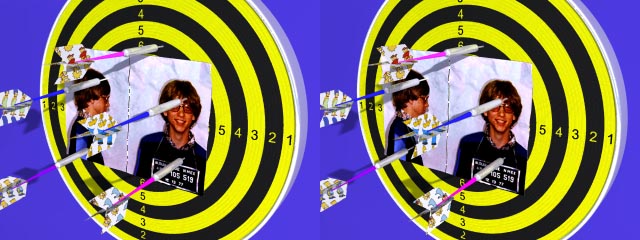
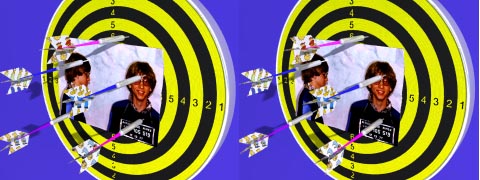
I just crammed a stereogram out of an unfinished scene of mine.

Just wondering; shy can't I use 'actual' eye distance? I tried 7 cm
between the cameras, but that produced far too different images. This
one uses 1 cm and the camera is ca. 50 cm away from.

sig.
Post a reply to this message
Attachments:
Download 'dart2.jpg' (53 KB)
Preview of image 'dart2.jpg'
|
|
| |
| |
|
|
|
|
| |
| |
|
|
> Just wondering; shy can't I use 'actual' eye distance? I tried 7 cm

eh _why_ of course
Post a reply to this message
|
|
| |
| |
|
|
|
|
| |
| |
|
|
Sigmund,
The camera separation depends on the focal length of the lens. The default
for POV is the equivalent of a 50mm lens, I think. With a "normal" lens of
35mm to 50mm the camera separation should be about 1 unit for every 30 units
between the camera and the closest object. In this case it would be the
edge of the target. Since the target is at an angle to the camera it is not
so simple, but you can approximate without doing the math. Where is the
target
located relative to the camera? If the target is at 0,0,0 and the camera is
at x*-50 then the rule of thumb would give a camera separation of 1.6667
units (cm).
Since the target is angled toward the camera, a separation of 1 should do
fine.
ps. Is the target person anyone we know?
Harolddd
Sigmund Kyrre Aas <as### [at] stud ntnuno> wrote in message
news:387E0D16.FE6D484F@stud.ntnu.no...
> I just crammed a stereogram out of an unfinished scene of mine.
>
> Just wondering; shy can't I use 'actual' eye distance? I tried 7 cm
> between the cameras, but that produced far too different images. This
> one uses 1 cm and the camera is ca. 50 cm away from.
>
> sig.
----------------------------------------------------------------------------
----
Post a reply to this message
|
|
| |
| |
|
|
|
|
| |
| |
|
|
> at x*-50 then the rule of thumb would give a camera separation of 1.6667


Sorry, I meant z*-50.
Post a reply to this message
|
|
| |
| |
|
|
|
|
| |
| |
|
|
Sigmund,
Alright, I realize my last message didn't really answer the question- why.
Well, when we look at things in the distance (infinity) the line of
sight of each eye is parallel. It is still pretty much parallel at
195cm. Given an average human eye separation of 6.5cm that works out
to be 1:30. When we look at things closer than this our eyes converge
(cross). So if the cameras are still parallel they will not provide
the same image as our eyes would when we look at things closer than
195cm. To recreate the effect of looking at a close object you would
need to angle the cameras toward the center. I don't know the formulae
to calculate that, so I just use the 30:1 rule. You should also be
aware that the separation used in creating the images directly
effects how large the object seems to be. Hence, if you use the 30:1
rule to make a stereo image of an insect, and the insect fills the
image area, it will appear to be a very large bug!

Harolddd

Sigmund Kyrre Aas <as### [at] studntnuno> wrote in message
news:387E0D16.FE6D484F@stud.ntnu.no...
> I just crammed a stereogram out of an unfinished scene of mine.
>
> Just wondering; shy can't I use 'actual' eye distance? I tried 7 cm
> between the cameras, but that produced far too different images. This
> one uses 1 cm and the camera is ca. 50 cm away from.
>
> sig.


----------------------------------------------------------------------------
----
Post a reply to this message
|
|
| |
| |
|
|
|
|
| |
| |
|
|
>ps. Is the target person anyone we know?


William Henry Gates III, New Mexico, 1977... busted! (If I'm not mistaken.)
Post a reply to this message
|
|
| |
| |
|
|
|
|
| |
| |
|
|
Harold Baize wrote:
>
> > at x*-50 then the rule of thumb would give a camera separation of 1.6667
>
> Sorry, I meant z*-50.

Don't be. The camera separation would be the same :) Here's my cam:
camera {
   #local L=28;
   #local Pos=<-45 , 12 ,-30>*.7;
   location  Pos + vnormalize(vcross(Pos,y))*clock
   look_at   <0, 0 , -2>
   angle degrees(atan2(35,L))
}
The target is at <0,0,0> and it's normal is -x. On closer inspection,
the camera distance is 39 units and the target radius is 15, so the "one
unit for every 30 units" rule is actually fulfilled.
Can this rule be derived from the focal length of the human eye or
something?

sig.
Post a reply to this message
|
|
| |
| |
|
|
|
|
| |
| |
|
|
Correct! Now can you do the tail people as well?

sig.

TonyB wrote:
>
> >ps. Is the target person anyone we know?
>
> William Henry Gates III, New Mexico, 1977... busted! (If I'm not mistaken.)
Post a reply to this message
|
|
| |
| |
|
|
|
|
| |
| |
|
|
Yes, I thought it was he, but he is so young there.

TonyB <ben### [at] panamaphoenixnet> wrote in message
news:387e5611@news.povray.org...
> >ps. Is the target person anyone we know?
>
>
> William Henry Gates III, New Mexico, 1977... busted! (If I'm not
mistaken.)
>
>
Post a reply to this message
|
|
| |
| |
|
|
|
|
| |
| |
|
|
Harold Baize wrote:
>
> Sigmund,
> Alright, I realize my last message didn't really answer the question- why.
> Well, when we look at things in the distance (infinity) the line of
> sight of each eye is parallel. It is still pretty much parallel at
> 195cm. Given an average human eye separation of 6.5cm that works out
> to be 1:30. When we look at things closer than this our eyes converge

ahhh ooohh It's coming to me .. gotta.. _think_... Nah. G'night everone!

sig., still cuious about that ratio..
Post a reply to this message
|
|
| |
| |
|
|
|
|
| |
| |
|
|
Sigmund Kyrre Aas <as### [at] studntnuno> wrote in message
news:387E5AB6.1772ADD6@stud.ntnu.no...
> Harold Baize wrote:

> Don't be. The camera separation would be the same :) Here's my cam:
> camera {
>    #local L=28;
>    #local Pos=<-45 , 12 ,-30>*.7;
>    location  Pos + vnormalize(vcross(Pos,y))*clock
>    look_at   <0, 0 , -2>
>    angle degrees(atan2(35,L))
> }

Whoa, hecka complex camera statement. Guess I'm still thinking with a
POV 1.0 camera syntax.

> The target is at <0,0,0> and it's normal is -x. On closer inspection,
> the camera distance is 39 units and the target radius is 15, so the "one
> unit for every 30 units" rule is actually fulfilled.

Which is why it produces a strong stereo effect without eye strain :-).
To look at an object 39cm from your eyes you would definitely need to
converge the eyes.  Instead you bring the cameras together. The
result is a dart board that appears to be more than a meter in diameter.

> Can this rule be derived from the focal length of the human eye or
> something?

Yes, but I'll have to look up the specifics if you want them. Ultimately
though, the rule is species specific, a dog would use a smaller separation,
say 1:20.

Harolddd
Post a reply to this message
|
|
| |
| |
|
|
|
|
| |
| |
|
|
Sigmund Kyrre Aas wrote:
>
> Correct! Now can you do the tail people as well?
>
> sig.

The Simpsons.

I recognized the grinning mug shot the moment I saw it; I'm surprised
the neighbors didn't complain about how loudly I was laughing.

-Mark Gordon
Post a reply to this message
|
|
| |
| |
|
|
|
|
| |
| |
|
|
Harold Baize wrote in message <387e613f@news.povray.org>...
>> camera {
>>    #local L=28;
>>    #local Pos=<-45 , 12 ,-30>*.7;
>>    location  Pos + vnormalize(vcross(Pos,y))*clock
>>    look_at   <0, 0 , -2>
>>    angle degrees(atan2(35,L))
>> }
>
>Whoa, hecka complex camera statement. Guess I'm still thinking with a
>POV 1.0 camera syntax.


How's this?  This is one of the cameras from a fly-through of the Grand
Canyon that I'm working on.

camera{
 #declare Clock = clock;
 // Some basic vector calculus, plus a fudge factor
 #declare UnitTangent = vnormalize(path(Clock+dclock)-path(Clock));
 #declare PlusdClock =
vnormalize(path(Clock+dclock+dclock)-path(Clock+dclock));
 #declare UnitNormal = vnormalize(PlusdClock - UnitTangent);
 #if(vlength(UnitNormal)=0)#declare UnitNormal =
vaxis_rotate(y,vcross(UnitTangent, y),
90-degrees(acos(vdot(UnitTangent,y))));#end
 #declare Curvature = vlength((PlusdClock -
UnitTangent)/dclock)/vlength((path(Clock+dclock)-path(Clock))/dclock);
 #declare UpVect1 = vaxis_rotate(y,vcross(UnitTangent, y),
90-degrees(acos(vdot(UnitTangent,y))));
 #declare AngleFract = atan2(Curvature,1)/(pi/2);
 #declare Angle = degrees(acos(vdot(UnitNormal, UpVect1)));
 #if(vdot(UnitNormal,UpVect1)<0)#declare Angle=(-360)+Angle;#end
 #declare Angle = (Angle/2)*AngleFract;

 #fopen FileID "GCanyon.dat" read
 #read(FileID, OldAngle)
 #fclose FileID

 #if(abs(Angle-OldAngle)>dAngle)
  #declare Angle=OldAngle+(abs(dAngle)*Sign(Angle));
 #end

 #fopen FileID "GCanyon.dat" write
 #write(FileID, Angle)
 #fclose FileID

 #declare UpVect = vaxis_rotate(UpVect1,UnitTangent,Angle);
 #declare UnitBinormal = vnormalize(vcross(UnitTangent, UpVect));
  #warning concat("Tangent:  ", str(UnitTangent.x,6,6),",",
str(UnitTangent.y,6,6), ",",str(UnitTangent.z,6,6), "\n")
  #warning concat("Normal:   ", str(UnitNormal.x,6,6),",",
str(UnitNormal.y,6,6), ",",str(UnitNormal.z,6,6), "\n")
  #warning concat("UpVect:   ", str(UpVect.x,6,6),",", str(UpVect.y,6,6),
",",str(UpVect.z,6,6), "\n")
  #warning concat("Binormal: ", str(UnitBinormal.x,6,6),",",
str(UnitBinormal.y,6,6), ",",str(UnitBinormal.z,6,6), "\n")
 location path(Clock)
 direction UnitTangent
 up UpVect
 right UnitBinormal*1.33
 angle 60
}


Mark
Post a reply to this message
|
|
| |
| |
|
|
|
|
| |
| |
|
|
Sigmund Kyrre Aas wrote:
>
> I just crammed a stereogram out of an unfinished scene of mine.

How do you view that? Some setup with a mirror or two?
I definitely can't misadjust my eyes in such a way that
I see something (apart from too slightly different images)...

> Just wondering; shy can't I use 'actual' eye distance? I tried 7 cm
> between the cameras, but that produced far too different images. This
> one uses 1 cm and the camera is ca. 50 cm away from.

I guess you have never really viewed a scene just from 50cm away
in real live. And it has to do with the viewing angle of the camera.
The larger this is, the closer together the cameras have to be.

Markus
Post a reply to this message
|
|
| |
| |
|
|
|
|
| |
| |
|
|
Just imagine how far apart in your scene the human eyes would be, and for the second
picture translate the camera that much.  make
each image look in a parallel direction - when people are looking at the stereo image,
the eye-crossing differences will be done by
their own eyes; it shouldn't be done by the camera.  That's how I did my image
earlier, and it looks fine.

- Slime


Sigmund Kyrre Aas <as### [at] studntnuno> wrote in message
news:387E5F6F.350AD066@stud.ntnu.no...
> Harold Baize wrote:
> >
> > Sigmund,
> > Alright, I realize my last message didn't really answer the question- why.
> > Well, when we look at things in the distance (infinity) the line of
> > sight of each eye is parallel. It is still pretty much parallel at
> > 195cm. Given an average human eye separation of 6.5cm that works out
> > to be 1:30. When we look at things closer than this our eyes converge
>
> ahhh ooohh It's coming to me .. gotta.. _think_... Nah. G'night everone!
>
> sig., still cuious about that ratio..
Post a reply to this message
|
|
| |
| |
|
|
|
|
| |
| |
|
|
Curious that this doesn't look exactly right, the left/right shift seems
enough based on the apparent displacements of the dart fins against the board.
When I see it in stereo it's flat, which kind of goes with what you say about
using 1cm instead of a wider 7cm, so maybe 3cm would have been better.
  The way I use to see these is just hold my hand flatout and aligned with my
nose between my eyes and angle my hand enough to only be able to see each
picture with the corresponding eye, closing each one at a time to be sure I have
only the full left or right image in view.  Sometimes I don't need to do this at
all for the small pictures or just a quick hand divider for my eyes for others.
I think another thing to keep in mind about it is these can be fairly deep 3D
and require some focusing.  By that I mean there can be near and far parts which
have to be looked upon as separate parts, otherwise you don't ever see the whole
picture forward to back "in focus" without actually looking at those parts
alone.  This can make for a seemingly distorted and nonmergeable stereopair.
Probably the predominate factor with this particular rendering.  That in mind I
believe it needs the wider camera separation.

Bob
Post a reply to this message
|
|
| |
| |
|
|
|
|
| |
| |
|
|
> Which is why it produces a strong stereo effect without eye strain :-).
> To look at an object 39cm from your eyes you would definitely need to
> converge the eyes.  Instead you bring the cameras together. The
> result is a dart board that appears to be more than a meter in diameter.

39 cm from the center, yes. With 15 cm target radius it's 33 cm away
from the closest rim of the target. Perhaps this 1:30 should be adjusted
when I've got a 28 mm lens? Maybe that's why it looks big. Oh, wait. I
didn't have a 28 attached. I copied from another scene file. It was
really 35mm.

sig.
Post a reply to this message
|
|
| |
| |
|
|
|
|
| |
| |
|
|
I forgot to ask you yesterday: Do you know why he was arrested?

sig.

TonyB wrote:
>
> >ps. Is the target person anyone we know?
>
> William Henry Gates III, New Mexico, 1977... busted! (If I'm not mistaken.)
Post a reply to this message
|
|
| |
| |
|
|
|
|
| |
| |
|
|
omniVERSE wrote:
>
>   Curious that this doesn't look exactly right, the left/right shift seems
> enough based on the apparent displacements of the dart fins against the board.
> When I see it in stereo it's flat, which kind of goes with what you say about
> using 1cm instead of a wider 7cm, so maybe 3cm would have been better.
...

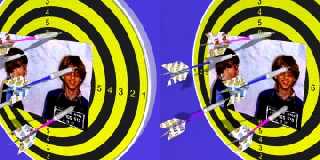
Attached is a 2-cm-apart image. I think this one's a bit unreal. Not
sure.
To wiew these I just cross my eyes till I see 3 images and let my built
in autofocous do the rest. This usually takes .2-.5 seconds.

> have to be looked upon as separate parts, otherwise you don't ever see the whole
> picture forward to back "in focus" without actually looking at those parts

Not sure if I follow you.. If the camera spacing is right, the whole
scene should look as in real life. Don't see why it shouldn't.
I thought about adding focal blur, but then the wiewer would have to
look at <0,0,0> all the time.

sig.
Post a reply to this message
Attachments:
Download 'dart.jpg' (42 KB)
Preview of image 'dart.jpg'
|
|
| |
| |
|
|
|
|
| |
| |
|
|
>I forgot to ask you yesterday: Do you know why he was arrested?


I can't remember. DUI? Monopoly?
Post a reply to this message
|
|
| |
| |
|
|
|
|
| |
| |
|
|
Slime,
Your absolutely right. The cameras should be kept parallel rather than
trying
to angle them to imitate convergence. That is why the 30:1 rule (which isn't
a
law mind you, but just a rule of thumb) is so useful.

Harold


<msk### [at] msncom> wrote in message news:387f120e@news.povray.org...
> Just imagine how far apart in your scene the human eyes would be, and for
the second picture translate the camera that much.  make
> each image look in a parallel direction - when people are looking at the
stereo image, the eye-crossing differences will be done by
> their own eyes; it shouldn't be done by the camera.  That's how I did my
image earlier, and it looks fine.
>
> - Slime
>
>
> Sigmund Kyrre Aas <as### [at] studntnuno> wrote in message
news:387E5F6F.350AD066@stud.ntnu.no...
> > Harold Baize wrote:
> > >
> > > Sigmund,
> > > Alright, I realize my last message didn't really answer the question-
why.
> > > Well, when we look at things in the distance (infinity) the line of
> > > sight of each eye is parallel. It is still pretty much parallel at
> > > 195cm. Given an average human eye separation of 6.5cm that works out
> > > to be 1:30. When we look at things closer than this our eyes converge
> >
> > ahhh ooohh It's coming to me .. gotta.. _think_... Nah. G'night everone!
> >
> > sig., still cuious about that ratio..
>
>
Post a reply to this message
|
|
| |
| |
|
|
|
|
| |
| |
|
|
Bob,
Are you trying to view Sigmound's image in parallel? I'm pretty sure
that the image is a cross-eye presentation. I works well for me viewed
cross-eyed. What you describe is a good way to learn to "free-view"
parallel images.

HB

omniVERSE <inv### [at] aolcom> wrote in message
news:387f1667@news.povray.org...
>   Curious that this doesn't look exactly right, the left/right shift seems
> enough based on the apparent displacements of the dart fins against the
board.
> When I see it in stereo it's flat, which kind of goes with what you say
about
> using 1cm instead of a wider 7cm, so maybe 3cm would have been better.
>   The way I use to see these is just hold my hand flatout and aligned with
my
> nose between my eyes and angle my hand enough to only be able to see each
> picture with the corresponding eye, closing each one at a time to be sure
I have
> only the full left or right image in view.  Sometimes I don't need to do
this at
> all for the small pictures or just a quick hand divider for my eyes for
others.
> I think another thing to keep in mind about it is these can be fairly deep
3D
> and require some focusing.  By that I mean there can be near and far parts
which
> have to be looked upon as separate parts, otherwise you don't ever see the
whole
> picture forward to back "in focus" without actually looking at those parts
> alone.  This can make for a seemingly distorted and nonmergeable
stereopair.
> Probably the predominate factor with this particular rendering.  That in
mind I
> believe it needs the wider camera separation.
>
> Bob
>
>
>
Post a reply to this message
|
|
| |
| |
|
|
|
|
| |
| |
|
|
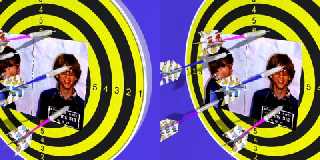
I can finally say I can see one of these images.  Probably because this one is
smaller.  The other ones were too far apart for me to focus on.

-Mike
Post a reply to this message
|
|
| |
| |
|
|
|
|
| |
| |
|
|
Sigmund,
Love you image and it has great depth.
Don't want to nit-pick but thought I should let you know about the
"violation of the stereo window". The term stereo window is used to
describe the plane defined by the edges of the image. It is as
if you were looking through a window. It is fine for things to come
trough the window into the space in front of this plane, but not to
be cut off, as this does not happen in the "real" world. The tail of
two of the darts is cut off by the edge of the image. In stereo
photography this is considered a big mistake. There is probably
a way to avoid this in the rendering, but it is easy to fix
after the images are rendered, you just trim the images a little to
move the centers a little apart, that will move everything in the
image back behind the plane of the stereo window. You take a few
pixels off the left side of the left image (on the right side in
this cross-eyed pair), and a few pixels off the right side of the
right image (on the left). Then the two darts that are further
away will fall behind the stereo window, while the other three
come out into the viewers space. A good way to think about this is
that the pixels that are at the same position in the two images
will be at the plane of the stereo window (your computer screen).

Harold


Sigmund Kyrre Aas <as### [at] studntnuno> wrote in message
news:387E0D16.FE6D484F@stud.ntnu.no...
> I just crammed a stereogram out of an unfinished scene of mine.
>
> Just wondering; shy can't I use 'actual' eye distance? I tried 7 cm
> between the cameras, but that produced far too different images. This
> one uses 1 cm and the camera is ca. 50 cm away from.
>
> sig.


----------------------------------------------------------------------------
----
Post a reply to this message
|
|
| |
| |
|
|
|
|
| |
| |
|
|
> To wiew these I just cross my eyes till I see 3 images and let my built
> in autofocous do the rest. This usually takes .2-.5 seconds.
Then your eyes/brain are faster than mine. I tried 5 minutes and still
couldn't read the numbers on the board. But it still became better and
better. Maybe it's training or I need new eyes :)

CU

	Bjoern
Post a reply to this message
|
|
| |
| |
|
|
|
|
| |
| |
|
|
> Just imagine how far apart in your scene the human eyes would be, and > for the
second picture translate the camera that much.  make
> each image look in a parallel direction - when people are looking at
As I said, when the cameras were 7 cm apart the images became far too
different to get a 3d effect. Making those cameras parallel (if that's
what you mean) won't be any different. The camera position in space is
all that matters. The look_at position is only used for panning so that
all the objects stays in the frame.

> their own eyes; it shouldn't be done by the camera.  That's how I did > my image
earlier, and it looks fine.

Actually, I had difficulties viewing your image. Too much camera
separation, I believe.

sig.
Post a reply to this message
|
|
| |
| |
|
|
|
|
| |
| |
|
|
Harold Baize wrote:
>
> Sigmund,
> Love you

Thanks

> two of the darts is cut off by the edge of the image. In stereo
> photography this is considered a big mistake. There is probably

and thanks again, you're absolutely right. Saving the best advice till
last, eh? This looks so much better now.

sig.
Post a reply to this message
|
|
| |
| |
|
|
|
|
| |
| |
|
|
"Harold Baize" <bai### [at] itsaucsfedu> wrote in message
news:387f6134@news.povray.org...
> Bob,
> Are you trying to view Sigmound's image in parallel? I'm pretty sure
> that the image is a cross-eye presentation. I works well for me viewed
> cross-eyed. What you describe is a good way to learn to "free-view"
> parallel images.
>

YeEs, I was making that mistake.  Although I would still think the depth focus
thing occurs with either type.  That being that since near parts are at
different depths than far parts you still have to train your view on each
individually.

Bob
Post a reply to this message
|
|
| |
| |
|
|
|
|
| |