|
|
|
|
|
|
| |
| |
|
|
|
|
| |
| |
|
|
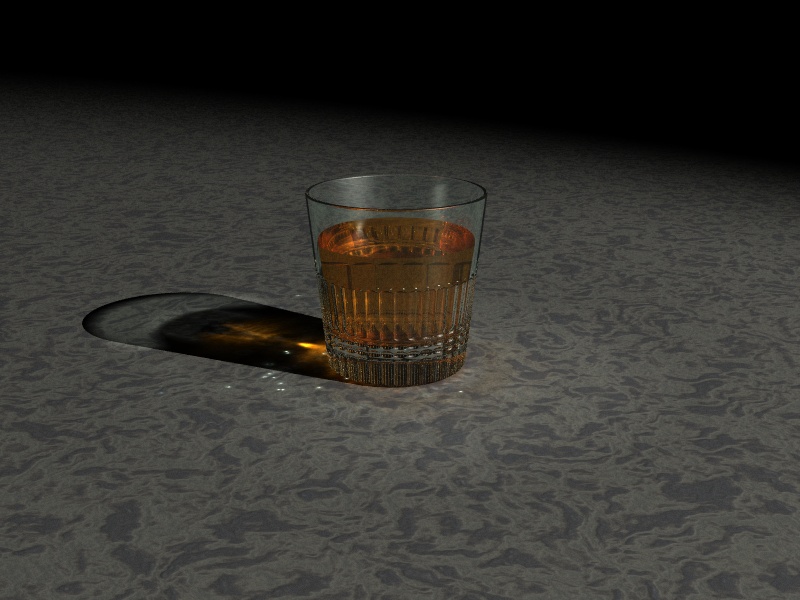
OK, you've already seen caustics with blobs, trees, birds... But have you
seen the caustics of a fine glass of liquor...? You have? Well, have some
more!
This damn thing took 30 minutes to parse and 17 hours to trace on my
PII416/64MB - mainly because reflections, but also because I turned on
reflected caustics on the glass (you _can_ see them, can't you?). Also, AA
had to be set to 0.1
For my next feat, I'll add some ice cubes (with media interior, reflections
and caustics), add reflections/reflected caustics to the whiskey and remove
"ignore_photons" from the glass. Then I'll take a nice 3-year vacation in
Burundi and hope to see it ready when I get back...

The glass itself is simple CSG, needs some work. I feel there is something
wrong with the refractions (at least upper part, where top of the wiskey
meets the glass).

It used 481,317 photons (overkill?), density .015, radius .15,2,.15. Whiskey
had refraction on, the glass had refrection & reflection on and
ignore_photons set.
I can only hope that the bright splotches are caustics from the
ornamentation on the glass.

Margus
Post a reply to this message
Attachments:
Download 'WGlassC.jpg' (131 KB)
Preview of image 'WGlassC.jpg'
|
|
| |
| |
|
|
|
|
| |
| |
|
|
I like this!
GrimDude
vos### [at] arkansas net
Post a reply to this message
|
|
| |
| |
|
|
|
|
| |
| |
|
|
Looks great!  Nice modeling on the glass.

Those bright splotches don't look right (I don't think I've seen anything
like that in reality).  They may be a bug.  Any chance you can email me
(or post) the code?

The reflective caustics do add a nice touch to the scene.  400k photons
is not too much for a scene (probably overkill for this particular scene,
though).  I am surprised at the parse time (since that's basically spent
shooting photons) and the render time for that matter... how high did
you set your max_trace_level?

-Nathan

Margus Ramst wrote:
>
> OK, you've already seen caustics with blobs, trees, birds... But have you
> seen the caustics of a fine glass of liquor...? You have? Well, have some
> more!
> This damn thing took 30 minutes to parse and 17 hours to trace on my
> PII416/64MB - mainly because reflections, but also because I turned on
> reflected caustics on the glass (you _can_ see them, can't you?). Also, AA
> had to be set to 0.1
> For my next feat, I'll add some ice cubes (with media interior, reflections
> and caustics), add reflections/reflected caustics to the whiskey and remove
> "ignore_photons" from the glass. Then I'll take a nice 3-year vacation in
> Burundi and hope to see it ready when I get back...
>
> The glass itself is simple CSG, needs some work. I feel there is something
> wrong with the refractions (at least upper part, where top of the wiskey
> meets the glass).
>
> It used 481,317 photons (overkill?), density .015, radius .15,2,.15. Whiskey
> had refraction on, the glass had refrection & reflection on and
> ignore_photons set.
> I can only hope that the bright splotches are caustics from the
> ornamentation on the glass.
>
> Margus
>
>  [Image]
Post a reply to this message
|
|
| |
| |
|
|
|
|
| |
| |
|
|
Hi,


>reflected caustics on the glass (you _can_ see them, can't you?

Yes! Don't worry, I can see them.

>The glass itself is simple CSG, needs some work. I feel there is something
>wrong with the refractions (at least upper part, where top of the wiskey
>meets the glass).

I might know what this is. If you fill a clear glass with water, and look at
the top where the water's surface meets the glass, you will see that the
surface doesn't stay flat, but in fact curves up slightly. This happens
because of water tension, and in fact happens with all liquids, AFAIK. The
only exception I know of is liquid mercury, which curves down instead of up.

Very nice image!

Equiprawn
Post a reply to this message
|
|
| |
| |
|
|
|
|
| |
| |
|
|
Equiprawn > wrote in message <36f03a21.0@news.povray.org>...
>
>I might know what this is. If you fill a clear glass with water, and look
at
>the top where the water's surface meets the glass, you will see that the
>surface doesn't stay flat, but in fact curves up slightly. This happens
>because of water tension, and in fact happens with all liquids, AFAIK. The
>only exception I know of is liquid mercury, which curves down instead of
up.
>


No-no, that's not what I meant (the whiskey surface actualy _does_ curve,
BTW)
I meant that there shouldn't be such a big gap between the inner surface of
the glass and the whiskey; I have modeled quite a few glasses (and stared at
them them in Real Life :) and they look different.
Let's see if I can explain this... Beacause of refraction or total internal
reflection, the walls of the glass should look very thin, i.e. the colour of
the liquid should extend all the way to the outer surface of the glass, even
if the glass is quite thick. The fact that the liquor in my image is so
clearly separated from the outer surface of the glass gives the impression
that the glass doesn't refract...
Hope you undesrtood. If not, feel free pour yourself a drink and check it
out. It's Black Velvet whiskey, if you want a precise test ;)

Margus
Post a reply to this message
|
|
| |
| |
|
|
|
|
| |
| |
|
|
Usually, I make the liquid a bit bigger than the interior of the glass.
Here's a cross-section:

++++ = glass
**** = liquid
#### = both

  |+++++|#|***************|#|+++++|
  |+++++|#|***************|#|+++++|
  |+++++|#|***************|#|+++++|

In other words, the liquid & glass overlap a bit.  Try it and see if
it works.

-Nathan

Margus Ramst wrote:
>
> Equiprawn > wrote in message <36f03a21.0@news.povray.org>...
> >
> >I might know what this is. If you fill a clear glass with water, and look
> at
> >the top where the water's surface meets the glass, you will see that the
> >surface doesn't stay flat, but in fact curves up slightly. This happens
> >because of water tension, and in fact happens with all liquids, AFAIK. The
> >only exception I know of is liquid mercury, which curves down instead of
> up.
> >
>
> No-no, that's not what I meant (the whiskey surface actualy _does_ curve,
> BTW)
> I meant that there shouldn't be such a big gap between the inner surface of
> the glass and the whiskey; I have modeled quite a few glasses (and stared at
> them them in Real Life :) and they look different.
> Let's see if I can explain this... Beacause of refraction or total internal
> reflection, the walls of the glass should look very thin, i.e. the colour of
> the liquid should extend all the way to the outer surface of the glass, even
> if the glass is quite thick. The fact that the liquor in my image is so
> clearly separated from the outer surface of the glass gives the impression
> that the glass doesn't refract...
> Hope you undesrtood. If not, feel free pour yourself a drink and check it
> out. It's Black Velvet whiskey, if you want a precise test ;)
>
> Margus
Post a reply to this message
|
|
| |
| |
|
|
|
|
| |
| |
|
|
Can't wait to see the version with the ice cubes, I like this a lot, but
if I had created it I'd be a bit worried about the bright white
reflections/refractions on the floor.

Steve

Margus Ramst wrote:
>
> OK, you've already seen caustics with blobs, trees, birds... But have you
> seen the caustics of a fine glass of liquor...? You have? Well, have some
> more!
> This damn thing took 30 minutes to parse and 17 hours to trace on my
> PII416/64MB - mainly because reflections, but also because I turned on
> reflected caustics on the glass (you _can_ see them, can't you?). Also, AA
> had to be set to 0.1
> For my next feat, I'll add some ice cubes (with media interior, reflections
> and caustics), add reflections/reflected caustics to the whiskey and remove
> "ignore_photons" from the glass. Then I'll take a nice 3-year vacation in
> Burundi and hope to see it ready when I get back...
>
> The glass itself is simple CSG, needs some work. I feel there is something
> wrong with the refractions (at least upper part, where top of the wiskey
> meets the glass).
>
> It used 481,317 photons (overkill?), density .015, radius .15,2,.15. Whiskey
> had refraction on, the glass had refrection & reflection on and
> ignore_photons set.
> I can only hope that the bright splotches are caustics from the
> ornamentation on the glass.
>
> Margus
>
>  [Image]
Post a reply to this message
|
|
| |
| |
|
|
|
|
| |
| |
|
|
And Liquid Nitrogen flows UP and not down...but you are right about mercury.....

Equiprawn wrote:

> Hi,
>
> >reflected caustics on the glass (you _can_ see them, can't you?
>
> Yes! Don't worry, I can see them.
>
> >The glass itself is simple CSG, needs some work. I feel there is something
> >wrong with the refractions (at least upper part, where top of the wiskey
> >meets the glass).
>
> I might know what this is. If you fill a clear glass with water, and look at
> the top where the water's surface meets the glass, you will see that the
> surface doesn't stay flat, but in fact curves up slightly. This happens
> because of water tension, and in fact happens with all liquids, AFAIK. The
> only exception I know of is liquid mercury, which curves down instead of up.
>
> Very nice image!
>
> Equiprawn
Post a reply to this message
Attachments:
Download 'us-ascii' (1 KB)
|
|
| |
| |
|
|
|
|
| |
| |
|
|
Nathan Kopp wrote in message <36F### [at] Koppcom>...
>Usually, I make the liquid a bit bigger than the interior of the glass.


I can't see why it should be better. Surely the reverse holds true in
nature. In raytracing terms - overlap or not, the surfaces are nearly
coincident so the change in reflection/refraction vectors should be
negligible. And I have gotten correct results with the liquid smaller than
the glass.
Anyway, I'll try. But if this works better, I'd like to know why...

Margus
Post a reply to this message
|
|
| |
| |
|
|
|
|
| |
| |
|
|
Ahh, I see what you mean now. You're right, it does look a bit strange. A
bug in Povray?

Equiprawn
Post a reply to this message
|
|
| |
| |
|
|
|
|
| |
| |
|
|
Very nice picture!
Here is a picture that is going to put renderman and its shader to shame.
I especially like the caustics of the whiskey. What a shame you did not work
more on the 'floor'.
I do hope that the photo mapping feature will be included in the next release of
POV.

Fabien Hénon.


Margus Ramst a écrit:

> OK, you've already seen caustics with blobs, trees, birds... But have you
> seen the caustics of a fine glass of liquor...? You have? Well, have some
> more!
> This damn thing took 30 minutes to parse and 17 hours to trace on my
> PII416/64MB - mainly because reflections, but also because I turned on
> reflected caustics on the glass (you _can_ see them, can't you?). Also, AA
> had to be set to 0.1
> For my next feat, I'll add some ice cubes (with media interior, reflections
> and caustics), add reflections/reflected caustics to the whiskey and remove
> "ignore_photons" from the glass. Then I'll take a nice 3-year vacation in
> Burundi and hope to see it ready when I get back...
>
> The glass itself is simple CSG, needs some work. I feel there is something
> wrong with the refractions (at least upper part, where top of the wiskey
> meets the glass).
>
> It used 481,317 photons (overkill?), density .015, radius .15,2,.15. Whiskey
> had refraction on, the glass had refrection & reflection on and
> ignore_photons set.
> I can only hope that the bright splotches are caustics from the
> ornamentation on the glass.
>
> Margus
>
>  [Image]
Post a reply to this message
|
|
| |
| |
|
|
|
|
| |
| |
|
|
Hmph. It does work! Both the refraction and the caustics look completely
different... But why? Total internal reflection?

Margus

Margus Ramst wrote in message <36f115e9.0@news.povray.org>...
>
>I can't see why it should be better. Surely the reverse holds true in
>nature. In raytracing terms - overlap or not, the surfaces are nearly
>coincident so the change in reflection/refraction vectors should be
>negligible. And I have gotten correct results with the liquid smaller than
>the glass.
>Anyway, I'll try. But if this works better, I'd like to know why...
>
>Margus
>
>
Post a reply to this message
|
|
| |
| |
|
|
|
|
| |
| |
|
|
Yep, does look strange at the liquid/solid barrier (fancy terminology
for whiskey meets glass), since you've stared plenty enough at such
objects you must know what you're talking about.
No one else commented on the darkness of the shadowed liquid. I would
expect to see the golden color on the table surface beyond just the
photon mapped part. No?


Margus Ramst wrote:
>
> OK, you've already seen caustics with blobs, trees, birds... But have you
> seen the caustics of a fine glass of liquor...? You have? Well, have some
> more!
> This damn thing took 30 minutes to parse and 17 hours to trace on my
> PII416/64MB - mainly because reflections, but also because I turned on
> reflected caustics on the glass (you _can_ see them, can't you?). Also, AA
> had to be set to 0.1
> For my next feat, I'll add some ice cubes (with media interior, reflections
> and caustics), add reflections/reflected caustics to the whiskey and remove
> "ignore_photons" from the glass. Then I'll take a nice 3-year vacation in
> Burundi and hope to see it ready when I get back...
>
> The glass itself is simple CSG, needs some work. I feel there is something
> wrong with the refractions (at least upper part, where top of the wiskey
> meets the glass).
>
> It used 481,317 photons (overkill?), density .015, radius .15,2,.15. Whiskey
> had refraction on, the glass had refrection & reflection on and
> ignore_photons set.
> I can only hope that the bright splotches are caustics from the
> ornamentation on the glass.
>
> Margus
>
>  [Image]

--
 omniVERSE: beyond the universe
  http://members.aol.com/inversez/homepage.htm
 mailto:inv### [at] aolcom?Subject=PoV-News
Post a reply to this message
|
|
| |
| |
|
|
|
|
| |
| |
|
|
Hickough.... ;-)
Now this is what I call realistic...

Markus
--
"Denkst Du vielleicht über den nächsten Satz nach, den Du sagen willst?
 Ich nicht eine Sekunde!!!" H. Heinol in Val Thorens
Post a reply to this message
|
|
| |
| |
|
|
|
|
| |
| |
|
|
test
Post a reply to this message
|
|
| |
| |
|
|
|
|
| |
| |
|
|
I ran into this problem when I was creating some illustrations for an optics
paper I was writing.  I found that the container for the liquid must be 0.01
smaller than the glass container it will be inside.  If you dont do this
Snell's law doesnt hold.  Hope this helps.

Kynar
Post a reply to this message
|
|
| |
| |
|
|
|
|
| |
| |
|
|
Kynar wrote:

> test

Passed
Post a reply to this message
|
|
| |
| |
|
|
|
|
| |
|
|