|
|
|
|
|
|
| |
| |
|
|
|
|
| |
| |
|
|
This may be my first post, but it isn't my first image. I've been using
PovRay sporadically since I found version 2 on a magazine cover disc
(I've still got a 100 sheet dot matrix printout of the entire manual!).

Currently unemployed, I decided to have another crack at doing Penrose
tiles, the hard way. After a week I gave up and did them the easy way :)

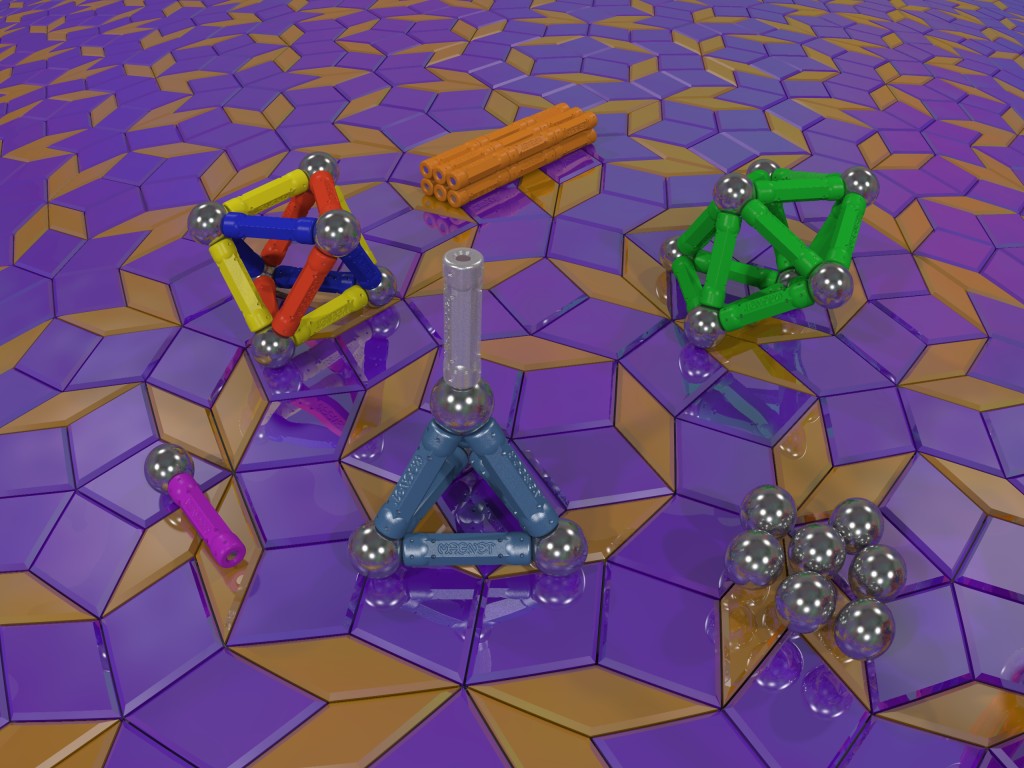
I also wanted to create some more Geomag models. Geomag consist of 27mm
long magnetic rods, and half inch diameter steel ball bearings. I
originally modelled it 2 or 3 years ago, based on a set I bought as a
present for my sister. Since then I've bought a load for myself, which
has a new rod design, and different colours. The shapes here are very
simple, I have built shapes with up to 540 rods and weighing over 3Kg
(As soon as I'm earning again I must go buy some more...).

I thought I could call Penrose tiling a chequered plane and combine that
with the reflective spheres of the Geomag, and present it here as a
first post.

Rendered on an AMD Athlon XP 1800, 768Mb ram, at 2560x1920 overnight.
Uses blurred reflections, area lights and radiosity, although the latter
doesn't really show. JPEG compression has done strange things to the
magenta piece.
Post a reply to this message
Attachments:
Download 'geomag_penrose-4.jpg' (173 KB)
Download 'us-ascii' (1 KB)
Preview of image 'geomag_penrose-4.jpg'
|
|
| |
| |
|
|
|
|
| |
| |
|
|
Alex wrote:

> I thought I could call Penrose tiling a chequered plane and combine that
> with the reflective spheres of the Geomag, and present it here as a
> first post.

Hmm. Very nice. Even though the reflective spheres have been cruelly
brought out of their native habitat of the checkered planes ;)

But, then again, dometicated dogs and cats don't seem to argue with air
conditioned homes, either.. :)

--
~Mike
World Society for the Preservation of Reflective Spheres in their Native
Habitat. (WSPRSNH)
Post a reply to this message
|
|
| |
| |
|
|
|
|
| |
| |
|
|
#include "colors.inc"

penrose's tilings are one of my obsessions, how do you made this mosaic?
manually?
pretty image, by the way.

--
light_source{0,1}#macro C(r,p)cylinder{x*-2,x*2,.9 pigment { rgb
p} /* B Gimeno estoeslarealidad */ rotate p*90 } #end difference
{box {-1,1} C(z /* http://usuarios.lycos.es/game2413 */,x)C(x,y)
C(z,z) pigment{rgb 2} rotate 45 translate z*4} // www.povray.org
Post a reply to this message
|
|
| |
| |
|
|
|
|
| |
| |
|
|
Post a reply to this message
Attachments:
Download 'us-ascii' (2 KB)
Download 'image3.jpg' (18 KB)
Download 'us-ascii' (1 KB)
Preview of image 'image3.jpg'

|
|
| |
| |
|
|
|
|
| |
| |
|
|
Alex <pov### [at] lazysod orguk> wrote:
> This may be my first post, but it isn't my first image. I've been using
> PovRay sporadically since I found version 2 on a magazine cover disc
> (I've still got a 100 sheet dot matrix printout of the entire manual!).
And I still have a dot-matrix printout of the manual for DKB 2.12 for Amiga.
:)
> Currently unemployed, I decided to have another crack at doing Penrose
> tiles, the hard way. After a week I gave up and did them the easy way :)
They can be tricky! :) What technique did you use? Here's one I posted back
in April: <web.425b6e5da45a985aad93754b0@news.povray.org>
I first started using Penrose macros from Boxer by John VanSickle, but I
ended up making up my own macros. I can post the sources if anyone's
interested.
> I also wanted to create some more Geomag models. Geomag consist of 27mm
> long magnetic rods, and half inch diameter steel ball bearings. I
> originally modelled it 2 or 3 years ago, based on a set I bought as a
> present for my sister. Since then I've bought a load for myself, which
> has a new rod design, and different colours. The shapes here are very
> simple, I have built shapes with up to 540 rods and weighing over 3Kg
> (As soon as I'm earning again I must go buy some more...).
They lok like fun, but a bit pricey for what you get. FWIW, you can get very
powerful magnets out of dead hard drives.
> I thought I could call Penrose tiling a chequered plane and combine that
> with the reflective spheres of the Geomag, and present it here as a
> first post.
It looks fine to me.
> Rendered on an AMD Athlon XP 1800, 768Mb ram, at 2560x1920 overnight.
> Uses blurred reflections, area lights and radiosity, although the latter
> doesn't really show. JPEG compression has done strange things to the
> magenta piece.
I normally try to use JPEG quality of 90% for pics I post here, and a little
smoothing to hide artifacts, but sometimes using .png is the only way to
show the true quality of an image.
Anyway, here's a close-up of an earlier Penrose tiling I did. We seem to
have chosen similar colour schemes. orguk> wrote:
> This may be my first post, but it isn't my first image. I've been using
> PovRay sporadically since I found version 2 on a magazine cover disc
> (I've still got a 100 sheet dot matrix printout of the entire manual!).
And I still have a dot-matrix printout of the manual for DKB 2.12 for Amiga.
:)
> Currently unemployed, I decided to have another crack at doing Penrose
> tiles, the hard way. After a week I gave up and did them the easy way :)
They can be tricky! :) What technique did you use? Here's one I posted back
in April: <web.425b6e5da45a985aad93754b0@news.povray.org>
I first started using Penrose macros from Boxer by John VanSickle, but I
ended up making up my own macros. I can post the sources if anyone's
interested.
> I also wanted to create some more Geomag models. Geomag consist of 27mm
> long magnetic rods, and half inch diameter steel ball bearings. I
> originally modelled it 2 or 3 years ago, based on a set I bought as a
> present for my sister. Since then I've bought a load for myself, which
> has a new rod design, and different colours. The shapes here are very
> simple, I have built shapes with up to 540 rods and weighing over 3Kg
> (As soon as I'm earning again I must go buy some more...).
They lok like fun, but a bit pricey for what you get. FWIW, you can get very
powerful magnets out of dead hard drives.
> I thought I could call Penrose tiling a chequered plane and combine that
> with the reflective spheres of the Geomag, and present it here as a
> first post.
It looks fine to me.
> Rendered on an AMD Athlon XP 1800, 768Mb ram, at 2560x1920 overnight.
> Uses blurred reflections, area lights and radiosity, although the latter
> doesn't really show. JPEG compression has done strange things to the
> magenta piece.
I normally try to use JPEG quality of 90% for pics I post here, and a little
smoothing to hide artifacts, but sometimes using .png is the only way to
show the true quality of an image.
Anyway, here's a close-up of an earlier Penrose tiling I did. We seem to
have chosen similar colour schemes.
Post a reply to this message
Attachments:
Download 'penrosem0.jpg' (75 KB)
Preview of image 'penrosem0.jpg'

|
|
| |
| |
|
|
|
|
| |
| |
|
|
"PM 2Ring" <nomail@nomail> schreef in bericht
news:web.42d322fa811cc7c3ad93754b0@news.povray.org...
> Alex <pov### [at] lazysodorguk> wrote:
> > Currently unemployed, I decided to have another crack at doing Penrose
> > tiles, the hard way. After a week I gave up and did them the easy way :)
>
> They can be tricky! :) What technique did you use? Here's one I posted
back
> in April:  <web.425b6e5da45a985aad93754b0@news.povray.org>
>
> I first started using Penrose macros from Boxer by John VanSickle, but I
> ended up making up my own macros. I can post the sources if anyone's
> interested.
>

You guys are really smart! (no irony here; just awe)
I have not tried my hand at Penrose tiles, but seeing your works makes me
slaver. I am afraid though, it is a little bit beyond my capabilities...

Thomas
Post a reply to this message
|
|
| |
| |
|
|
|
|
| |
| |
|
|
In message <web.42d322fa811cc7c3ad93754b0@news.povray.org>, PM 2Ring
<nomail@nomail.?.invalid> writes
>Alex <pov### [at] lazysodorguk> wrote:

>> Currently unemployed, I decided to have another crack at doing Penrose
>> tiles, the hard way. After a week I gave up and did them the easy way :)
>
>They can be tricky! :) What technique did you use? Here's one I posted back
>in April:  <web.425b6e5da45a985aad93754b0@news.povray.org>
>
See other post. I'm afraid I must have missed your post, I've been
subscribed to the group for some time but skipped some posts recently in
order to catch up. I shall attempt to request it with my newsreader!

>I first started using Penrose macros from Boxer by John VanSickle, but I
>ended up making up my own macros. I can post the sources if anyone's
>interested.
>
I remember seeing some of those animations. Some interesting patterns &
objects. Can't say I can remember any Penrose tiles, I may go look
later.

>> I also wanted to create some more Geomag models. Geomag consist of 27mm
>> long magnetic rods, and half inch diameter steel ball bearings. I
>> originally modelled it 2 or 3 years ago, based on a set I bought as a
>> present for my sister. Since then I've bought a load for myself, which
>> has a new rod design, and different colours. The shapes here are very
>> simple, I have built shapes with up to 540 rods and weighing over 3Kg
>> (As soon as I'm earning again I must go buy some more...).
>
>They lok like fun, but a bit pricey for what you get.

Yes it's expensive, but very very good. Once you have some you want to
go out and buy some more, to make bigger things! There are some cheap
copycat sets about (I have some), but they are pathetic.

>FWIW, you can get very
>powerful magnets out of dead hard drives.
>
I've taken 2 apart before. I have several other dead ones I could
dismantle. The magnets are very brittle, though.

>>JPEG compression has done strange things to the
>> magenta piece.
>
>I normally try to use JPEG quality of 90% for pics I post here, and a little
>smoothing to hide artifacts, but sometimes using .png is the only way to
>show the true quality of an image.
>
The .png version was 851KB, I couldn't find any guidelines for
attachment sizes, but I thought it a little big.

>Anyway, here's a close-up of an earlier Penrose tiling I did. We seem to
>have chosen similar colour schemes.
>
I chose my colours so they averaged to 50% grey, that was the first pair
I found that didn't look awful. I thought it might help the appearance
of the blurred reflections of distant tiles.

I notice you've divided your tiles up to show both the rhomb and the
kites/darts tiling together, that's pretty smart. And you've done proper
curved edges, I just did a flat bevel by intersection of planes.
--
Alex
Post a reply to this message
|
|
| |
| |
|
|
|
|
| |
| |
|
|
Post a reply to this message
|
|
| |
| |
|
|
|
|
| |
| |
|
|
Post a reply to this message
Attachments:
Download 'penrosem0.jpg' (5 KB)
Download 'rprismh1.jpg' (144 KB)
Preview of image 'rprismh1.jpg'

|
|
| |
| |
|
|
|
|
| |
| |
|
|
Post a reply to this message
|
|
| |
| |
|
|
|
|
| |
| |
|
|
In message <web.42dcff7c811cc7c3d46eca60@news.povray.org>, PM 2Ring
<nomail@nomail.?.invalid> writes
>Alex <pov### [at] lazysodorguk> wrote:
>> In message <web.42d322fa811cc7c3ad93754b0@news.povray.org>, PM 2Ring
>> <nomail@nomail.?.invalid> writes
>> >Alex <pov### [at] lazysodorguk> wrote:
>>
>> >> Currently unemployed, I decided to have another crack at doing Penrose
>> >> tiles, the hard way. After a week I gave up and did them the easy way :)
>
>What's the hard way? Placing them "by hand". I've done a few like that...
>
Projecting a specific subset of a 5 dimensional integer lattice onto a 2
dimensional plane to give the vertices of the rhombs. The principle is
very simple, and it's easy to do with a 3 dimensional lattice, but for
the life of me I can't work out the nitty gritty of the higher
dimensional cases. All the resources I can find just explain the
principle.

Method discovered by deBruijn.

See http://gregegan.customer.netspace.net.au/APPLETS/12/12.html for an
example, click the applet until you get Penrose tiling. Some of the
other applets on the site are well worth checking out, "Wythoff" is
another stunning one which gave my a couple of ideas for geomag.

>> >They can be tricky! :) What technique did you use? Here's one I posted back
>> >in April:  <web.425b6e5da45a985aad93754b0@news.povray.org>
>> >
>> See other post. I'm afraid I must have missed your post, I've been
>> subscribed to the group for some time but skipped some posts recently in
>> order to catch up. I shall attempt to request it with my newsreader!
>
>And I missed this post (and the one from Thomas), but I just use the Web
>interface. If you want to see my earlier pic, the Web interface may be the
>easiest way, because from here, links like the one above are live.
>
>> >I first started using Penrose macros from Boxer by John VanSickle, but I
>> >ended up making up my own macros. I can post the sources if anyone's
>> >interested.
>> >
>> I remember seeing some of those animations. Some interesting patterns &
>> objects. Can't say I can remember any Penrose tiles, I may go look
>> later.
>
>I never actually saw the Boxer animations. I found it through Google,
>searching for "Penrose tiling". From the source code, the Boxer anim uses a
>simple flat Penrose tiling for the floor.
>
Just found it on my HDD. The tiling was quite subtle, I never noticed it
before!

>> >FWIW, you can get very
>> >powerful magnets out of dead hard drives.
>> >
>> I've taken 2 apart before. I have several other dead ones I could
>> dismantle. The magnets are very brittle, though.
>
>Very brittle, indeed. And they can attract each other with enough force to
>fracture them, so I have lots of small pieces of them. These magnets are
>*not* toys! Keep out of reach of children! Skin pinched between
>supermagnets is painful! :)

Glad I'm not the only stupid person :)

>
>> >Anyway, here's a close-up of an earlier Penrose tiling I did. We seem to
>> >have chosen similar colour schemes.
>> >
>> I chose my colours so they averaged to 50% grey, that was the first pair
>> I found that didn't look awful.
>
>:) Things start getting awfully muddy down at that greylevel.
>
I lied about my colour scheme, all the pairs of colours looked awful so
I used something different.

>>I thought it might help the appearance
>> of the blurred reflections of distant tiles.
>
>That makes sense. Still, the floor is a little too dark for my tastes.

Maybe. But make everything bright and the highlights don't show up as
much. It's a difficult one to judge.

>
>> And you've done proper
>> curved edges, I just did a flat bevel by intersection of planes.
>
>Those curved edges... They were a bit trickier than I thought they were
>going to be. I ended up making one macro for rounded isoceles triangle
>tiles, and another one for rounded polygonal prisms. I suppose I should
>tidy them up a bit and post them.
>
That's why I didn't bother. Achieving a constant width gap between
different shaped tiles was tricky enough.

>Here's a Penrose tiling, using rounded pentagonal prisms, in standard stone
>textures. The tiles were placed by simple #while loops, not recursive
>macros.
>
Similar to a "pentaflake" fractal, but with some pentagons filling the
larger gaps.
--
Alex
Post a reply to this message
|
|
| |
| |
|
|
|
|
| |
| |
|
|
Post a reply to this message
|
|
| |
| |
|
|
|
|
| |
| |
|
|
Post a reply to this message
|
|
| |
| |
|
|
|
|
| |
| |
|
|
In message <web.42dd997f811cc7c3ad93754b0@news.povray.org>, PM 2Ring
<nomail@nomail.?.invalid> writes
>Alex <pov### [at] lazysodorguk> wrote:
>
>
>> Projecting a specific subset of a 5 dimensional integer lattice onto a 2
>> dimensional plane to give the vertices of the rhombs. The principle is
>> very simple, and it's easy to do with a 3 dimensional lattice, but for
>> the life of me I can't work out the nitty gritty of the higher
>> dimensional cases. All the resources I can find just explain the
>> principle.
>>
>> Method discovered by deBruijn.
>
>Of course, how could I forget. I thought of using deBruijn's method, but I
>couldn't figure out a way to do it in POV. Also, it's been a while since
>I've played with higher-dimensional geometry, but I think that simple
>orthographic projections are used to project from n dimensions to n-1
>dimensions.
>
Yes. Projecting from n to n-3 dimensions is more tricky. I thought I
sussed out how to do it (for the umpteenth time), but once I coded it it
didn't work and I couldn't be bothered to look at it any more. I had
originally hoped to be able to create a procedural texture!

>If I understand this stuff correctly, the deBruijn construction is a regular
>5D Voronoi diagram, so it should be easy to implement in POV by modifying
>the code for the crackle pattern.
>
I'm not messing with source code. I never did suss out c.

<snip>

>
>> >>I thought it might help the appearance
>> >> of the blurred reflections of distant tiles.
>> >
>> >That makes sense. Still, the floor is a little too dark for my tastes.
>>
>> Maybe. But make everything bright and the highlights don't show up as
>> much. It's a difficult one to judge.
>
>I suppose that this is where Jaime's Lightsys comes in very useful, although
>I've just started exploring Lightsys myself.
>
Just had a quick look at it, looks interesting. Lighting can be very
tricky.

>
>> >Here's a Penrose tiling, using rounded pentagonal prisms, in standard stone
>> >textures. The tiles were placed by simple #while loops, not recursive
>> >macros.
>> >
>> Similar to a "pentaflake" fractal, but with some pentagons filling the
>> larger gaps.
>
>Yes. I few years back, I wrote a little C program for my Amiga to play with
>pentagonal tilings by hand. I spent many, many hours exploring these
>tilings.
>
I never knew about these tilings until relatively recently, although I
have programmed similar L-system fractal algorithms on my old CPC464.
--
Alex
Post a reply to this message
|
|
| |
| |
|
|
|
|
| |
| |
|
|
In message <web.42dd8e85811cc7c3ad93754b0@news.povray.org>, PM 2Ring
<nomail@nomail.?.invalid> writes
>"PM 2Ring" <nomail@nomail> wrote:
>>
>I don't know what's happened to my last 3 posts! I'm certainly not posting
>blank messages. And how come Alex could see one of them? Very strange!
>
>
I can see all of them. 5 in this thread so far.

Perhaps I'm just more perceptive :)
--
Alex
Post a reply to this message
|
|
| |
| |
|
|
|
|
| |
| |
|
|
Post a reply to this message
Attachments:
Download 'rprismh1.jpg' (4 KB)
Download 'achmeag5.jpg' (125 KB)
Preview of image 'achmeag5.jpg'

|
|
| |
| |
|
|
|
|
| |
| |
|
|
PM 2Ring wrote:
> I've rendered the demo files & am in the process of transforming one
> of Jaime's indoor scenes, rearranging and modifying the furniture &
> adding little things like a door handle. See below for an example.

   Nice improvement! The arrangement seems more natural than on my poor
demo (but the patio image on the frame needs a gamma correction... :)

> Ah! The old Amstrad. Such a pleasant machine to program.

   Yeah.. It was too my first computer. I programed there with BASIC
some prehistoric computer graphics...

--
Jaime
Post a reply to this message
|
|
| |
| |
|
|
|
|
| |
| |
|
|
Post a reply to this message
Attachments:
Download 'achmeag5.jpg' (2 KB)
Download 'achmeaa2.jpg' (113 KB)
Preview of image 'achmeaa2.jpg'

|
|
| |
| |
|
|
|
|
| |
| |
|
|
In message <web.42e0ac70811cc7c35464b3b50@news.povray.org>, PM 2Ring
<nomail@nomail.?.invalid> writes
>Alex <pov### [at] lazysodorguk> wrote:
>> In message <web.42dd997f811cc7c3ad93754b0@news.povray.org>, PM 2Ring
>> <nomail@nomail.?.invalid> writes


>> >If I understand this stuff correctly, the deBruijn construction is a regular
>> >5D Voronoi diagram, so it should be easy to implement in POV by modifying
>> >the code for the crackle pattern.
>> >
>> I'm not messing with source code. I never did suss out c.
>
>I've been programming in C for almost 25 years, but I wasn't suggesting that
>it would be a task for we lesser mortals. :) I was hoping that deBruijn's
>construction might be incorporated as a standard pattern into the official
>POV, some time in the future.
>
Can't see it myself, but if somebody can add quaternion fractals to
Povray then I suppose anything's possible.

>> >
>> >I suppose that this is where Jaime's Lightsys comes in very useful, although
>> >I've just started exploring Lightsys myself.
>> >
>> Just had a quick look at it, looks interesting. Lighting can be very
>> tricky.
>
>I've rendered the demo files & am in the process of transforming one of
>Jaime's indoor scenes, rearranging and modifying the furniture & adding
>little things like a door handle. See below for an example.
>
Looks good. Why are you growing plants in a sports trophy?
>> >
>> >> >Here's a Penrose tiling, using rounded pentagonal prisms, in
>> >> >standard stone
>> >> >textures. The tiles were placed by simple #while loops, not recursive
>> >> >macros.
>> >> >
>> >> Similar to a "pentaflake" fractal, but with some pentagons filling the
>> >> larger gaps.
>> >
>> >Yes. I few years back, I wrote a little C program for my Amiga to play with
>> >pentagonal tilings by hand. I spent many, many hours exploring these
>> >tilings.
>> >
>> I never knew about these tilings until relatively recently, although I
>> have programmed similar L-system fractal algorithms on my old CPC464.
>> --
>
>Ah! The old Amstrad. Such a pleasant machine to program.
>
It was a great machine, as was the ZX81. I just wish the IBM PC had been
based on the Z80 processor as well :)
--
Alex
Post a reply to this message
|
|
| |
| |
|
|
|
|
| |
|
|