|
|
|
|
|
|
| |
| |
|
|
|
|
| |
| |
|
|
Am 13.05.2017 um 12:59 schrieb Kenneth:
> As far as I know, there is no exact solution or *equation* for solving the
> "n-body problem", except for special cases where one or more of the variables is
> simplified.
>
> I think this is the reason why interplanetary spacecraft need 'course
> corrections' every now and then, to arrive at their destinations. There are just
> too many interacting variables to consider.
I don't think so; the trajectories of spacecraft can be computed
numerically (simulated, if you will) with pretty good precision. There
are plenty other reasons for course corrections:
Some course corrections are simply inevitable, e.g. to enter or leave a
stable orbit around a celestial body.
Other course corrections are there to compensate for known
non-gravitational effects that cannot be compensated for by adjusting
the initial trajectory. An example would be decelerating effects on
orbital trajectories, such as atmospheric drag.
Spacecraft orbiting earth for any reasonably long duration will also
undergo occasional course corrections to evade pieces of "space junk".
Yet other course corrections are performed to compensate for influences
that would be impossible to predict with sufficient precision in
advance, such as mechanical tolerances in the propulsion systems,
acceleration due to non-uniform thermal radiation from the space probe,
interaction with coronar mass ejections, and other some such.
Post a reply to this message
|
|
| |
| |
|
|
|
|
| |
| |
|
|
I do a fair amount of amateur 'armchair thinking' about the n-body problem,
about why it hasn't been solved. (No solution from me yet-- ha!)
It seems that a new mathematical tool still needs to be found or invented, to
solve this and give an exact solution... a tool that's within our grasp, but
that just hasn't yet been formulated by a genius like Newton, Einstein or
Feynman. (By solving it, I mean for the purely gravitational interactions of
all the planets, their moons, and the Sun-- without the 101 other subtle effects
involved.)
Calculus was invented to solve a 'similarly difficult' kind of problem (in
another mathematical realm), which had no real solution until then. And
Feynman's 'renormalization process' helped put quantum electrodynamics on a
surer footing. My gut feeling is that a new kind of tool like these is needed,
for exact solutions to mutually interacting objects, when there are lots of
objects involved.
Post a reply to this message
|
|
| |
| |
|
|
|
|
| |
| |
|
|
On 5/12/2017 8:10 AM, Bald Eagle wrote:
>
> Here's the animation of the solar system over one Earth year.
>
> I just worked out a fast and efficient approximation for apsidal (orbital)
> precession last night. (not that it will make any noticeable effect)
>
> Still need to look up a bunch of things and do some further editing on the code
> before it gets fleshed out.
>
> Not sure how I ought to place the planets - so I just started at full syzygy.
> I may trace out the orbits in a future version.
>
I tried modeling the solar system once in another program. I could never
figure out the "starting point" of each planet's revolution in time.
I.e. whether GMT is "aligned" correctly with respect to the sun and the
rest of the solar system.
I was unable to find this data in the source I looked in. IIRC there was
some sort of online database that you could access using queries, and it
would spit out the data relative to a chosen epoch. Can't remember the
name of the database now.
Mike
Post a reply to this message
|
|
| |
| |
|
|
|
|
| |
| |
|
|
On 5/15/2017 1:45 AM, Mike Horvath wrote:
> On 5/12/2017 8:10 AM, Bald Eagle wrote:
>>
>> Here's the animation of the solar system over one Earth year.
>>
>> I just worked out a fast and efficient approximation for apsidal
>> (orbital)
>> precession last night. (not that it will make any noticeable effect)
>>
>> Still need to look up a bunch of things and do some further editing on
>> the code
>> before it gets fleshed out.
>>
>> Not sure how I ought to place the planets - so I just started at full
>> syzygy.
>> I may trace out the orbits in a future version.
>>
>
> I tried modeling the solar system once in another program. I could never
> figure out the "starting point" of each planet's revolution in time.
> I.e. whether GMT is "aligned" correctly with respect to the sun and the
> rest of the solar system.
>
If you want to be that accurate then search for "The equation of time".
That will give you the four days of the year when local time is the same
as solar time.
http://www.sundials.co.uk/equation.htm
> I was unable to find this data in the source I looked in. IIRC there was
> some sort of online database that you could access using queries, and it
> would spit out the data relative to a chosen epoch. Can't remember the
> name of the database now.
>
That would be handy.
--
Regards
Stephen
Post a reply to this message
|
|
| |
| |
|
|
|
|
| |
| |
|
|
Stephen <mca### [at] aol com> wrote:
> On 5/12/2017 1:10 PM, Bald Eagle wrote:
> > Not sure how I ought to place the planets - so I just started at full syzygy.
> > I may trace out the orbits in a future version.
> >
>
> The orbit of the moon would be nice to see.
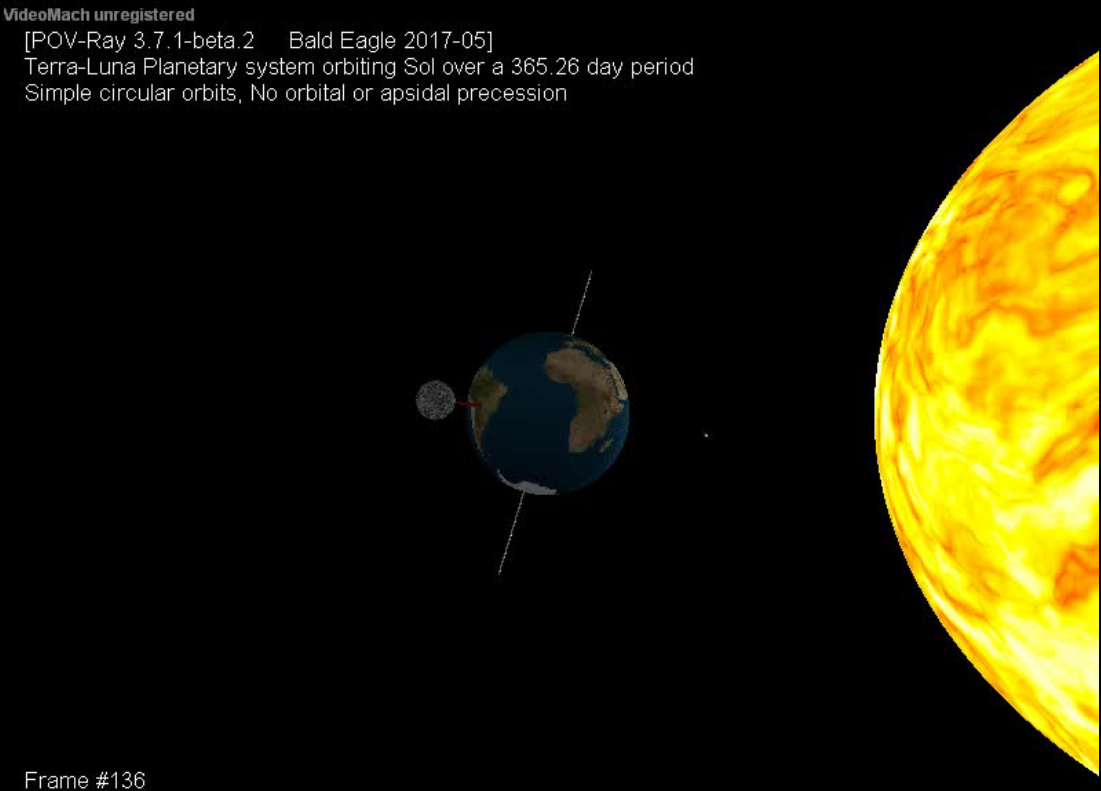
Got about 24 of Jupiter's moons coded, both of Mars', and Earth's.
Jupiter is uv-mapped.
For some reason, my moons don't cast shadows onto my planets... :|
I worked out lines connecting the center of the planet to the tiny moons, so
they can be tracked, and then added camera-facing text labels that revolve with
the moons, and I _think_ I got a torus object worked out to show the circular /
elliptical orbit. I've only tested that with Luna.
Need to work out a formula to automatically adjust the typeface size for camera
distance.
(I have that as a 5730 kb animation - where to post?)
Got the auto-width bounding box, lines, and tori worked out - it's not perfect,
but it makes those things usable since I have a camera that moves across the
whole solar system ;)
For some reason, I can see the far side of the torus through/in-front-of my
planet. NO idea what's going on there. A top-down view shows that the torus
fully surrounds the planet - so it's not a confusing viewpoint thing.
Camera definitions that follow a chosen planet around its orbit, so the
[visible] moons in the planetary system can be seen.
(Some of these "moons" are really _really_ tiny rocks :O )
Need to get a bit more data on celestial bodies.
Need to work out how to make my orbits precessing ellipses - for animation
purposes, and how to implement the stated eccentricity as a formula, and maybe
add some stars. com> wrote:
> On 5/12/2017 1:10 PM, Bald Eagle wrote:
> > Not sure how I ought to place the planets - so I just started at full syzygy.
> > I may trace out the orbits in a future version.
> >
>
> The orbit of the moon would be nice to see.
Got about 24 of Jupiter's moons coded, both of Mars', and Earth's.
Jupiter is uv-mapped.
For some reason, my moons don't cast shadows onto my planets... :|
I worked out lines connecting the center of the planet to the tiny moons, so
they can be tracked, and then added camera-facing text labels that revolve with
the moons, and I _think_ I got a torus object worked out to show the circular /
elliptical orbit. I've only tested that with Luna.
Need to work out a formula to automatically adjust the typeface size for camera
distance.
(I have that as a 5730 kb animation - where to post?)
Got the auto-width bounding box, lines, and tori worked out - it's not perfect,
but it makes those things usable since I have a camera that moves across the
whole solar system ;)
For some reason, I can see the far side of the torus through/in-front-of my
planet. NO idea what's going on there. A top-down view shows that the torus
fully surrounds the planet - so it's not a confusing viewpoint thing.
Camera definitions that follow a chosen planet around its orbit, so the
[visible] moons in the planetary system can be seen.
(Some of these "moons" are really _really_ tiny rocks :O )
Need to get a bit more data on celestial bodies.
Need to work out how to make my orbits precessing ellipses - for animation
purposes, and how to implement the stated eccentricity as a formula, and maybe
add some stars.
Post a reply to this message
Attachments:
Download 'screenshot.png' (283 KB)
Preview of image 'screenshot.png'
|
|
| |
| |
|
|
|
|
| |
| |
|
|
On 5/15/2017 1:08 PM, Bald Eagle wrote:
> Stephen <mca### [at] aolcom> wrote:
>> On 5/12/2017 1:10 PM, Bald Eagle wrote:
>
>
> For some reason, my moons don't cast shadows onto my planets... :|
>
You have checked no_shadow is not set? :)
Use a white plane to see if any shadows are being cast.
>
> (I have that as a 5730 kb animation - where to post?)
>
You can try this newsgroup. If it is too large it can only fail.
Otherwise youtube and post a link.
You are getting on great guns.
Looking forward to seeing it.
--
Regards
Stephen
Post a reply to this message
|
|
| |
| |
|
|
|
|
| |
| |
|
|
Stephen <mca### [at] aolcom> wrote:
> You can try this newsgroup. If it is too large it can only fail.
> Otherwise youtube and post a link.
Too big.
An initial run was 5.59, the good one is 6.13MB.
Shall I email the good one to you?
Post a reply to this message
|
|
| |
| |
|
|
|
|
| |
| |
|
|
http://planetpixelemporium.com/planets.html
Wowza. :)
Just the sort of thing I was looking for!
Post a reply to this message
|
|
| |
| |
|
|
|
|
| |
| |
|
|
On 5/15/2017 5:13 PM, Bald Eagle wrote:
> Stephen <mca### [at] aolcom> wrote:
>
>> You can try this newsgroup. If it is too large it can only fail.
>> Otherwise youtube and post a link.
>
> Too big.
>
> An initial run was 5.59, the good one is 6.13MB.
> Shall I email the good one to you?
>
That would be good. But I am sure others would like to see it as well.
--
Regards
Stephen
Post a reply to this message
|
|
| |
| |
|
|
|
|
| |
| |
|
|
Stephen <mca### [at] aolcom> wrote:
> That would be good. But I am sure others would like to see it as well.
I'll email you, 'cause I know you're over there chomping at the bit, biting your
nails on the edge of your seat ;)
I'll re-render at a smaller size or maybe a slightly sparser frame number and
post here.
It was a busy weekend :)
Post a reply to this message
|
|
| |
| |
|
|
|
|
| |