|
 |
On 4/4/26 18:41, kurtz le pirate wrote:
>
> Hello,
>
>
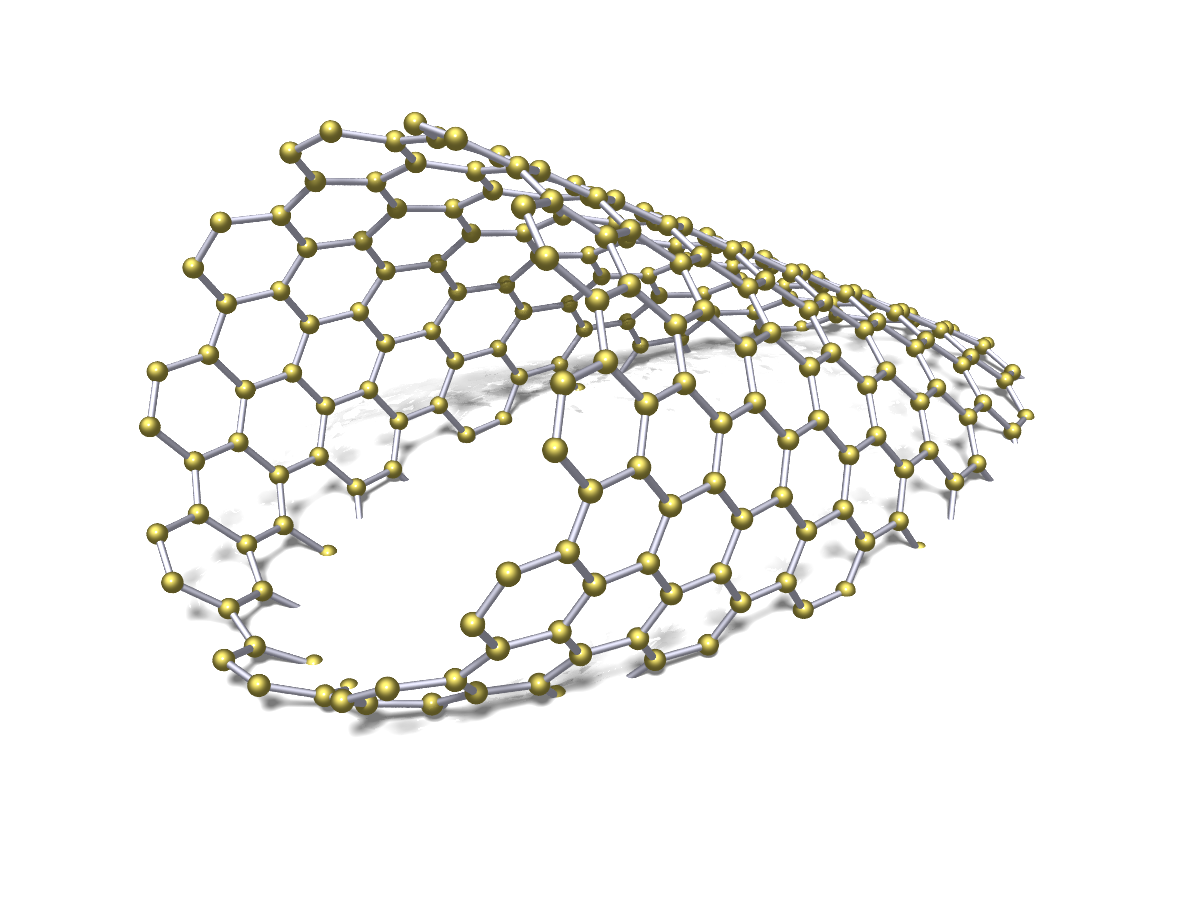
> My first attempt with nanotubes.
>
> I don't know if that's "chemically" correct.
> I've always been pretty bad at that stuff.
Is this a pure geometric abstraction or a model
derived from real datas/formulas ?
> But I think it makes for a nice picture.
Remember of an old experiment :)
http://la.buvette.org/POV/FromOBJ/p/
May be, I can revive this project one day or other ?
> Happy Easter weekend
Thanks, I've got a nice sun over my home for this w-e.
--
** **
* tTh des Bourtoulots *
* http://maison.tth.netlib.re/ *
** **
Post a reply to this message
|
|
|
|
Le 2026-04-04 à 12:41, kurtz le pirate a écrit :
>
> Hello,
>
>
> My first attempt with nanotubes.
>
> I don't know if that's "chemically" correct.
> I've always been pretty bad at that stuff.
That's pretty much the actual structure of a real nanotube.
>
> But I think it makes for a nice picture.
>
Agree.
>
>
>
> Happy Easter weekend
>
Post a reply to this message
|
|
|
|
kurtz le pirate <kur### [at] free fr> wrote:
> I don't know if that's "chemically" correct.
> I've always been pretty bad at that stuff.
This should be chemically correct. *
* there is a certain strain energy that cannot be exceeded for stable molecules.
So, as long as your nanotube has a certain minimum radius, then it should be
fine. That's not to say that they've actually made/discovered on of that exact
size, just that there's nothing obviously wrong with the theoretical structure.
Usually when making things like this, there are the fundamental thermodynamic
considerations (is it stable?) but there can be overriding kinetic realities
that control what actually happens. (Structure A is less stable but forms
faster, so it out-competes structure B and winds up unexpectedly being the major
reaction product.)
The only other thing that's "missing" is the filling of the empty valence
orbitals on those dangling edge carbons. What is at the edge of a crystal?
This is where a lot of interesting research goes on in the field of surface
chemistry.
You could also likely terminate those sites with methyl groups, alkenes (double
bonds) or some sort of aldehyde, ketone, or carboxylic acid.
You can also "dope" nanotubes with small quantities of other elements to replace
some of the carbons - boron, nitrogen, silicon, ... to imbue them with various
useful properties.
- BE fr> wrote:
> I don't know if that's "chemically" correct.
> I've always been pretty bad at that stuff.
This should be chemically correct. *
* there is a certain strain energy that cannot be exceeded for stable molecules.
So, as long as your nanotube has a certain minimum radius, then it should be
fine. That's not to say that they've actually made/discovered on of that exact
size, just that there's nothing obviously wrong with the theoretical structure.
Usually when making things like this, there are the fundamental thermodynamic
considerations (is it stable?) but there can be overriding kinetic realities
that control what actually happens. (Structure A is less stable but forms
faster, so it out-competes structure B and winds up unexpectedly being the major
reaction product.)
The only other thing that's "missing" is the filling of the empty valence
orbitals on those dangling edge carbons. What is at the edge of a crystal?
This is where a lot of interesting research goes on in the field of surface
chemistry.
You could also likely terminate those sites with methyl groups, alkenes (double
bonds) or some sort of aldehyde, ketone, or carboxylic acid.
You can also "dope" nanotubes with small quantities of other elements to replace
some of the carbons - boron, nitrogen, silicon, ... to imbue them with various
useful properties.
- BE
Post a reply to this message
|
|