|
 |
"Bald Eagle" <cre### [at] netscape net> wrote:
> "GioSeregni" <gms### [at] hotmailcom> wrote:
>
> > I'm not sure I understand what you mean (epsilon?)
>
> "Epsilon" is a mathematical concept or symbol used to represent the smallest
> value obtainable without actually being zero.
> In programming, it is just used as some small value to represent the difference
> between 2 values, or just a very small number - such as for use in adding or
> subtracting from surfaces in POV-Ray to avoid coincident surface artefacts.
>
>
> > In any case I eventually have to clean up
> > duplicates and corruptions from my 4 decimal approximation.
>
> I have not done any work with processing large meshes, so I don't know if this
> will be of any help.
>
> Can you use an octree to limit the number of vertices that you have to check
> against any other for duplicates? The pre-sorting might seem like a large
> up-front cost, however the subsequent checking to see if any other vertices in
> that cube have similar connections might be well worth it.
>
> Surely there has to be some prior art to search. Graphics Gems, academic
> papers, internet article. RedBlob games, Stack Exchange, Stack Overflow,
> internet articles, YouTube videos...
>
> It has to be a common problem with so many mesh-based applications.
>
> - BE
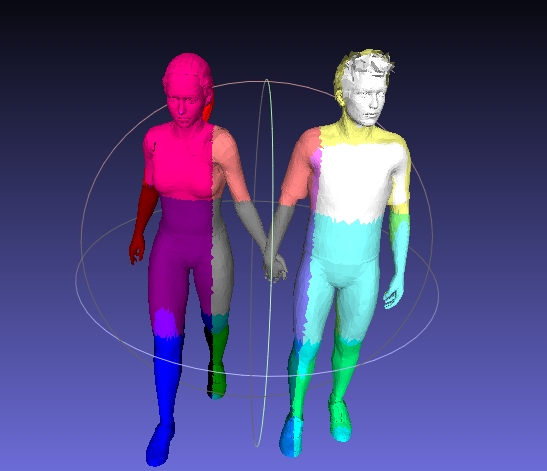
Yes, I already use it. Here's a test where my 3x3x3 partitions are highlighted
with colors. But I have to say, it's not very helpful. The partitioning is fast,
but it doesn't improve much over time. Perhaps it's because the faces straddle
adjacent partitions and slow down.
But it's not a huge problem, I've now ported all the features to a 64-bit
auxiliary program, and the difference is astonishing. Now I only have the
interface in 32 bit. Then, when everything is ready, I'll convert that too. net> wrote:
> "GioSeregni" <gms### [at] hotmailcom> wrote:
>
> > I'm not sure I understand what you mean (epsilon?)
>
> "Epsilon" is a mathematical concept or symbol used to represent the smallest
> value obtainable without actually being zero.
> In programming, it is just used as some small value to represent the difference
> between 2 values, or just a very small number - such as for use in adding or
> subtracting from surfaces in POV-Ray to avoid coincident surface artefacts.
>
>
> > In any case I eventually have to clean up
> > duplicates and corruptions from my 4 decimal approximation.
>
> I have not done any work with processing large meshes, so I don't know if this
> will be of any help.
>
> Can you use an octree to limit the number of vertices that you have to check
> against any other for duplicates? The pre-sorting might seem like a large
> up-front cost, however the subsequent checking to see if any other vertices in
> that cube have similar connections might be well worth it.
>
> Surely there has to be some prior art to search. Graphics Gems, academic
> papers, internet article. RedBlob games, Stack Exchange, Stack Overflow,
> internet articles, YouTube videos...
>
> It has to be a common problem with so many mesh-based applications.
>
> - BE
Yes, I already use it. Here's a test where my 3x3x3 partitions are highlighted
with colors. But I have to say, it's not very helpful. The partitioning is fast,
but it doesn't improve much over time. Perhaps it's because the faces straddle
adjacent partitions and slow down.
But it's not a huge problem, I've now ported all the features to a 64-bit
auxiliary program, and the difference is astonishing. Now I only have the
interface in 32 bit. Then, when everything is ready, I'll convert that too.
Post a reply to this message
Attachments:
Download '658895462_27369642039302458_4039020701347973422_n.jpg' (115 KB)
Preview of image '658895462_27369642039302458_4039020701347973422_n.jpg'
|
|