|
|
|
|
|
|
| |
| |
|
|
|
|
| |
| |
|
|
Due to my current inability to render a Dupin cyclide (DC) made of its
equivalent Villarceau circles based on my own reasoning, I'm trying to explore
other avenues.
My current state of things experienced frustration due to finding apparently
flawed implementations of computing the center and radius of a circle in 3d
given 3 points.
I currently have a known-good version.
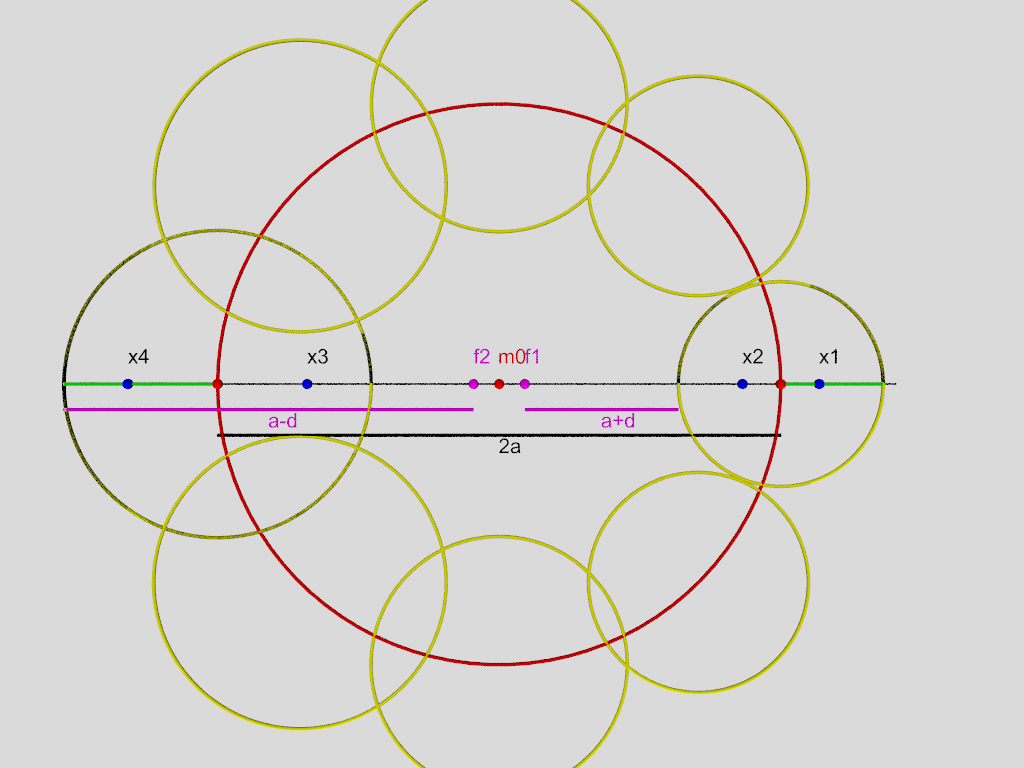
My present experiment is trying to leverage the "easily parameterizable" nature
of DC's and replicate the following diagram:
https://en.wikipedia.org/wiki/Dupin_cyclide#/media/File:Zyklide-maxwell-abcd.svg
The equations in the accompanying text sometimes seem to work, and sometimes
not.
So do I question my code, or the equations?
And for context:
The equations are presumably written by a mathematician who was for many years a
member of Working Group 2 for Geometry & Algebra of the Department of
Mathematics of the TU Darmstadt, and contributed to MANY articles on Wikipedia
from 2013-2022.
There are issues with signs, circles have negative radii, and I'm trying to
document what is correct and what is not --- but it keeps changing depending on
the values I assign to x1, x2, x3, x4.
Perhaps others can try to replicate the diagram and the channel surface (the
envelope of spheres, which I'm representing as circles so i can still see the
rest of the diagram)
https://en.wikipedia.org/wiki/Dupin_cyclide#/media/File:Zyklide-kanalfl-1-2.svg
- BE
Post a reply to this message
Attachments:
Download 'dupincyclide_wikipedia.png' (121 KB)
Preview of image 'dupincyclide_wikipedia.png'
|
|
| |
| |
|
|
|
|
| |
| |
|
|
"Bald Eagle" <cre### [at] netscape net> wrote:
> The equations in the accompanying text sometimes seem to work, and sometimes
> not.
> So do I question my code, or the equations?
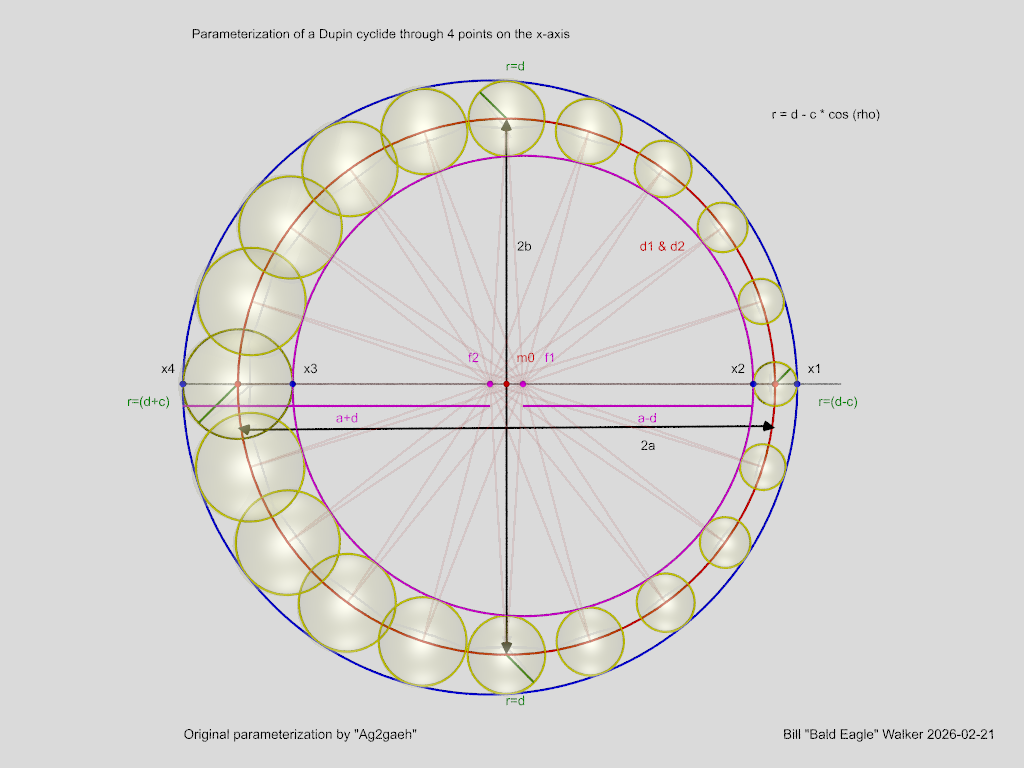
I get sleep and proofread my code another dozen times.
There was a + where there should have been a -.
So I am a lot less frustrated, and a lot happier now that I'm managed to get
that all set down into working code.
Now I can move on to learning the Bambu P1S and hopefully not have it rip the
print off the base after 2h into the print.
And then maybe implement the AMS so that I can do fancy multi-color printing.
Enjoy. :) net> wrote:
> The equations in the accompanying text sometimes seem to work, and sometimes
> not.
> So do I question my code, or the equations?
I get sleep and proofread my code another dozen times.
There was a + where there should have been a -.
So I am a lot less frustrated, and a lot happier now that I'm managed to get
that all set down into working code.
Now I can move on to learning the Bambu P1S and hopefully not have it rip the
print off the base after 2h into the print.
And then maybe implement the AMS so that I can do fancy multi-color printing.
Enjoy. :)
Post a reply to this message
Attachments:
Download 'dupincyclide_wikipedia.png' (224 KB)
Preview of image 'dupincyclide_wikipedia.png'
|
|
| |
| |
|
|
From: yesbird
Subject: Re: Help: Erroneous mathematics information on the web
Date: 21 Feb 2026 18:41:43
Message: <699a42b7$1@news.povray.org>
|
|
|
| |
| |
|
|
On 21/02/2026 20:34, Bald Eagle wrote:
> Now I can move on to learning the Bambu P1S and hopefully not have it rip the
> print off the base after 2h into the print.
>
There are few tips to avoid this unpleasant event:
1. Keep printer from drafts - environment temperature should be as
stable as possible.
2. Increase the temperature of the first layer if software allows.
3. Increase extrusion of the first layer ...
4. Try to use brim.
If nothing of the above helps read software instruction ).
> And then maybe implement the AMS so that I can do fancy multi-color printing.
It should be interesting ...
--
YB
Post a reply to this message
|
|
| |
| |
|
|
|
|
| |
| |
|
|
yesbird wrote:
> On 21/02/2026 20:34, Bald Eagle wrote:
> > Now I can move on to learning the Bambu P1S and hopefully not have it rip the
> > print off the base after 2h into the print.
> >
>
> There are few tips to avoid this unpleasant event:
>
> 1. Keep printer from drafts - environment temperature should be as
> stable as possible.
> 2. Increase the temperature of the first layer if software allows.
> 3. Increase extrusion of the first layer ...
> 4. Try to use brim.
1-3: interesting
4: I added a brim after trying to print the whole thing in one go wasn't even
sticking. So I sliced it in half and rotated it so that I was printing a
semicircle.
> If nothing of the above helps read software instruction ).
The issue was that the print head suddenly crashed into the top of the piece and
flung it off the plate.
I am going to look into "z-lift" and "z-hop", as well as try to run some
calibration tests on the extrusion. Maybe bake the filament to make sure it's
bone-dry.
I'm also going to reorient it so that can make 2 "clam-shell" pieces and glue
them together. Now that I can calculate the exact radius at each point of the
cyclide, I'm planning on printing spheres so that I have a Steiner chain.
> > And then maybe implement the AMS so that I can do fancy multi-color printing.
>
> It should be interesting ...
Indeed it should! :)
Thanks for the tips.
- BE
Post a reply to this message
|
|
| |
| |
|
|
From: yesbird
Subject: Re: Help: Erroneous mathematics information on the web
Date: 22 Feb 2026 04:24:23
Message: <699acb47$1@news.povray.org>
|
|
|
| |
| |
|
|
On 22/02/2026 04:41, Bald Eagle wrote:
> 4: I added a brim after trying to print the whole thing in one go wasn't even
> sticking.
First layer is a common problem, for every type of filament special
temperature and extrusion should be set. Also I am using additional
borosilicate glass on the printer's bad and sometimes even water
with sugar to increase adhesion.
> I am going to look into "z-lift" and "z-hop", as well as try to run some
> calibration tests on the extrusion.
Good idea about tests, but the main source of info is suggestions of
filament manufacturer. This forum:
https://forum.simplify3d.com/viewforum.php?f=8
is also can help a lot.
Maybe bake the filament to make sure it's
> bone-dry.
It depends on filament - some of them are humidity insensitive:
I suggest to avoid ABS and choose PLA, until you need superior strength
of the parts. Find the best filament for your needs, then adjust the
printing process.
>
> I'm also going to reorient it so that can make 2 "clam-shell" pieces and glue
> them together. Now that I can calculate the exact radius at each point of the
> cyclide, I'm planning on printing spheres so that I have a Steiner chain.
>
It will be interesting to look at results ...
--
YB
Post a reply to this message
|
|
| |
| |
|
|
From: yesbird
Subject: Re: Help: Erroneous mathematics information on the web
Date: 22 Feb 2026 06:31:24
Message: <699ae90c@news.povray.org>
|
|
|
| |
| |
|
|
On 22/02/2026 12:24, yesbird wrote:
> This forum:
> https://forum.simplify3d.com/viewforum.php?f=8
> also can help a lot.
Espcially following section:
https://www.simplify3d.com/resources/print-quality-troubleshooting/
Here is your case:
https://www.simplify3d.com/resources/print-quality-troubleshooting/not-sticking-to-the-bed/
--
YB
Post a reply to this message
|
|
| |
| |
|
|
|
|
| |
| |
|
|
"Bald Eagle" <cre### [at] netscapenet> wrote:
> So I am a lot less frustrated, and a lot happier now that I'm managed to get
> that all set down into working code.
Well,
I am back to what I was struggling with in my first attempt:
orienting and placing the Villarceau circle equivalents.
To my knowledge, there is no clear documentation about where the centers lie, or
how to calculate the locus of all the centers, or if there is another parameter
like c, which lies along the a semimajor axis, but that lies along the b
semiminor axis. There is also a movement in y.
My initial attempt involved modeling a torus, inverting it to a cyclide, and
then finding the tangent points of the Villlarceau circles on the torus,
inverting those, and finding the centers. But orienting them is another step
entirely.
And although I love my circles almost as much as Archimedes, I'm getting a bit
frustrated going around and around this one.
Perhaps someone has a personal insight, a literature reference, an internet
link, or something that an AI actually gets right - to put me on the path to
solving this last critical step.
- BE
Post a reply to this message
|
|
| |
| |
|
|
|
|
| |