|
|
|
|
|
|
| |
| |
|
|
From: Thomas de Groot
Subject: Re: Early Earth: The Late Heavy Bombardment [latest image]
Date: 6 Jul 2012 08:02:25
Message: <4ff6d3d1@news.povray.org>
|
|
|
| |
| |
|
|
Maybe physically not entirely correct, but visually certainly attractive :-)

Thomas
Post a reply to this message
Attachments:
Download 'earlyearth - lhb_04.png' (781 KB)
Preview of image 'earlyearth - lhb_04.png'

|
|
| |
| |
|
|
From: Paolo Gibellini
Subject: Re: Early Earth: The Late Heavy Bombardment [latest image]
Date: 6 Jul 2012 10:09:26
Message: <4ff6f196$1@news.povray.org>
|
|
|
| |
| |
|
|
>Thomas de Groot  on date 06/07/2012 14.02 wrote:
> Maybe physically not entirely correct, but visually certainly attractive
> :-)
>
> Thomas
Wow, the explosion begins to become /great/!
;-)
Paolo
Post a reply to this message
|
|
| |
| |
|
|
From: Thomas de Groot
Subject: Re: Early Earth: The Late Heavy Bombardment [latest image]
Date: 6 Jul 2012 10:31:47
Message: <4ff6f6d3$1@news.povray.org>
|
|
|
| |
| |
|
|
On 6-7-2012 16:10, Paolo Gibellini wrote:
> Wow, the explosion begins to become /great/!
> ;-)

Thanks Paolo! I am rather happy with this so far. Again, it does not
need to be scientifically correct all the way but to suggest the impact.
A few more things to do.

Thomas
Post a reply to this message
|
|
| |
| |
|
|
From: Jörg 'Yadgar' Bleimann
Subject: Re: Early Earth: The Late Heavy Bombardment [latest image]
Date: 6 Jul 2012 17:42:45
Message: <4ff75bd5$1@news.povray.org>
|
|
|
| |
| |
|
|
Hi(gh)!

On 06.07.2012 14:02, Thomas de Groot wrote:
> Maybe physically not entirely correct, but visually certainly attractive

If the impact is several hundred kilometres afar, its blast should not
obscure the high wispy clouds...

See you in Khyberspace!

Yadgar
Post a reply to this message
|
|
| |
| |
|
|
From: Alain
Subject: Re: Early Earth: The Late Heavy Bombardment [latest image]
Date: 6 Jul 2012 21:55:23
Message: <4ff7970b$1@news.povray.org>
|
|
|
| |
| |
|
|
Le 7/6/2012 8:02 AM, Thomas de Groot a écrit :
> Maybe physically not entirely correct, but visually certainly attractive
> :-)
>
> Thomas

Now you'r talking. Mostly incandecent ejectae. Not unrealistic if you
think a secong about just how much heat is released by that impact...
Then, there is all that heating from the huge supersonic shock wave.


Alain
Post a reply to this message
|
|
| |
| |
|
|
From: Alain
Subject: Re: Early Earth: The Late Heavy Bombardment [latest image]
Date: 6 Jul 2012 21:58:47
Message: <4ff797d7$1@news.povray.org>
|
|
|
| |
| |
|
|
Le 7/6/2012 5:42 PM, Jörg 'Yadgar' Bleimann a écrit :
> Hi(gh)!
>
> On 06.07.2012 14:02, Thomas de Groot wrote:
>> Maybe physically not entirely correct, but visually certainly attractive
>
> If the impact is several hundred kilometres afar, its blast should not
> obscure the high wispy clouds...
>
> See you in Khyberspace!
>
> Yadgar
>
I agree. The top of the projection is probably climbing well abode those
clouds anyway, right up to the top of the statosphere, with some debrits
escaping back to outer space.


Alain
Post a reply to this message
|
|
| |
| |
|
|
|
|
| |
| |
|
|
With the light output of those meteors, shouldn't they be creating diffraction
artifacts in your time machine's camera similar to those of the stars?
Post a reply to this message
|
|
| |
| |
|
|
|
|
| |
| |
|
|
On 7-7-2012 4:33, Cousin Ricky wrote:
> With the light output of those meteors, shouldn't they be creating diffraction
> artifacts in your time machine's camera similar to those of the stars?
>
I have been hesitating about that. The answer should be yes, shouldn't
it? I shall add small ones...

Thomas
Post a reply to this message
|
|
| |
| |
|
|
From: Thomas de Groot
Subject: Re: Early Earth: The Late Heavy Bombardment [final image]
Date: 9 Jul 2012 08:03:53
Message: <4ffac8a9@news.povray.org>
|
|
|
| |
| |
|
|
This should be the final development of the scene.

Thomas
Post a reply to this message
Attachments:
Download 'earlyearth - lhb_05.png' (835 KB)
Preview of image 'earlyearth - lhb_05.png'

|
|
| |
| |
|
|
From: Paolo Gibellini
Subject: Re: Early Earth: The Late Heavy Bombardment [final image]
Date: 10 Jul 2012 04:06:08
Message: <4ffbe270$1@news.povray.org>
|
|
|
| |
| |
|
|
>Thomas de Groot  on date 09/07/2012 14.03 wrote:
> This should be the final development of the scene.
>
> Thomas
Ooh.
The explosion is less terrifying (due to the daylight), but the sea and
the fog are very convincing.
;-)
Paolo
Post a reply to this message
|
|
| |
| |
|
|
From: Thomas de Groot
Subject: Re: Early Earth: The Late Heavy Bombardment [final image]
Date: 10 Jul 2012 07:32:34
Message: <4ffc12d2$1@news.povray.org>
|
|
|
| |
| |
|
|
On 10-7-2012 10:07, Paolo Gibellini wrote:
>  >Thomas de Groot  on date 09/07/2012 14.03 wrote:
>> This should be the final development of the scene.
>>
>> Thomas
> Ooh.
> The explosion is less terrifying (due to the daylight), but the sea and
> the fog are very convincing.
> ;-)

Thanks Paolo. I am still terrified though ;-)

I am adding a spherical shock wave to complete the impact.

For the fog over the water I used a df3 file made with Gilles Tran's
MakeCloud.

Thomas
Post a reply to this message
|
|
| |
| |
|
|
From: Thomas de Groot
Subject: Re: Early Earth: The Late Heavy Bombardment [final image]
Date: 11 Jul 2012 07:32:20
Message: <4ffd6444@news.povray.org>
|
|
|
| |
| |
|
|
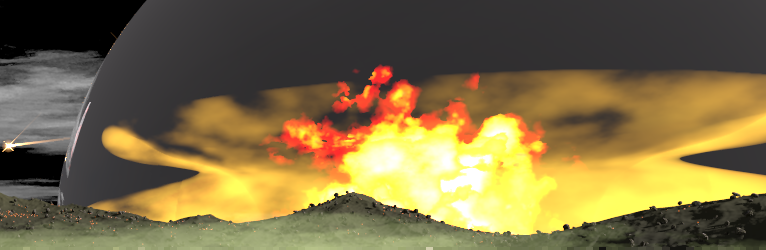
This is really the final image. Added a spherical shock wave.

Thomas
Post a reply to this message
Attachments:
Download 'earlyearth - lhb_final.png' (835 KB)
Preview of image 'earlyearth - lhb_final.png'

|
|
| |
| |
|
|
From: Alain
Subject: Re: Early Earth: The Late Heavy Bombardment [final image]
Date: 11 Jul 2012 16:30:51
Message: <4ffde27b$1@news.povray.org>
|
|
|
| |
| |
|
|
Le 7/11/2012 7:32 AM, Thomas de Groot a écrit :
> This is really the final image. Added a spherical shock wave.
>
> Thomas

I have some problem with that shock wave: It don't difract light.
A shell with an ior of about 1.1 to 1.17 would be more convincing.


Alain
Post a reply to this message
|
|
| |
| |
|
|
From: Thomas de Groot
Subject: Re: Early Earth: The Late Heavy Bombardment [final image]
Date: 12 Jul 2012 04:43:33
Message: <4ffe8e35@news.povray.org>
|
|
|
| |
| |
|
|
On 11-7-2012 22:31, Alain wrote:
> I have some problem with that shock wave: It don't difract light.
> A shell with an ior of about 1.1 to 1.17 would be more convincing.
>

This gets me into problems :-(

For the example I switched off the solid ejecta. I also tuned down the
fog over the water.

For the shock wave I used an ior of 1.01. Obviously, now its media
interacts with the other media inside, especially the dust ejecta
container. Higher ior makes it worse.


Thomas
Post a reply to this message
Attachments:
Download 'earlyearth - lhb.png' (159 KB)
Preview of image 'earlyearth - lhb.png'

|
|
| |
| |
|
|
From: Alain
Subject: Re: Early Earth: The Late Heavy Bombardment [final image]
Date: 12 Jul 2012 18:49:11
Message: <4fff5467$1@news.povray.org>
|
|
|
| |
| |
|
|
Le 7/12/2012 4:43 AM, Thomas de Groot a écrit :
> On 11-7-2012 22:31, Alain wrote:
>> I have some problem with that shock wave: It don't difract light.
>> A shell with an ior of about 1.1 to 1.17 would be more convincing.
>>
>
> This gets me into problems :-(
>
> For the example I switched off the solid ejecta. I also tuned down the
> fog over the water.
>
> For the shock wave I used an ior of 1.01. Obviously, now its media
> interacts with the other media inside, especially the dust ejecta
> container. Higher ior makes it worse.
>
>
> Thomas
>
It looks like a solid, full, shell. Make the shock wave shell as a
difference of 2 spheres.
To bad we can't have variable ior, as in this case, it should go from 1
(in the air in front of the wave), raise in an S shape to maybe around
1.1, then drop slightly under 1 before returning to 1.

You may also try playing giving the area inside the sinside an ior
slightly less than 1, like 0.98 to 0.995...


Alain
Post a reply to this message
|
|
| |
| |
|
|
From: Thomas de Groot
Subject: Re: Early Earth: The Late Heavy Bombardment [final image]
Date: 13 Jul 2012 03:45:12
Message: <4fffd208$1@news.povray.org>
|
|
|
| |
| |
|
|
On 13-7-2012 0:49, Alain wrote:
> It looks like a solid, full, shell. Make the shock wave shell as a
> difference of 2 spheres.
I did too but that was not better, rather worse.

> To bad we can't have variable ior, as in this case, it should go from 1
> (in the air in front of the wave), raise in an S shape to maybe around
> 1.1, then drop slightly under 1 before returning to 1.
Yes, that would be cool.

>
> You may also try playing giving the area inside the sinside an ior
> slightly less than 1, like 0.98 to 0.995...
Yes, I tried too. It corrected somewhat the inner media but did not
change the chock wave appearance.

I shall still make a couple of experiments.

Thomas
Post a reply to this message
|
|
| |
| |
|
|
From: Thomas de Groot
Subject: Re: Early Earth: The Late Heavy Bombardment [final image]
Date: 13 Jul 2012 10:56:22
Message: <50003716@news.povray.org>
|
|
|
| |
| |
|
|
The best I can get at this stage (no good) using a differenced sphere
for the shock wave. Diffractions looks ok at the border but I cannot get
the transparency of the sphere right. The cloud layer is also
differenced (a tiny bit larger sphere) to ensure that no clouds are
present inside the shock wave.

Code snippet:

difference {
sphere {0, 1
   hollow
   texture {pigment {rgbt <1,1,1,1>} }
   interior {
	  ior 1.1
     media {
       intervals 1
       samples 10, 1000
       scattering {1, 0.000025
         extinction 1
       }
     }
   }
}
sphere {0, 0.98
   hollow
   texture {pigment {rgbt <1,1,1,1>} }
   interior {
	  ior 1.0
	}
}
   scale MediaScale * 1.52
   translate <CamLoc.x, CamLoc.y, 5000> + <2800, 0, 0>
}


Thomas
Post a reply to this message
Attachments:
Download 'earlyearth - lhb.png' (114 KB)
Preview of image 'earlyearth - lhb.png'

|
|
| |
| |
|
|
From: Thomas de Groot
Subject: Re: Early Earth: The Late Heavy Bombardment [experimental image #2]
Date: 14 Jul 2012 04:01:22
Message: <50012752@news.povray.org>
|
|
|
| |
| |
|
|
Trying to get at the problem. I here switched off the sphere
representing the sky and the atmospheric media. Also corrected the shock
wave container as follows:

//start code
difference {
   sphere {0, 1.00 hollow}
   sphere {0, 0.98 hollow}
   material {
     texture {pigment {rgbt <1,1,1,1>} }
     interior {
       ior 1.1 	//shock waved air
       media {
         intervals 1
         samples 10, 1000
         scattering {1, 0.0001
           extinction 1
         }
       }
     }
   }
   scale MediaScale * 1.52
   translate <CamLoc.x, CamLoc.y, 5000> + <2800, 0, 0>
}
//end code

While one can see /inside/ the shock wave, it is not possible to see the
stars through the opposite end of the sphere... why?

Thomas
Post a reply to this message
Attachments:
Download 'earlyearth - lhb.png' (145 KB)
Preview of image 'earlyearth - lhb.png'

|
|
| |
| |
|
|
From: Thomas de Groot
Subject: Re: Early Earth: The Late Heavy Bombardment [experimental image #3]
Date: 14 Jul 2012 08:13:06
Message: <50016252@news.povray.org>
|
|
|
| |
| |
|
|
OK. Got the transparency solved. Just a stupid max_trace_level issue :-(

Next problem is to get rid of this sphere edge seen in cross section...

Thomas
Post a reply to this message
Attachments:
Download 'earlyearth - lhb_.png' (144 KB)
Preview of image 'earlyearth - lhb_.png'

|
|
| |
| |
|
|
From: clipka
Subject: Re: Early Earth: The Late Heavy Bombardment [experimental image #2]
Date: 14 Jul 2012 08:47:06
Message: <50016a4a$1@news.povray.org>
|
|
|
| |
| |
|
|
Am 14.07.2012 10:01, schrieb Thomas de Groot:

> While one can see /inside/ the shock wave, it is not possible to see the
> stars through the opposite end of the sphere... why?

max_trace_level maybe?
Post a reply to this message
|
|
| |
| |
|
|
From: clipka
Subject: Re: Early Earth: The Late Heavy Bombardment [experimental image #3]
Date: 14 Jul 2012 08:51:21
Message: <50016b49$1@news.povray.org>
|
|
|
| |
| |
|
|
Am 14.07.2012 14:12, schrieb Thomas de Groot:
> OK. Got the transparency solved. Just a stupid max_trace_level issue :-(
>
> Next problem is to get rid of this sphere edge seen in cross section...

... and here your real problems begin. You'll need to somehow mimic an
ior gradient.
Post a reply to this message
|
|
| |
| |
|
|
From: Alain
Subject: Re: Early Earth: The Late Heavy Bombardment [experimental image #3]
Date: 14 Jul 2012 20:03:20
Message: <500208c8$1@news.povray.org>
|
|
|
| |
| |
|
|
Le 7/14/2012 8:51 AM, clipka a écrit :
> Am 14.07.2012 14:12, schrieb Thomas de Groot:
>> OK. Got the transparency solved. Just a stupid max_trace_level issue :-(
>>
>> Next problem is to get rid of this sphere edge seen in cross section...
>
> ... and here your real problems begin. You'll need to somehow mimic an
> ior gradient.

Ugly cludge that can simulate an ior gradient:
Use many shells of decreasing thickness each varying in ior by a small
amount in the order of 0.002 or less.
The outer shell have an ior in the order of 1.001 or maybe even less,
then each other have a slightly larger ior.
Each thinner shells must reside inside any previous ones. No merge as
you need all those internal surfaces.


Big increase in rendering time and needs a large max_trace_level.


Alain
Post a reply to this message
|
|
| |
| |
|
|
From: Thomas de Groot
Subject: Re: Early Earth: The Late Heavy Bombardment [experimental image #2]
Date: 15 Jul 2012 03:11:19
Message: <50026d17$1@news.povray.org>
|
|
|
| |
| |
|
|
On 14-7-2012 14:46, clipka wrote:
> max_trace_level maybe?

I need to learn to count beyond five fingers... :-)

Thomas
Post a reply to this message
|
|
| |
| |
|
|
From: Thomas de Groot
Subject: Re: Early Earth: The Late Heavy Bombardment [experimental image #3]
Date: 15 Jul 2012 03:15:12
Message: <50026e00$1@news.povray.org>
|
|
|
| |
| |
|
|
On 15-7-2012 2:03, Alain wrote:
> Le 7/14/2012 8:51 AM, clipka a écrit :
>> Am 14.07.2012 14:12, schrieb Thomas de Groot:
>>> Next problem is to get rid of this sphere edge seen in cross section...
>>
>> ... and here your real problems begin. You'll need to somehow mimic an
>> ior gradient.
>
> Ugly cludge that can simulate an ior gradient:
> Use many shells of decreasing thickness each varying in ior by a small
> amount in the order of 0.002 or less.
> The outer shell have an ior in the order of 1.001 or maybe even less,
> then each other have a slightly larger ior.
> Each thinner shells must reside inside any previous ones. No merge as
> you need all those internal surfaces.
>
>
> Big increase in rendering time and needs a large max_trace_level.

Hmm, yes, that might work. I leave that experiment for later though, as
I want to get on with my raytracing life ;-)

Would this be something for POV-Ray 4.0?

Thomas
Post a reply to this message
|
|
| |
| |
|
|
From: clipka
Subject: Re: Early Earth: The Late Heavy Bombardment [experimental image #3]
Date: 15 Jul 2012 10:30:36
Message: <5002d40c@news.povray.org>
|
|
|
| |
| |
|
|
Am 15.07.2012 09:15, schrieb Thomas de Groot:
> On 15-7-2012 2:03, Alain wrote:
>> Le 7/14/2012 8:51 AM, clipka a écrit :
>>> Am 14.07.2012 14:12, schrieb Thomas de Groot:
>>>> Next problem is to get rid of this sphere edge seen in cross section...
>>>
>>> ... and here your real problems begin. You'll need to somehow mimic an
>>> ior gradient.
>>
>> Ugly cludge that can simulate an ior gradient:
>> Use many shells of decreasing thickness each varying in ior by a small
>> amount in the order of 0.002 or less.
>> The outer shell have an ior in the order of 1.001 or maybe even less,
>> then each other have a slightly larger ior.
>> Each thinner shells must reside inside any previous ones. No merge as
>> you need all those internal surfaces.
>>
>>
>> Big increase in rendering time and needs a large max_trace_level.
>
> Hmm, yes, that might work. I leave that experiment for later though, as
> I want to get on with my raytracing life ;-)
>
> Would this be something for POV-Ray 4.0?

I'm not sure whether a dedicated feature would be able to significantly
reduce that render time.
Post a reply to this message
|
|
| |
| |
|
|
From: Alain
Subject: Re: Early Earth: The Late Heavy Bombardment [experimental image #3]
Date: 15 Jul 2012 18:58:12
Message: <50034b04$1@news.povray.org>
|
|
|
| |
| |
|
|
Le 7/15/2012 10:30 AM, clipka a écrit :
> Am 15.07.2012 09:15, schrieb Thomas de Groot:
>> On 15-7-2012 2:03, Alain wrote:
>>> Le 7/14/2012 8:51 AM, clipka a écrit :
>>>> Am 14.07.2012 14:12, schrieb Thomas de Groot:
>>>>> Next problem is to get rid of this sphere edge seen in cross
>>>>> section...
>>>>
>>>> ... and here your real problems begin. You'll need to somehow mimic an
>>>> ior gradient.
>>>
>>> Ugly cludge that can simulate an ior gradient:
>>> Use many shells of decreasing thickness each varying in ior by a small
>>> amount in the order of 0.002 or less.
>>> The outer shell have an ior in the order of 1.001 or maybe even less,
>>> then each other have a slightly larger ior.
>>> Each thinner shells must reside inside any previous ones. No merge as
>>> you need all those internal surfaces.
>>>
>>>
>>> Big increase in rendering time and needs a large max_trace_level.
>>
>> Hmm, yes, that might work. I leave that experiment for later though, as
>> I want to get on with my raytracing life ;-)
>>
>> Would this be something for POV-Ray 4.0?
>
> I'm not sure whether a dedicated feature would be able to significantly
> reduce that render time.

It would require sampling along the ray path, determine the direction of
the ior gradient as well as it's value and deflect the ray accordingly.
In fact, you'll need to construct a spline that will describe the path
of each tracing ray through the object.
I don't think that it's unfeasible, but will be very computationaly
intencive and thus slow as hell. If the ior can be assumed to only
change relatively slowly, some interpolation and extrapolation may be
possible between rays that may help speeding thing. You'll need to use a
max_gradient just like in an isosurface.

With my cludge, you have the local normal and the ior is quantified into
discreete steps. It can be applyed to an isosurface by changing the
thressold. If applyed to a CSG object, the smaller versions need to have
individual components scalled separately from the whole object. Some
complexe primitives, like a julia_fractal or a some mesh, don't realy
support the needed scalling without self intersecting. A torus need to
have it's minor axis altered, but not it's major axis.
Heavy, potentialy memory hungry, SLOW, error prone, but should work.

With a sampling along the ray, you don't have any normal available to
help you and the ior may change in rather strange ways...


Alain
Post a reply to this message
|
|
| |
| |
|
|
|
|
| |